Real World Example: Issue with BFO

526 views
Skip to first unread message

Michael DeBellis

unread,
Dec 9, 2021, 1:06:24 PM12/9/21
to ontolog-forum
I had an experience working with a friend last night that I want to share with the group. This isn't meant as an attack on BFO or Upper Models. I'm coming around to see the value proposition  in having them. But I've always had an issue with how opaque BFO is because it is based on philosophical jargon and last night was a perfect example. 

My friend is developing a startup to help facilitate funding for charities in India. Her thesis was on India and in doing it she realized one of the issues that there might be a technology fix for is that while India mandates that corporations spend a certain percentage on donations to charities (I think called CSR: Corporate Social Responsibility) much of that money doesn't get to the people who most need it because many of the people most in need are served by very small charities that are run by people who are barely literate and who can't navigate the bureaucracy to get funding from corporations and they rely on local funding which is much less. She believes technology could help streamline the bureaucracy and in so doing help get funding to the people who would put it to best use. She's doing it because she believes in helping not for money. Her team right now are all volunteers. I've been encouraging her to look at knowledge graphs but her team keeps pushing back because they are either young kids who just know Python or retired guys who know relational databases.

One of the things I always stress is that OWL and RDF are really very intuitive. She knows a bit of OWL and Protege because we worked together and used it on one of her class projects and she really likes Protege. Last night she said one of the things they want to do are various kinds of analysis on where funding is and should be going based on the UN Sustainable Development Goals. I Googled "UN Sustainable Development Goals Ontology" and we found this: https://www.ebi.ac.uk/ols/ontologies/sdgio As soon as I looked at it and saw "Continuant"  "Occurent", etc. I groaned internally and my friend had a WTF? reaction. She remembered Protege being intuitive and having models that even a non-technical person like her could understand but the first thing she sees are a bunch of jargon terms that make no sense to her and have no relevance to her business problem. As we browsed the ontology we kept drilling down: 

Entity
    Continuant
        Generally Dependent Continuant
         Independent Continuant
         Specifically Dependent Continuant

And so on. Again... WTF? The actual business terms are buried under all this philosophic jargon. Also, I'm not sure the people who did this ontology are even using BFO correctly. E.g., there is a top level class called AdministrativeRegion that I think should be under Continuant (or some other BFO class, I still don't understand BFO very well). And if they aren't using BFO correctly I think that just demonstrates how unintuitive and opaque BFO is (the very opposite of what I think a good upper model should be). 

I don't mean this as an attack on BFO, just a comment on an issue I've seen before but really hit me last night. I can only imagine the push back from her team about Semantic Web technology being too complex if they looked at this ontology. IMO if BFO wants to really provide value they should rethink their terminology. Everyone with a decent education understands concepts like Process, LivingThing, PhysicalObject, and relations like subPart but the philosophic jargon is really off putting (I also question the philosophy it is based on but that's a different issue). Just interested in any reactions from the group. 

Michael

Barry Smith

unread,
Dec 9, 2021, 1:44:23 PM12/9/21
to ontolog-forum
There are more than 400 groups using BFO as the starting  point for building their ontologies
Each of them finds different ways to cope with the ugly parts of BFO (which should ideally be kept under the hood, and not shown to the people actually using the domain ontologies built in its terms).
One good way to cope is to find a BFO-based ontology in a closely related term and start from there. We are currently working on a BFO ontology for commercial exchange, for example, and that might conceivably be extended or re-engineered for charitable purposes.  
Note that some of our choices were deliberately ugly -- words like 'attribute' or 'property' or 'concept' have so many different meanings, that to use them for purposes of ensuring consistency of meaning across multiple domains would just lead to more disasters.
BS

--
All contributions to this forum are covered by an open-source license.
For information about the wiki, the license, and how to subscribe or
unsubscribe to the forum, see http://ontologforum.org/info/
---
You received this message because you are subscribed to the Google Groups "ontolog-forum" group.
To unsubscribe from this group and stop receiving emails from it, send an email to ontolog-foru...@googlegroups.com.
To view this discussion on the web visit https://groups.google.com/d/msgid/ontolog-forum/1191ee98-a996-4c31-bd4f-73ad1d505f12n%40googlegroups.com.

Alex Shkotin

unread,
Dec 10, 2021, 3:37:19 AM12/10/21
to ontolog-forum
Michael,

We should look quietly at formal ontology as a computer-based artifact - like a program or database. When the first step may be to look at code or DB tables for self-evidence, but the next is to ask for a User Guide:-)
We have it for BFO and it should be for https://www.ebi.ac.uk/ols/ontologies/sdgio. I do not see the author reference in ontology annotation but the project is here https://github.com/SDG-InterfaceOntology/sdgio.
SDGIO
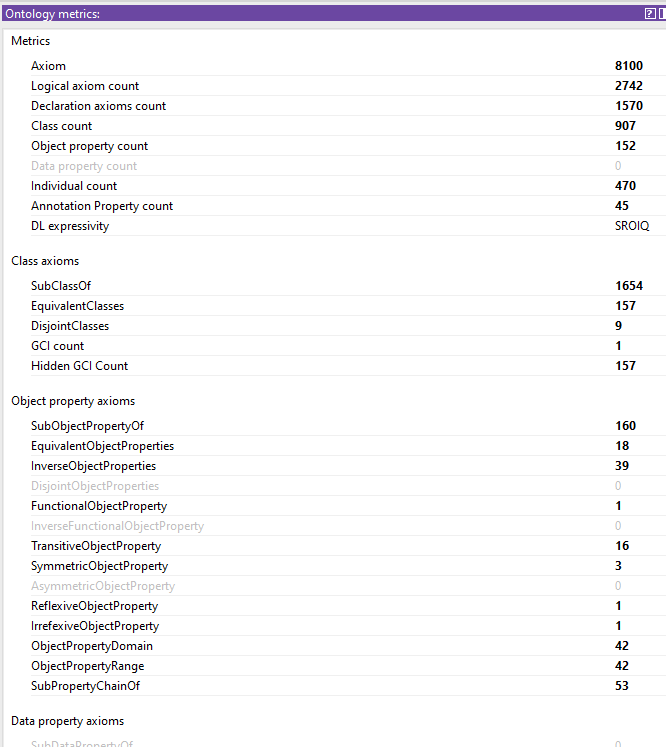
This ontology does not import BFO - this is strange!
It is interesting how to extract from this bunch [1] their own stuff. For example, classes should be here https://github.com/SDG-InterfaceOntology/sdgio/wiki/Native-SDGIO-classes six years ago.
BFO
And let's keep BFO studying separately - for ex. it's strange that 'process profile' is a subclass of 'process' [2]. But who knows.
And it's strange that 'occurrent' has only one subclass - 'process'
image.png
but 'process' has the definition: "p is a process = Def. p is an occurrent that has temporal proper parts and for some time t, p s-depends_on some material entity at t. (axiom label in BFO2 Reference: [083-003])"

Very interesting.

Alex

[1] 
image.png
[2]
image.png


чт, 9 дек. 2021 г. в 21:06, Michael DeBellis <mdebe...@gmail.com>:
--

Alex Shkotin

unread,
Dec 10, 2021, 4:02:57 AM12/10/21
to ontolog-forum
UPD: the power of BFO UG
image.png

чт, 9 дек. 2021 г. в 21:06, Michael DeBellis <mdebe...@gmail.com>:
I had an experience working with a friend last night that I want to share with the group. This isn't meant as an attack on BFO or Upper Models. I'm coming around to see the value proposition  in having them. But I've always had an issue with how opaque BFO is because it is based on philosophical jargon and last night was a perfect example. 
--

Alex Shkotin

unread,
Dec 10, 2021, 4:26:06 AM12/10/21
to ontolog-forum
UPD:BFO
as usual UG or RM should be here https://basic-formal-ontology.org/bfo-2020.html 
"
but you know ;-)

чт, 9 дек. 2021 г. в 21:06, Michael DeBellis <mdebe...@gmail.com>:
I had an experience working with a friend last night that I want to share with the group. This isn't meant as an attack on BFO or Upper Models. I'm coming around to see the value proposition  in having them. But I've always had an issue with how opaque BFO is because it is based on philosophical jargon and last night was a perfect example. 
--

Michael DeBellis

unread,
Dec 10, 2021, 2:01:28 PM12/10/21
to ontolog-forum
Barry, thanks for the reply and I'm glad you are working on things to make BFO more usable. However, regarding this statement:

"Note that some of our choices were deliberately ugly -- words like 'attribute' or 'property' or 'concept' have so many different meanings, that to use them for purposes of ensuring consistency of meaning across multiple domains would just lead to more disasters."

I disagree. During the 1990's I spent a fair amount of time consulting for some large clients who were adopting OOP for the first time. One of my mentors, a brilliant guy named Mike Evangelist took me aside after one of my presentations and told me I was losing people with all the new terminology I was deluging them with from the start. He did the next presentation and he started it by telling the client's IT staff who had been programming in COBOL all their lives: "OOP isn't really all that new. It is just taking all the best practices you have been using such as structured programming, encapsulation,  and abstract data types and building support for your good programming techniques into the language." 

This worked amazingly well. It started by acknowledging we respected their knowledge and were not trying to steam roller them into doing things completely differently. And it was much easier (and less anxiety provoking) for people to learn new ideas by understanding how they built on what they already knew. I think the idea of purposely using "deliberately ugly" terminology is exactly the opposite of this approach. 

Michael

Michael DeBellis

unread,
Dec 10, 2021, 2:17:54 PM12/10/21
to ontolog-forum
Thanks Alex. I don't know BFO well but I agree, I think that that UN ontology isn't using it correctly. But I think that illustrates a problem with BFO. An upper model should be intuitive. If people can't use it without reading a 100 page manual it seems like more effort than it is worth. Also, while my experience with BFO is very limited, this isn't the first time I've seen something like this. I've seen several ontologies that just have the BFO model as (at least what seems to me) a layer of crud you have to click through to get to the actual business classes and the Upper Model does nothing useful and in fact makes the ontology harder to understand because the real classes you care about are under the crud. 

I think there is also an assumption about how to do development built in to BFO that experience has shown to be wrong. When we first started developing software systems we tried to use the same methodologies people used to build bridges and buildings. But there is a fundamental difference: a bridge doesn't change the model people use for driving and a building doesn't re-invent business processes. Software does. That's why iterative Agile approaches are so much better at reducing risk and increasing quality. The BFO model assumes there is one way that all ontologies must be modeled that is cast in stone. One model that says the universe consists of occurents and continuants. But to my knowledge there is no real evidence for this. There is no empirical evidence that this model is better than others. There are no formal proofs that these concepts are the best way to organize domains as diverse as Financial Service and Quantum Mechanics.

Michael

deddy

unread,
Dec 10, 2021, 2:22:52 PM12/10/21
to ontolo...@googlegroups.com
Michael -

>>>>>
> Entity
Continuant
Generally Dependent Continuant
Independent Continuant
Specifically Dependent Continuant

And so on. Again... WTF? The actual business terms are buried under all this philosophic jargon.
>>>>>

Jargon!? I would not be so kind.

How about TBBS... techno babble bull shit? (Hmmmm... looks like an excellent URL)

______________________
David Eddy
Babson Park, MA
781-455-0949

http://www.legacysoftware.co.uk
> https://groups.google.com/d/msgid/ontolog-forum/17ac2170-1e2d-40d7-a5cb-
5acfcce32f91n%40googlegroups.com.
>

John F Sowa

unread,
Dec 11, 2021, 12:22:24 AM12/11/21
to ontolo...@googlegroups.com
Michael DB and David E,
 
I strongly agree with the point that the programmers who have been working in the trenches on legacy systems know far more about software design, development, use, and maintenance than the people who designed the tools for the Semantic Web and other monstrosities.  I don't blame them for ignoring that stuff.

MDB> WTF? The actual business terms are buried under all this philosophic jargon.

DE> Jargon!? I would not be so kind. How about TBBS... techno babble bull shit?

The primary reason for the failure of the SemWeb to grow beyond a minor cottage industry is that it was developed by and for theoreticians who had no experience in software design, development, and use.  The Biggest Systems in the world will take data in SW formats as input, but internally, they use their own software that is far more powerful and efficient.
 
When the major SW software in use today was developed by a university, you know that the amount of use is too small for any business that wants to stay in business to pay attention.
 
The world economy runs on legacy systems based on poorly documented ontologies that have been inherited from cutting-edge projects in the 1960s.  Every new project must accommodate the old ontologies.  The web interfaces make them look glitzy.  But underneath the covers, all the oldy moldy foundations are still there.
 
They won't go away for one good reason:  They work.
 
And by the way, if any company that had any truly intelligent systems wanted to make money, I would suggest that they support the programmers who maintain and update legacy systems. That's worth trillions of $$$.  The fact that they don't do that is a strong reason why I don't believe that they have truly intelligent systems.
 
John


Alex Shkotin

unread,
Dec 11, 2021, 3:42:55 AM12/11/21
to ontolog-forum
Michael,

For me, BFO-2020 is an example of a well-formed formal ontology with good documentation. It is interesting as a formalization of philosophical doctrine which should be issued separately.
To use or not use it is not a problem, but to use ontology that uses it may be a problem, as you described.
My way is to create an axiomatic formal theory (from informal;-) with definitions when we have primary terms (concepts, relations, attributes) for this particular domain. Primary attributes, for example, are measurable.
But if we use the terms "process" or "object" formally in our axiomatic theory, then they are or primary (then what are their axioms?) xor they have definitions (which one?).
And here TLO comes, not necessarily BFO, saying: import me - I have "process" and "object" inside - you need not think about it!
What do you think?
BFO
It has 36(!) classes [1] with "object" and "process" available :-)
It has 64(!) binary relations (object properties) that look unfamiliar [2].
But if we look in bfo-2020-labeled.ofn from zip on https://standards.iso.org/iso-iec/21838/-2/ed-1/en/, we found 101 skos:definition. That means for me we have a preliminary formal theory of some philosophical doctrine.

My point is that we should stop inventing formal ontologies and should begin to formalize existing scientific and engineering texts as we did for IUGS Recommendations for igneous rock definitions [0].
Every sentence of formal ontology should have reference to scientific or technological text to be valuable.
But I know inventing formal ontologies is more exciting than coding:-) But as a result, we have a new kind of computer-based artifacts to study and maybe use.

Alex

[1]
 
[2]


пт, 10 дек. 2021 г. в 22:17, Michael DeBellis <mdebe...@gmail.com>:

Matteo Bianchetti

unread,
Dec 11, 2021, 6:20:16 AM12/11/21
to ontolo...@googlegroups.com
Hi All, 

Just a minor note. Whether we like BFO or not, SDGIO is not an example of misuse of BFO. It is an example of an incomplete project that did not fix, to date, some issues. 

I worked on SDGIO May-Sep 2019 and was not involved in the parts that have been isolated as problematic here (I worked on plans and objectives). However, I remember that the classes that currently do not appear under any BFO class were imported some time before I joined the project from other ontologies (you can understand it by looking at the URIs). The reason for the import was that SDGIO wanted to re-use classes that belonged to other OBO ontologies whenever possibles. OBO ontologies use BFO. As they explained to me at the time, they did so partly to facilitate the re-use of classes and relations in other ontologies. For example, the food experts would create and maintain the class "diet" and other ontologies, maintained by persons with different expertise, could reuse that class with some confidence that it was well defined.

The classes that SDGIO imports are all under some BFO class in their original ontology. For example, the class "administrative region" (http://purl.obolibrary.org/obo/ENVO_00000004), mentioned in this exchange, is from ENVO, where it appears under some BFO class. 
image.png
However, the import process sometimes did not work correctly and placed some classes outside the BFO hierarchy. That was a known issue but SDGIO received little or no funding and it lacked the workforce to fix various things. 

As for the comment that SDGIO does not import BFO, it does though not through owl:imports. The persons working on OBO created a tool (I think it is this one) that generates ontology templates with BFO pre-installed.

That said, I am neither defending nor attacking BFO (or SDGIO for that matter). Just clarifying a side issue concerning the use of BFO in SDGIO. 

All the best,
Matteo


Alex Shkotin

unread,
Dec 11, 2021, 6:25:42 AM12/11/21
to ontolog-forum
Thanks for the explanation. 

сб, 11 дек. 2021 г. в 14:20, Matteo Bianchetti <mttb...@gmail.com>:

Kingsley Idehen

unread,
Dec 11, 2021, 8:03:35 PM12/11/21
to ontolo...@googlegroups.com
On 12/10/21 2:01 PM, Michael DeBellis wrote:
Barry, thanks for the reply and I'm glad you are working on things to make BFO more usable. However, regarding this statement:

"Note that some of our choices were deliberately ugly -- words like 'attribute' or 'property' or 'concept' have so many different meanings, that to use them for purposes of ensuring consistency of meaning across multiple domains would just lead to more disasters."

I disagree. During the 1990's I spent a fair amount of time consulting for some large clients who were adopting OOP for the first time. One of my mentors, a brilliant guy named Mike Evangelist took me aside after one of my presentations and told me I was losing people with all the new terminology I was deluging them with from the start. He did the next presentation and he started it by telling the client's IT staff who had been programming in COBOL all their lives: "OOP isn't really all that new. It is just taking all the best practices you have been using such as structured programming, encapsulation,  and abstract data types and building support for your good programming techniques into the language." 

This worked amazingly well. It started by acknowledging we respected their knowledge and were not trying to steam roller them into doing things completely differently. And it was much easier (and less anxiety provoking) for people to learn new ideas by understanding how they built on what they already knew. I think the idea of purposely using "deliberately ugly" terminology is exactly the opposite of this approach. 

Michael


Hi Michael,

I agree wholeheartedly!

There is nothing new under the sun. Everything happens within a innovation continuum.

Building on what exists, and saying so, is the best way to engage people -- in my experience.

Kingsley

To view this discussion on the web visit https://groups.google.com/d/msgid/ontolog-forum/17ac2170-1e2d-40d7-a5cb-5acfcce32f91n%40googlegroups.com.


-- 
Regards,

Kingsley Idehen	      
Founder & CEO 
OpenLink Software   
Home Page: http://www.openlinksw.com
Community Support: https://community.openlinksw.com
Weblogs (Blogs):
Company Blog: https://medium.com/openlink-software-blog
Virtuoso Blog: https://medium.com/virtuoso-blog
Data Access Drivers Blog: https://medium.com/openlink-odbc-jdbc-ado-net-data-access-drivers

Personal Weblogs (Blogs):
Medium Blog: https://medium.com/@kidehen
Legacy Blogs: http://www.openlinksw.com/blog/~kidehen/
              http://kidehen.blogspot.com

Profile Pages:
Pinterest: https://www.pinterest.com/kidehen/
Quora: https://www.quora.com/profile/Kingsley-Uyi-Idehen
Twitter: https://twitter.com/kidehen
Google+: https://plus.google.com/+KingsleyIdehen/about
LinkedIn: http://www.linkedin.com/in/kidehen

Web Identities (WebID):
Personal: http://kingsley.idehen.net/public_home/kidehen/profile.ttl#i
        : http://id.myopenlink.net/DAV/home/KingsleyUyiIdehen/Public/kingsley.ttl#this

Haonan Qiu

unread,
Dec 12, 2021, 5:52:55 AM12/12/21
to ontolog-forum
Hi Michael,

I am Haonan Qiu. I am a knowledge graph developer. I came across your email and discussed one of my friends in Deli who is a data scientist and care about the project your friend is executing. 
We both would like to learn more about the proposal to the organization and roadblocks such that appropriate contributions from our sides can be made. We would be interested to have a meeting to discuss it.

Best,
Haonan

--

Michael DeBellis

unread,
Dec 13, 2021, 1:54:44 PM12/13/21
to ontolog-forum
David, LOL, I wouldn't go quite that far. I mean from what I understand about BFO I think there is some serious thought to the ideas and I can see how they would make sense for certain kinds of domains. What I think is wrong is to assume that those concepts have to be the starting point for ALL ontologies. I'm not certain a universal upper model even makes sense. I think perhaps an upper model for business and one for various engineering and scientific domains might make more sense. Either that or if there is one upper model recommended for all ontologies I think it should be very lean and just capture the most basic concepts (like organic vs. inorganic) and relations (such as partOf). 

What worries me is that I often see people using BFO because they read some book that says you have to start with an upper model and what they end up with are ontologies like the one I linked to in my original post. An ontology where the domain concepts are either missing or buried beneath several layers of BFO and where BFO itself is used incorrectly. The result is that make the actual domain entities are harder to find and understand (or even missing). 

I've also given some thought to Barry's statement that "some of our choices were deliberately ugly". To me that is such an academic point of view, that some small group understands the one and only way to model things and they make it obtuse on purpose so that people have to spend a lot of effort to understand their way of conceptualizing the world. I find that there is a lot of resistance among real world developers to using OWL (as opposed to RDF/RDFS or property graphs... especially property graphs have a lot of traction in industry) and that telling people they always have to start OWL ontologies with something as difficult to understand as BFO will make this problem worse rather than better. 

Michael

Michael DeBellis

unread,
Dec 13, 2021, 2:23:56 PM12/13/21
to ontolog-forum
Alex, 

>BFO-2020 is an example of a well-formed formal ontology 

I've never understood this to be honest. OWL is already formal as I understand the term and as I've typically seen the term used in areas like Formal Methods for Software Engineering. It has a well defined semantics in the form of Description Logic. In fact that is one of the weaknesses I see in BFO, that it was developed before OWL and (at least as far as I can tell) without an understanding of Description Logic. There is a lot of formal analysis that can be done on ontologies with Description Logic and I don't see how BFO adds anything "formal", if anything it seems to take some power away because it prohibits you from doing things like multiple inheritance which are perfectly fine in terms of Description Logic. 

> with good documentation.

There is certainly a lot of documentation. How good it is is debatable. I have a pretty solid understanding of logic and set theory and I've spent some time trying to understand BFO and I still don't. On the other hand there are domain specific vocabularies such as Prov-O that I've been able to understand and use by just glancing at the documentation and then referring back when I had specific questions. IMO an upper model should be intuitive and easy to grasp the basics  immediately (hence not built on terms that are "deliberately ugly"). Again, this is one of the benefits I see to OWL is that I can sit down with people who are not technical and show them something in Protege and they can understand it immediately and give me feedback on it. But that isn't the case at all with the BFO concepts or ontologies built on them. 

>It is interesting as a formalization of philosophical doctrine which should be issued separately.

This is another thing I've never understood about BFO. We are supposed to be scientific. So where is the evidence that BFO is the best upper model? Such evidence could be in the form of proofs or formal reasoning or empirical studies but as far as I can see there is none of that. It is in papers that I find a chore to read from arm chair philosophers whose work is IMO essentially pseudo-science because they argue with each other using their own jargon but they have no objective measure of truth the way a mathematician or scientist would. 

E.g., I've read at least one BFO paper that mocks the idea of prototype theory and the work of people such as Elain Roche.  The BFO paper I read provided no evidence that Roche's ideas are wrong it just dismissed them with a wave of the hand. That's a whole other topic because prototype theory is not the same as Description Logic and people such as Lakoff IMO make claims which I think are far too strong that Roche's work indicates that set theory and logic are essentially irrelevant for science and math. But my point is that if one is to have a good upper model it should be founded on either mathematical proof and analysis or empirical research (e.g., an empirical study of the concepts that ontologies used for real world problems typically have in common). There is plenty of research that also supports the idea that humans use some form of set theory for concept formation such as the work of Frank Keil and early work done or cited by people such as Newell and Simon. 

>My point is that we should stop inventing formal ontologies and should begin to formalize existing scientific 
>and engineering texts 

I agree. 

Michael

dr.matt...@gmail.com

unread,
Dec 13, 2021, 2:25:27 PM12/13/21
to ontolo...@googlegroups.com

Dear Michael,

What I can say from personal experience is that if you understand one (any) of the better Top-Level Ontologies, and it is relevant to your domain, then it can really help you to develop those ontologies better-faster-cheaper, by acting as a framework for ontological analysis (rather than a start point). This means doing the homework to make sure you understand how the TLO works and that it does work for your domain.

However, what I have now seen several times is that people have developed a bottom up ontology, reinventing (usually badly) mereology and other core bits of a TLO, and then miss-attach their work to a TLO that they clearly do not understand, as if that is enough to make it reusable. This just makes a mess while claiming token compliance (not really any kind of compliance at all).

Regards

Matthew West

Michael DeBellis

unread,
Dec 13, 2021, 2:33:00 PM12/13/21
to ontolog-forum
Matteo, thanks for the explanation. That confirms my impression that we are better off developing an ontology of our own that models the UN SDGs. But I think this is an example of what I've seen in other ontologies (although I realize I'm not really supporting the argument since I just have this one example) where the work on the upper model takes people away from the business domain. How much funding is required to model the UN SDGs? My guess is not very much, I expect I can do it in a few hours. If they had worked on the actual domain rather than on the upper model perhaps they would have created something useful. 

Michael

Michael DeBellis

unread,
Dec 13, 2021, 2:35:09 PM12/13/21
to ontolog-forum
Haonan, Thanks. I will contact you off list so perhaps we can collaborate. Just one caveat: as of now there is no funding for this project so everyone that is working is just volunteering their time. 

Michael

Chris Mungall

unread,
Dec 13, 2021, 2:42:27 PM12/13/21
to ontolo...@googlegroups.com, Pier Buttigieg
Hi Michael

I was involved partially with the development of SDGIO, I agree completely that we need to make ontologies like this more intuitive to domain specialists.

There are a few approaches people are taking.

1. Many ontologies are providing annotations on domain-root classes which is respected by browsers like the OLS, effectively hiding the BFO upper levels

I made an issue for these annotations to be added to SDGIO:

But this is still not ideal since these abstract terms still leak out

2. The OBO community is moving towards a domain upper ontology that is conformant with BFO but hides a lot of the abstractions that would not be recognizable by a domain scientist.

3. I still think we can go further, and using OWL to factor out upper level classification while retaining any entailments they yield:

This seems to me to a win-win, it effectively hides all abstract terms from the user in a hierarchical view while losing none of the logical entailments, but this proposal hasn't got any traction.

The issue you point out with administrative region are likely a build issue rather than a misplacement: https://github.com/SDG-InterfaceOntology/sdgio/issues/238 - Matteo already pointed this out in this thread.

Thanks for your feedback - I would encourage using the github tracker to highlight any issues as many of the developers of these ontologies aren't on this list.


--

Michael DeBellis

unread,
Dec 13, 2021, 2:43:48 PM12/13/21
to ontolog-forum
Matthew, thanks for that feedback. I apologize, I know my comments came off as very anti-BFO and anti Upper Models in general but I'm really just trying to understand and leverage the ideas and in my experience the best way to understand something is to be honest about the issues I see, even if, actually especially because they may be wrong. I realize that the first thing I have to do is invest more time to really understand BFO and other Upper Models such as Dolce and that my comments may be just a reflection of my lack of knowledge at this point. I intend on doing that sometime soon. BTW, I have changed my opinion on Upper Models already. I used to be completely opposed to them but I see how they could provide a good foundation for reuse. 

Michael

dr.matt...@gmail.com

unread,
Dec 14, 2021, 3:33:16 AM12/14/21
to ontolo...@googlegroups.com

Dear Michael,


Matthew, thanks for that feedback. I apologize, I know my comments came off as very anti-BFO

[MW] Oh that’s alright. I’m anti-BFO too (I’m a 4-Dimensionalist and have a range of technical criticisms of BFO). However, within its limitations, it is still way better than a blank piece of paper to help analyse and structure a domain ontology, and I get cross when I see it being misused by those who have obviously not done their homework.


and anti Upper Models in general but I'm really just trying to understand and leverage the ideas and in my experience the best way to understand something is to be honest about the issues I see, even if, actually especially because they may be wrong. I realize that the first thing I have to do is invest more time to really understand BFO and other Upper Models such as Dolce and that my comments may be just a reflection of my lack of knowledge at this point.

[MW] DOLCE is much the same as BFO at the top (i.e. 3-dimensionalist). You need to look at what a TLO is trying to do, and DOLCE is trying to do something different from BFO for example. You should at least look at one or two 4-Dimensionalist top level ontologies as well to get an alternative view, they I would argue, are more maths/science based that any 3D ontology. I recommend (of course) my book “Developing High Quality Data Models” as probably the easiest way to introduce yourself to 4-dimensionalism.

https://www.elsevier.com/books/developing-high-quality-data-models/west/978-0-12-375106-5


I’m the Technical Lead for a UK programme developing an Information Management Framework to support a UK National Digital Twin, as part of which we (some of whom are on this forum) undertook a survey of Top Level Ontologies including an analysis of their different characteristics. You can find this here:

https://digitaltwinhub.co.uk/files/file/90-a-survey-of-top-level-ontologies/

That should give you a long, around 40, but still incomplete list to consider of resources that have been claimed to be Top Level Ontologies.

We then looked at our requirements and ran a selection criteria that showed that the 4D TLOs would provide us with the best foundation.

https://digitaltwinhub.co.uk/files/file/91-the-approach-to-develop-the-foundation-data-model-for-the-information-management-framework/

We are currently developing a unifying 4D TLO from the source TLOs identified.


I intend on doing that sometime soon. BTW, I have changed my opinion on Upper Models already. I used to be completely opposed to them but I see how they could provide a good foundation for reuse. 

[MW] Well, it depends what you are trying to do. If, as with the UK National Digital Twin, your aim is to integrate data from a wide range of different sources (hundreds to thousands) so that a patchwork of interfaces is not going to do the job, then, in order to bring the data together so it can be reused and repurposed the only efficient solution is a hub and spoke architecture with a common data model for the hub. There are other papers that look at some of that here:

https://digitaltwinhub.co.uk/projects/imf/imf-resources/

Hint: it’s a lot more than just ontologies.


Regards

Matthew

Dr Matthew West OBE
Technical Lead – National Digital Twin programme
https://www.cdbb.cam.ac.uk/what-we-do/national-digital-twin-programme

image001.png
image003.jpg

Alex Shkotin

unread,
Dec 14, 2021, 4:03:58 AM12/14/21
to ontolog-forum
Michael,

see in [] below.

Alex

пн, 13 дек. 2021 г. в 22:23, Michael DeBellis <mdebe...@gmail.com>:
Alex, 

>BFO-2020 is an example of a well-formed formal ontology 

I've never understood this to be honest. OWL is already formal as I understand the term and as I've typically seen the term used in areas like Formal Methods for Software Engineering. It has a well defined semantics in the form of Description Logic. In fact that is one of the weaknesses I see in BFO, that it was developed before OWL and (at least as far as I can tell) without an understanding of Description Logic. There is a lot of formal analysis that can be done on ontologies with Description Logic and I don't see how BFO adds anything "formal", if anything it seems to take some power away because it prohibits you from doing things like multiple inheritance which are perfectly fine in terms of Description Logic. 
[It is just a misunderstanding. OWL is a formal language, or more precisely a set of formal languages (Functional Style is my favorite, Turtle or Manchester are most readable). And it has some sublanguages they call profiles. BFO is a formal ontology written on DL-sublanguage of OWL, it is also equivalently written on Common Logic. I am sure there are guys who know BFO to discuss your strange for me point "...it prohibits you from doing things like multiple inheritance".
] 

> with good documentation.

There is certainly a lot of documentation. How good it is is debatable. I have a pretty solid understanding of logic and set theory and I've spent some time trying to understand BFO and I still don't. On the other hand there are domain specific vocabularies such as Prov-O that I've been able to understand and use by just glancing at the documentation and then referring back when I had specific questions. IMO an upper model should be intuitive and easy to grasp the basics  immediately (hence not built on terms that are "deliberately ugly"). Again, this is one of the benefits I see to OWL is that I can sit down with people who are not technical and show them something in Protege and they can understand it immediately and give me feedback on it. But that isn't the case at all with the BFO concepts or ontologies built on them. 
[as good documentation I kept in mind "Basic Formal Ontology 2020SPECIFICATION AND USER’S GUIDEINCLUDING REVISIONS IN BFO 2020Corresponding author: Barry SmithJune 26, 2015 (Revised version from September 9, 2020)."] 

>It is interesting as a formalization of philosophical doctrine which should be issued separately.

This is another thing I've never understood about BFO. We are supposed to be scientific. So where is the evidence that BFO is the best upper model? Such evidence could be in the form of proofs or formal reasoning or empirical studies but as far as I can see there is none of that. It is in papers that I find a chore to read from arm chair philosophers whose work is IMO essentially pseudo-science because they argue with each other using their own jargon but they have no objective measure of truth the way a mathematician or scientist would. 
[My point I think is more formal: I need a philosophical text keeping the same knowledge that BFO keeps formally. Then we have a chance for philosophical discussion. ] 

E.g., I've read at least one BFO paper that mocks the idea of prototype theory and the work of people such as Elain Roche.  The BFO paper I read provided no evidence that Roche's ideas are wrong it just dismissed them with a wave of the hand. That's a whole other topic because prototype theory is not the same as Description Logic and people such as Lakoff IMO make claims which I think are far too strong that Roche's work indicates that set theory and logic are essentially irrelevant for science and math. But my point is that if one is to have a good upper model it should be founded on either mathematical proof and analysis or empirical research (e.g., an empirical study of the concepts that ontologies used for real world problems typically have in common). There is plenty of research that also supports the idea that humans use some form of set theory for concept formation such as the work of Frank Keil and early work done or cited by people such as Newell and Simon. 
[I keep it even more straightforward: any scientific and technological text may be formalized. For example "The science of Logic" by G.W.F. Hegel. There are two questions: do we have a formal language strong enough (No) and do we need this formalization? (I don't know). ] 

>My point is that we should stop inventing formal ontologies and should begin to formalize existing scientific 
>and engineering texts 

I agree. 
[Great. 
With BFO most interesting problem - how to handle domain ontology where BFO is used?
My way is that we begin formalization from particular science (maybe geology): we choose some primary concepts, relations, attributes for this particular science. All facts and axioms with or about this primary are established by measurements and experiments done by experts. For example, only an expert picking up a stone from the ground may say whether it is a sample of this particular rock he is staying on. And we just formalize `S001 is a sample at coordinates Nxxx Wyyy.` and later, after some measurements on this sample will be done, our reasoner may derive 'S001 is a harzburgite.' :-)] 

Alex Shkotin

unread,
Dec 14, 2021, 5:59:03 AM12/14/21
to ontolog-forum
Dear Matthew,

You mentioned a great topic here "...people have developed a bottom up ontology, reinventing (usually badly) mereology and other core bits of a TLO..." valuable for a separate thread, and just to begin: what are these "other core bits of a TLO"?
Is it possible to say that TLO should cover:
-mereology
-the logic of space and geometrical figures
-the logic of time and processes, events
-units of measurement
...
What do you think?
Let me just picture [2] quickly from document [1].

Very interesting, thank you,

Alex

[2] 
image.png


пн, 13 дек. 2021 г. в 22:25, <dr.matt...@gmail.com>:

dr.matt...@gmail.com

unread,
Dec 14, 2021, 7:08:13 AM12/14/21
to ontolo...@googlegroups.com

Dear Alex,


Dear Matthew,


You mentioned a great topic here "...people have developed a bottom up ontology, reinventing (usually badly) mereology and other core bits of a TLO..." valuable for a separate thread, and just to begin: what are these "other core bits of a TLO"?

Is it possible to say that TLO should cover:

-mereology

-the logic of space and geometrical figures

-the logic of time and processes, events

[MW] Yes to the ones above, plus topology, and probably more.

-units of measurement

[MW] No. This is down in the weeds. You need to know about how measurements happen and a lot of other stuff before you get to UoM. It would be in what I would call a Foundation Data Model which would be about common ontological patterns that are beneath the basic categories of a TLO. The division between the two is somewhat arbitrary though.

...

What do you think?

Let me just picture [2] quickly from document [1].

[MW] Yes, ISO 21838-1 tries to identify some subjects that a TLO ought to be able to cover to support “life the universe and everything” or tell you how to cover with extensions and what they look like. That looks like just part of the table comparing BFO (3D) and ISO 15926 (4D) which illustrates just what different approaches can be taken by different TLOs.

Regards

Matthew

Very interesting, thank you,


Alex


[2] 


image001.png

Matteo Bianchetti

unread,
Dec 14, 2021, 8:50:54 AM12/14/21
to ontolo...@googlegroups.com
Dear All, 

another minor observation concerning SDGIO.

Michael DeBellis wrote: "How much funding is required to model the UN SDGs? My guess is not very much, I expect I can do it in a few hours."

SDGIO does more than modeling the SDGs. It describes how specific actors (e.g. Bioversity International) are contributing or plan to contribute to each SDG, by how much, and how to measure the degree of success of these initiatives. This required getting info from the actors, following-up, etc. It also required to unpack concepts like poverty by finding its definition in institutional sources (e.g. World Bank and International Monetary Fund) and involving subject-matter experts. Then one had to model that definition and poverty, to stick with that example, is pretty complex. It can be lack of money, but also many other things according to the institutional definitions: unreliability of the income, lack of an appropriately varied diet, and much more. Therefore SDGIO tried to model "diet", "diet-variation", "income", etc. Moreover, "reducing poverty" is also something that can and should happen on different levels, and, so, the complexity of the task increases even more. Doing so also involved cooperating with other OBO ontologies (e.g. we involved FOODON to define diet). So, you cannot do SDGIO in a few hours though you can certainly create a simple ontology that describes the SDGs without many details in a few hours. 

This is not a defense of SDGIO. Just a correction of some misrepresentations of it. Concerning the criticism, I only note that the proposition that SDGIO does not serve Michael DeBellis' friend does not warrant the conclusion that SDGIO did anything importantly wrong (though here I neither deny or affirm that SDGIO did anything wrong).

Many thanks,
Matteo


John F Sowa

unread,
Dec 14, 2021, 1:29:56 PM12/14/21
to ontolog-forum
Dear Matthew, Alex, and anybody who wants better, more general, more powerful, and easier to use tools
 
As many people have observed, a TLO that is loaded with esoteric terminology (from philosophy, mathematics, or whatever) is likely to be more misleading than helpful.  Even for people who are familiar with philosophy, mathematics, or whatever, there is a huge gap between the terminology at the top and the words used by (a) the programmers, (b) the people who design the technology, and (c) the people who use the applications.
 
All those people use some natural language, usually sprinkled with esoteric terms for the technology.  That is why systems such as WordNet have been widely used for relating and aligning independently developed ontologies.  There are also tools, such as Formal Concept Analysis (FCA), which have been used to relate NLs to formal ontologies (in OWL or other notations).  Another example is the NIAM methodology and tools that start with the words and statements in the natural language of the subject matter. 
 
Those tools were available in the 1990s, but many of them used undecidable logics very successfully.  Unfortunately, the decidability gang used decidability as a weapon to kill any project that was superior to what they were proposing.
 
In 2004, the US intelligence agencies could see that the DAML project that was developing OWL was hopelessly inadequate.  Following is an excerpt from the final report for the IKRIS project, http://jfsowa.com/ikl/iklmitre2.pdf .  Unfortunately, Newt Gingrich shut down funding for the gov't in 2006, and many projects, including IKRIS, were canceled. 
 
Page 4 lists the participants in the project.  You might find some familiar names in that list.  You might ask some of them for their recollections.  For other work related (or unrelated) to IKRIS, see http://jfsowa.com/ikl  .
 
The major accomplishments of the IKRIS Challenge Workshop are summarized as follows:
?IKL—the IKRIS Knowledge Language. This is the key technical result of the IKRIS
Challenge Workshop. IKL is a formally-specified language, based on an emerging ISO
standard called Common Logic, into and out of which a variety of distinctly different
knowledge representation (KR) formalisms can be translated.
?ICL—the IKRIS Context Logic. ICL is a logic formalism for representing and
reasoning about context-dependent knowledge, including alternative hypotheses, points of
view, world states and scenarios.
?ISIT—the IKRIS Scenarios Inter-Theory. The Scenarios Inter-Theory specifies an
approach to translating among the principal formalisms in current use for declaratively
representing processes.
?Evaluation Report. The Evaluation Working Group has produced a report showing that
IKL is a sound and effective mechanism for knowledge interchange.
?Capstone Demonstration. The Capstone Demonstration serves both as an evaluation of
knowledge interchange using IKL, and as an illustration of the potential Intelligence
Community impact of the IKRIS-developed approach to interoperability.
?IKL translators. IKRIS participants at Stanford University implemented a set of
software tools for building automated translators into and out of IKL

Alex> You [Matthew] mentioned a great topic here "...people have developed a bottom up ontology, reinventing (usually badly) mereology and other core bits of a TLO..." valuable for a separate thread, and just to begin: what are these "other core bits of a TLO"?
 
JFS> The core bits include Common Logic and other tools being developed for IKRIS.  Nothing in the Semantic Web or the ISO standard for ontologies comes close to supporting IKRIS or the other systems that are discussed in the final report.
 
I strongly recommend that final report for anyone who wants to know why I keep saying that the SemWeb technology is obsolete, and that much better technology could have replaced it ten or more years ago.  For the slides I used for an invited talk at the 2020 European Semantic Net Workshop, see http://jfsowa.com/talks/eswc.pdf .  I discussed the kinds of tools that could be built today -- many of them along the lines of the things that were planned for IKRIS.
 
John

Alex Shkotin

unread,
Dec 15, 2021, 3:08:22 AM12/15/21
to ontolog-forum
Dear John,

The question was not about tools and the story of OWL2 as the main language to formalize domain knowledge is another fairy tale. There are other onto-languages - you point to CL, and I ask you time from time how to install CL processor and where is CL User Guide, RM, Primer, IDE etc.
By the way one of the BFO formulations is on CL:-)

Let me show an example of a topic pointed out for me by MW.
In our DB Proba ontology created semi-automatically from Proba RDB we have this kind of ACE-statement:
The place _P32994 is a part of Iceland.
The place _P32994 is a part of Atlantic_Ocean. 
 formalized in FOL as
part_of(_PLC1809 Iceland).
part_of(_PLC1809 Atlantic_Ocean).  
Just facts - no any theory.
And the point of MW is that if we begin to develop part_of relation theory it should be better not to invent the wheel but just include, import some mereology formalization.
And I asked MW about other this kind of top-level theories. And cited part of ISO TLO Requirements document, which from my point of view should be reviewed by logicians and philosophers;-)

Alex


вт, 14 дек. 2021 г. в 21:29, John F Sowa <so...@bestweb.net>:
--
All contributions to this forum are covered by an open-source license.
For information about the wiki, the license, and how to subscribe or
unsubscribe to the forum, see http://ontologforum.org/info/
---
You received this message because you are subscribed to the Google Groups "ontolog-forum" group.
To unsubscribe from this group and stop receiving emails from it, send an email to ontolog-foru...@googlegroups.com.

Alex Shkotin

unread,
Dec 15, 2021, 3:14:33 AM12/15/21
to ontolog-forum
Dear Matteo,

The most interesting thing is what kind of usage we have for SDGIO? Which applications and how.
Is there any information?
I am sure it is valuable itself as it "does more than modeling the SDGs".

Alex

вт, 14 дек. 2021 г. в 16:50, Matteo Bianchetti <mttb...@gmail.com>:

Michael DeBellis

unread,
Dec 15, 2021, 3:55:20 PM12/15/21
to ontolog-forum
Thanks Matthew, that makes a lot of sense. Have you looked at Schema.org? I had the privilege to talk with Jim Hendler a while ago and he mentioned that he's seen people using it as a starting point for their ontologies. I downloaded it into Protege and I like it, it seems like a nice common sense foundation and one that has a fair amount of traction both in academia and perhaps more so industry. 

Michael 

On Monday, December 13, 2021 at 11:25:27 AM UTC-8 dr.matthew.west wrote:

Michael DeBellis

unread,
Dec 15, 2021, 3:56:52 PM12/15/21
to ontolog-forum
Thanks.

Michael DeBellis

unread,
Dec 15, 2021, 4:01:39 PM12/15/21
to ontolog-forum
Mathew, thanks for those links. The survey on 40 (!) Upper Models looks especially interesting. I'll check your book out to. BTW, one book on the business side that I really like is Software Wasteland by Dave McComb. I'm still reading it but what I've read so far has been very good. 

Michael

Michael DeBellis

unread,
Dec 15, 2021, 4:10:31 PM12/15/21
to ontolog-forum
>SDGIO does more than modeling the SDGs. It...

 Matteo: All good points, my criticism of SDGIO wasn't really fair and was just based on a gut reaction. I was looking for a particular solution, got excited because I thought I had found it and it would really help my friend, but then got very disappointed when it wasn't what I thought it was. 

Adrian Walker

unread,
Dec 15, 2021, 4:45:57 PM12/15/21
to ontolog-forum
Hi All,

I'm mainly just a follower of this discussion, but I wonder if you could educate me please on the following.

What is the process for evaluating an ontology of the kind discussed here?  Is it like 

(a) refereeing an academic paper

(b) counting references to it in other ontologies

(c) inventing and running test benchmarks

(d)  testing for inconsistency

(e)  some combination of the above

(f) other..

(g)  a combination of numerical scores for (a) -(g) ?

Or is the above a mistake of the kind -- trying to be too accurate too soon?

                                      Thanks,  --Adrian


John F Sowa

unread,
Dec 15, 2021, 6:35:23 PM12/15/21
to Dan Brickley, ontolo...@googlegroups.com, ontolog...@googlegroups.com
Dan B and all,
 
DB>  http://jfsowa.com/ikl/iklmitre2.pdf is 404 / missing for me
 
I.m apologize.  I usually type all my URLs in lower case, but that one had the first three letters in upper case.  It should be http://jfsowa.com/ikl/IKLmitre2.pdf .
 
By the way, Jim Hendler,who wrote the original requirements for the DAML project, which produced OWL, did not mention decidability as a requirement.  Tim Berners-Lee, who won the contract for producing the Semantic Web Desingn of 2005, did not include decidability in his winning proposal.  But,some people who joined the design team added decidability to the requirements.
 
Unfortunately, Tim B-L and Jim H accepted their arguments about decidability,.  But in his slides of 2016, Jim admitted that exoressivity is far more important than decidability.   See the attached hendler.png, which is a screen shot from a slide in each of the follwoing presentations by Him in 2016:


In 2007, I published the following article in a journal of which Jim H. was the editor.  "Fads and fallacies about logic", http://jfsowa.com/pubs/fflogic.pdf .
 
Jim said that he originally thought he would hate that article, but he later admitted that he really liked it.   The people who desiigned the requirements for the IKRIS project and the great majority of the people who worked on the project knew that  expressive power was of primary importance.  I was one of those people, My fflogic paper was a statement of what we considered obvious.
 
John
 
PS:  For more discussion and background on IKRIS and the developments before and after it, see http://jfsowa.com/ikl .
Hendler.png

Alex Shkotin

unread,
Dec 16, 2021, 2:36:00 AM12/16/21
to ontolog-forum
Adrian,

 think for BFO we have ISO TLO Requirements. In your classification, it's like (a1) referencing a standard.
For SDGIO, OBO Foundry requirements [1] may be applicable.
May I change your question a little bit? Who ordered the  SDGIO project? What requirements did he issue?

Alex


чт, 16 дек. 2021 г. в 00:45, Adrian Walker <adrian...@gmail.com>:

Alex Shkotin

unread,
Dec 16, 2021, 2:46:13 AM12/16/21
to ontolog-forum
UPD "think for BFO" --> "I think for BFO"

чт, 16 дек. 2021 г. в 10:35, Alex Shkotin <alex.s...@gmail.com>:

Matteo Bianchetti

unread,
Dec 16, 2021, 9:48:35 AM12/16/21
to ontolo...@googlegroups.com, Alex Shkotin
@Alex Shkotin: my part was paid by the CGIAR, an organization studying agriculture techniques and policies. They used that part for organizing some presentations with stakeholders and funders and for more general knowledge sharing with actors external to the organization. That was my first gig as an ontologist and I was a consultant working under someone else's supervision. I think I delivered what they wanted (whether meaningful or not) since they paid 100%. Who ordered SDGIO and how they use(d) it more in general I do not know. 

Maybe prompted by the discussion in this mailing list, some developers are restarting the project, as they discuss in this issue.

All the best,
Matteo

Alex Shkotin

unread,
Dec 16, 2021, 10:46:20 AM12/16/21
to Matteo Bianchetti, ontolog-forum
Matteo,

thanks for the clear answer. I saw the project page and issue tracking. It looks SDGIO was used on its own - what you mentioned as "modeling". 

Regards,

Alex

чт, 16 дек. 2021 г. в 17:48, Matteo Bianchetti <mttb...@gmail.com>:

John F Sowa

unread,
Dec 16, 2021, 12:31:27 PM12/16/21
to ontolog-forum
Alex,
 
In the good old days, telephones and TV sets did not have user guides, primers, or tutorials.  Nobody should be forced to study such things in order to do their work or play.
 
AS> I ask you time from time how to install CL processor and where is CL User Guide, RM, Primer, IDE etc.
By the way one of the BFO formulations is on CL:-)
 
The point I keep making is that no user should ever design an ontology.  The ideal method is to give a system a collection of documents of any kind, push a button, and let the computer create the ontology.  That is not a hope for the future.  That is a solution that my colleague Arun Majumdar implemented successfully over 20 years ago.  The logic he used was conceptual graphs, and the implementation language was Prolog.
 
For the application that Arun and Andre Leclerc implemented, see slides 47 to 55   of http://jfsowa.com/talks/cogmem.pdf
 
To develop the solution, Arun and Andre spent 15 person-weeks to produce the results that Accenture claimed would require 20 person years.  Today, the goal is to eliminate the 15 person-weeks by experts , such as Arun and Andre. 
 
Summary:  The  only people who should learn logics such as Prolog, CL, and conceptual graphs are professional system programmers.  The people who need  ontologies should never see the inner workings of those systems.  To develop an ontology, all they should do is to dump a bunch of documents into the system and push a button.
 
That is the point I was trying to make in my talk at the European Semantic Web Conference:  http://jfsowa.com/pubs/eswc.pdf .  I wrote those slides for the experts who develop the technology for people who need ontologies.  The people who use ontologies should never worry about how the system develops the ontologies.
 
John

Michael DeBellis

unread,
Dec 16, 2021, 2:44:02 PM12/16/21
to ontolo...@googlegroups.com
John, that is a fascinating presentation. I love the anecdote that the ontology discovered two computers who were employees and were getting paychecks!

I'm still not convinced that users and domain experts shouldn't be involved in ontology design though. The main issue I have is from a business more than a technical perspective.E.g., consider the idea of feeding in a bunch of documentation and then generating the code or ontology from it. Back when we were just automating manual processes that would have been a great idea. However, since the client-server revolution, the best organizations have recognized that the most productive way to use software is not to automate manual business processes but to reinvent them.  

That is why I think Agile methods are so important for real world development. Because building software isn't like building a bridge. A bridge doesn't radically change the way people drive. But software can radically change how a customer does business and create new models of business like B2B and eCommerce. I would see this all the time when I worked at Accenture and we started developing a rule-based or OOP system at a client site. We would start off solving one problem and then suddenly realize that there was a way to use the software we hadn't even considered but now that the developers understood the business better and the business people understood the technology better they saw new opportunities. So I think that business people need to be part of the team for the entire life-cycle including designing the ontology. 

Michael

--
All contributions to this forum are covered by an open-source license.
For information about the wiki, the license, and how to subscribe or
unsubscribe to the forum, see http://ontologforum.org/info/
---
You received this message because you are subscribed to a topic in the Google Groups "ontolog-forum" group.
To unsubscribe from this topic, visit https://groups.google.com/d/topic/ontolog-forum/qBROcUuycdI/unsubscribe.
To unsubscribe from this group and all its topics, send an email to ontolog-foru...@googlegroups.com.
To view this discussion on the web visit https://groups.google.com/d/msgid/ontolog-forum/a5552260072341f1a5ab5e9d9d003e1f%40bestweb.net.

David Eddy

unread,
Dec 16, 2021, 4:05:03 PM12/16/21
to ontolo...@googlegroups.com
Michael 


On Dec 16, 2021, at 2:43 PM, Michael DeBellis <mdebe...@gmail.com> wrote:

most productive way to use software is not to automate manual business processes but to reinvent them.  

The necessary “reinvention” (yet more bafflegab… I have a dual autographed copy of Champy + Hammer BPR book) knowledge is burried in the chatter in business “conversations”… emails, project plans, PPT decks, budget negotiations, etc.

[History note: By the early ‘80s, MIT/Sloan boutique Financial 10 systems consultancy had found it took a minimum of 4 years to move from senior management idea at HBS MoU summer cocktail party, to working systems… which is why they got out of systems & went into the handwaving BPR trade… “no tangible deliverables…”]


I just did the math… I’ve had my eye on “machine translation” (aka / au courant NLP) for 56 years now… & will grudgingly conceed there has been some progress.

Now if some attention can be turned to UNLP (my acronym: “un-natural langage processing”)… the operational “rules” in use in running software (as JFS describes in his work 20 years ago with Arun & Andre) could use some attention.


A challenge on this list is that other than JFS, there is ZERO interest in using SemWeb “stack" to understand, maintain & support operational systems.

- David

Alex Shkotin

unread,
Dec 17, 2021, 2:27:39 AM12/17/21
to ontolog-forum
Oh, John!

Back to the old good days of our ontolog-forum: thank you for your orthogonal answer.

Sincerely yours,

Alex

чт, 16 дек. 2021 г. в 20:31, John F Sowa <so...@bestweb.net>:
--
All contributions to this forum are covered by an open-source license.
For information about the wiki, the license, and how to subscribe or
unsubscribe to the forum, see http://ontologforum.org/info/
---
You received this message because you are subscribed to the Google Groups "ontolog-forum" group.
To unsubscribe from this group and stop receiving emails from it, send an email to ontolog-foru...@googlegroups.com.

David Eddy

unread,
Dec 17, 2021, 8:13:23 AM12/17/21
to ontolo...@googlegroups.com
Alex -


On Dec 17, 2021, at 2:27 AM, Alex Shkotin <alex.s...@gmail.com> wrote:

thank you for your orthogonal answer.

“Orthogonal” has always been (for me) one of those mysterious terms… I have to look it up in OAD & that doesn’t help at all.

In the context of what John said & your response… what do you MEAN by “orthogonal” or “orthogonal answer?"

OAD offers…


adjective of or involving right angles; at right anglesStatistics (of variates) statistically independent• (of an experiment) having variates which can be treated as statistically independent


dr.matt...@gmail.com

unread,
Dec 17, 2021, 10:18:13 AM12/17/21
to ontolo...@googlegroups.com

Dear Michael,

Yes, I’m aware of Schema.org. It is actually quite a good example of what we are not doing in that it is what we would consider a “generic” top level.

We are particularly not trying to do common sense, rather more rigorous science and engineering. So we want to know about gravity rather than which way is up.

Regards

Matthew

Michael DeBellis

unread,
Dec 17, 2021, 10:45:52 AM12/17/21
to ontolo...@googlegroups.com
>“Orthogonal” has always been (for me) one of those mysterious terms… 
>I have to look it up in OAD & that doesn’t help at all.
>In the context of what John said & your response… 
>what do you MEAN by “orthogonal” or “orthogonal answer?"

It's an idiom that I hear most used in the business tech world in the US. As you know an orthogonal line is one that is at a 90 degree angle to another line. So the Y axis is orthogonal to the X axis. It means a conversation was going in one direction (talking about a specific issue) and someone took it in a completely different direction. 

Michael

--
All contributions to this forum are covered by an open-source license.
For information about the wiki, the license, and how to subscribe or
unsubscribe to the forum, see http://ontologforum.org/info/
---
You received this message because you are subscribed to a topic in the Google Groups "ontolog-forum" group.
To unsubscribe from this topic, visit https://groups.google.com/d/topic/ontolog-forum/qBROcUuycdI/unsubscribe.
To unsubscribe from this group and all its topics, send an email to ontolog-foru...@googlegroups.com.
To view this discussion on the web visit https://groups.google.com/d/msgid/ontolog-forum/A46A41E6-844E-4251-8920-B508AFD676D4%40davideddy.com.

Michael DeBellis

unread,
Dec 17, 2021, 10:51:42 AM12/17/21
to ontolo...@googlegroups.com
Matthew, thanks. This gets back to a point I think I made somewhere in this thread that there probably should be different Upper Models for different domains. So for business systems you seldom care about the theory of gravity or N dimensional spaces and you care more about common sense concepts whereas for science of course it is just the opposite.   Although I could see someone making an argument about that last point, AllegroGraph has support for N dimensional geometry and uses it for all sorts of business and science problems (not just involving space-time the space could be a problem space such as various dimensions in a social network as well), that's one of the reasons I want to learn more about the model you described.

Michael

You received this message because you are subscribed to a topic in the Google Groups "ontolog-forum" group.
To unsubscribe from this topic, visit https://groups.google.com/d/topic/ontolog-forum/qBROcUuycdI/unsubscribe.
To unsubscribe from this group and all its topics, send an email to ontolog-foru...@googlegroups.com.
To view this discussion on the web visit https://groups.google.com/d/msgid/ontolog-forum/024101d7f359%244d3c10e0%24e7b432a0%24%40gmail.com.

Nadin, Mihai

unread,
Dec 17, 2021, 10:52:51 AM12/17/21
to ontolo...@googlegroups.com

NOT PERTINENT TO THE MATTER UNDER CONSIDERATION—is the meaning of orthogonal. This direction is pursued in order to break free from a predefined way of thinking.


Different direction—instead of going north you go south. Fine. You might get to the same place (at least on a sphere) but it will take longer.


Mihai Nadin (please smile: ontology experts not sure about what orthogonal means!)


From: ontolo...@googlegroups.com <ontolo...@googlegroups.com> On Behalf Of Michael DeBellis

You received this message because you are subscribed to the Google Groups "ontolog-forum" group.

To unsubscribe from this group and stop receiving emails from it, send an email to ontolog-foru...@googlegroups.com.
To view this discussion on the web visit https://groups.google.com/d/msgid/ontolog-forum/CALGFikdrk%3DdXaARTGyuHvEa%3DPQujbOpqBNJR_Om823sLu49d5A%40mail.gmail.com.

Chris Partridge

unread,
Dec 17, 2021, 11:10:39 AM12/17/21
to ontolo...@googlegroups.com
Hi Michael,

inline ...

On Fri, 17 Dec 2021 at 15:51, Michael DeBellis <mdebe...@gmail.com> wrote:
Matthew, thanks. This gets back to a point I think I made somewhere in this thread that there probably should be different Upper Models for different domains. So for business systems you seldom care about the theory of gravity or N dimensional spaces and you care more about common sense concepts whereas for science of course it is just the opposite.   
I suspect that the general point that people might make different choices if they have different concerns is probably right.
But for some business systems, particularly operational systems, the level of accuracy one needs can be quite high, whether the kinds of things you are dealing with are 'common sense' or 'science'. Indeed, to reinforce Matthew's point the kind of accuracy you need is very similar to the kind of accuracy you need in scientific and engineering contexts.
So the important distinction may well not be the content of business (common sense) and science - but rather the level of accuracy that is required - where this may be rough and ready as is often the case with common sense or more refined as is more often the case with science and engineering. 
 

Michael DeBellis

unread,
Dec 17, 2021, 11:21:25 AM12/17/21
to ontolo...@googlegroups.com

Alex Shkotin

unread,
Dec 17, 2021, 11:52:03 AM12/17/21
to ontolog-forum
David,

The space of themes and topics is so multi-dimensional that we can move from this particular point of conversation in many directions absolutely independent of each other, i.e. orthogonal. 
For example, my orthogonal direction is that all most interesting processes on the Earth, like biological ones, preserve nuclei and electrons number - all that we see around and use is a recombination of nuclei and electrons with photon interchange - this is the real base of ontology.

Alex

пт, 17 дек. 2021 г. в 16:13, David Eddy <de...@davideddy.com>:
--
All contributions to this forum are covered by an open-source license.
For information about the wiki, the license, and how to subscribe or
unsubscribe to the forum, see http://ontologforum.org/info/
---
You received this message because you are subscribed to the Google Groups "ontolog-forum" group.
To unsubscribe from this group and stop receiving emails from it, send an email to ontolog-foru...@googlegroups.com.

dr.matt...@gmail.com

unread,
Dec 17, 2021, 12:14:13 PM12/17/21
to ontolo...@googlegroups.com

Dear Michael,

Oddly it turns out that being able to cope with gravity in no way prevents you from dealing with business data, and when you look at swim lane diagrams often used to model process interactions, they are almost exactly 4D space-time diagrams.

Nadin, Mihai

unread,
Dec 17, 2021, 12:48:04 PM12/17/21
to ontolo...@googlegroups.com

Alex and everyone else:

- all that we see around and use is a recombination of nuclei and electrons with photon interchange - this is the real base of ontology.

Really. What about the observation that the phase space of living processes is continuously changing. Cells are not aggregates of nuclei and electrons. Protein folding is non-deterministic (no matter what DeepMind, celebrated or predictive models of folding suggest).

Ontology has to account for the fundamental distinction between the living and the non-living. If it does not, it will fail as much as physics does in describing life. By the way, the condition of language is part of this larger perspective. And so is the condition of mathematics (from where Alex Shkotin and others come).

Stay healthy!


Mihai Nadin


From: ontolo...@googlegroups.com <ontolo...@googlegroups.com> On Behalf Of Alex Shkotin


Sent: Friday, December 17, 2021 10:52 AM
To: ontolog-forum <ontolo...@googlegroups.com>

Subject: Re: [ontolog-forum] Eliminate User Guides and Primers (was Real World Example


David,

Alex Shkotin

unread,
Dec 17, 2021, 1:00:35 PM12/17/21
to ontolog-forum
Mihai,
"phase space" is a mathematical abstraction. I told nothing about "aggregates of nuclei and electrons" I told that they are moving and exchanging photons. They are moving quantum-mechanically. And the puzzle of life is a puzzle, but the cell is first of all quantum-mechanical entity. and the organism is a system of electronically interacting cells. How? I don't know. But one guy has shown on youtube that he uses electrical signals to create a worm with two heads.
I am going to sleep healthy:-)

Alex

пт, 17 дек. 2021 г. в 20:48, Nadin, Mihai <na...@utdallas.edu>:

Nadin, Mihai

unread,
Dec 17, 2021, 1:25:47 PM12/17/21
to ontolo...@googlegroups.com

Dear and respected colleague,

If I understood Alex Shkotin correctly, it was decided (like in religion—which Sowa knows why we better stay away from) that the cell is a quantum-mechanical entity.  No proof, but broad ascertainments. Science by fiat!


Sleep well Alex, El sueño de la razón produce monstruos—the sleep of reason produces monsters. In the Soviet Union it was dialectic materialism; here we have other theologies. Covid-19 is only one outcome of this way of thinking and acting.


Best wishes.

Alex Shkotin

unread,
Dec 18, 2021, 2:32:25 AM12/18/21
to ontolog-forum
Dear and respected Mihai,

"cell is a quantum-mechanical entity" is just a hypothesis:-)
What is yours?

After sleeping well,

Alex

пт, 17 дек. 2021 г. в 21:25, Nadin, Mihai <na...@utdallas.edu>:

Nadin, Mihai

unread,
Dec 19, 2021, 11:38:54 AM12/19/21
to ontolo...@googlegroups.com

Dear and respected Alex Shkotin:

The cell can be described as an anticipatory system. There are other possible descriptions that can be considered.  The quantum-mechanics description is one of them. But I stay away from taking a description/representation and confusing it with the entity described. Once upon a time everything was declared to be a hydraulic mechanism, after that pneumatic, electric, now computer…When a metaphor is confused with the real thing we are in theology, and no longer in science.

Since you slept well, you will have no difficulty in understanding what I am trying to explain.

Alex Shkotin

unread,
Dec 20, 2021, 2:31:16 AM12/20/21
to ontolog-forum
Mihai,

Ontologically speaking what do you think about this bio-law-1: in all bio-processes, there are no nuclei reactions so we have the law of conservation of atomic nuclei in biological processes.
Biophysics is a diverse discipline and Quantum biophysics is there.
Describing cell as "an anticipatory system" is bio-law-1 applicable?

Alex

вс, 19 дек. 2021 г. в 19:38, Nadin, Mihai <na...@utdallas.edu>:

Michael DeBellis

unread,
Dec 20, 2021, 11:57:46 AM12/20/21
to ontolo...@googlegroups.com
I don't know much about the biology of cells but from the perspective of philosophy of science I think you are both correct. The way many people see science now is that it isn't a way to define reality, that is there isn't just one SCIENCE that goes from sub-atomic particles to animals and solar systems and the whole universe. Rather there are different models. So it can be useful (I assume) to have a model that views the cell as a "quantum mechanical entity" and also to have a model that views it as "an anticipatory system". The ideal of science is that the models eventually are all integrated as physics and chemistry were finally integrated via quantum theory. But that's a goal we are very far away from in fields like biology and even more so psychology and sociology. 

BTW, getting back to my points about Upper Models, that's one of the main reasons I'm skeptical that there can or should be just one upper model. In science sometimes Euclidean geometry is the best way to get an accurate answer, sometimes non-Euclidean geometry. Sometimes quantum theory sometimes relativity. And that is a good example of why we are so far from having just one integrated model. Even the most mature discipline we have (physics) where we can make predictions to levels of accuracy that are amazing... even in that discipline we have two different models: relativity and quantum theory, that are yet to be reconciled.  

Michael

You received this message because you are subscribed to a topic in the Google Groups "ontolog-forum" group.
To unsubscribe from this topic, visit https://groups.google.com/d/topic/ontolog-forum/qBROcUuycdI/unsubscribe.
To unsubscribe from this group and all its topics, send an email to ontolog-foru...@googlegroups.com.
To view this discussion on the web visit https://groups.google.com/d/msgid/ontolog-forum/CAFxxROS4vHMpZyXD%2BsN%3DgPmXBLGejwzwctgGr%2BT3pXBNeNkY0w%40mail.gmail.com.

Alex Shkotin

unread,
Dec 21, 2021, 2:54:26 AM12/21/21
to ontolog-forum
Michael,

Just to add: in science, we have phenomena and search for explanations. The applicability of quantum physics to bio-systems is here [1]. 
Maybe Mihai has an example of bio-phenomena which can't be explained by quantum physics or even any kind of physics. 

Alex


пн, 20 дек. 2021 г. в 19:57, Michael DeBellis <mdebe...@gmail.com>:

Alex Shkotin

unread,
Dec 21, 2021, 3:24:59 AM12/21/21
to ontolog-forum
just for the longest night:-)
image.png

пн, 20 дек. 2021 г. в 19:57, Michael DeBellis <mdebe...@gmail.com>:

Alex Shkotin

unread,
Dec 21, 2021, 3:44:55 AM12/21/21
to ontolog-forum
Mihai,

I am sure it is possible to study your approach as being a New Kind of Science (see S. Wolfram book issued 20 years ago). And it would be great to look at "cell can be described as an anticipatory system"
But following "Nature evolves in a continuous anticipatory fashion targeted at survival. The dynamics of stem cells demonstrate this mechanism." on [1] let me point out my initial old fashioned (Leibnitz first at least for monadology) position of teleology: in the citation for me "targeted at survival" is teleological, where anticipatory is just "fashion" of the goal and knowledge about the environment. 
The more sciences the better:-)
For me teleologically you say: cell has a goal to survive and act in this direction according to the environment. Is that correct?
And then we claim that no one physical system can have a goal.
Am I on the right way?
And by the way 
bio-law-1: in all bio-processes, there are no nuclei reactions so we have the law of conservation of atomic nuclei in biological processes.
may be put to geology also:
geo-law-1: in all geo-processes (from the surface to 100 km deep), there are no nuclei reactions so we have the law of conservation of atomic nuclei in geological processes.
Of course, we must somehow mention the deposits of radioactive ores. 

Alex


вс, 19 дек. 2021 г. в 19:38, Nadin, Mihai <na...@utdallas.edu>:

Nadin, Mihai

unread,
Dec 21, 2021, 11:21:59 AM12/21/21
to ontolo...@googlegroups.com

Dear Alex Shkotin,

Dear everyone else interested in living matter

  1. The atom is definitory for matter—living or not
  2. Living matter is matter above the threshold of G-complexity, i.e. the description of its dynamics is undecidable
  3. The nucleus of an atom is less significant to change of  living matter than the cell nucleus or nuclei. These are different entities.
  4. The laws of physics, i.e. our descriptions of regularities of physical phenomena, hold for everything matter. But their relevance for living matter is different. It is not the atom nucleus but rather the cell nucleus that makes the difference. Yes, cell are made of atoms…
  5. 2 standard definitions will explain the difference
    a. The atomic nucleus is the central area of the atom. It is composed of two kinds of subatomic particles: protons and neutrons. The number of protons and neutrons in the atom define what type of atom or element it is. An element is a bunch of atoms that all have the same type of atomic structure.

b. A nucleus is a membrane-bound organelle that contains the cell's chromosomes. Pores in the nuclear membrane allow for the passage of molecules in and out of the nucleus.


To finish: your questions are orthogonal to my focus on defining the living.

Best wishes.


Mihai Nadin

PS I can give you many examples of biophenomena (as you define them) for which quantum mechanics based descriptions will not suffice. Change in the living and change in non-living matter (including radioactive decay) are fundamentally different.

Azamat Abdoullaev

unread,
Dec 21, 2021, 11:54:20 AM12/21/21
to ontolo...@googlegroups.com
Here are we again, an eternal ontological problem, holism (ontological/methodological/theoretical) vs. reductionism. 
If parts can only be understood in relation to the whole or vice versa [a complex phenomenon  should be analyzed or described in terms of its simple or fundamental constituents, like a cell is a QM system].
One might like to think that reality is composed of a minimum number of kinds of entities: substances or states or changes or relations. But the world of reality is not so simple
There is always the golden solution, reconciling all sides, as a holistic reductionism or reductive holism, where all complex systems are nonlinear causal hierarchical networks governed by the downward and upward causality.
Physical-chemical-biological-information phenomena... >... information-biological-chemical-physical phenomena. 

Michael DeBellis

unread,
Dec 21, 2021, 12:34:33 PM12/21/21
to ontolo...@googlegroups.com
>Here are we again, an eternal ontological problem, 
>holism (ontological/methodological/theoretical) vs. reductionism. 

I'm reading Sciences of the Artificial by Herb Simon right now and he has one of the best discussions I've ever read on this issue and the related issue of emergent phenomena. 

Michael

You received this message because you are subscribed to a topic in the Google Groups "ontolog-forum" group.
To unsubscribe from this topic, visit https://groups.google.com/d/topic/ontolog-forum/qBROcUuycdI/unsubscribe.
To unsubscribe from this group and all its topics, send an email to ontolog-foru...@googlegroups.com.
To view this discussion on the web visit https://groups.google.com/d/msgid/ontolog-forum/CAKK1bf9HG-Z%3DjdF-8mxDJZSqj25OcPd2Bg_HEk18mztUHwidhA%40mail.gmail.com.

Alex Shkotin

unread,
Dec 22, 2021, 3:39:30 AM12/22/21
to ontolog-forum
Dear Mihai Nadin,

Maybe this question is not so orthogonal for you: is bacteriophage a living entity?
And thank you I got now about this amazing discovery in 2017 "Research in 2017 revealed that the bacteriophage Φ3T makes a short viral protein that signals other bacteriophages to lie dormant instead of killing the host bacterium. Arbitrium is the name given to this protein by the researchers who discovered it.[55][56]" here
For me, the bacteriophage is like a naval mine floating on water and anticipating a victim. But the results of destroying differ dramatically: naval mine can't replicate.
Is replication necessary and sufficient to become a living entity? 
By the way, naval mine was created by the mind and there is a strong point of view that bio-things also, and the important question is how autonomous they are? The natural sciences begin from the hypothesis that they are absolutely autonomous until we get experimental evidence of otherwise.

When a question is orthogonal to the answerer, for conversation this means that we will not get the answer. What's a pity.

And folowing your "PS I can give you many examples of biophenomena (as you define them) for which quantum mechanics based descriptions will not suffice."
Please, just few to think about.

Sincerely anticipating to learn,

Alex


вт, 21 дек. 2021 г. в 19:22, Nadin, Mihai <na...@utdallas.edu>:

Alex Shkotin

unread,
Dec 22, 2021, 3:49:50 AM12/22/21
to ontolog-forum
Azamat,

The amazing live circle of science is that we begin from phenomena we can't explain, we create a bunch of explanations developing one or another theory, and usually (amazingly) different explanations have different new phenomena predicted. One of them exists, the other not. This is a game of science.

Alex

вт, 21 дек. 2021 г. в 19:54, Azamat Abdoullaev <ontop...@gmail.com>:

Alex Shkotin

unread,
Dec 22, 2021, 4:21:03 AM12/22/21
to ontolog-forum
Michael,

Exactly, and what is important about orthogonality, that the projection from any point of the new direction is zero to the initial direction.
direction#1 "how to install CL processor and where is CL User Guide, RM, Primer, IDE etc."
orthogonal direction#2 (just initial points) "The point I keep making is that no user should ever design an ontology.  The ideal method is to give a system a collection of documents of any kind, push a button, and let the computer create the ontology."

Colleagues,

Happy winter solstice :-)✳🔆

Alex


пт, 17 дек. 2021 г. в 18:45, Michael DeBellis <mdebe...@gmail.com>:
You received this message because you are subscribed to the Google Groups "ontolog-forum" group.
To unsubscribe from this group and stop receiving emails from it, send an email to ontolog-foru...@googlegroups.com.
To view this discussion on the web visit https://groups.google.com/d/msgid/ontolog-forum/CALGFikdrk%3DdXaARTGyuHvEa%3DPQujbOpqBNJR_Om823sLu49d5A%40mail.gmail.com.

Nadin, Mihai

unread,
Dec 22, 2021, 11:19:57 AM12/22/21
to ontolo...@googlegroups.com

…just to add my 5 cents to what science is…or maybe only to what THEORY is…

theory-01.jpg
Reply all
Reply to author
Forward
0 new messages