UPS

416 views
Skip to first unread message

Peter

unread,
Jan 1, 2017, 6:39:00 AM1/1/17
to Loxone English
I seem to recall reading that installing a UPS in the enclosure is a good idea to guard against spikes which may cause the Miniserver to shut down and reboot. I haven't experienced any problems so far, but something I'm thinking about.
Had a search on the web and came across this
http://uk.farnell.com/phoenix-contact/mini-dc-ups-24dc-2/psu-din-rail-24v-2a/dp/2068418?MER=sy-me-pd-mi-acce
But only half the story as presumably you'd need a battery as well
http://uk.farnell.com/phoenix-contact/mini-bat-24dc-1-3ah/battery-module-24v-1-3ah/dp/2068416?MER=sy-me-pd-mi-acce
(I can't see how long this battery would last?)
At £150 is it worth the trouble?

Duncan

unread,
Jan 1, 2017, 2:00:07 PM1/1/17
to Loxone English
ive just got a mains loop out to an external ups - the usual 1500va type on the floor below my wall cabinet - it then powers an external 24v psu which supplies some of my led lighting and acts as emergency lighting, and a loop back in to power the loxone 24v power supply and 12v supply for various auxillary items such as movement sensors, and the knx power supply.

Seb

unread,
Jan 1, 2017, 2:06:49 PM1/1/17
to Loxone English
Hi Duncan, in doing that do you also have to have 2 RCDs and 2 neutral bars in the cabinet? One for each set of PSUs?

Duncan

unread,
Jan 2, 2017, 5:50:12 AM1/2/17
to loxone-...@googlegroups.com
the mains system has 3 large RCDs in each cabinet, each with its own neutral bar to meet current wiring regs and each one feeds multiple circuit breakers for the various house circuits

the internal power supplies are on one of these, and so a single 6A circuit breaker connects to an IEC female lead which exits into the UPS. a male IEC plug/lead goes from the output of the UPS back into the cabinet, and feeds the internal 24v, 12v and KNX power supplies. A separate IEC male lead from the UPS goes directly to wall mounted sealed 24v power supplies for the led strip/wall lights that provide night/emergency illumination etc in handrails, walls etc.

the loxone system, movement sensors, knx switches and LV led lighting are all fed from an upstairs and downstairs 1500VA UPS so in a power failure, the whole system stays running with the LV lights on as usual, providing low level night/exit lighting and no delays in running again once the main power is up again

the multi-room audio is musicserver4lox / squeezebox and is run from a laptop so it has its own battery backup and doesnt crash/reboot in a power glitch (or when im playing with things!)

David

unread,
Jan 2, 2017, 6:07:37 AM1/2/17
to Loxone English
APC UPS are good -  provides normal sockets. Can plug in the transformer for the Loxone kit and any essential lights.
Auto charges included battery and runs  from mains normally. I use this for my NAS and router. 

Cheers David

Seb

unread,
Jan 2, 2017, 7:18:48 AM1/2/17
to Loxone English
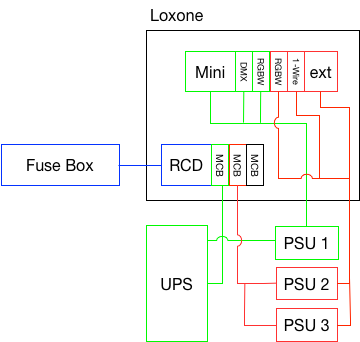
Hi Duncan, I think I get that:
  • RCD > MCB > Internal PSU not powered by UPS
  • RCD > MCB > UPS > Internal PSU for core systems (mini server / KNX / etc)
  • RCD > MCB > UPS > External PSU for the LED strips
Rather than use the internal TDK PSUs, can you also use those external [1] PSU to power the loxone kit? Something like the attached diagram (I need Visio as its pretty poor)?

loxone wiring.png

Duncan

unread,
Jan 2, 2017, 10:32:25 AM1/2/17
to Loxone English
there wouldnt be any problem using an external 24v psu for the loxone kit, but i wanted a degree of redudancy, and during my 'playing' i wanted to be able to power down leds and lighting without affecting the loxone core
Message has been deleted

Seb

unread,
Jan 2, 2017, 7:41:14 PM1/2/17
to Loxone English
Thanks for the confirmation. Looking at the price and power, the external PSU are about £0.28 per watt (based on the 320w PSU on my last post), and the TDK (100w, the biggest that will fit in the future automation cabinet) is £0.55. Given you can only get a handful of the 100w in a cabinet (not a clue how much it would draw for the whole house), larger wattage external PSUs would make sense providing there is space.

However, what I do not know is how reliable the TDKs are vs the PowerMax. Do you have a recommendation on manufacturers?

Duncan

unread,
Jan 3, 2017, 4:32:42 AM1/3/17
to Loxone English
i cant personally make a specific recommendation- i have used meanwell din 30w psus inside the cabinet and so far 100% reliable, and my external led suplies are no-name chinese waterproof ones at around £40 for 250w including delivery - again 100% reliable

Ian Norton

unread,
Jan 3, 2017, 6:10:57 AM1/3/17
to Duncan, Loxone English
Only comment I would make on this approach is that it's massively inefficient. You're dropping mains down to charge batteries, which then power an inverter to drive power supplies which drop back down to DC....

There are a number of off the shelf solutions for DC backup power that mean your 24vdc runs directly from battery in the event of a power failure, which will net you a longer run time, greater efficiency and probably at less cost.

Elmdene offer a range of these - http://www.elmdene.co.uk/24V-G-Range-N-Series.html though seems like it's only up to 5A which may or may not be enough for your needs. Ah, they also do a 10A version which should be enough for most needs - http://www.elmdene.co.uk/24V-G-Range-BM-Series.html

CPC have the 10A version http://cpc.farnell.com/elmdene/stx2410-e/en54-power-supply-24v-10a-17ah/dp/PW03919?mckv=967CUuIm&CMP=CPC-PLA which at £280 isn't cheap, but probably comparable costs to the UPS approach.

ymmv...

Ian.


On 1 January 2017 at 19:00, Duncan <joanne...@gmail.com> wrote:
ive just got a mains loop out to an external ups - the usual 1500va type on the floor below my wall cabinet - it then powers an external 24v psu which supplies some of my led lighting and acts as emergency lighting, and a loop back in to power the loxone 24v power supply and 12v supply for various auxillary items such as movement sensors, and the knx power supply.

--
You received this message because you are subscribed to the Google Groups "Loxone English" group.
To unsubscribe from this group and stop receiving emails from it, send an email to loxone-english+unsubscribe@googlegroups.com.
To view this discussion on the web visit https://groups.google.com/d/msgid/loxone-english/eb64d5b1-79c5-4a1f-bd1e-700d891ff5fb%40googlegroups.com.

For more options, visit https://groups.google.com/d/optout.


--
Ian Norton

Simon Still

unread,
Jan 3, 2017, 7:24:53 AM1/3/17
to Loxone English


On Sunday, 1 January 2017 11:39:00 UTC, Peter wrote:
At £150 is it worth the trouble?

My conclusion was that while it would be neater it wasn't worth the expense.  I bought an APC Back UPS 500 for about £50 and it's more than adequate to cope with short power cuts.  As well as the miniserver power supply (and the 12V/5v I use for a few other things) and I have a couple of LED lights that mean the route to the CU is lit if everything else in the house trips for some reason. 

It might not be the neatest or most efficient solution but it's cheap and very simple to swap out when it needs replacing. 


Andrew B

unread,
Jan 3, 2017, 7:32:19 PM1/3/17
to Loxone English
I have a computer UPS backing up my system and providing surge suppression. AC feeds the UPS which provides the 3 AC outlets for my 3 x 600W 24v PSUs. Works well.

The only caution I would offer is that you should verify that if your UPS uses an approximate sine curve output (and many do), that your PSU(s) can tolerate it. I only discovered this after ordering the UPS and just got lucky that the PSUs I have can tolerate it.

My UPS had 1320W peak output and >2000va. Usual power draw without many lights on is <4A @ 115v. This gives a decent endurance if the power fails.

Simon Still

unread,
Jan 6, 2017, 4:09:26 AM1/6/17
to Loxone English


On Wednesday, 4 January 2017 00:32:19 UTC, Andrew B wrote:

The only caution I would offer is that you should verify that if your UPS uses an approximate sine curve output (and many do), that your PSU(s) can tolerate it. 


How do you tell/find out? 

Andrew Brownsword

unread,
Jan 6, 2017, 11:43:07 AM1/6/17
to Loxone English
If it says “true sine wave” it is probably okay, otherwise the documentation or a call to their tech support.  Or an oscilloscope.  The approximation curve from a UPS is usually 2 square waves overlapped… i.e. a very poor step function rather than a nice smooth curve.

Many PSUs don’t care, but modern “switching” PC power supplies with PFC won’t work correctly if its not a nice sine wave.  Since I’m using such power supplies I had to verify (based on info from the PSU tech support) that the peak voltage output from my UPS was high enough.  Fortunately it is and things seem to be working… lots of short power outages this winter, and nary a flickering light to be seen at our house.


--
You received this message because you are subscribed to a topic in the Google Groups "Loxone English" group.
To unsubscribe from this topic, visit https://groups.google.com/d/topic/loxone-english/kY2BKDDP648/unsubscribe.
To unsubscribe from this group and all its topics, send an email to loxone-englis...@googlegroups.com.
To view this discussion on the web visit https://groups.google.com/d/msgid/loxone-english/fb890e1d-3a22-49e7-b1f1-a419655af959%40googlegroups.com.

ToneYoda

unread,
Aug 23, 2017, 8:28:48 AM8/23/17
to Loxone English

How do you handle the need to “Please note that all power supplies for the Loxone equipment must have their GNDs commoned”?  [That is extracted from Loxone’s website].  Is that possible and still necessary when some of the DC supplies are protected by UPS and others aren’t?

Bartel Eerdekens

unread,
Aug 24, 2017, 4:15:29 AM8/24/17
to Loxone English
I am now about to use my own created UPS system.

For this I will use the DR-UPS40 of Mean Well (http://www.meanwell.com/webapp/product/search.aspx?prod=DR-UPS40)

I will just hook up 2x lead-acid 12V batteries in series (to get the 24V) to the UPS as the main DC.
The Mean Well module has outputs to give feedback to the Loxone system, so I know when I have to go in "power-saving-mode" when main power is down.

Purpose is only to power some LV (24V) emergency lights, but keep my alarm system (Loxone Tree : Loxone motion sensors + 24V alarm siren) active in case of a power failure.
I will also hook up my internet (modem / switches / ...) to this DC bus, in order to keep this active as well.

Will report back here when my system is actually in place!

smartbusinesstools.be

unread,
Aug 25, 2017, 4:47:43 AM8/25/17
to loxone-...@googlegroups.com
That's exactly how we do it. But we use this one http://www.smartbusinesstools.be/shop/product/meanwell-drc-100b-power-supply-with-ups-for-loxone-417?category=65
which includes a 2A power supply and is much smaller (although too big for a regular consumer DIN rail cabinet)

Also, we switch the internet connection to a 4G mobile connection and also send an alarm message when the power is down.

Bartel Eerdekens

unread,
Aug 25, 2017, 5:32:44 AM8/25/17
to Loxone English
Yeah, this module could be recommended too, because I have to set my main DC power supply to this 27.3V DC in order to be able to charge the batteries.
(Which is totally acceptable though for all components on the DC power bus.)

Dave

unread,
Aug 26, 2017, 5:48:51 AM8/26/17
to Loxone English
Sounds interesting. Can anyone explain the calculation of how to work out the battery size that is needed to run a certain 24V load for a certain time? eg. Suppose I need 2A for miiniserver and basic functions, and I want to survive a 3-hour power cut.....how big must the batteries be?

Also, as this backup PSU outputs 27.3V DC, could this be too much for the miniserver and other 24V accessories?


On Friday, 25 August 2017 09:47:43 UTC+1, smartbusinesstools.be wrote:
That's exactly how we do it. But we use this one http://www.smartbusinesstools.be/shop/product/meanwell-drc-100b-power-supply-with-ups-for-loxone-417?category=65
which includes a 2A power supply and is much smaller (although too big for a regular consumer DIN rail cabinet)

Also, we switch the internet connection to a 4G mobile connection and also send an alarm message when the power is down.

On Thursday, August 24, 2017 at 10:15:29 AM UTC+2, Bartel Eerdekens wrote:
I am now about to use my own created UPS system.

For this I will use the R-UPS40 of Mean Well (http://www.meanwell.com/webapp/product/search.aspx?prod=DR-UPS40)

Bartel Eerdekens

unread,
Aug 29, 2017, 4:09:28 AM8/29/17
to loxone-...@googlegroups.com
I found this calculator tool:


The first 4 fields you can find in a datasheet of a (lead-acid) battery.
I bought batteries from the brand Kung Long, (2x 12V 18Ah in series): http://www.klb.com.tw/dbf/WP18-12SHR.pdf

Other types are listed here:

In your specific example, with this battery, the settings in the calculator would be:

Capacity AH rating 1 C1
18 AH

Hour Rate AH rating is at R1

20 Hour Rate

Capacity AH rating 2 C2

15.3 AH

Hour Rate AH rating is at R2

Hour Rate
   
Battery Temperature Check if Battery Temp is Over/Under 0-85 °F
   

Age of Battery

 Check if Battery is more than 6 months old.
   
Peukerts Constant1.132801268 
   
Amperage of Load Applied 2 Amps

Yielding: 
To keep a safe 50% discharge level, use for 4 hour(s) 3 minute(s) under your given load.

Meaning: a 12Ah to 15Ah would be ideal in your specific case.

Dave

unread,
Aug 29, 2017, 6:22:56 AM8/29/17
to Loxone English
That`s really useful - thank you.

Bartel Eerdekens

unread,
Aug 29, 2017, 6:32:19 AM8/29/17
to Loxone English
Oh and by the way:

In the shop of each Loxone component there is a DC voltage rating: (min. 9VDC max. 28VDC)
(For example: https://shop.loxone.com/enuk/valve-actuator-tree.html)

And many other 24V accessories can handle mostly up to 30V, so the 27,3V won't be an issue.

On Saturday, 26 August 2017 11:48:51 UTC+2, Dave wrote:
Reply all
Reply to author
Forward
0 new messages