
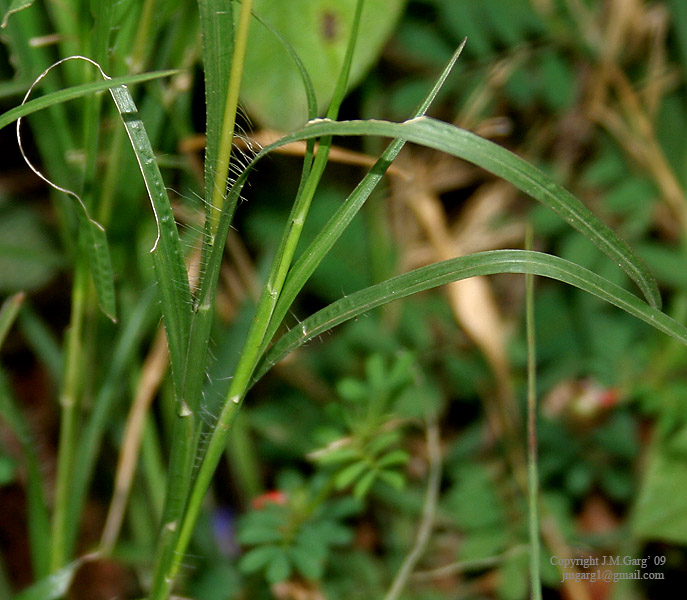
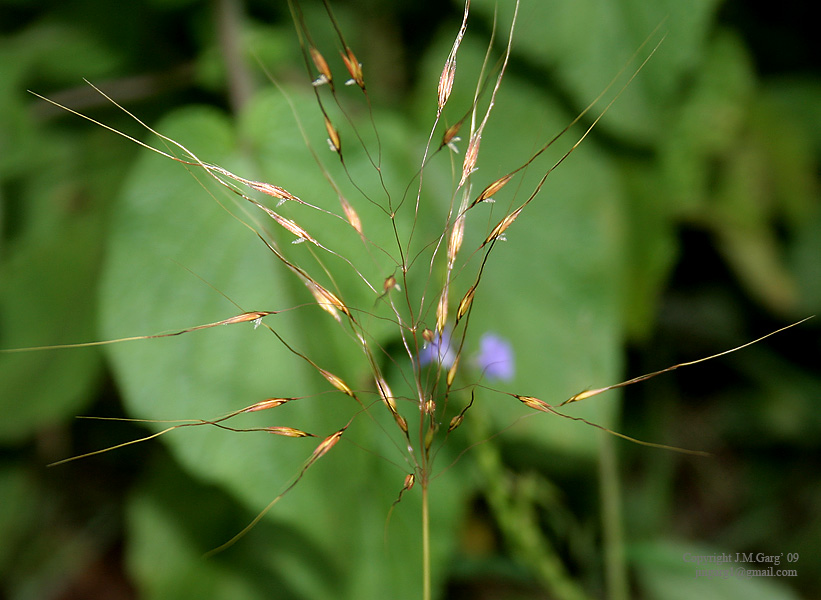
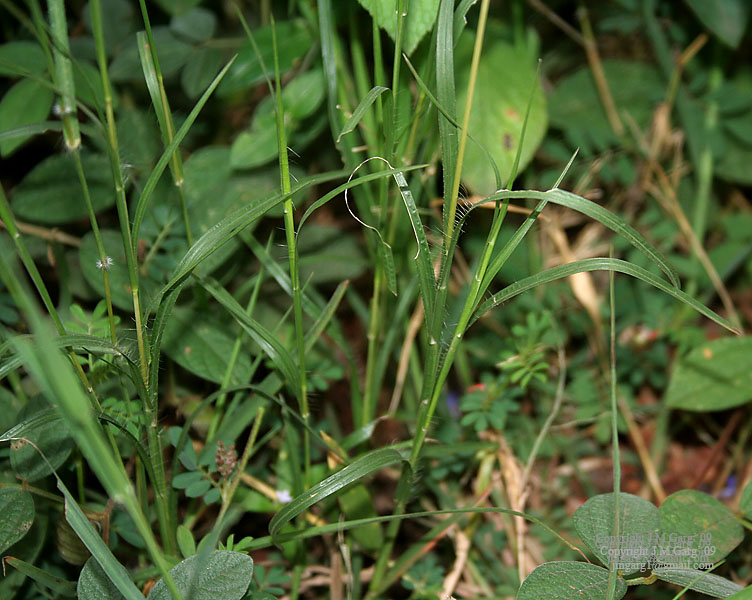
Grass for id 031109jm2

J.M. Garg
On 11/10/09 along roadside in Ananthagiri HIll forest in Rangareddy district of Andhra Pradesh.
--With regards,
J.M.Garg (jmg...@gmail.com)
http://en.wikipedia.org/wiki/User:Jmgarg1
'Creating awareness of Indian Flora & Fauna'
Image Resource of thousands of my images of Birds, Butterflies, Flora etc. (arranged alphabetically & place-wise): http://commons.wikimedia.org/wiki/Category:J.M.Garg
For learning about Indian Flora, visit/ join Google e-group- Indiantreepix:http://groups.google.co.in/group/indiantreepix?hl=en

Nayan Singh
Chief Conservator of Forests
and Field Director
Satpura Tiger Reserve Hoshangabad
M.P.
09424792100
From: J.M. Garg <jmg...@gmail.com>
To: indiantreepix <indian...@googlegroups.com>
Cc: grassman <crazyg...@gmail.com>; Avinash dada <avinas...@gmail.com>; Rani Bhagat <raani...@gmail.com>
Sent: Tue, 3 November, 2009 9:04:54 AM
Subject: [indiantreepix:22092] Grass for id 031109jm2
Yahoo! India has a new look. Take a sneak peek.

Aparna Watve
Taxonomist's Warning
"Identification of Poaceae, Cyperaceae, Eriocaulaceae (to name a few)
should not be confirmed from photographs"
(In the interest of scientific accuracy)
: )
Aparna
Dr. Aparna Watve
Dr. Aparna Watve
Asha Appt, Shanti Nagar, Ekata Colony
Nr. BSNL tower, Akbar Ward,
Seoni.480661
tel: 07692-228115
mobile: (0)9755667710 and 9822597288 still works

Swapna Prabhu
Regards,
- Swapna.
J.M. Garg
One hardly finds much details on net for such species.
> Seoni.480661
tel: 07692-228115
mobile: (0)9755667710 and 9822597288 still works

Vijayasankar Raman
R. Vijayasankar
FRLHT, Bangalore
Aparna Watve
As a short answer to the earlier mails, - I stand by what I said in
spite of the issues Garg ji has raised. Some reasons have already
been pointed out by Vijay ji.
Before I proceed to give a long answer, I would like to ask all here
some questions,
a. What is the accuracy of identification that we are aiming for?
My answer -for every plant I want a "scientifically accurate" identification.
b. What is the reason for scientific accuracy?
Because I see that handbooks and electronic databases, are now very
commonly being used for ecological surveys, environment impact
assessments, teaching, making books, making environment education
material, species distribution mapping, natural resource management
planning, ( For each of this- I can give an example from real life
where it was done). All this work requires scientific accuracy of
identification. Even many of the laymen (-a word I dont like to use)
are experts in their own field where they use this knowledge, for
example ayurvedic doctors who want to know plants to be used in
medicine.
c. Can we guarantee scientific accuracy of identification from a photo?
But before that, what kind of photo? - a simple reporting picture (as
are most on this mailing list) lacks most characters of id. I always
try to point out what more is required and some like Dr. Satish Phadke
are taking more and more pics with necessary key characters.
For the tricky families, if a person can take a picture showing all
necessary characters for the identification it will be possible to id
even grasses,sedges, eriocaulons clearly. But with the characters in
question, it will mean not only macro photos, but scanning electron
micrographs for characters of nut. How many can do this?
It is true that an expert, with his vast field knowledge can take one
look at a specimen and tell you what it is. Rani and Anilkumar (I know
both of them personally) on this group who know grasses well can do
it, . They have certain field characters in their mind by which they
do it, and they will turn out to be correct in most cases. But if
others try to use that photo for more identifications from similar
looking plants, they might get it wrong.
Dr. S. R. Yadav, of Kolhapur university and his PHD students working
on Poaceae of Maharashtra have developed an EXCELLENT set of
photographs of grass genera, from which identification is easy and
ACCURATE. I do hope they publish it soon. If one can get pictures like
that, then I will not mind id from digital photos.
for the rest of garg ji's points-
> We can't wait for the perfect things (which never will in any case) to happen.
- It is not perfection but ACCURACY being discussed. Even a bad photo
of a tiger is enough for id. But with the greatest photo of flowering
sedge it still is difficult to accurately distinguish Pycreas and
Cyperus.
> Our Floras only bulky technical details, hardly readable to a laymen.
Well I agree only partially to this, some floras of present are not
even good enough for a trained experienced taxonomist to use. But
please remember that floras were and will be written for those trained
in the subject. If a person trains him/herself to understand the
subject (like many notable examples on this group) they will follow it
too.
BTW, any technical subject book is going to be difficult to follow for
a person not from the background. I can hardly hope to easily
understand medical textbooks, or computer software books, though I
would love to diagnose my own sickness and write my own software
programmes.
>Or we simply stop photographing or knowing about Poaceae, Cyperaceae etc.
Well this is subjective. Those who want, can continue to do it as it
is, (and I attach the taxonomist's warning) or do it after reading up
technical literature on identification of these species and try and
get as many characters in the photo as possible (in that case my
warnings become little diluted, depending on the nature of the
photograph....)
Also as I have worded the warning, - it says "confirm" the
identification. A "confirmed identification" is where there is no
doubt remaining about the identity of the species in that photograph.
A simple identification is where there remains a chance that the
identification is wrong, and hence use of that identification is at
the person's own risk. The photo and subsequent comments on it can
give pointers, indications, as I usually try to give (for less complex
families), if I am not sure about identification based on the photo
alone.
Perhaps you should also put this subject on the mailing list of Indian
Association of Angiosperm Taxonomists. It will be most interesting to
hear their views.
Regards
Aparna
Gurcharan Singh
interact. The main aim of this group, I think is to encourage more and more
people to look at plants, know about their uses, local names, and ultimately
it would be a big step towards environmental management.
I have been practicing taxonomy for last 40 years, but the madness
about plants started only after I joined this group. We the taxonomists are
often happy to pick up the local flora and identify the plants, not
realising that a few related species must have cropped in into the area
after that local flora was published. Only after joining this group I came
to know about plants which I thought something else from Maheshwari's Flora
of Delhi. This I know must have also been the experience of other
colleagues. Sometimes I am amazed by the critical eye of Tabish ji, Garg ji
and others not professional taxonomists.
I know and many others must be feeling how useful the FlowersofIndia
website is for identification. We are all learning and let us encourage
others.
All of us know Poaceae and Cyperaceae are difficult to identify, but once
one of us has spent time on identification, there are always some physical
markers to remember identification of that grass or sedge. When we identify
hundreds of plants (including grasses and sedges) in our ecology/taxonomy
classes, or herbarium identification, we seldom look for books. If these
photographs go to our websites, it would help in awareness about grasses and
sedges.
My personal request! Let us not discourage members from taking photos
of grasses and sedges, rather encourage them and urge them to include shots
of auricles and ligules, closeup of spikelets. The digital photography
today allows clearer view than our naked eyes.
Today herbaria are discouraging taxonomists from handling of actual
specimens, and rather use their virtual herbaria. We should be happy that we
are using photgraphs of live plants with everything preserved.
Good photography for all
Dr. Gurcharan Singh
Associate Professor
SGTB Khalsa College
University of Delhi, Delhi
India
http://people.du.ac.in/~singhg45
From: "Aparna Watve" <aparna...@gmail.com>
To: "Vijayasankar Raman" <vijay.b...@gmail.com>
Cc: "J.M. Garg" <jmg...@gmail.com>; "Nayan Singh"
<ns_dun...@yahoo.co.in>; "indiantreepix"
<indian...@googlegroups.com>; "grassman" <crazyg...@gmail.com>;
"Avinash dada" <avinas...@gmail.com>; "Rani Bhagat"
<raani...@gmail.com>

Satish Phadke
One point in favour of digital photography:
Taxonomist and botanists use small hand held lenses to observe tiny parts of the plants.
The macro lenses replace these and to one's surprise when he goes back to his computer after the field visit the observations are found to be far better than actual field observations. Even the freshness of the parts is preserved in the picture as against the herbarium samples.
After some time the era of digital herbarium is going to come. The limitations about it will be sorted out by some experts e.g.pictures can be taken with ruler kept by the side of specimen etc.
(Myself being a medical doctor can site one comparable example: Earlier use of sonography(Ultrsound test) in pregnancy for monitoring fetal development used to be taken with a pinch of salt because of its limitations but now a days no pregnancy continues without at least one sonography test... Technology used judiciously has its own advantages. The interpreter behind it of course matters a lot.)
I urge in this forum to all experts to device methods to sort out problems and limitations of digital photography similar to what Gurcharan ji and Aparna ji have always suggested. In this way the internet and other technologial gadgetary will be properly used for the benefit of the science.
Dr Satish Phadke
Aparna Watve
The issue is not about photography (digital or otherwise or any other
technology) but whether a photograph (the kind that commonly
circulated on this list) is good enough for identification of Poaceae,
Cyperaceae, Eriocaulaceae (I am at present and in the previous mails
mainly talking about these complex families.. for which I included a
warning clearly stating so). I have taken great care to choose the
words I have used, and want to limit the discussion to these families
only. For other families, i have been giving pointers as and when I
could.
I totally agree with Dr. Gurucharan ji, that one can keep giving
suggestions for improvement in photos... (I already do that for many
other taxa). But for these three families, I find it unlikely that
people on this list will take the kind of photographs that are
required for an accurate identification of the taxa up to species
level in Poaceae, Cyperaceae, Eriocaulaceae.
I would be most happy if I am proven wrong and someone surprises me by
giving an excellent photo of nut ornamentation, or a complete set of
pictures for a grass species or Eriocaulon species showing all
characters mentioned in the key to id upto species level.
Regards,
Aparna
Vijayasankar Raman
Aparna Watve
the discussion constructive.
I wish someone can influence Dr. SR Yadav to take part in this
discussion as we all will benefit from his experience of combining
photography and plant identification so successfully.
Regards
Aparna
--
Dr. Aparna Watve
Dr. Aparna Watve
Asha Appt, Shanti Nagar, Ekata Colony
Nr. BSNL tower, Akbar Ward,
Vijayasankar Raman

Anil Kumar
regards
Dr.Anil Kumar
Gurcharan Singh
I may be wrong but my experience says that we need crucial microscopic
characters only when we don't have an identified herbarium specimen and are
sitting with an unidentified and a book with relevant keys. When we go to
different herbaria with our own herbarium specimens, we don't dissect
herbarium specimens (ours or that of herbarium) to arrive at an
identification. What I have been stressing on, is that pictures of
different angles of a plant can allow any one who has once seen, studied
and identified a particular species, grasses or no grasses. I think Dinesh
ji, Tabish ji, Satish ji, Pankaj ji, Nayan ji, Prashant ji (many of whom may
not be professional taxonomists) give identification within minutes simply
because they have specnt lot of time with that plant and know its physical
markers. For me Asteraceae is more complex identifications mostly based on
achene and pappus structures.
Coix may have unique fruit characters but I remember Coix lachryma-jobi
was identified within minutes of its uploading, by several members on this
group. On this group now it is now fastest finger first. How lucky we are.
My request again, let us not scare people from grasses and sedges.
Encourage them to know more and more of them.
Dr. Gurcharan Singh
Associate Professor
SGTB Khalsa College
University of Delhi, Delhi
India
http://people.du.ac.in/~singhg45
----- Original Message -----
From: "Aparna Watve" <aparna...@gmail.com>
To: "Satish Phadke" <phadke...@gmail.com>
Cc: "Gurcharan Singh" <sin...@sify.com>; "Vijayasankar Raman"
<vijay.b...@gmail.com>; "J.M. Garg" <jmg...@gmail.com>; "Nayan Singh"
<ns_dun...@yahoo.co.in>; "indiantreepix"
<indian...@googlegroups.com>; "grassman" <crazyg...@gmail.com>;
"Avinash dada" <avinas...@gmail.com>; "Rani Bhagat"
<raani...@gmail.com>
Sent: Wednesday, November 04, 2009 12:37 AM
Subject: Re: [indiantreepix:22164] Re: Grass for id 031109jm2
Aparna Watve
>may be wrong but my experience says that we need crucial microscopic characters only when we don't have an identified herbarium specimen and are sitting with an unidentified and a book with relevant keys.
Please take into consideration the diversity shown by the families in
question in our vast country. Simple matching with a herbarium
specimen for these genera is as inaccurate as matching with a photo.
One needs to key out a specimen most times to arrive at an ACCURATE
identification. For ex. I am familiar with Cyperaceae in Western Ghats
of Maharashtra. But when I go to Delhi, and see a plant I can identify
visually, I prefer to key it out using Delhi floras, as that region
may have certain species which look a lot like the one I know from
Maharashtra. Some Eriocaulon sp. look very different, visually (as a
photo would capture) when they are young individuals, from what they
will look like when they mature- chance of inaccurate identification
are high.
>When we go to different herbaria with our own herbarium specimens, we don't dissect herbarium specimens (ours or that of herbarium) to arrive at an identification.
Well we don't do that as a normal practice, because we trust the
person who has originally keyed out them, and it means that the
species matches the description already written in literature. We
certainly do dissect our own specimens, again and again till we are
sure of identification. And at times, botanists, especially those who
are experts, or reviewers of certain groups, do dissect out specimens
from standard herbariums like BSI, (we had several such visitors in
Pune BSI ,western circle), duplicates generally or originals (even
types) by special permissions, because the whole purpose of a
herbarium specimen is to serve a reference for future workers
>What I have been stressing on, is that pictures of different angles of a plant can allow any one who has once seen, studied and identified a particular species, grasses or no grasses.
I wish it was true, but it isn't due to diversity and variation seen
in plants in general, and in Poaceae, Cyperaceae, Eriocaulaceae in
particular. If the pictures include key characters (to name a few nut
ornamentation, ligule, stigma, underground parts, lodicules, glumes,
arrangement of glumes,,,, and several more) expert might be able to
figure it out eventually.
I think Dinesh ji, Tabish ji, Satish ji, Pankaj ji, Nayan ji, Prashant
ji (many of whom may not be professional taxonomists) give
identification within minutes simply because they have specnt lot of
time with that plant and know its physical markers.
I respect them all for this, and they do this for non complex
families, and are mostly accurate in id. However, the point is not
fast identification, but ACCURATE identification and that too of
Poaceae, Cyperaceae, Eriocaulaceae.
For me Asteraceae is more complex identifications mostly based on
achene and pappus structures.
> Yes it is one of the complex ones. I personally feel comfortable in guessing a genera of Asteraceae from a picture. But I will never claim to be accurate about it, knowing my limitations and the diversity of this family.
Coix may have unique fruit characters but I remember Coix
lachryma-jobi was identified within minutes of its uploading, by
several members on this group. On this group now it is now fastest
finger first. How lucky we are.
> In case of Coix what generally is considered a nut is not nut at all (this is not a unique fruit character). In fact, Prashant ji's picture yesterday was very similar to coix, but Pankaj has already commented that he thinks not, and I would like to see the typical character, to which Prashant ji has said, that he also felt something was different from coix and hence one should not jump to conclusions (please see his relevant mail on this). Second example to corroborate my views, a picture of Echinochloa was identified as Brachiaria spp. by Avinash ji. Later Dr. Anil Kumar corrected the id to Echinochloa colona. If he was not around on the list, the plant would have gone by a wrong name, and would have confused someone later. SO the experts on this group have to be constantly vigilant about wrong ids. I personally would aim at accuracy rather than speed.
Perhaps, we should think of a scientific review of the database as
Vijay ji has mentioned.
> My request again, let us not scare people from grasses and sedges. Encourage them to know more and more of them.
My warning is carefully worded as : "Identification of Poaceae,
Cyperaceae, Eriocaulaceae (to name a few) should not be confirmed from
photographs"
I do not think these words can scare anyone or discourage them from
photographing a species they like. The aim of attaching the warning
message, is to keep people aware of the fact that Poaceae, Cyperaceae,
Eriocaulaceae are complex families, which need a lot more care than
many others in identification. And, hence if they want to accurately
identify species of these families, they need more effort in making it
possible.
Regards,
Aparna
Satish Phadke
I can say that we should close this topic here only.
Regards
Satish Phadke
J.M. Garg
Let's take this thread as closed now.
2009/11/3 Satish Phadke <phadke...@gmail.com>
2009/11/3 Gurcharan Singh <sin...@sify.com>

Dr. Pankaj Kumar
Thing is nothing could be confirmed just from the pics, its not just
the grasses or sedges. If I reply on any plant, it may look like I am
replying abruptly, but its not so. Yeah sometimes I do get confused so
I tend to misidentify but that way I get to learn. Why I identified
that, and where was my mistake, it really helps me in learning more.
Infact, one of my greatguru, Dr. T. K. Ghosh (student of Dr. P.
Maheshwari) told me never to identify a plant in the field. Just study
it and keep it with u.
The main problem here is, how many of you have an access to the
microscope to check if there is a pappus or hair inside the flower on
the filament or not......good god, they missed seeing if the hairs
were multicellular or unicellular; branched or unbranched!!! But yeah,
digital photography is not enough, it just shows the external details
of a plant, but some families do need to be checked for some key
characters lying inside the flower. Try your luck with any of the
Asteraceae or Poaceae member, how good pic of pappus can u get!!!
CLOSEUP SHOTS FROM A DIGITAL CAMERA DOESNT HELP MUCH AT MOST OF THE
TIMES. This is just an example. I dont think I have ever seen a person
sharing a pic of dissected flower ever! Some times I do ask for a
better pic or dissected flower, as today I did for Curcuma mutabilis.
If I am not confirm myself, then I answer a post that way only
otherwise, I confirm it with a affirmative. If u ask a grass expert he
will say grasses are too easy but orchids are too tough, if u ask a
orchid expert, then he will say orchids are too easy, grasses are too
tough!!!
I think the better way will be to explain, how u identified that
particular plant from the pic rather than just giving the name. But
there are many people including me who are not a professional
taxonomist to explain how they reached to the genus or species of that
particular plant? Trust me when I say, I can confirm a plant that its
an orchid in the field by touching....I dont know how but it is the
fact. Another example, how many of u ever dissected a Ficus fruit to
confirm the id? but you know Ficus religiosa is religiosa and hispida
is hispida!! yet another example, in Eucalyptus you have to see the
angle between two cotyledons to confirm, how many of you ever tried
that?
I think this is a community where most of the members are not
taxonomist and most of them including me are not professional
taxonomist either. So their should be a way to address both groups.
Its like if I am giving a determinative but unable to explain, then a
professional taxonomist can provide an explanation to it. Otherwise
many people wont even give it a try in identifying a plant, THOUGH IT
HAS BEEN STATED BY APARNA JI, THAT IT IS NOT TO DISCOURAGE PEOPLE.
And yes, we usually dont dissect an herbarium specimen unless we have
special permission and unless we are doing some monographic study!!
But who will confirm that the determinative attached to a herbarium
sheet is correct, though they might be given by experts??? Recently, I
got an opportunity to typify some sheets (types of four species) kept
at K and LINN. The determinative was given by one of the great
orchidologist of his time. I was kind of scared whether should I
correct it or not, but I did just because I knew I was correct!!
Offcourse, I know Dr. Yadav, and I know he has a great knowledge of
plant taxonomy. It would really be great if he is here and is an
active member and there are many others too who can offcourse help in
many ways.
I would have preferred that:
1. Members should think before giving names, but they should be free
to give it, not abruptly though.
2. Experts are always there to correct it if others are wrong.
3. Experts should also be encouraged to give an explanation about the
identification as well as when they are making corrections.
This is still open for discussion I believe......................



Dr Santhosh Kumar
JM Garg
From: JM Garg <jmg...@gmail.com>
Date: Tuesday, 3 November, 2009 at 9:04:54 am UTC+5:30
Subject: Grass for id 031109jm2
To: indiantreepix <indian...@googlegroups.com>


J.M. Garg
You received this message because you are subscribed to the Google Groups "eFloraofIndia" group.
To unsubscribe from this group and stop receiving emails from it, send an email to indiantreepi...@googlegroups.com.
To view this discussion on the web, visit https://groups.google.com/d/msgid/indiantreepix/f00bcdbf-d867-48a7-bbd6-6850a5dacce3n%40googlegroups.com.
J.M.Garg


J.M. Garg
From: Manoj Chandran
Date: Thu, 2 Nov 2023 at 11:17
Subject: Re: [efloraofindia:457477] Fwd: Grass for id 031109jm2
To: J.M. Garg <jmg...@gmail.com>
J.M.Garg