
Re: [ERA] Cooling Climate Chaos - A Proposal to Cool the Planet within Twenty years. The book is out and pdf is included in this mail.

Tom Goreau
Thanks, Rob and Peter, congratulations! Good luck!
I’m just back from coral extinction rescue efforts in Cuba and will try to read your book in coming weeks in Maldives, Zanzibar, Tanzania, or Pacific atolls.
A very quick skim of the ocean chapter suggests Ocean Blue Carbon sinks are under-appreciated.
All readers of this list could benefit from reading Susan Solomon, 2024, Solvable: How We Healed The Earth, And How We Can Do It Again, not because it provides any solutions but because it is an exceptionally clear discussion of the basic history and science of global pollution and how political/industrial interests tried to prevent action to save the planet. She argues that because we managed to prevent catastrophe on ozone, smog, lead, and pesticides, the same international good will and common purpose can solve runaway climate change! I hope she’s right, but lovers of one size fits all solutions will find no road maps here. In all the cases she discusses, policy makers were forced to listen to the scientists due to intense public awareness of the urgency of the crises, but this has NOT happened yet with climate change since the fossil fuel industry, and the politicians they bribe, persistently put profits ahead of the planet’s future.
Here’s an example from “Solvable” on misunderstandings about the role of the water cycle (p. 52-53):
“Another example is the weaponization of the statement that water vapor is Earth’s dominant greenhouse gas, not carbon dioxide. It’s true, and it’s also irrelevant. Indeed water vapor does absorb infrared radiation strongly, but it responds to the climate instead of driving climate. Water vapor has a very short lifetime in the atmosphere – typically days. The water in the atmosphere is controlled by the balance between evaporation at the surface (from the oceans, but also from soils or plants) versus removal by formation of clouds and rain. Evaporation in turn depends on surface temperature. Consider for example, the humid air of a tropical jungle versus the extreme dryness of Antarctica, even coastal Antarctica. Changes in humidity are a response to climate and not a forcing of it – it’s not going to make the climate change, it’s going to react to a change in climate”. She goes on to discuss the long persistent tail of CO2 responses after sources are reduced……..
Unfortunately she does not allow for the fact that only intact continental scale tropical rain forests can punch water vapor above the stratopause, where it has the best chance of radiating latent heat to space!
The Amazonian Basin drought continues to intensity, especially in the Clear Rivers areas like Tocantins, Tapajos, Xingu, Madeira, Purus, Jurua, etc. We’re fast approaching precisely what Robert Goodland warned (1975) would happen in Amazonia: Green Hell to Red Desert ecosystem, ecosystem collapse on a continental scale first, then global.
Thomas J. F. Goreau, PhD
President, Global Coral Reef Alliance
Chief Scientist, Blue Regeneration SL
President, Biorock Technology Inc.
Technical Advisor, Blue Guardians Programme, SIDS DOCK
37 Pleasant Street, Cambridge, MA 02139
gor...@globalcoral.org
www.globalcoral.org
Skype: tomgoreau
Tel: (1) 617-864-4226 (leave message)
Books:
Geotherapy: Innovative Methods of Soil Fertility Restoration, Carbon Sequestration, and Reversing CO2 Increase
http://www.crcpress.com/product/isbn/9781466595392
Innovative Methods of Marine Ecosystem Restoration
http://www.crcpress.com/product/isbn/9781466557734
Geotherapy: Regenerating ecosystem services to reverse climate change
No one can change the past, everybody can change the future
It’s much later than we think, especially if we don’t think
Those with their heads in the sand will see the light when global warming and sea level rise wash the beach away
“When you run to the rocks, the rocks will be melting, when you run to the sea, the sea will be boiling”, Peter Tosh, Jamaica’s greatest song writer
From:
'rob de laet' via EcoRestoration Alliance <ecorestorat...@googlegroups.com>
Date: Saturday, July 13, 2024 at 6:48 AM
To: EcoRestoration Alliance <ecorestorat...@googlegroups.com>, Evergreening Fellows & Affiliates <evergreening-fel...@googlegroups.com>, Skeena Rathor <skeen...@gmail.com>, Julia Adams <cotswoldmeri...@gmail.com>, j.po...@greenfutures.org.uk
<j.po...@greenfutures.org.uk>, Jojo Mehta <jo...@stopecocide.earth>, Sir David King <d...@camkas.co.uk>, David Jones <david...@co2eco.com>, Tim Lenton <t.m.l...@exeter.ac.uk>
Cc: Peter Bunyard <peter....@btinternet.com>, Stephanie Mines <tara-a...@prodigy.net>
Subject: [ERA] Cooling Climate Chaos - A Proposal to Cool the Planet within Twenty years. The book is out and pdf is included in this mail.
Hello everybody,
Peter Bunyard and I have published the book ''Cooling Climate Chaos'',
To address the climate crisis, which is causing life-threatening extreme events, we must transform our economic and societal models towards sustainability and resilience while gaining a holistic understanding of climate. Drawing on James Lovelock’s Gaia Theory and Indigenous cosmologies, this book posits that Earth functions as a living organism, with ecosystems maintaining life-supporting conditions. It explores the atmosphere's role within this living planet, emphasizing water's critical function, based on Peter Bunyard's earlier work, "Climate Chaos." The interaction between the biosphere, soils, water, and the atmosphere stabilizes weather and cools the planet, but ecosystem destruction disrupts these cycles, contributing to global warming. Restoring ecosystems and transitioning to sustainable agriculture can quickly stabilize the climate, offering effective solutions. Implementing these strategies globally can mitigate the worst effects of climate change within decades, protect biodiversity, and address social inequities. While reducing emissions is essential, repairing nature and water cycles through regenerative agriculture, agroforestry, and ecosystem restoration is equally vital. These efforts can restore the planet’s natural balance, leading to a sustainable and abundant future.
A special thank you goes to the founders of Climate Change and Consciousness, Stephanie Mines, the chairperson of Biology for a Livable Climate, Philip Bogdonoff and the co-founder of EcoRestoration Alliance, Jon Schull.
In no particular order, many thanks to: Ed Huling, Jim Laurie, Walter Jehne, Michael Pilarski, Russ Speer, Stephanie Mines, Charles Eisenstein, Daniel Pinchbeck, Ousmane Pame, Rodger Savory, Antonio Nobre, Carlos Nobre, Germán Poveda, Anastassia Makarieva, Douglas Sheil, Jim Laurie, Alan Savory, David Ellison, Douglas Sheil, Zuzka Mulkerin, Michal Kravčík, Jan Pokorny, Judy Schwartz, Alpha Lo, Erica Geis, Duane Norris, Sue Butler, Ananda Fitzsimmons, Elizabeth Herald, Howard Dryden, Colin Grant, Bru Pearce, Brian von Herzen, Anamaria Frankic, Tom Goreau, Stefan Schwarzer, Christopher Haines, Richard Betts, Zac Goldsmith, Ben Goldsmith, Alexander Goldsmith, Martin Hodnett, Rafael Mantilla, Martin von Hildebrand, Phoebe Barnard and Atossa Soltani. All of these people have contributed in one way or other to this body of knowlegde.
We are still looking for a European publisher who would like to bring this in paperback form on the market. Suggestions are most welcome.
Please share as widely as possible. Onward to a livable planet!
--
View this message at
https://groups.google.com/a/googlegroups.com/d/msg/ecorestoration-alliance/topic-id/message-id
Group emails flooding your inbox? Click here:
https://groups.google.com/g/ecorestoration-alliance/settings#email
Our website is at http://EcorestorationAlliance.org/
Our calendar is at https://tinyurl.com/EcoResCalendar
---
You received this message because you are subscribed to the Google Groups "EcoRestoration Alliance" group.
To unsubscribe from this group and stop receiving emails from it, send an email to
ecorestoration-al...@googlegroups.com.
To view this discussion on the web visit
https://groups.google.com/d/msgid/ecorestoration-alliance/1683296324.236563.1720867552537%40mail.yahoo.com.
Tom Goreau
Sorry, meant to say Tropopause, not Stratopause, mea culpa!
Very large volcanic eruptions like Agung, Tambora, Toba, Pinatubo, etc. that are also very high in sulfur can get above the stratopause, and the effects can last a few years.
Rain forest climate benefits are self-replicating and permanent only if maintained as regenerative healthy ecosystems, but can be lost permanently through degenerative mis-development, while volcanoes are utterly unpredictable and can’t be counted on whenever needed, or not!
From:
Jon Schull <jsc...@gmail.com>
Date: Saturday, July 13, 2024 at 9:29 AM
To: Tom Goreau <gor...@globalcoral.org>
Cc: Anastassia Makarieva <ammak...@gmail.com>, Antonio Nobre <anob...@gmail.com>, David Jones <david...@co2eco.com>, EcoRestoration Alliance <ecorestorat...@googlegroups.com>, Evergreening Fellows & Affiliates <evergreening-fel...@googlegroups.com>,
Foster Brown <fbr...@woodwellclimate.org>, Healthy Planet Action Coalition <healthy-planet-...@googlegroups.com>, Jojo Mehta <jo...@stopecocide.earth>, Julia Adams <cotswoldmeri...@gmail.com>, Peter Bunyard <peter....@btinternet.com>,
Sir David King <d...@camkas.co.uk>, Skeena Rathor <skeen...@gmail.com>, Stephanie Mines <tara-a...@prodigy.net>, Tim Lenton <t.m.l...@exeter.ac.uk>, j.po...@greenfutures.org.uk <j.po...@greenfutures.org.uk>, rob de laet <robd...@yahoo.com>
Subject: Re: [ERA] Cooling Climate Chaos - A Proposal to Cool the Planet within Twenty years. The book is out and pdf is included in this mail.
This looks fantastic!
Congratulations!
Proud that we all played a small part...
jsc...@e-NABLE.org cell: 585-738-6696
Co-Founder, e-NABLE: volunteers worldwide making free, 3D printed prosthetics
Innovation Fellow, JMK Innovation Fund
Sent from iPhone: beware tyops.
To view this discussion on the web visit https://groups.google.com/d/msgid/ecorestoration-alliance/BY3PR13MB49946B18288A2352C5C7485CDDA72%40BY3PR13MB4994.namprd13.prod.outlook.com.

Oswald Petersen
Hi Tom,
could you (or someone) please explain to me why SO2 spread in the stratosphere does not cause the same problems ( to human respiratory systems or ocean acidity … ) as SO2 spread by ships or coal-fired power plants… once it comes down to earth. This is not a rhetoric question, I would really like to understand this…
TIA
Oswald
--
You received this message because you are subscribed to the Google Groups "Healthy Planet Action Coalition (HPAC)" group.
To unsubscribe from this group and stop receiving emails from it, send an email to healthy-planet-action...@googlegroups.com.
To view this discussion on the web visit https://groups.google.com/d/msgid/healthy-planet-action-coalition/BY3PR13MB49946604161A4FC0B0C6F83CDDA72%40BY3PR13MB4994.namprd13.prod.outlook.com.
Tom Goreau
I never said that, I agree too many people have forgotten what acid rain did!
Any sulfur based SAI proposal will contribute to acid rain.
The long term impacts of acid rain in North America were discovered in the Hubbard Brook Forest watershed where I measured soil GHG sources and sinks for my thesis.
Half a decade after dirty high sulfur coal emissions were stopped in the 1970s, the negative effects on forests, and soil nutrients of North America and Europe are still underway, and longer legacy ocean acidification is just starting!
China and India have yet to reap what they have sown on their own soils and forests!
Ocean acidification is very real, and can’t be reversed quickly.
Those proposing sulfur based SAI must show that these impacts will be negligible.
Some models focused on very localized SAI for arctic ice enhancement in certain seasons suggest reasonable ice albedo feedbacks could take place without impacting other latitudes, according to people like Mike MacCracken who knows more about it.
I hope they are right that it is very different from 1) the tropospheric acid rain and ocean acidification caused by fossil abuse, or 2) the catastrophic global stratosphere acid sulfate, iron, and chlorine shower after the Chicxulub asteroid vaporized the gypsum and salt beds.
Oswald Petersen
Thanks Tom,
this is really helpful
Oswald

David Price
Unfortunately she [Susan Solomon] does not allow for the fact that only intact continental scale tropical rain forests can punch water vapor above the stratopause, where it has the best chance of radiating latent heat to space!
You received this message because you are subscribed to the Google Groups "Healthy Planet Action Coalition (HPAC)" group.
To unsubscribe from this group and stop receiving emails from it, send an email to healthy-planet-action...@googlegroups.com.
To view this discussion on the web visit https://groups.google.com/d/msgid/healthy-planet-action-coalition/BY3PR13MB49946B18288A2352C5C7485CDDA72%40BY3PR13MB4994.namprd13.prod.outlook.com.
Tom Goreau
Yes, water enters the stratosphere mainly through volcanic eruptions and meteorite strikes, but tropical convection goes up to, and if sufficiently vigorous, through the tropopause, and this leakage is a major source of lower stratosphere water. We are getting surface temperatures above 40C on a regular basis now! This causes the highest elevation natural convective clouds from surface heating.
From:
David Price <da...@pricenet.ca>
Date: Saturday, July 13, 2024 at 4:27
PM
David Price
On Jul 13, 2024, at 2:40 PM, Tom Goreau <gor...@globalcoral.org> wrote:
To view this discussion on the web visit https://groups.google.com/d/msgid/healthy-planet-action-coalition/BY3PR13MB49948F8424D54A740E701F43DDA72%40BY3PR13MB4994.namprd13.prod.outlook.com.

Oeste
The explosive phase of even the largest volcanic eruptions which are able to inject SO2 into the stratosphere does by far not last for a year. This fact is the main difference of SAI to the natural phenomenon of explosive volcanic eruptions. The SAI method produces one round about ~100 year lasting artificial SO2 injection into the stratosphere. Additional: according to the SAI method the amount of SO2 increases year for year according to the greenhouse gas level increase.
H2SO4 Aerosols emitted to the troposphere have only a short lifetime because they act as cloud condensation nuclei, produce clouds and become washed onto the ground or into the sea with the next rain or snow shower. In the stratosphere is neither rain no snow.
Hence the cleaning mechanism working in the troposphere does not exist in the stratosphere. Sulfuric acid aerosol is driven out of the Stratosphere only by the extreme slow Brewer-Dobson air cycling process. This cycle moves air upward from equatorial troposphere to the stratosphere and then polward and then downward into the polar troposphere. Probably the down-trickeling sulfuric acid aerosol will induce tropospheric fog and or cloud cover in the polar arctic. These clouds and fog acts warming by IR radiation absorption during the half year lasting dark winter time. A cooling by these S-induced clouds and fog happens only during arctic summer time according to sun short wave radiation reflection.
Franz
Sun shine dimming
To view this discussion on the web visit https://groups.google.com/d/msgid/healthy-planet-action-coalition/000001dad534%24f180b290%24d48217b0%24%40hispeed.ch.
Tom Goreau
The annual average of stratosphere sulfate and water injection is very small in most years, but very large after a suitably large eruption. You are talking stochastic non-linear forcing.
For the most recent example:
Water vapor injection into the stratosphere by Hunga Tonga-Hunga Ha’apai
HOLGER VÖMEL HTTPS://ORCID.ORG/0000-0003-1223-3429 , STEPHANIE EVAN HTTPS://ORCID.ORG/0000-0003-1014-0907, AND MATT TULLY
SCIENCE
22 Sep 2022
Vol 377, Issue 6613
pp. 1444-1447
Up in the air
The eruption of the submarine volcano Hunga Tonga-Hunga Ha’apai in January of 2022 was so violent that its plume penetrated into the stratosphere. Vömel et al. studied in situ measurements by radiosondes (weather balloons), which showed that the event injected at least 50 teragrams of water vapor into the stratosphere. Because the volcano was underwater, the amount of water vapor in the developing stratospheric plume was high, and, unlike other large eruptions, it may have increased the amount of global stratospheric water vapor by more than 5%. —HJS
Abstract
Large volcanic eruptions, although rare events, can influence the chemistry and the dynamics of the stratosphere for several years after the eruption. Here we show that the eruption of the submarine volcano Hunga Tonga-Hunga Ha’apai on 15 January 2022 injected at least 50 teragrams of water vapor directly into the stratosphere. This event raised the amount of water vapor in the developing stratospheric plume by several orders of magnitude and possibly increased the amount of global stratospheric water vapor by more than 5%. This extraordinary eruption may have initiated an atmospheric response different from that of previous well-studied large volcanic eruptions.
https://www.science.org/doi/10.1126/science.abq2299
You’ll have to do your own literature study on mechanisms of water formation and loss in the stratosphere and upper troposphere, you will find there is a vast literature, much of it based on models that may, or may not be right, but some very useful experimental measurements following the rare events that can make all the difference.
To once again quote Mike MacCracken, when we fly over the equatorial zone you can see huge thunderheads reaching to the tropopause, and sometimes above it! I have a book on this someplace in my basement.
Tom Goreau
Stratosphere sources of water have a large literature. The water is known to be there even though you believe it is impossible for water to reach the stratosphere,. I don’t have time to read all this vast literature for you, but here’s a start from just a few minutes of searching. And another major source is methane photolysis above the ozone layer……
“tropopause-overshooting convection presents itself as a likely source of H2O extrema in much of the world, while meridional isentropic transport of air from the tropical upper troposphere to the extratropical lower stratosphere is also possible.”
https://doi.org/10.5194/acp-23-14375-2023 | 
20 Nov 2023
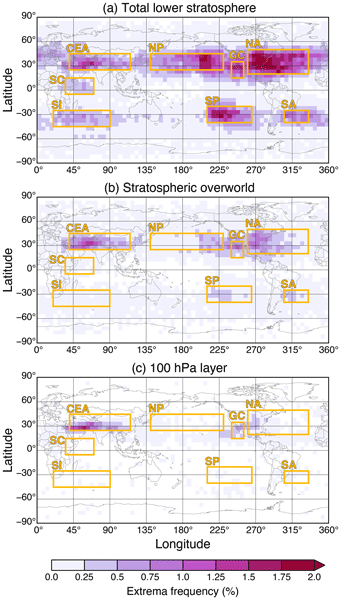
Climatology, sources, and transport characteristics of observed water vapor extrema in the lower stratosphere
Emily N. Tinney and Cameron R. Homeyer
Abstract
Stratospheric water vapor (H2O) is a substantial component of the global radiation budget and therefore important to variability in the climate system. Efforts to understand the distribution, transport, and sources of stratospheric water vapor have increased in recent years, with many studies utilizing long-term satellite observations. Previous work to examine stratospheric H2O extrema has typically focused on the stratospheric overworld (pressures ≤ 100 hPa) to ensure the observations used are truly stratospheric. However, this leads to the broad exclusion of the lowermost stratosphere, which can extend over depths of more than 5 km below the 100 hPa level in the midlatitudes and polar regions and has been shown to be the largest contributing layer to the stratospheric H2O feedback. Moreover, focusing on the overworld only can lead to a large underestimation of stratospheric H2O extrema occurrence. Therefore, we expand on previous work by examining 16 years of Microwave Limb Sounder (MLS) observations of water vapor extrema (≥ 8 ppmv) in both the stratospheric overworld and the lowermost stratosphere to create a new lower-stratosphere climatology. The resulting frequency of H2O extrema increases by more than 300 % globally compared to extrema frequencies within stratospheric overworld observations only, though the percentage increase varies substantially by region and season. Additional context is provided for this climatology through a backward isentropic trajectory analysis to identify potential sources of the extrema. We show that, in general, tropopause-overshooting convection presents itself as a likely source of H2O extrema in much of the world, while meridional isentropic transport of air from the tropical upper troposphere to the extratropical lower stratosphere is also possible.
How to cite.
Tinney, E. N. and Homeyer, C. R.: Climatology, sources, and transport characteristics of observed water vapor extrema in the lower stratosphere, Atmos. Chem. Phys., 23, 14375–14392, https://doi.org/10.5194/acp-23-14375-2023, 2023.
Stratospheric water vapor affecting atmospheric circulation
- Edward Charlesworth,
- Felix Plöger,
- Thomas Birner,
- Rasul Baikhadzhaev,
- Marta Abalos,
- Nathan Luke Abraham,
- Hideharu Akiyoshi,
- Slimane Bekki,
- Fraser Dennison,
- Patrick Jöckel,
- James Keeble,
- Doug Kinnison,
- Olaf Morgenstern,
- David Plummer,
- Eugene Rozanov,
- Sarah Strode,
- Guang Zeng,
- Tatiana Egorova &
- Martin Riese
Nature Communications volume 14, Article number: 3925 (2023)
Abstract
Water vapor plays an important role in many aspects of the climate system, by affecting radiation, cloud formation, atmospheric chemistry and dynamics. Even the low stratospheric water vapor content provides an important climate feedback, but current climate models show a substantial moist bias in the lowermost stratosphere. Here we report crucial sensitivity of the atmospheric circulation in the stratosphere and troposphere to the abundance of water vapor in the lowermost stratosphere. We show from a mechanistic climate model experiment and inter-model variability that lowermost stratospheric water vapor decreases local temperatures, and thereby causes an upward and poleward shift of subtropical jets, a strengthening of the stratospheric circulation, a poleward shift of the tropospheric eddy-driven jet and regional climate impacts. The mechanistic model experiment in combination with atmospheric observations further shows that the prevailing moist bias in current models is likely caused by the transport scheme, and can be alleviated by employing a less diffusive Lagrangian scheme. The related effects on atmospheric circulation are of similar magnitude as climate change effects. Hence, lowermost stratospheric water vapor exerts a first order effect on atmospheric circulation and improving its representation in models offers promising prospects for future research.
https://dash.harvard.edu/handle/1/10121968
The Sources and Significance of Stratospheric Water Vapor: Mechanistic Studies from Equator to Pole

View/Open
Smith_gsas.harvard_0084L_10034.pdf (14.19Mb)
Author
Metadata
Citation
Smith, Jessica Birte. 2012. The Sources and Significance of Stratospheric Water Vapor: Mechanistic Studies from Equator to Pole. Doctoral dissertation, Harvard University.
Abstract
It is the future of the stratospheric ozone layer, which protects life at Earth’s surface from harmful ultraviolet (UV) radiation, that is the focus of the present work. Fundamental changes in the composition and structure of the stratosphere in response to anthropogenic climate forcing may lead to catastrophic ozone loss under current, and even reduced, stratospheric halogen loading. In particular, the evolution toward a colder, wetter stratosphere, threatens to enhance the heterogeneous conversion of inorganic halogen from its reservoir species to its catalytically active forms, and thus promote in situ ozone loss. Water vapor concentrations control the availability of reactive surface area, which facilitates heterogeneous chemistry. Furthermore, the rates of the key heterogeneous processes are tightly controlled by the ambient humidity. Thus, credible predictions of UV dosage require a quantitative understanding of both the sensitivity of these chemical mechanisms to water vapor concentrations, and an elucidation of the processes controlling stratospheric water vapor concentrations. Toward this end, we present a set of four case studies utilizing high resolution in situ data acquired aboard NASA aircraft during upper atmospheric research missions over the past two decades. 1) We examine the broad scale humidity structure of the upper troposphere and lower stratosphere from the midlatitudes to the tropics, focusing on cirrus formation and dehydration at the cold-point tropical tropopause. The data show evidence for frequent supersaturation in clear air, and sustained supersaturation in the presence of cirrus. These results challenge the strict thermal control of the tropical tropopause. 2) We investigate the likelihood of cirrus-initiated activation of chlorine in the midlatitude lower stratosphere. At midlatitudes the transition from conditions near saturation below the local tropopause to undersaturated air above greatly reduces the probability of heterogeneous activation and in situ ozone loss in this region. 3) We probe the details of heterogeneous processing in the wintertime Arctic vortex, and find that in situ measurements of OH provide incontrovertible evidence for the heterogeneous reaction of HOCl with HCl. This reaction is critical to sustaining catalytically active chlorine and prolonging ozone loss in the springtime vortex. 4) We revisit the topic of midlatitude ozone loss with an emphasis upon the response of ozone in this region to changes in the chemical composition and thermal structure of the lower stratosphere induced by anthropogenic climate change. Specifically, we show evidence for episodic moisture plumes in the overworld stratosphere generated by the rapid evaporation of ice injected into this region by deep convection, and find that these high water vapor plumes have the potential to alter the humidity of the lower stratosphere, and drastically increase the rate of heterogeneous chemistry and in situ ozone loss, given sufficient reactive surface.
https://skepticalscience.com/print.php?r=136
What is the role of stratospheric water vapor in global warming?
What The Science Says:
The effect from stratospheric water vapor contributes a fraction of the temperature change imposed from man-made greenhouse gases. Also, it's not yet clear whether changes in stratospheric water vapor are caused by a climate feedback or internal variability
(eg - linked to El Nino Southern Oscillation). However, the long term warming trend seems to speak against the possibility of a negative feedback.
Climate Myth: Water vapor in the stratosphere stopped global warming
A new study authored by Susan Solomon, lead author of the study and a researcher at the National Oceanic and Atmospheric Administration in Boulder, Colo. could explain why atmospheric carbon is not contributing to warming significantly. According to the study,
as carbon levels have risen, the cold air at high altitudes over the tropics has actually grown colder. The lower temperatures at this "coldest point" have caused global water vapor levels to drop, even as carbon levels rise. Water vapor helps trap heat, and
is a far the strongest of the major greenhouse gases, contributing 36–72 percent of the greenhouse effect. However more atmospheric carbon has actually decreased water vapor levels. Thus rather than a "doomsday" cycle of runaway warming, Mother Earth appears
surprisingly tolerant of carbon, decreasing atmospheric levels of water vapor -- a more effective greenhouse gas -- to compensate. (Daily Tech)
The role of stratospheric water vapor is examined in Contributions of Stratospheric Water Vapor to Decadal Changes in the Rate of Global Warming (Solomon 2010). The atmosphere is divided into several layers. The troposphere is the lowest part of the atmosphere. It contains most of the atmosphere's water vapor, predominantly supplied by evaporation from the ocean surface. Through the troposphere, temperature falls as altitude rises. The boundary between the troposphere and stratosphere is called the tropopause. This is known as the "cold point", the coldest point in the lower atmosphere. In the stratosphere, temperature actually rises with altitude. It warms as you get higher - the opposite of the troposphere.

Figure 1: Atmospheric layers: Troposphere, Stratosphere and Mesosphere
Solomon 2010 looks at the trend of water vapor in the stratosphere. Before 1993, the only observations of stratospheric water vapor were made by weather balloons above Boulder, Colorado (black line in Figure 2). They observed a slight increase from 1980. After 1993, several different satellites also took measurements (coloured circles, squares and diamonds in Figure 2). The various observations all found a significant drop in stratospheric water vapor around 2000. Most of the change in water vapor occurs in the lower stratosphere, just above the tropopause. The greatest changes also occur in the tropics and subtropics.

Figure 2: Observed changes in stratospheric water vapor. Black line: balloon measurements of water vapor, taken near Boulder Colorado. Blue diamonds: UARS HALOE satellite measurements. Red diamonds: SAGE II instruments.
Turquoise squares: Aura MLS satellite measurements. Uncertainties given by colored bars (Solomon 2010).
What effect would this have on climate? Figure 2 shows the change in radiative forcing imposed by changes in stratospheric water vapor. The dotted line is the radiative forcing without the effect of stratospheric water vapor changes. The grey shaded region shows the possible range of contribution from changing stratospheric water vapor. As it's a greenhouse gas, increasing water vapor has a warming effect. Consequently, the steady rise from 1980 to 2000 added some warming to the existing warming from greenhouse gases. The drop in water vapor after 2000 had a cooling effect.

Figure 3: Impact of changes in stratospheric water vapor on radiative forcing since 1980 due to well-mixed greenhouse gases (WMGHG), aerosols, and stratospheric water vapor. The shaded region shows the stratospheric
water contribution (Solomon 2010).
What caused these changes? Water vapor in the stratosphere has two main sources. One is transport of water vapor from the troposphere which occurs mainly as air rises in the tropics. The other is the oxidation of methane which occurs mostly in the upper stratosphere. Most of the change in water vapor occurs in the lower stratosphere in the vicinity of regions affected by the El Nino Southern Oscillation. This seems to point towards convection and internal variability driving the changes. A comparison between stratospheric water vapor and tropical sea surface temperatures show good correlation which corroborates a link with El Nino. However, the correlation breaks down in some periods suggesting other processes may also be important. Consequently, the authors are cautious in coming to a firm conclusion on the cause.
There seem to be two major misconceptions arising from this paper. The first is that this paper demonstrates that water vapor is the major driver of global temperatures. In fact, what this paper shows is the effect from stratospheric water vapor contributes a fraction of the temperature change imposed from man-made greenhouse gases. While the stratospheric water vapor is not insignificant, it's hardly the dominant driver of climate being portrayed by some blogs.
The other misinterpretation is that this paper proves negative feedback that cancels out global warming. As we've just seen, the magnitude of the effect is small compared to the overall global warming trend. The paper doesn't draw any conclusions regarding cause, stating that it's not clear whether the water vapor changes are caused by a climate feedback or decadal variability (eg - linked to El Nino Southern Oscillation). The radiative forcing changes (Figure 3 above) indicate that the overall effect from stratospheric water vapor is that of warming. The cooling period consists of a stepwise drop around 2000 followed by a resumption of the warming effect. This seems to speak against the possibility of a negative feedback.
From:
David Price <da...@pricenet.ca>
Date: Sunday, July 14, 2024 at 1:14
AM
David Price
On Jul 14, 2024, at 3:32 AM, Tom Goreau <gor...@globalcoral.org> wrote:
To view this discussion on the web visit https://groups.google.com/d/msgid/healthy-planet-action-coalition/BY3PR13MB4994BA215278886E371EAF72DDA02%40BY3PR13MB4994.namprd13.prod.outlook.com.

Michael MacCracken
Dear Oswald--You seem to keep coming up with
confusing or mistaken information. With SAI, the SO2 injected
into the stratosphere would have the same lifetime as the SO2
injected by volcanic eruptions (so roughly 1-2 years depending
on altitude and latitude injected). Thus to maintain a sulfate
loading, enough would need to be added to balance the amount
that would be coming out, and to build up to a larger loading,
the amount being injected would need to increase. On the
100-year time scale, yes, given the challenge of getting the CO2
concentration down, SAI would need to be continued for many
decades--dependent on how rapidly CO2 emissions are brought down
and CO2 is pulled from the atmosphere.
In this sense it is like your proposal to reduce the methane concentration--what your effort is trying to do is increase the sink process for methane. There will have to be continuing injections of iron salt aerosol as methane will continue to be emitted, adding to the loading. For your aerosols injected in the lower troposphere, the aerosol lifetime might be only a few days, so the iron salt aerosol loading will have to be renewed virtually continually. With methane emissions continuing and its lifetime being presently of order a decade or two, you will need to be injecting enough to be reacting with the most of the emitted methane (some would presumably be allowed to get through to maintain the original background concentration). Regarding your 20-year time scale, I assume that this is the time that you are saying that it will take to build up so that enough Iron aerosol (or whatever) is being added to deal with the human increment to the rate of emissions.
With respect to your further comment that the SO2 (or sulfate) coming out of the stratosphere due to human injection (SAI) is the same type of sulfur as the volcanic aerosol sulfur, where did this notion that the downward moving aerosol will induce fog or cloud cover come from? I don't believe that that happens with volcanic aerosol. The amount that would be involved is a small fraction of the amount of SO2 being injected into the troposphere now by human activities, and spread out over a much larger area that typical human emissions. Respectfully, you really need to stop speculating on SAI and its challenges and aspects and stick to the challenge that your proposal has, which is not at all insignificant--and capable of only offsetting a fraction to the human-induced GHG trapping of IR energy.
Mike MacCracken
To view this discussion on the web visit https://groups.google.com/d/msgid/healthy-planet-action-coalition/f61e8ef3-5030-43ab-ab78-7214b3cde7e8%40gm-ingenieurbuero.com.
Oswald Petersen
Dear Mike,
Thanks for your extensive answer.
I did not come up with any information, I just posed a question.
Pls find more detail below
Regards
Oswald Petersen
Atmospheric Methane Removal AG
Lärchenstr. 5
CH-8280 Kreuzlingen
Tel: +41-71-6887514
Mob: +49-177-2734245
Von: healthy-planet-...@googlegroups.com <healthy-planet-...@googlegroups.com> Im Auftrag von Michael MacCracken
Gesendet: Sonntag, 14. Juli 2024 23:32
An: Oeste <oe...@gm-ingenieurbuero.com>; healthy-planet-...@googlegroups.com
Betreff: Re: [HPAC] Re: [ERA] Cooling Climate Chaos - A Proposal to Cool the Planet within Twenty years. The book is out and pdf is included in this mail.
Dear Oswald--You seem to keep coming up with confusing or mistaken information. With SAI, the SO2 injected into the stratosphere would have the same lifetime as the SO2 injected by volcanic eruptions (so roughly 1-2 years depending on altitude and latitude injected). Thus to maintain a sulfate loading, enough would need to be added to balance the amount that would be coming out, and to build up to a larger loading, the amount being injected would need to increase. On the 100-year time scale, yes, given the challenge of getting the CO2 concentration down, SAI would need to be continued for many decades--dependent on how rapidly CO2 emissions are brought down and CO2 is pulled from the atmosphere.
***understood, thanks
In this sense it is like your proposal to reduce the methane concentration--what your effort is trying to do is increase the sink process for methane. There will have to be continuing injections of iron salt aerosol as methane will continue to be emitted, adding to the loading. For your aerosols injected in the lower troposphere, the aerosol lifetime might be only a few days, so the iron salt aerosol loading will have to be renewed virtually continually.
***our models assume a lifetime of 2-4 weeks, depending on altitude of injection.
With methane emissions continuing and its lifetime being presently of order a decade or two, you will need to be injecting enough to be reacting with the most of the emitted methane (some would presumably be allowed to get through to maintain the original background concentration). Regarding your 20-year time scale, I assume that this is the time that you are saying that it will take to build up so that enough Iron aerosol (or whatever) is being added to deal with the human increment to the rate of emissions.
***our 20 years time scale is the time it takes to bring methane levels back down to pre-industrial, compare pitch-deck enclosed.
With respect to your further comment that the SO2 (or sulfate) coming out of the stratosphere due to human injection (SAI) is the same type of sulfur as the volcanic aerosol sulfur, where did this notion that the downward moving aerosol will induce fog or cloud cover come from?
***I did not make such comment.
I don't believe that that happens with volcanic aerosol. The amount that would be involved is a small fraction of the amount of SO2 being injected into the troposphere now by human activities, and spread out over a much larger area that typical human emissions. Respectfully, you really need to stop speculating on SAI and its challenges and aspects and stick to the challenge that your proposal has, which is not at all insignificant--and capable of only offsetting a fraction to the human-induced GHG trapping of IR energy.
***Again: I did not speculate on SAI, so there is nothing I need to stop. What is your judgement of me based on? I just asked a simple question! Anyway, since I really value your expertise, I assume that this is probably just a misunderstanding.
I do not think that you properly understood our proposal, that’s why I enclose our pitchdeck. GRAP is meant to cool down the globe by 0.5 to 1.0 degrees, which would basically solve the global warming problem for the next 100 years, which is the time needed to stop CO2 emissions. I am aware that this is a great challenge, but it is a great idea, not mine, but Renaud’s and Franz’. AMR only adds expertise in dispersion technology to make it happen, we have not invented EAMO.
End of August we will run a number of tests in our lab which will (hopefully) prove the oxidation capacity of ISA. If these experiments work out well, we will start planning our field test in 2025. If they do not work well, we will close shop. We will keep you and HPAC informed.
COOL PLANET EARTH!
Oswald
To view this discussion on the web visit https://groups.google.com/d/msgid/healthy-planet-action-coalition/db44fc7c-519c-4d86-8ce9-4c0e7ce8bd1f%40comcast.net.
Michael MacCracken
Hi Oswald--My mistake not noticing that it was Franz that wrote the message and was speculating on the consequences of the SO2/sulfate coming down out of the stratosphere and on SAI.
That said, on the iron salt aerosol lifetime, it is quite fortunate for all of us that the typical lifetime of aerosols in the troposphere is well short of 2 to 4 weeks; otherwise we'd likely have a very hard time ever seeing the horizon.
Best, Mike
To view this discussion on the web visit https://groups.google.com/d/msgid/healthy-planet-action-coalition/004301dad677%24dc2c1620%2494844260%24%40hispeed.ch.
Oswald Petersen
Hi Mike,
no problem.
Aerosols normally are emitted close to the ground. We want to emit ISA nano-particles thousands of meters above ground, so I think we can assume they will remain airborne longer than the others…
To view this discussion on the web visit https://groups.google.com/d/msgid/healthy-planet-action-coalition/f938dcf3-fe6b-4fe7-a969-59eccc82ea7e%40comcast.net.
Michael MacCracken
Dear Oswald--There is extensive experience on this for all the emissions from coal fired power plants and other sources. You are right that surface emissions, if not lofted by heat, fires, etc. tends to come out in a day or so if it stays in the boundary layer, often filtered out on vegetation. So, to get over local pollution, emissions were put out through quite tall stacks ("the solution to pollution is dilution"). This is now the case for most SO2 and other emission. This tended to lengthen the time to a week to 10 days. In that the lifetime of water vapor in the atmosphere is 8-10 days, this is really saying that tropospheric air goes through cloud systems about this often, and that is how much of the scavenging of aerosols is done. I don't see how iron salt aerosols would escape this. The issue is not how long the particles would take to settle out--air movement and processing will determine the lifetime of the particles.
Mike
Oswald Petersen
Hi Mike,
the highest stacks for coal-fired plants ever built were around 400 m. We intend to go 5 – 10 times higher. Also we intend to use nano-particles, which have no tendency to sink. This is why we end up at two to four weeks expected atmospheric residence. Dispersion of particles at this altitude is a completely new thing, we cannot draw on former experience.
Still it is all just modelling at this stage, we do no really know how things will work out in reality over the subtropic oceans we aim at.
Regards
Oswald
Oeste
Hi Roger
There are two options Oswald has if he emits his ISA aerosol within this altitude:
- Above a cloud cover of strato cumulus or cumulus clouds the UV photon level is up to 40% increased in comparison to a cloud-free heaven. Cause is the cloud reflection of UV and visible sun radiation. Hence the daylight-activated clorine radicals and the oxidized methane molekules increase round about the same percentage. When the ISA aerosol touches the clouds and become involved into the convective movement within the clouds the cloud-generated H2O2 becomes spontaneous splitted into OH radicals by the Fenton reaction. According to the chloride introduced by ISA becomes oxidized at the acidic pH introduced by ISA and changes to chlorine atoms by oxidation with OH radicals. This activates the methane oxidation within the clouds substancial. If the clouds produce drizzle or rain this would end the existence of ISA in the atmosphere because of outwashing ISA to the surface of the sea.
- If no clouds are there and the dew point of the air according to the moisture content of the air is high enough as to produce new clouds by ISA, then ISA aerosol will stay in the troposphere and will go on acting as an photooxidant of methane.
Franz
I don't see how dispersal at 2 - 4 km could make much of a difference. That's still within the strong mixing zone of tropospheric turbulence. The particles are still going to become nucleation centers for cloud droplets. Won't they be washed out by rainfall at much the same rate as smoke or any other particles emitted into the troposphere?
- Roger
To view this discussion on the web visit https://groups.google.com/d/msgid/healthy-planet-action-coalition/001201dad6e1%2440fba430%24c2f2ec90%24%40hispeed.ch.
Michael MacCracken
Well, the SO2 emitted above the boundary layer mixed up through the troposphere where it was chemically converted to sulfate (small particles) and again, the sulfate had a lifetime of 5-10 days or so. I'm not convinced you can get around this, except perhaps by very skillfully choosing possible injection sites, but will be hard to do.
Mike

Clive Elsworth
Wouldn’t an inversion layer of descending warm air be suitable? This is typical of the ‘subtropical highs’ (high pressure zones). An inversion layer is what keeps stratocumulus clouds at low altitude:
https://www.weather.gov/source/zhu/ZHU_Training_Page/clouds/stratus_form_dissipate/Marine_Layer.html
Clive
To view this discussion on the web visit https://groups.google.com/d/msgid/healthy-planet-action-coalition/88fd4981-c7b8-443f-aad6-2504b1f4ab44%40comcast.net.

Mike Williamson
Sent: Monday, July 15, 2024 11:03 AM
To: 'Michael MacCracken' <mmac...@comcast.net>; 'Oeste' <oe...@gm-ingenieurbuero.com>; healthy-planet-...@googlegroups.com <healthy-planet-...@googlegroups.com>
Subject: AW: AW: AW: [HPAC] Re: [ERA] Cooling Climate Chaos - A Proposal to Cool the Planet within Twenty years. The book is out and pdf is included in this mail.
Oswald Petersen
Hi Roger,
our plan is to disperse ISA in subtropic ocean regions, which are very dry. There are hardly any clouds there, and we can pause dispersion during the occasional subtropic storms. We see a great chance to keep most of the particles afloat for many days, even weeks.
Regards
Oswald Petersen
Atmospheric Methane Removal AG
Lärchenstr. 5
CH-8280 Kreuzlingen
Tel: +41-71-6887514
Mob: +49-177-2734245
Von: Roger Arnold <silver...@gmail.com>
Gesendet: Montag, 15. Juli 2024 20:49
An: Oswald Petersen <oswald....@hispeed.ch>
Cc: Michael MacCracken <mmac...@comcast.net>; Oeste <oe...@gm-ingenieurbuero.com>; healthy-planet-...@googlegroups.com
Betreff: Re: AW: AW: [HPAC] Re: [ERA] Cooling Climate Chaos - A Proposal to Cool the Planet within Twenty years. The book is out and pdf is included in this mail.
I don't see how dispersal at 2 - 4 km could make much of a difference. That's still within the strong mixing zone of tropospheric turbulence. The particles are still going to become nucleation centers for cloud droplets. Won't they be washed out by rainfall at much the same rate as smoke or any other particles emitted into the troposphere?
- Roger
To view this discussion on the web visit https://groups.google.com/d/msgid/healthy-planet-action-coalition/001201dad6e1%2440fba430%24c2f2ec90%24%40hispeed.ch.
Oswald Petersen
Hello Mike,
interesting stuff, thanks!
We will use planes flying circular (or rather 8-shaped) courses, which will ensure dispersion over a large area. The technical challenge is to disperse and distribute the material al widely as possible, in other words: to maximise the air penetrated, and with the air the number of methane molecules.
Regards
Oswald Petersen
Atmospheric Methane Removal AG
Lärchenstr. 5
CH-8280 Kreuzlingen
Tel: +41-71-6887514
Mob: +49-177-2734245
To view this discussion on the web visit https://groups.google.com/d/msgid/healthy-planet-action-coalition/SA0PR18MB348759C3C48D5D7472A12002D2A12%40SA0PR18MB3487.namprd18.prod.outlook.com.
Michael MacCracken
How will you figure out how much methane is being chemically destroyed as atmospheric mixing will tend to fill in gaps? Just as SO2 emissions spread out from individual sources and one gets a relatively even distribution of haze, methane in unaffected air will tend to fill in depressions in the methane concentrations created by reactions with the aerosols.
And how will you figure out how long the
nanoparticles remain in the air given the atmospheric
circulation will disperse them relatively quickly?
Mike
Oswald Petersen
Hello Mike,
these are excellent questions. I do not have excellent answers, this is very complex. There are people working on the measurement of methane oxidation, but it is not us. We will concentrate on the dispersion, measurement must be done by others. We just do not have the capacities needed. Also it makes no sense for us to measure ourselves, nobody would believe it anyway...
I can give you an educated guess. Once atmospheric methane oxidation is a proven process and the efficiency has been established in principle, the removal will be estimated by measuring the output of FeCl3. It’s a bit like growing trees, where nobody goes and actually measures the weight of the wood, but rather works on estimates based on the area planted. It is a clumsy approach, but it is better than nothing. I guess all geoengineering suffers the lack of proper measurement.
IF EAMO works (that’s still a big IF) then it will be done. Finance will come from governments, corporations and individuals who want to contribute their share to climate restoration. After all, IF it works, it will not cost an arm and a leg. We thing 1 - 3 billion USD per year will do. It is small change in comparison to the cost of GW.
Regards
Oswald Petersen
Atmospheric Methane Removal AG
Lärchenstr. 5
CH-8280 Kreuzlingen
Tel: +41-71-6887514
Mob: +49-177-2734245
To view this discussion on the web visit https://groups.google.com/d/msgid/healthy-planet-action-coalition/f91bfdc1-ef48-42bb-aa50-e9a19fea69ba%40comcast.net.
Michael MacCracken
Dear Oswald--Well, I'd suggest some brainstorming on the idea. I suggested doing a test in a large enclosed stadium or arena, though one does lack sunlight--but maybe one could do with varying amounts of light and see if you could measure a difference. Or maybe under certain meteorological conditions there are air masses trapped in valleys where an experiment could be arranged. Or maybe one could release some methane in a sort of trapped air mass that would have a particular isotopic ratio in the H or C and one could actually observe changes.
Or maybe with the new CH4 measuring satellite, one could figure out something. As I understand it, they are able to detect plumes of methane or at least regions of enhanced methane--maybe it would be worth doing a flight through one of these regions and seeing if one can reduce the intensity of the excess concentration of create a hole. I know one of the scientists involved and he might be able to brainstorm with you a bit (though do know that it was an environmental group that put up the satellite and I'm not sure what they might think of an attempt at a global intervention--they do recognize that methane is a key GHG and needs to be reduced and are proposing to do it by identifying excess sources and getting those emissions stopped).
While I guess it might be hard to detect that you are doing anything other than by observing that you have flights going on and presumably will be advertising that you are doing this (or want to do this to raise money for doing it), I'd suggest it would be worthwhile to think through the possibilities for getting some confirming field studies done before going global.
Best, Mike
To view this discussion on the web visit https://groups.google.com/d/msgid/healthy-planet-action-coalition/001a01dad789%248a76e4f0%249f64aed0%24%40hispeed.ch.

Roger Arnold
To view this discussion on the web visit https://groups.google.com/d/msgid/healthy-planet-action-coalition/001201dad6e1%2440fba430%24c2f2ec90%24%40hispeed.ch.

Chris Vivian
Mike,
Marine incineration of industrial waste was phased out many years ago and is now banned under the London Convention since 1996 and all marine incineration is banned under the London Protocol and the OSPAR Convention for the NE Atlantic.
Chris.
To view this discussion on the web visit https://groups.google.com/d/msgid/healthy-planet-action-coalition/SA0PR18MB348759C3C48D5D7472A12002D2A12%40SA0PR18MB3487.namprd18.prod.outlook.com.

rob de laet
Elsewhere on this forum we’ve had various people state that neither latent nor sensible heat “radiates to space”. I admit i am not clear on the physics, but obviously atmospheric thermal reradiation to space must occur somehow — otherwise life on Earth would be impossible. But for sure increased ET at Earth’s surface (from tropical forests or anywhere else) will not (cannot) increase planetary thermal reradiation.
“Cannot” because Earth’s thermal radiation flux is the only significant mechanism by which it loses heat to space, and the total transfer of heat from the surface (in either sensible or latent form) to the ultimate location of its outgoing reradiation within the atmosphere, must, over time, balance the total of incoming solar radiation absorbed (i.e., not reflected), over Earth’s entire surface area. Otherwise the first law of thermodynamics would be violated.
I am one of those who maintain latent heat "radiates to space." It seems to me it must, since half the latent heat released on condensation will radiate upwards into an atmosphere much lower in greenhouse absorbers. I use the analogy of an elevator. Green life absorbs long wave radiation low in the atmosphere, where water vapor and CO2 are high in concentration, and puts it in the latent-heat-elevator, which carries it higher in the atmosphere, before opening the doors again and letting it out on condensation, yet in an atmosphere with less water vapor and CO2. Thus, it escorts the heat past the absorbers to where it can have better chances of escape.
Your objection seems to be that it can't happen because it violates the first law of thermodynamics. I'm not arguing the science of what you say, but from a logical standpoint it doesn't make sense that I should deny what is very clear to me because of an abstract physical law.
Indeed, I wonder if this is not the problem, that we keep trying to explain biological events with physics. I would argue that life is the ultimate physicist, because it uses physics in innumerable, ingenious ways to do things, one of which is to remove heat from its environment. Wouldn't it make sense that life has evolved to remove heat from the atmosphere? Otherwise, how would it avoid heating the planet with so much dark land cover? Further, why can't the fact that the planet is radiating out less heat than it's absorbing have something to do with the destruction of the planet's biological means to do so? To me, again, it makes perfect sense.
In "The Earth is Not a Sleeping Person," I described EVT, as others have, as something of a heat engine. If we keep destroying Earth's heat engines, why wouldn't that result in less outgoing radiation?
And as Anastassia Makarieve and others have argued, https://www.frontiersin.org/journals/forests-and-global-change/articles/10.3389/ffgc.2023.1150191/full large intact forests are able to create circulation patterns via the biotic pump that keep released latent heat in the atmosphere for longer duration, meaning it has more time to radiate to space before falling back to Earth.
Lastly, here is an image by Alpha Lo of the Climate Water Project that provides a very simple diagram of how it works. It makes perfect sense to me. Please explain again why you don't think this can happen.
Respectfully, Rob Lewis

To view this discussion on the web visit https://groups.google.com/d/msgid/ecorestoration-alliance/BY3PR13MB4994BA215278886E371EAF72DDA02%40BY3PR13MB4994.namprd13.prod.outlook.com.
View this message at https://groups.google.com/a/googlegroups.com/d/msg/ecorestoration-alliance/topic-id/message-id
Group emails flooding your inbox? Click here: https://groups.google.com/g/ecorestoration-alliance/settings#email
Our website is at http://EcorestorationAlliance.org/
Our calendar is at https://tinyurl.com/EcoResCalendar
---
You received this message because you are subscribed to the Google Groups "EcoRestoration Alliance" group.
To unsubscribe from this group and stop receiving emails from it, send an email to ecorestoration-al...@googlegroups.com.
David Price
Hello Rob
Thank you for noticing and responding to my thoughts!This last point is important because leaves are the essential means of intercepting solar radiation for photosynthesis — so leaves generally experience direct heating by the solar energy they absorb. Large leaves are particularly prone to overheating because they have a thick boundary layer — which creates a large resistance to diffusive heat loss. Transpiration via stomata evolved to allow some heat regulation. The excess heat absorbed by the leaf tissue is used to vaporize water within the “substomatal cavity” — water which is drawn up from the soil. The vaporization helps the leaf avoid temperature increases that could otherwise be lethal.
I can see this is going to get sticky. I have responded to your statements below in blue. Please don't be offended if I sound obnoxious. 🙂
================
I acknowledge that I reside on
unceded Traditional
Territory of the Secwépemc
People
"Science is not about building a body of known 'facts'.
It is a method for asking awkward questions and subjecting
them [the
answers!] to a reality-check, thus avoiding the
human tendency to believe whatever makes us feel good."
Terry Pratchett.
The wrath of God will destroy those who destroy the Earth.
Rev.
11:18
Hello David and others in this thread:
I'd like to respond to a couple things you said David, not as a scientist, but as a citizen trying to make sense out of all of this. The paragraphs in question are:
Elsewhere on this forum we’ve had various people state that neither latent nor sensible heat “radiates to space”. I admit i am not clear on the physics, but obviously atmospheric thermal reradiation to space must occur somehow — otherwise life on Earth would be impossible. But for sure increased ET at Earth’s surface (from tropical forests or anywhere else) will not (cannot) increase planetary thermal reradiation.
“Cannot” because Earth’s thermal radiation flux is the only significant mechanism by which it loses heat to space, and the total transfer of heat from the surface (in either sensible or latent form) to the ultimate location of its outgoing reradiation within the atmosphere, must, over time, balance the total of incoming solar radiation absorbed (i.e., not reflected), over Earth’s entire surface area. Otherwise the first law of thermodynamics would be violated.
I am one of those who maintain latent heat "radiates to space." It seems to me it must, since half the latent heat released on condensation will radiate upwards into an atmosphere much lower in greenhouse absorbers.
I use the analogy of an elevator. Green life absorbs long wave radiation low in the atmosphere, where water vapor and CO2 are high in concentration, and puts it in the latent-heat-elevator, which carries it higher in the atmosphere, before opening the doors again and letting it out on condensation, yet in an atmosphere with less water vapor and CO2. Thus, it escorts the heat past the absorbers to where it can have better chances of escape.
With respeict, I suggest you abandon your analogy because it is completely inaccurate -- and obviously misleading! Green plants “absorb” a relatively narrow portion of the solar spectrum. Specifically around 0.4 to 0.7 micrometer waveband. This is “shortwave” radiation. Plant tissue is generally transparent to longer wavelengths of solar radiation (at wavelengths in the so-call near-infra red (NIR) waveband which I think extends to about 4 micrometers). This a feature of plant leaves which sets them up to handle sun-exposure quite successfully. (In comparsion, I think photovoltaic cells simply absorb this NIR and get hot, without producing any electrical power.) At ambient temperatures (say around 300 K = 23 C), plant tissue emits longwave radiation like everything else - at wavelengths of 10 to 15 micrometers or longer— according to the S-B law. Note the S-B says that higher temperature objects shift their maximum radiation to shorter wave lengths. Hence the sun, at around 6000 K surface temperature emits with a peak output around 0.55 micrometers (which is actually green). OK I had to check this. Here is a nice simple diagram which explains it (But of course you'll need to read my caveat about diagrams below!)
: Comparison of the emission spectra of the sun and the earth. Note the huge disparity in the amount of energy emitted by the sun (left-hand scale) and the earth (right-hand scale). Source: PAOS Weather Lab in Colorado University (http://wxpaos09.colorado.edu).

Incidentally, I think you should find out more about ecophysiology and biometerology. An excellent book I can recommend, which I used extensively in my grad school days as this one:
I owned a copy of the first edition (which
sadly I must have lent to someone years ago and never got back).
I see it is now in its 5th edition. If you read it you will
quickly learn how all things biological are subject to the laws
of physics (it doesn't really go into chemistry so much, but you
should get the general idea).
Your objection seems to be that it can't happen because it violates the first law of thermodynamics. I'm not arguing the science of what you say, but from a logical standpoint it doesn't make sense that I should deny what is very clear to me because of an abstract physical law.
Indeed, I wonder if this is not the problem, that we keep trying to explain biological events with physics.
I would argue that life is the ultimate physicist, because it uses physics in innumerable, ingenious ways to do things, one of which is to remove heat from its environment. Wouldn't it make sense that life has evolved to remove heat from the atmosphere?
Hah! No life did not evolve to remove heat from the atmosphere! That is sheer pseudo-religious Avatar fantasy. Life evolved basically as a process of self-replicating molecules, in suitable chemical and physical conditions. At some point (which I cannot explain) organisms evolved with self-replicating molecule machinery which enabled those molecules (i.e., DNA) to be "more successful" in replication. The last 500+ million years of Earth's history is all about how each species of organism survived, adapted, competed, died, and ultimately disappeared -- or reproduced (actually it all boils down to sex!) in order to continue propagating DNA. Every species is in it for themselves--or more succinctly for their DNA. (We humans are only here for the exact same reason! -- 🙁... Unless it is now our pre-ordained human mission to remove heat from the global environment?)
I think Lovelock would have agreed with something I am fond of stating: even in the event of global climate catastrophe, I am sure cockroaches, rats and dandelions will all manage to survive. Evolution by natural selection, as first elucidated by Darwin and Wallace, is amazing in the diversity of live on Earth it has created ... But evolution was never directed towards controlling the planetary climate, in the same way that natural selection would never have caused a poodle to evolve. That vegetation has had an important (and widely underappreciated) role in affecting global climate over the last few million years -- and today -- is an emergent property. Look at it this way: Without any biota the Earth would still be a perfectly "functional" planet -- it just wouldn't support life and its climate would be markedly different. No thing (or divine presence), dictated a priori that life would develop on Earth. We are simply spectators to that "happy accident" due to Earth's near-optimal orbital distance from its Sun. (I recently read something Stephen Hawking, a noted physicist who knew a thing or two about planetary radiation balance, wrote on that topic -- I agree with him 100%.)
Otherwise, how would it avoid heating the planet with so much dark land cover?
Further, why can't the fact that the planet is radiating out less heat than it's absorbing have something to do with the destruction of the planet's biological means to do so? To me, again, it makes perfect sense.
It makes no sense to me to make such claims. Watch out for my response to Tom Goreau's recent assertion:
only
intact continental scale tropical rain forests can punch water
vapor above the [tropopause],
where it has the best chance of radiating latent heat to
space!
I am sorry to say he is wrong -- and it is just as well because if more water vapour did "punch above the tropopause" significantly, this would add to the water vapour content in the stratosphere. This has been happening over recent decades in any case as a consequence of increasing CO2 -- and the positive feedback due to a generally warmer atmosphere allowing it to hold more water vapour. The consequence of GHG increase seems to be that the stratosphere has been cooling. (This is what satellite measurments have shown since 1980 when the first measurements could be made.) I confess this is not my area of expertise, but a cooling stratosphere means the planetary surface (and lower atmosphere is getting warmer. I think the explanation comes down to the S-B Law again: a cooler stratosphere radiates less longwave outward to space --- so more heat is being retained within the biosphere (including the oceans...). The implication is that if reforesting the Amazon actually had this effect it would only make things worse. Fortunately, it cannot have that effect, mainly because of the laws of thermodynamics....
In "The Earth is Not a Sleeping Person," I described EVT, as others have, as something of a heat engine. If we keep destroying Earth's heat engines, why wouldn't that result in less outgoing radiation?
Can anyone explain using rational scientific arguments (i.e., not hand-waving intuitions) how exactly the atmospheric heat engine actually conveys more water vapour to the upper atmosphere and why this would be a good thing?
And as Anastassia Makarieve and others have argued, https://www.frontiersin.org/journals/forests-and-global-change/articles/10.3389/ffgc.2023.1150191/full large intact forests are able to create circulation patterns via the biotic pump that keep released latent heat in the atmosphere for longer duration, meaning it has more time to radiate to space before falling back to Earth.
From what I have seen of Makarieva et al., they do not argue that the biotic pump has anything to do with reradiation of heat to space. And with all due respect, latent heat does not radiate. Warm water droplets have temperature and radiate according to the Stefan-Boltzmann Law. Actually I don't believe I've seen that paper by Makarieva et al. Does it really exist? I just pasted the link into Chrome and it came back with a 404 error!! I did this twice. I invite you to do the same. If you happen to have a copy of the PDF please send it to me.
Lastly, here is an image by Alpha Lo of the Climate Water Project that provides a very simple diagram of how it works. It makes perfect sense to me. Please explain again why you don't think this can happen.
Respectfully, Rob Lewis

On Sun, Jul 14, 2024 at 3:32 AM Tom Goreau <gor...@globalcoral.org> wrote:
To view this discussion on the web visit https://groups.google.com/d/msgid/ecorestoration-alliance/BY3PR13MB4994BA215278886E371EAF72DDA02%40BY3PR13MB4994.namprd13.prod.outlook.com.
rob de laet
Tom Goreau
Just back from Maldives. Some points that you appear to have misunderstood.
- No one said latent heat radiates to space! It is the sensible heat released when water vapor condenses, the higher the more effective.
- You repeat again your claim that water can’t get into the stratosphere! I sent you a pile of references on how water is indeed pumped into the stratosphere by the most extreme tropical storm vertical convection events, causing transient variations in stratosphere water.
Respectfully, Rob Lewis

David Price
Tom,
Welcome back!
Some points I am afraid you have misunderstood:
1. Unfortunately several people, including Rob Lewis, and Rob de
Laet, appear to think otherwise. It could be they are using
imprecise language but it is nevertheless what they said. E.g. Rob
Lewis wrote: I am one of those
who maintain latent heat "radiates to space." See also
the diagram he shared from Alpha Lo, which includes the words:
"Latent heat released by water, radiates into space, cooling
the earth."
Of course you are correct
to say it is the sensible heat that is released which ultimately
"radiates". And that is exactly what I explained. However I note
that Anastassia Makarieva argued in an email some weeks ago that
strictly this explanation is also incorrect, though I admit I did
not follow the details of her argument.
2. I did not say, nor did I
ever say, "water can’t get into the
stratosphere!". What I said, and I will go to great
lengths to explain this to you again (citing some of the very
references you sent), is that the amount of water vapour in
the stratosphere is necessarily very small compared to what is
in the troposphere, because at that altitude the atmosphere is
very cold and therefore most of the water vapour has already
condensed or frozen and precipitated out (i.e., below the
tropopause). And in fact if you read my email, you will note
my words about how recent satellite measurements have shown
that water vapour content in the lower stratosphere has
increased in recent years -- which is contributing to
stratospheric cooling and hence contributing to GHG
warming at the surface. Again I admit I am hazy on how this
works, as it must also affect the atmospheric windows, which
increasing CO2 and water vapour are gradually obscuring, and
which would presumably lead to greater atmospheric warming. I
guess the explanation is that the density of GHGs (in g / m3)
must be much lower in the stratosphere -- so the effect on the
"total column atmospheric window" is really small compared to
what happens in the troposphere. But I don't really understand
why the stratosphere is getting cooler. Perhaps you can
elaborate on that?
================
I acknowledge that I reside on
unceded Traditional
Territory of the Secwépemc
People
"Science is not about building a body of known 'facts'.
It is a method for asking awkward questions and subjecting
them [the
answers!] to a reality-check, thus avoiding the
human tendency to believe whatever makes us feel good."
Terry Pratchett.
The wrath of God will destroy those who destroy the Earth.
Rev.
11:18
Tom Goreau
Agreed, stratosphere water is usually extremely low compared to the troposphere, but extreme vertical convection events in the tropics (Hunga Tonga, and more) do put some in, and it takes a while to dissipate before the next unpredictable input event. Above the ozone layer many photolysis reactions take place that can’t happen in the troposphere. One example is photolysis of water vapor in the stratosphere, which removes water and results in escape of hydrogen to space, it’s how the Earth lost most of its primordial hydrogen before there was enough oxygen to form an ozone layer.
I don’t know most of the people receiving this, or if they are interested in spending time on it, time to end this thread?
It’s explained in much more detail in those references.
From:
David Price <da...@pricenet.ca>
Date: Sunday, July 28, 2024 at 5:46 PM
To: Tom Goreau <gor...@globalcoral.org>, Rob Lewis <earthcraf...@gmail.com>
Cc: rob de laet <robd...@yahoo.com>, EcoRestoration Alliance <ecorestorat...@googlegroups.com>, Evergreening Fellows & Affiliates <evergreening-fel...@googlegroups.com>, Skeena Rathor <skeen...@gmail.com>, Julia Adams <cotswoldmeri...@gmail.com>,
Healthy Planet Action Coalition <healthy-planet-...@googlegroups.com>, j.po...@greenfutures.org.uk <j.po...@greenfutures.org.uk>, Jojo Mehta <jo...@stopecocide.earth>, Sir David King <d...@camkas.co.uk>, David Jones <david...@co2eco.com>,
Tim Lenton <t.m.l...@exeter.ac.uk>, Foster Brown <fbr...@woodwellclimate.org>, Antonio Nobre <anob...@gmail.com>, Anastassia Makarieva <ammak...@gmail.com>, Peter Bunyard <peter....@btinternet.com>, Stephanie Mines <tara-a...@prodigy.net>
Subject: Re: [HPAC] Re: [ERA] Cooling Climate Chaos - A Proposal to Cool the Planet within Twenty years. The book is out and pdf is included in this mail.
Tom,
Welcome back!
David Price
Dear Tom
Thanks again for sending me those links and references. To be quite frank, none of them provide any support for your bold assertion that I challenged. Here it is again:
Unfortunately
she [Susan Solomon] does not allow for the fact that only
intact continental scale tropical rain forests can punch water
vapor above the [tropopause],
where it has the best chance of radiating latent heat to
space!
Please note: in response to
the comment in your last email. I forgot to mention that you
also write that "water vapor.... has the best chance of
radiating latent heat to space".
"... while abundant in the troposphere, water vapor (H2O) in the stratosphere is uniformly low. In the lower stratosphere (LS), however, the per molecule radiative forcing of H2O is maximized, where even small increases (on the order of <1 ppmv) can lead to substantial surface warming (Solomon et al., 2010; Dessler et al., 2013; Wang et al., 2017)." [My italics added for emphasis.]

The caption for this figure reads:
Figure 6. The binned percentage of H2O extrema trajectories classified as large-scale TST at their initialized location for (a) DJF, (b) MAM, (c) JJA, and (d) SON. To restrict the analysis to bins with sufficient sampling of extrema, percentages are only shown for bins with 20 observations for the corresponding season.
What is interesting about these maps (and all the other maps
presented in this paper) is that there appears to be very little
TST activity over South America -- and really none over and
downwind of the Amazon, although there is some shown over S
Brazil, Uruguay and N Argentina extending into the southern
Atlantic Ocean. You and Rob de Laet might argue that a superb
effort at reforesting the Amazon would change the picture... But
I have my doubts because (a) The Amazon is not entirely
deforested (yet); (b) in many regions of the Amazon, as in
deforested regions elsewhere, there is still some vegetation
cover which can contribute to evapotranspiration -- so long as
the vegation has a decent leaf area index; and (c) it should be
pretty clear from these maps that most of the TST appear over
open ocean -- which is already responsible for about 90% of
global ET -- compared to which the Amazon contributes an
astonishing ~1%. I suppose the emergence of a TST event could
be hundreds of km downwind of the source on the surface, but I
didn't get that message from my scan of the paper.
==================
"Previous studies have indicated that an increase in stratospheric water vapor may contribute to stratospheric cooling (2, 21). Therefore, the injected amounts of water vapor may contribute to stratospheric cooling and surface warming over the months to come." [My italics added for emphasis.]
Solomon et al write:
"More limited data suggest that stratospheric water vapor probably increased between 1980 and 2000, which would have enhanced the decadal rate of surface warming during the 1990s by about 30% as compared to estimates neglecting this change. These findings show that stratospheric water vapor is an important driver of decadal global surface climate change." [My italics added for emphasis.]
I acknowledge that I reside on
unceded Traditional
Territory of the Secwépemc
People
"Science is not about building a body of known 'facts'.
It is a method for asking awkward questions and subjecting
them [the
answers!] to a reality-check, thus avoiding the
human tendency to believe whatever makes us feel good."
Terry Pratchett.
To view this discussion on the web visit https://groups.google.com/d/msgid/healthy-planet-action-coalition/BY3PR13MB49940CF5131765EB2B2D75A2DDA02%40BY3PR13MB4994.namprd13.prod.outlook.com.
David Price
Dear Rob
With the greatest of respect, yes of course at some level
everything can be reduced to the laws of physics (and I write this
as a life-long biologist -- later ecologist, forester,
micrometeorologist -- who gradually came to this realization). And
yes even though it may not be possible today to explain clearly
how physics drives human consciousness and the complexity of
microbiology, that does not mean they do not have physical
explanations (as there must be). All it means is that, if we are
honest, we don't have those explanations (yet).
Based on my discussions with you, I'd say that even if we did have
complete physical (and chemical) explanations for human
consciousness (as a prime example), there are many people who
still wouldn't believe them!
Regards
================
I acknowledge that I reside on
unceded Traditional
Territory of the Secwépemc
People
"Science is not about building a body of known 'facts'.
It is a method for asking awkward questions and subjecting
them [the
answers!] to a reality-check, thus avoiding the
human tendency to believe whatever makes us feel good."
Terry Pratchett.
The wrath of God will destroy those who destroy the Earth.
Rev.
11:18
To view this discussion on the web visit https://groups.google.com/d/msgid/healthy-planet-action-coalition/1935336722.840812.1722199014663%40mail.yahoo.com.
rob de laet
Hi David:You can find all of Anastassia Makarieva's work at https://bioticregulation.ruWhen I said "latent heat radiates to space," I meant the sensible heat released on condensation, obviously.Also obvious: physical laws are more than mere abstraction, particularly that one about gravity. My point is your argument leads to an abstraction of thought. For instance, in the drawing I provide there is a scenario of actual heat being absorbed at one elevation (high greenhouse absorbers) and released again at a higher elevation, with less absorbers. That released heat will radiate in all directions, some of which is upward. These are concrete processes involving physical things: water, vapor, clouds, movement, heat, cold, etc.. Your argument that it can't happen because it violates a physical law leaves a void in the mind, an abstraction based on a theoretical supposition, and doesn't change the action in the drawing, as far as I can tell.I don't see why the spectral range of leaf absorption should have much to do with the fact that in the process of transpiration surrounding heat is absorbed by water to transform it to vapor. I look at it this way. The water produced by the plant starts blue, but upon absorbing heat to become vapor turns purple (blue and red (heat) makes purple), which rises as vapor to cloud level, recondenses and the heat (red) is released and the blue water falls back again. Half of that radiation will be pointed upward, some of which will (must) escape. I still haven't seen anything to suggest heat isn't being escorted from one level to another.As for whether life regulates physics, or visa versa, or some combination in between, please bear in mind we have these conversations while breathing. Take out life and there's no conversation. In my mind, it takes a good bit of hubris to claim life is a dumb passenger on this planet, but that gets into the philosophical realm.A while ago I heard a Lakota say that elders were reporting something like Alzheimer's in the hills, like the land was losing memory. I can't imagine what sort of physical laws must be broken for that understanding to happen, but I don't doubt it in the least, because it makes sense. When we convert land to human purpose we overwrite it's biotic, genetic memory. Indigenous people often say "believing is seeing," which is a big scientific no no, but reveals a certain humility and wisdom. Though it would be hard to prove in a scientific sense whether an individual can sense a landscape losing memory, the ability to do so is only with the indigenous. A scientifically oriented mind will get only a blank. The indigenous person, in this instance, is farther along the path of knowing, in my humble opinion.If you wish to respond, please do, but I'm going to have to move on from this thread. Projects to attend to. All best, Rob.

Robin Collins

daleanne bourjaily
To view this discussion on the web visit https://groups.google.com/d/msgid/healthy-planet-action-coalition/1214900829.728495.1722154919429%40mail.yahoo.com.

Vyt Garnys (CETEC)
Temerity and time but not technology seem to be our challenges. Are they covariants?
 |
Dr Vyt Garnys |
From: healthy-planet-...@googlegroups.com <healthy-planet-...@googlegroups.com>
On Behalf Of daleanne bourjaily
Sent: Tuesday, July 30, 2024 10:42 PM
To: rob de laet <robd...@yahoo.com>
Cc: Tom Goreau <gor...@globalcoral.org>; Rob Lewis <earthcraf...@gmail.com>; David Price <da...@pricenet.ca>; EcoRestoration Alliance <ecorestorat...@googlegroups.com>; Evergreening Fellows & Affiliates <evergreening-fel...@googlegroups.com>;
Skeena Rathor <skeen...@gmail.com>; Julia Adams <cotswoldmeri...@gmail.com>; Healthy Planet Action Coalition <healthy-planet-...@googlegroups.com>; j.po...@greenfutures.org.uk; Jojo Mehta <jo...@stopecocide.earth>; Sir David King
<d...@camkas.co.uk>; David Jones <david...@co2eco.com>; Tim Lenton <t.m.l...@exeter.ac.uk>; Foster Brown <fbr...@woodwellclimate.org>; Antonio Nobre <anob...@gmail.com>; Anastassia Makarieva <ammak...@gmail.com>; Peter Bunyard <peter....@btinternet.com>;
Stephanie Mines <tara-a...@prodigy.net>
Subject: Re: [HPAC] Re: [ERA] Cooling Climate Chaos - A Proposal to Cool the Planet within Twenty years. The book is out and pdf is included in this mail.
Dear all,
To view this discussion on the web visit https://groups.google.com/d/msgid/healthy-planet-action-coalition/CANhw0zxAHUSCqX3RyN%3Dg3S4Xrnprksb2ZOkh8D3HLEBsppQFwA%40mail.gmail.com.
Message protected by MailGuard: e-mail anti-virus, anti-spam and content filtering.
https://www.mailguard.com.au/mg
David Price
Hello Rob
Interesting that the people who want to "end this thread" are
exactly the ones who don't like my arguments!
Thank you for the link to Makarieva's pubs. I have looked at several and I see she and her coworkers are doing interesting work on a variety of topics including the biotic pump concept and the dynamical processes of cyclones. (I will try to find time to look at a few more). Her work is highly theoretical and uses lots of physics! (Talk about abstraction!)
Three I have looked at are:
Makarieva et al. 2020, https://doi.org/10.1175/JAS-D-20-0156.1
Makarieva et al. 2022, https://doi.org/10.1016/j.heliyon.2022.e11173
Makarieva et al. 2023, https://doi.org/10.1175/JAS-D-21-0172.1
It is important to note that none of these refer to global
cooling, or even mention stratospheric water vapour -- they are
devoted to processes occurring within (i.e., not above)
the troposphere.
But another really interesting paper is this one:
https://link.springer.com/chapter/10.1007/978-3-030-74458-8_9
Makarieva, A.M. (2022). Natural Ecosystems and Earth’s Habitability: Attempting a Cross-Disciplinary Synthesis. In: Wilderer, P.A., Grambow, M., Molls, M., Oexle, K. (eds) Strategies for Sustainability of the Earth System. Strategies for Sustainability. Springer, Cham. https://doi.org/10.1007/978-3-030-74458-8_9
I am afraid I am not about to shell out US$30 to download the PDF
of the full chapter! From the abstract, I'd say it looks very interesting
because it appears to present a legitimate basis for a "Gaia"
world. It is this kind of work that is easily hyped by
misinformed optimistic non-scientists! From the abstract
"Here
I discuss the biotic regulation theory, whereby the genetic
and environmental stability are mutually guaranteed: the
genetic program of environmental regulation by life encodes
such an environment where disruptive mutants cannot spread.
The key interdisciplinary question is what these environmental
properties are. This
is not an academic question: once the natural ecosystems are
destroyed, the environment will rapidly degrade even if carbon
emissions discontinue. Global change mitigation efforts can be
misguided if the key role of natural ecosystems in stabilizing
a life-favorable environment continues to be neglected."
I can appreciate the interest this kind of discussion would generate! Those concerns about global change mitigation efforts should extend to reforesting the Amazon and other restoration projects. In my not-so-humble opinion, it is important that such projects take account of the environmental changes (i.e., CO2 and other GHGs, consequent temperature increases etc.) which have occurred, mainly over the last 200 years, in parallel with the deforestation that Rob de Laet et al want to reverse. A 50% increase in atmospheric CO2, caused mainly by burning fossil carbon, is the major cause of global temperature increase about to exceed 1.5 deg C (deforestation and soil degradation have been estimated to contribute about 20% of total CO2 emissions). This "excess CO2 problem" will not (cannot) just go away in 20 years (probably not even in 200 years) even if we could completely reverse global deforestation -- there is no credible reason why we should expect the biosphere to simply soak up this extra CO2 in such a short-time frame! (And that would be assuming the global biosphere would be "fully restored" to the state it was in before the Anthropocene began -- which, with 8 billion plus humans, just ain't going to happen in a thousand years.) This is where I think Rob de Laet is unrealistically optimistic -- even delusional. I don't have the full chapter so I can only guess: perhaps Makarieva does not consider that the very recent and unprecedented rates of change in environmental conditions (relative to geological time scales, caused by human activities) will completely disrupt her concept of BR. I see two things in this: (1) BR theory addresses an emergent property of natural selection of species adapting to continuously changing environmental conditions on Earth (a direct consequence of evolution by natural selection); AND/BUT (2) if humans, having created an extraordinarily rapid change in recent environmental conditions, were suddenly to disappear, BR would eventually reassert "control"; but in that process, many of today's rarer species would still go extinct and many regions would endure significant climatic changes that might take millennia to reverse, even as other natural variations in climate (and speciation) continued, and even as natural C sinks gradually brought the CO2 concentration back down to the pre-industrial level.
But, I cannot accept hand-waving arguments about how increased surface evapotranspiration (ET) will contribute to increases in planetary reradiation to space! My rants about the laws of thermodynamics stand: we might plant more trees and increase the amount of latent heat (LE) released at the surface -- which would indeed make the local surface climate a bit cooler. But this increase in LE MUST necessarily be balanced by a corresponding decrease in the sensible heat (i.e., corresponding to the decrease in local temperature). The sum total of energy transported upwards by convective processes WILL BE THE SAME. [E.g., see https://en.wikipedia.org/wiki/First_law_of_thermodynamics ]
================
I acknowledge that I reside on
unceded Traditional
Territory of the Secwépemc
People
"Science is not about building a body of known 'facts'.
It is a method for asking awkward questions and subjecting
them [the
answers!] to a reality-check, thus avoiding the
human tendency to believe whatever makes us feel good."
Terry Pratchett.
The wrath of God will destroy those who destroy the Earth.
Rev.
11:18
Actually, skip that bit about "moving on from this thread." Of course, I'll reply to more. I started this side-thread after all. You have a lot of knowledge, more than me. I'm in the category of learner here. Just trying not to get lost in the philosophical weeds, though maybe that's a good thing. 🙂 Rob L.
On Mon, Jul 29, 2024 at 9:13 AM Rob Lewis <earthcraf...@gmail.com> wrote:
Hi David:
You can find all of Anastassia Makarieva's work at https://bioticregulation.ru
When I said "latent heat radiates to space," I meant the sensible heat released on condensation, obviously.
Also obvious: physical laws are more than mere abstraction, particularly that one about gravity. My point is your argument leads to an abstraction of thought. For instance, in the drawing I provide there is a scenario of actual heat being absorbed at one elevation (high greenhouse absorbers) and released again at a higher elevation, with less absorbers. That released heat will radiate in all directions, some of which is upward. These are concrete processes involving physical things: water, vapor, clouds, movement, heat, cold, etc.. Your argument that it can't happen because it violates a physical law leaves a void in the mind, an abstraction based on a theoretical supposition, and doesn't change the action in the drawing, as far as I can tell.
I don't see why the spectral range of leaf absorption should have much to do with the fact that in the process of transpiration surrounding heat is absorbed by water to transform it to vapor. I look at it this way. The water produced by the plant starts blue, but upon absorbing heat to become vapor turns purple (blue and red (heat) makes purple), which rises as vapor to cloud level, recondenses and the heat (red) is released and the blue water falls back again. Half of that radiation will be pointed upward, some of which will (must) escape. I still haven't seen anything to suggest heat isn't being escorted from one level to another.
As for whether life regulates physics, or visa versa, or some combination in between, please bear in mind we have these conversations while breathing. Take out life and there's no conversation. In my mind, it takes a good bit of hubris to claim life is a dumb passenger on this planet, but that gets into the philosophical realm.
A while ago I heard a Lakota say that elders were reporting something like Alzheimer's in the hills, like the land was losing memory. I can't imagine what sort of physical laws must be broken for that understanding to happen, but I don't doubt it in the least, because it makes sense. When we convert land to human purpose we overwrite it's biotic, genetic memory. Indigenous people often say "believing is seeing," which is a big scientific no no, but reveals a certain humility and wisdom. Though it would be hard to prove in a scientific sense whether an individual can sense a landscape losing memory, the ability to do so is only with the indigenous. A scientifically oriented mind will get only a blank. The indigenous person, in this instance, is farther along the path of knowing, in my humble opinion.
If you wish to respond, please do, but I'm going to have to move on from this thread. Projects to attend to. All best, Rob.
On Sun, Jul 28, 2024 at 12:44 PM David Price <da...@pricenet.ca> wrote:
David Price
On Aug 4, 2024, at 11:10 AM, Rob Lewis <earthcraf...@gmail.com> wrote:
Hi David:Thanks. I've read your email but haven't been able to study it in any depth, as I'm tied up in other things. I think that's the main motivation for people wanting to bring the thread to a close; it's especially the case with me in summer. Have a little break coming up and will get back to you then, though I'm not sure what I'll have to offer. It does seem like there is a lot of agreement on some things, and other things are still being figured out. Glad you found the Makarieva work interesting. I am still getting acquainted with it myself.Rob
Respectfully, Rob Lewis
<image.png>