
HATH KATRO KHAMB: FACT OR FACTOID (THE PILLORY THAT BELONGS TO NONE) (Cédric Lobo)

Goa-Research-Net
HATH KATRO KHAMB: FACT OR FACTOID (THE PILLORY THAT BELONGS TO NONE)
Amidst the stunning UNESCO World Heritage churches and convents of the city of Goa (Old Goa) has once historically called, one notices a solitary black basalt pillar near the Bom Jesus Basilica, located at a busy intersection now overshadowed by a flyover. The pillar, mounted on a round pedestal, is accompanied by a stone plaque that reads ‘Pelourinho Novo’ (New Pillory). The pillory consists of two distinct pillar sections: the upper part, topped with a capital, is round in shape, while the lower part is octagonal and rests on a square base.


Structures like this pelourinho can be found in various Portuguese towns and villages, as detailed in Antonio Manuel Amar Rosa’s masters thesis ‘Os Pelourinhos da Lusitania’ (1820–1974).
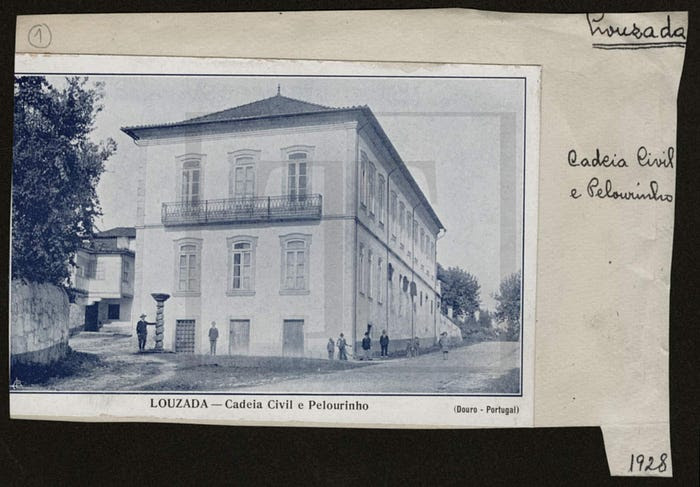

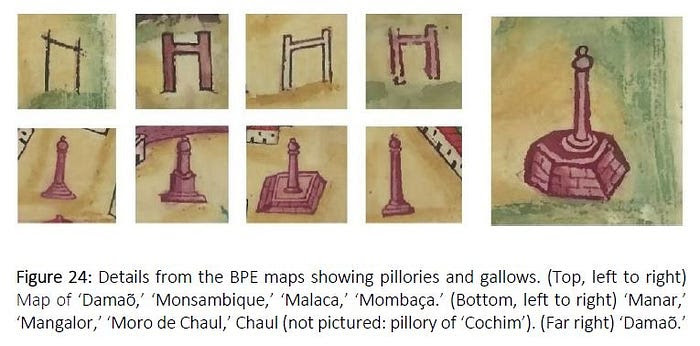
Similarly, numerous former Portuguese colonies in the East Indies were marked by Pelourinhos, as highlighted in Antonio Boccaro’s 17th-century work ‘Book of the Plans of All Fortresses, Towns, and Villages of the East Indies.’
The Pelourinho Novo in Goa is first clearly depicted on the late 16th-century map by Dutch traveler Jan Huygen van Linschoten and the early 17th-century map of Old Goa by Manuel Godinho de Erédia.


The pillory is later depicted in a sketch in the 1886 book ‘A Índia Portuguesa’ by Portuguese explorer António Lopes Mendes, under the subtitle Pelourinho Novo.

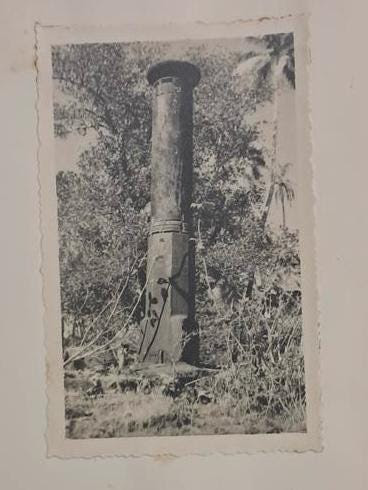

Recent 21st-century online sources however have referred to the pillory as the ‘Inquisition pillar’ and in the local language as ‘Hath Katro Khamb,’ meaning the pillar where the hands of those who refused conversion were cut off. The Goa Inquisition* spanned between 1560–1820 but this anecdotal account lacks contemporary documentation or primary evidence relating to the Goa Inquisition or the non-conversion of Hindus.
This misleading narrative appears to have been initially spread around 10 to 12 years ago by a right-wing group based in Goa called the Hindu Janajagruthi Samiti and also published the same on their website, who constructed a false story around the pillar, which has since been institutionalised and widely accepted to be the truth. Not much information is detailed about the pillar and the sources for their alleged claims nonetheless in recent years, the group has called for the pillar’s protection, along with a list of other demands.


The Goa Inquisition* database produced from extensive archival research and compiled by Bruno Feitler and Alan Machado, affirms that hand-cutting was never a punishment used during the Inquisition. The Inquisition tribunals were established in locations, such as Brazil, Portugal among others, nor is there any evidence of hand-cutting being a form of punishment despite the presence of pelourinhos in these regions.
In 2008, respected Goan heritage activist Percival Noronha explained in a news report that the original Pelourinho Novo had fallen into disrepair after the liberation of Goa and was found about 20 meters away from its original location. It was the Athaide family who later relocated and re-erected it on their property after completing the construction of their house. The property with the house is now dis annexed from the pelourinho by the road construction. The author has confirmed the legitimacy of the claim by verifying land records and asserts that the property located across the road, on survey number 122/1 of Ella village is indeed owned by Dr. Pedro de Ataide. If the pillar truly held significant historical importance, it would not have been neglected or abandoned by the government or others, only to gain historical recognition at a much later time.
The original site of the pelourinho is said to have been where the Gandhi statue stands today, yet there are no written records linking the original site to the cutting of hands or its association with the Inquisition. Erstwhile this site was where seven roads converged along with the main commercial street Rua Direita, as noted by Walter Rossa. Jan Huygen van Linschoten in his work makes an excellent description of this street. It is astonishing, says he, to see here the crowd of sellers and buyers during the market hours. Persons of all creeds and races mingle together, with large umbrellas in their hands, which protect them from the heat of the sun in the hot season and the rain during the monsoons (Linschoten, Histoire de la Navigation, 1596).
An ASI publication from 2004 titled ‘World Heritage Series – Old Goa’ as well as the 1979, Gazetteer of the Union Territory Goa, Daman, and Diu: District Gazetteer (Page 808) titles the monument as The Old Pillory, a lone pillar on a raised platform and is of basalt, with iron rings, and states that it might have once been a part of an ancient Brahmanical temple. These publications make no mention of its use in the Inquisition or as the site where hands were severed.
At the time of writing this article, the Goa Archaeology and Archives Department is set to declare the artifact a state-protected monument under ‘The Goa, Daman, and Diu Ancient Monuments and Archaeological Sites and Remains Act, 1978’.
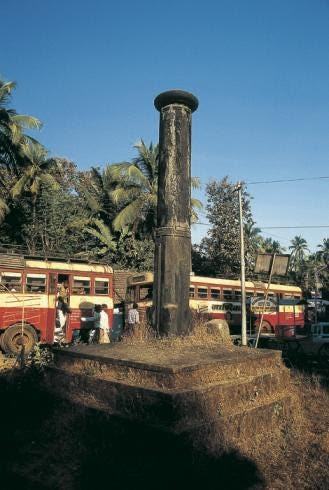
Pelourinhos were typically places where corporal offenders of the law faced punishment, and were whipped publicly. They also served as sites for the public announcement of municipal decrees or laws (Serrão, 1986). However, no historical evidence exists that the specific pillar in question was used for either of these purposes or the false narrative of the severing of hands as previously mentioned.
In the vicinity, in front of the lawns of St. Francis of Assisi Church, stands another pillar that, while resembling a Pelourinho, did not function as one. The base of this pillar has been hollowed out to accommodate plumbing, with metal spigots installed and connected to a small stone basin or trough, transforming it into a public water fountain.


Over the last few years these malicious campaigns surrounding the pillar have only exacerbated and spread online to include new malicious narratives that now vilify St. Francis Xavier and for this very precise reason I began a quest to investigate deeply into the very claims surrounding the pillar. These false and malicious narratives lacking any authenticity read that St. Xavier ordered for the cutting of hands of those Hindus who refused to convert to the Christian faith. During his ten years sojourn in the East, Francis Xavier returned to Goa about four times but his total stay in Goa did not exceed eleven months, this is a well documented fact.


In light of the false, malicious misinformation campaigns driven by right-wing groups for their agendas, it is essential to distinguish between fact and factoids. These distorted narratives hinder meaningful, credible, and intellectual discussions, often serving as vehicles for political propaganda rather than fostering genuine understanding.
“Given this, the recent historians on the Goa Inquisition have struggled to communicate the new research and facts from the opening and study of the archival sources, the complexities of its history, how it worked, who was tried, and for what reasons because political propaganda is always the loudest in every discussion about it. Historians find it difficult to discuss any data that does not fit this propaganda”- Dale Luis Menezes, PhD researcher in South Asian history at Georgetown University, in the preface of the book ‘The Trial of Catarina de Orta by the Goa Inquisition’.
So also, Goan-origin researcher Alan Machado who has spent a considerable amount of time analyzing archival material and data through his publication ‘Goa’s Inquisition: Facts, Fiction and Factoids’ has this to say about the Goa Inquisition “Writing the history of the Inquisition involves a balancing act and an unbiased evaluation of the primary archival data, not selective repetitions of earlier histories compiled largely from secondary sources”.
History is a set of lies agreed upon – Napoleon Bonaparte
* The Inquisition or Inquisição, the Portuguese name which means to investigate or inquire, was an ecclesiastical tribunal set up to primarily investigate cases of heresy amongst the neo-converts and New Christians. The subjects of religious conversions, anti-Hindu laws and religious policies that widely cause public outcry were never directly handled by the Inquisition tribunal or fell under its jurisdiction. This misunderstanding largely stems from A.K. Priolkar’s 1961 book ‘The Goa Inquisition: The Terrible Tribunal of the East’ which has significantly shaped public opinion in India regarding the Goa Inquisition. The Inquisition in Goa is unfortunately one of the most misinformed and distorted subject for this very reason, while the book in recent years has been largely discredited by serious researchers and historians on the subject who have gained access to the global archives for the lack of sufficient archival data and misinformation.
Reference
- Goa’s Inquisition: Facts, Fiction and Factoids – Alan Machado
https://archive.org/details/goa-inquistion-book
2. A database of individuals sentenced by the Inquisition of Goa from 1650 until its final abolition in 1812
https://domusdados.unifesp.br/dataset.xhtml?persistentId=hdl:20.500.12682/rdp/QUN1E4
