
Sixth International Geoengineering Governance Summer School, 2019

Andrew Lockley
https://legal-planet.org/2019/10/03/sixth-international-geoengineering-governance-summer-school-2019/
Sixth International Geoengineering Governance Summer School, 2019
A brief report from a recent Emmett-convened event
As the severity of climate change risks and the inability of current efforts to adequately limit risks become clear, geoengineering technologies – active large-scale environmental interventions to reduce disruptions caused by elevated greenhouse gases – are increasingly receiving attention and generating controversy. These proposals would either remove and sequester atmospheric carbon dioxide or modify the Earth’s radiation balance, such as increasing the planet’s reflectivity, through “solar geoengineering.”
Some of these technological responses appear to offer substantial risk-reduction opportunities. They may also present serious new risks, and certainly present novel and potentially severe governance challenges. It is thus essential to research these technologies to better understand how they might work, how well they might achieve desired objectives, and what environmental risks and social impacts they might present. It is also essential to start discussions — among governments, relevant experts, civil society groups, and concerned citizens — about the specific nature of political and governance challenges these technologies present, and how these might be mitigated, now and in the future. Yet while these discussions are important, they are also challenging due to the multiple scientific, social, and political areas they implicate, the depth of uncertainty, and the intensity of conflict. The global scale of geoengineering’s effects and the multiple values implicated call for new and diverse voices — particularly from developing countries — to join the scientific and policy debates. Yet entering such an uncertain and contested space can be daunting.
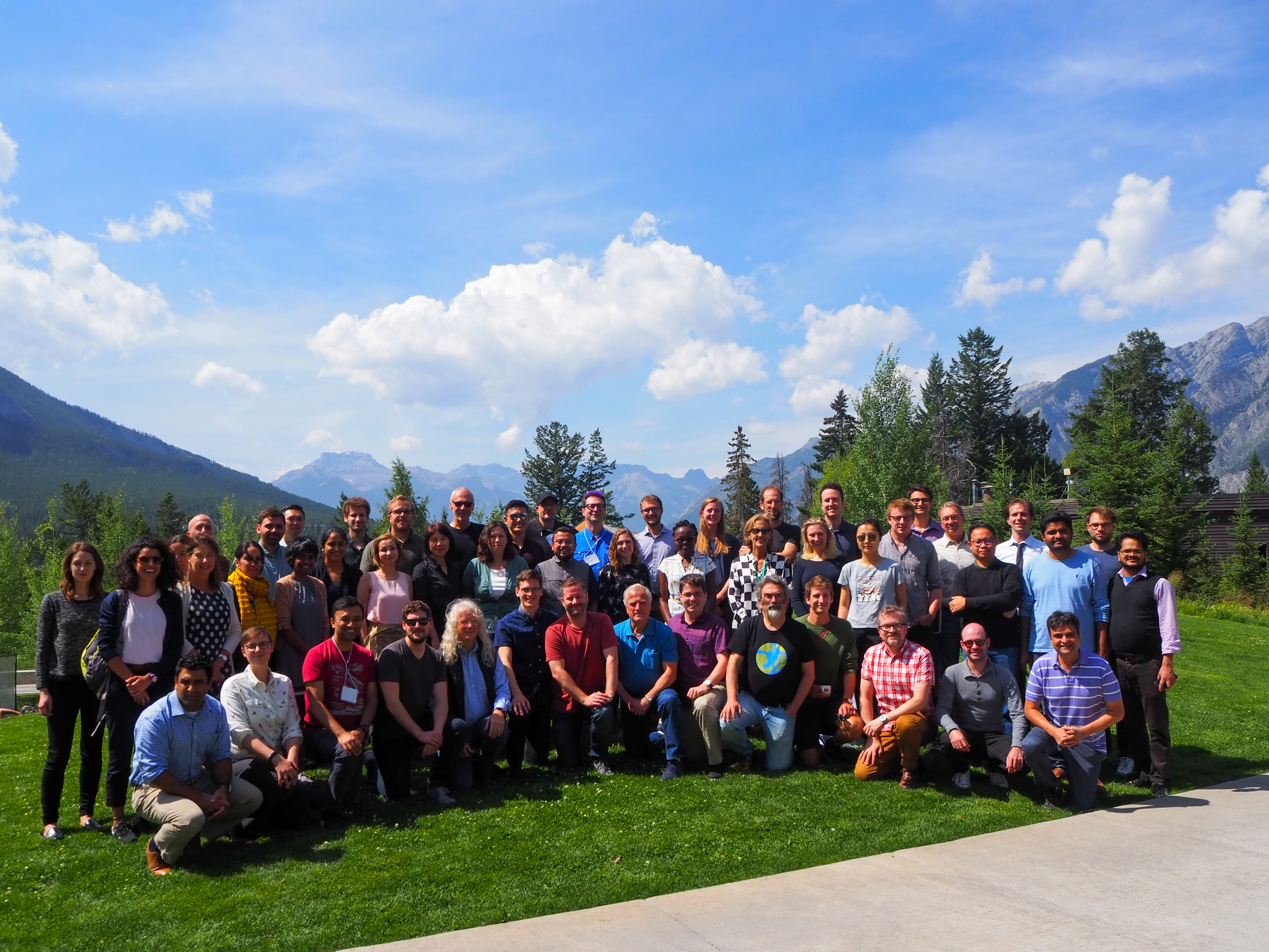
(Most) participants and instructors of the Sixth International Geoengineering Governance Summer School, 2019
To help advance these conversations, in August the UCLA Law School’s Emmett Institute on Climate Change and the Environment convened the Sixth International Geoengineering Governance Summer School in Banff, Alberta, Canada, with support from a generous grant by the Open Philanthropy Project. Organized and directed by Emmett Institute faculty co-director Ted Parson and co-sponsored by the Emmett Institute and four partner organizations,* the Summer School brought together sixty international (from sixteen countries!) leading experts, advanced students, early-career researchers, and professionals for five days of intensive, collaborative exploration of the societal, political, governance, and ethical aspects of geoengineering.
The Summer School focused on the governance opportunities and challenges posed by geoengineering, related both near-term to research, development, and capacity-building, as well as longer-term and more speculatively to potential deployment. A particularly salient issue was how these interventions might interact with the primary climate responses of emissions cuts and adaptation.
The program followed a novel two-part structure. It opened with two days of intensive instructor-led briefings and panels, which (together with an extensive advance reading list) aimed to provide essential basic information to let all participants, whatever their field of expertise and career stage, to be informed and confident participants in discussions. Briefings covered introductions to scientific and technological issues presented by carbon dioxide removal and solar geoengineering; governance foundations and proposals; interactions between geoengineering and other key elements of climate-change response such as emissions cutting and adaptation; current developments and controversies; and issues related to knowledge and uncertainty — i.e., what do, or can, we know about these as-yet undeveloped technologies, how do we know it, and how can we learn more?
Following these opening briefing sessions, the remaining three days of the Summer School comprised two parallel tracks of collaborative work. In the first track, any participant was invited to propose a project for a group to undertake, via a statement posted online and a short oral “pitch” presentation to the group. After brief clarifying discussion of the proposals, participants self-selected into workgroups and projects on which they wanted to focus. This track thus involved no central control by organizers, but rather was entirely driven by participants’ interests and choices. In selecting projects, participants were urged to consider a few explicit criteria: that the projects address some interesting and important issues related to governance of geoengineering; that they not duplicate existing work; and that they offer the prospect of meaningful progress in the limited time available. Otherwise, there was no central control. In particular, the form and intended output of projects was completely unconstrained, explicitly including starting collaborative research projects, drafting op-eds or other non-specialist publications, developing proposed contributions to policy or governance, crafting instructional material, or creating a story or other work of art on the theme of geoengineering and its governance. Eight workgroups formed, each of which completed substantial interim work products by the end of the Summer School, including:
- a draft paper on the meaning of and requirements for legitimacy in international governance of geoengineering;
- a draft paper on how the governance needs of research on solar geoengineering — in particular outdoor experiments that involve actively perturbing environmental conditions — vary with the spatial and time scale of the experiment;
- a draft paper exploring the neglected area of potential interactions between climate change adaptation and carbon dioxide removal;
- an op-ed on the potential implications of geoengineering technologies for geopolitics and international security;
- a draft paper on the ambiguous and contradictory ways in which the concepts of “nature” and “natural” are used in discussions of geoengineering (and more broadly) — including a mischievous Twitter bot that tweets randomly selected sentiments and images about “nature”;
- an online resource to support teaching about geoengineering in college-level courses;
- a strategic plan and set of briefing notes to introduce geoengineering to senior national-level government officials and identify potential near-term issues, decisions, and controversies; and
- a draft terms-of-reference and business plan for a new nongovernmental organization that would support and manage research on solar geoengineering.
The second track of collaborative work was a scenario exercise, in which assigned groups of participants dealt with scenarios of potential events related to future deployment of geoengineering and intended to generate acute — yet plausible — challenges to international policy and governance. Four scenarios each presented a distinct challenge, all set against background conditions in the year 2040, in which international climate policy has achieved moderate progress, roughly in line with present Paris commitments, but climate change and impacts are mounting rapidly. In each scenario, the geoengineering-related challenge is driven by a different set of political actors. In two of them, the actors presenting the challenge are nation-states: a group of middle powers in the first scenario, and a group of highly vulnerable middle and low-income countries in the second. The other two scenarios are driven by non-state actors: a group of multinational firms in one case (combining former oil majors and large technology firms), and a widespread, loosely coordinated grassroots movement in the other.
For all scenarios, two groups were tasked with developing a proposed governance response to address the challenge. Each group then received a critique and challenge to their proposed governance solution, prepared by the other group working with the same scenario. Finally, the two groups on each scenario collaborated to identify the most promising governance response they could generate, by combining and amending elements of both their proposals, and to identify the most serious contingencies and uncertainties they judged likely to influence their joint response’s effectiveness.
There are multiple published outputs in preparation based on work conducted in the summer school in each of these two tracks. From the first track, the eight workgroups are all developing their outputs to publish and disseminate in a wide variety of scholarly, popular, and other outlets, each in line with the character and aims of the work. Organizers of the summer school are preparing reports, which will outline the innovative process model and aims of the Summer School and synthesize key issues and insights from across the work of the eight workgroups. For the scenario exercise, organizers and participants are preparing a collection of reports that will summarize the overall context and aims of the exercise, the substantive details and groups’ governance responses to the four scenarios, and resultant insights arising from critical comparison across all scenarios and responses. Further discussions and insights arising from the Summer School will be reported here on Legal Planet and also as one or more Pritzker Briefs published by the Emmett Institute.
* In addition to the Emmett Institute, co-sponsoring partner organizations for the Summer School included the Forum for Climate Engineering Assessment, the Solar Radiation Management Governance Initiative, Harvard’s Solar Geoengineering Research Program, and the Carnegie Climate Governance Initiative. The Emmett Institute’s project on geoengineering governance is sponsored by a grant from the Open Philanthropy Project.