Here’s is your weekly roundup of SRM updates from the past week (03 March - 09 March 2025):
By Andrew Lockley
10 March 2025
Subscribe for monthly SRM updates here:
1. Research Papers2. Web Posts3. Thesis4. Job Opportunities5. Upcoming Events6. Podcasts7. YouTube Videos
Jang, K. B., & Woo, T. H. (2025). Analysis of Solar Radiation Shielding in Space for Climate Mitigations of the Earth. Energy Science & Engineering.Abstract: SRM through space solar shielding is a proposed strategy to mitigate global warming. This approach involves reflecting sunlight back into space while allowing Earth's infrared radiation to escape, thereby controlling climate change. The effectiveness of space solar shielding is evaluated using a complex algorithm that considers various parameters of the shielding satellite, such as its size, orbit, and deployment mechanism. The thickness of the shield should be similar to the solar wavelength, around 400-600 nm, to deflect sunlight with an expected mass density lower than 1.5 g/m2. The primary objective is to reduce the greenhouse effect by mitigating the increase in atmospheric CO2 levels. In 2022, CO2 levels in the United States surpassed the pre-industrial level of 278 ppm, increasing by approximately 7.11 ppm due to the consumption of coal, natural gas, and petroleum for electricity generation. This point reflects the relatively recovered climate environment at the end of the pandemic. Therefore, long-wavelength solar radiation energy going out from the Earth is absorbed and increases the temperature of the Earth's atmosphere, so we want to reduce the solar energy coming into the Earth. The performance of space solar shielding is analyzed using a system dynamics (SD) model, which incorporates feedback loops and non-linear relationships between various variables. The results indicate that while the effectiveness of CO2 reduction may diminish over time, the overall climate mitigation benefits could be significant. However, the large scale of space solar shielding raises concerns about potential side effects. Further research is necessary to assess the environmental and socio-economic implications of this geoengineering approach.
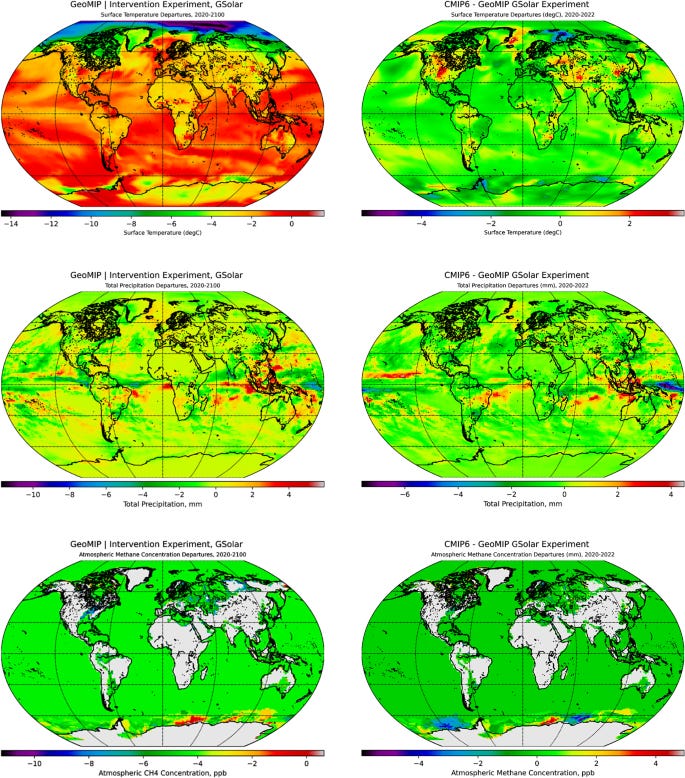
Gay, B.A., Mandrake, L., Miner, K.R. et al. (2025). Assessing the impacts of mitigation and geoengineering intervention scenarios on Earth system dynamics and climatological variability with multimodal simulations. Sci Rep 15, 8158.Abstract: Given a world increasingly dominated by climate extremes, modifying the Earth’s climate with large-scale geoengineering intervention is inevitable. However, geoengineering faces a conundrum: forecasting the consequences of climate intervention accurately in a system for which we have incomplete observations and an imperfect understanding. We evaluate the global response and potential implications of mitigation and intervention deployment by utilizing CRU TS4.08 observations, ERA5 reanalysis data, and CMIP6 scenario-based UKESM0-1-LL simulations. From 1950 to 2022, global weighted mean surface temperature (Tsurf) and total precipitation (P) rose by 1.37±0.48 °C and 0.05±0.57 mm day-1. Significant regional Tsurf anomalies and erratic interannual variability of P were revealed, with ranges from 7.63 °C in Greenland and northern Siberia to -2.38 °C in central Africa and 1.17 mm day-1 in southern Alaska to -1.20 mm day-1 in Colombia and east Africa. Collectively, mitigation and intervention simulations tended to overestimate the variability and magnitude of Tsurf and P, exhibiting substantial regional discrepancies and scenario-specific heterogeneity when estimating atmospheric methane concentration ([CH4]). Despite capturing significant departures in Tsurf, P, and [CH₄], replicating historical P teleconnections and spatial patterns of warming remained a challenge. These results underscore regional disparities with global implications, harkening the necessity to refine existing architectures while developing novel methods to evaluate the risks and feasibility of geoengineering intervention.
Martin, C., & Moore, S. (2024). Geoengineering Wars and Atmospheric Governance. Available at SSRN.Abstract: The increasingly harsh and unevenly distributed heat-related harms caused by climate change, together with frustration over the collective inability to respond to the crisis, are likely to make unilateral geoengineering efforts increasingly attractive. Stratospheric aerosol injection (“SAI”) is a form of solar radiation modification that is effective, technically feasible, and within the financial means of many states and even non-state actors. Yet, there are virtually no global governance structures in place to specifically regulate such activity, and existing international law would provide only weak constraints on unilateral SAI efforts. These features create incentives for unilateral action in what is known as a “free driver” problem: few constraints on a unilateral action that has low direct cost combined with immediate direct individual benefit despite widely distributed risks and indirect costs.
There would be significant collateral environmental and climatic harms associated with SAI. That, coupled with the high risk of unilateral action, is reason enough for both caution and stronger governance. But another risk posed by any unilateral SAI effort—one that is underappreciated and under-theorized—is that of armed conflict. We explore how and why states would likely perceive the potential risks associated with unilateral SAI effort as constituting a threat to national security, and in the absence of adequate legal and institutional mechanisms to constrain such unilateral action, might well contemplate the use of force to defend against the perceived threat. The Article explores and explains how and why the jus ad bellum regime is unlikely to prevent states from engaging in unauthorized use of force against unilateral SAI actors.
In sum, there are strong incentives for unilateral SAI deployment, there is little in the way of global governance to constrain it, states will view it as a threat to national security, and the jus ad bellum regime is in turn unlikely to constrain any use of force in response—which creates a distinct risk that unilateral SAI deployment could result in armed conflict.
We argue that this underappreciated risk, combined with the growing pressure and incentive for unilateral action, provides further grounds for the urgent development of more robust governance for SAI specifically, apart from other forms of geoengineering. We argue that a traditional multilateral treaty structure with an accompanying institutional apparatus is required, and we provide some preliminary ideas on the objects and purposes of such a governance structure. We explain that either the United Nations Framework Convention on Climate Change (“UNFCCC”) or the Montreal Protocol would provide an ideal forum within which to commence the work of developing such a governance structure.
Duccini, J. (2025). Contested Futures. Epistemology, Power, and Governmentality of Climate Change: The Case of Solar Geoengineering.Abstract: As the climate crisis intensifies and mitigation measures from governments and private institutions remain dubious, solar geoengineering has emerged as a contentious proposal to buy humanity some time until proper mitigation and adaptation measures are taken. This thesis critically examines the debate around stratospheric aerosol injection (SAI), using the SCoPEx project as a central case study. The debates for and against SAI are deeply rooted in epistemological questions about how power relations produce and shape knowledge. Proposals supporting and opposing SAI shape and are shaped by different visions of the future and the role of technology in society and in addressing crises, as shown. Imaginaries of the spatiality and temporality of SAI are linked also to ideas of governance and control of this new technology. The duality of ‘proponents’ and ‘opponents,’ along with the term ‘geoengineering,’ oversimplifies the complex and multifaceted nature of these debates. The discussion is embedded in a discussion on reductionist and/or misaligned framings from many sides of the debate. Emphasizing the need for inclusive and democratic dialogue, this work seeks to unpack the intersections of knowledge, power, and justice that shape decisions about both SAI and how those are inherently related to broader discussions around climate change.
Solar Geoengineering Events Calendar
SRM Governance with Cynthia Scharf | Climate Reflections: The SRM360 Podcast | SRM Governance with Cynthia Scharf Climate Reflections: The SRM360 Podcast 33:52 |
"Cynthia Scharf has spoken with senior policy makers, UN officials, think tanks and NGOs across the world about climate change and sunlight reflection methods (SRM). Eight years ago, when she first began having these discussions, most people did not see SRM as a serious issue with implications for every country in the world. Now, they are interested. But as interest grows, the gap between the research community and policymakers' knowledge has also grown.Join our exclusive conversation with Cynthia Scharf, Senior Fellow at the Center for Future Generations, as she shares what policymakers are thinking about SRM and what information needs to be shared to enable transparency in this controversial space."
Plan B? | Cool The Country "Mankind's impact on the planet is growing... and we are not acting fast enough to stop it.Nature-based solutions are the answer, but they will take time. We may need some sort of engineered solution to buy us time. Although these are risky and controversial, we need to be prepared.And the heat engine region is one of the most remote and sparsely populated places on Earth. It could be an ideal laboratory to test a plan B."
Space Solar Shielding for Earth's Climate Mitigation | Remove and Reflect Podcast "Mr. Sun (AI-generated) & Ms. Remove (AI-generated) dives deep into a new article from Energy Science & Engineering in 2025 that analyzes the feasibility of using space-based solar radiation shielding as a method to mitigate global warming. It explores the design, mechanics, and potential effectiveness of such a system, utilizing a system dynamics model to simulate its performance in reducing incoming solar energy and consequently the greenhouse effect. The study considers factors like satellite size, orbit, and shield properties, while also acknowledging potential environmental and socio-economic side effects. Ultimately, the research suggests that while costly and requiring international cooperation, space solar shielding could offer significant climate mitigation benefits.Paper: Jang, K. B., & Woo, T. H. (2025). Analysis of Solar Radiation Shielding in Space for Climate Mitigations of the Earth. Energy Science & Engineering.This audio is entirely AI-generated"
US-China Geoengineering Cooperation and Competition in Stratospheric Aerosol Injection | Remove and Reflect Podcast "In this episode, Mr. Sun (AI character) & Ms. Remove (AI character) dive deep into a new paper that explores the geopolitical implications of stratospheric aerosol injection (SAI) as a climate intervention within the context of the strategic competition between the United States and China. It examines how the unique capabilities of these nations to unilaterally deploy SAI could create a novel source of international influence and a potential national security dilemma. The research analyzes four distinct policy scenarios: competing to deter, cooperating to deter, competing to deploy, and cooperating to deploy SAI, outlining the risks and opportunities each presents. Ultimately, it argues that regardless of the chosen path, both nations would benefit from expanded SAI research and continued conventional climate change mitigation efforts.Paper: Nielsen, J. (2025). The Big Green Button: Stratospheric Aerosol Injection as a Geopolitical Dilemma During Strategic Competition Between the United States and China, and Implications for Expanding Aerosol Injection Near-term Research. Oxford Open Climate Change, kgaf009.This audio is entirely AI-generated"
Planetary Solvency | Climate Emergency Forum "In this episode of the Climate Emergency Forum, the discussion centers around the concept of "planetary solvency" and a recent report on the subject. Host Herb Simmens introduces the topic, highlighting the report's emphasis on tipping points and the urgent need for action to mitigate climate risks. Dr. Peter Carter, a renowned expert in climate science, provides critical insights, arguing that the report may be overly optimistic about avoiding insolvency and achieving balance with nature. He emphasizes that the world has been out of balance with nature for decades and that committed global warming is already set to exceed 2.4°C.This video was recorded on February 26th, 2025, and published on March 9th, 2025, and represents the opinions of the discussion participants.The conversation delves into the risks associated with climate tipping points, which are now being exceeded at a global temperature of over 1.5°C. Dr. Carter notes that these risks increase exponentially beyond this threshold, underscoring the urgency of reducing emissions. Paul Beckwith, a climate system scientist, joins the discussion, highlighting the potential economic impacts of climate change, including a possible 50% hit to GDP by 2070. He also emphasizes the role of the reinsurance industry in recognizing and addressing climate risks, suggesting that financial sectors may be more receptive to climate warnings than governments.The dialogue concludes with reflections on the limitations of current climate policies and the need for more drastic measures. Herb Simmens notes the report's courageous critique of economic projections that underestimate climate risks, comparing them to ignoring the possibility of a ship sinking after hitting an iceberg. The discussion also touches on the potential for geoengineering and solar radiation management as supplementary strategies, given the challenges of relying solely on emission reductions. Overall, the episode provides a stark assessment of the climate emergency and the imperative for immediate, comprehensive action to avoid catastrophic outcomes."
Follow us on: Twitter | Bluesky | YouTube | Substack | Google Group | Podcast 1 | Podcast 2
Support us here: | |
  | |