| SOLAR GEOENGINEERING WEEKLY SUMMARY (15 JULY - 21 JULY 2024)Subscribe to our newsletter to receive monthly updates on Solar Geoengineering:
DEADLINESSRM Sessions at AGU2024:
RESEARCH PAPERSClark, C. J. (2024). Why Conceptions of Scale Matter to Artificity Arguments in SRM Ethics. Ethics, Policy & Environment, 1-13. Abstract Ethicists have raised a variety of concerns about solar radiation management (SRM). This essay investigates the specific worries associated with artificity: Does SRM transform the planet into an artifact? Should experimental SRM strategies be implemented if the consequences are unpredictable? These worries have led some to strongly reject SRM. But the conceptual framework used by environmental scientists to understand the scope of management interventions might offer a way to adequately defuse the perceived ethical concerns about artificity. Concepts from theories of scale, like discontinuity and panarchy, are discussed to demonstrate how the artificity arguments appear to depend on disputable premises.
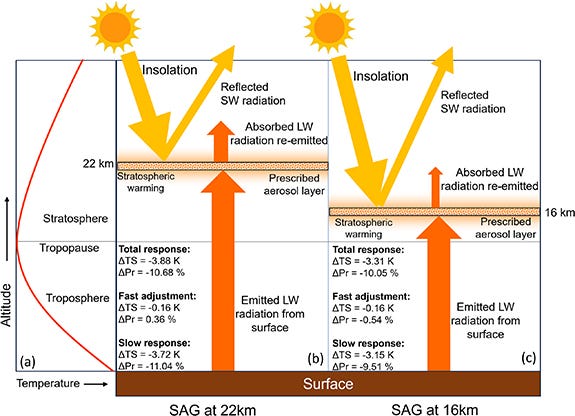
KH, U., Bala, G., & Xavier, A. (2024). Sensitivity of the global hydrological cycle to the altitude of stratospheric sulphate aerosol layer. Environmental Research Letters. Abstract Stratospheric aerosol geoengineering (SAG) has been proposed as one of the potential options to offset the impacts of anthropogenically induced climate change. Previous modelling studies have shown that the efficacy of the cooling via SAG increases with altitude of the aerosol layer. It has been also shown that the stratospheric heating associated with SAG could stabilize the tropical atmosphere and weaken the tropical hydrological cycle. Using a global climate model, we perform a systematic study by prescribing volcanic sulphate aerosols at three different altitudes (22 km, 18 km and 16 km) and assess the sensitivity of the global and tropical mean precipitation to the altitude. We find that even though the efficacy of cooling increases with altitude of the aerosol layer, the global and tropical mean precipitation changes are less sensitive to the height of the aerosol layer. This is because the magnitude of both the global and tropical mean precipitation reduction increases with aerosol altitude in response to increasing efficacy of aerosols, but this sensitivity related to the slow response is nearly offset by the sensitivity of fast precipitation adjustments to aerosol altitude. A perspective and analysis based on atmospheric energy budget is presented to explain the lack of sensitivity of the hydrological cycle to the altitude of the stratospheric sulphate aerosol layer.
Tan, M. L., Tew, Y. L., Liew, J., Bala, G., Tye, M. R., Chang, C. K., & Muhamad, N. (2024). Assessment of solar geoengineering impact on precipitation and temperature extremes in the Muda River Basin, Malaysia using CMIP6 SSP and GeoMIP6 G6 simulations. Science of The Total Environment, 174817. Abstract The concept of solar geoengineering remains a topic of debate, yet it may be an effective way for cooling the Earth's temperature. Nevertheless, the impact of solar geoengineering on regional or local climate patterns is an active area of research. This study aims to evaluate the impact of solar geoengineering on precipitation and temperature extremes of the Muda River Basin (MRB), a very important agricultural basin situated in the northern Peninsular Malaysia. The analysis utilized the multi-model ensemble mean generated by four models that contributed to the Geoengineering Model Intercomparison Project (GeoMIP6). These models were configured to simulate the solar irradiance reduction (G6solar) and stratospheric sulfate aerosols (G6sulfur) strategies as well as the moderate (SSP245) and high emission (SSP585) experiments. Prior to the computation of extreme indices, a linear scaling approach was employed to bias correct the daily precipitation, maximum and minimum temperatures. The findings show that the G6solar and G6sulfur experiments, particularly the latter, could be effective in holding the increases in both annual and monthly mean precipitation totals and temperature extremes close to the increases projected under SSP245. For example, both G6solar and G6sulfur experiments project increases of temperature over the basin of 2 °C at the end of the 21st century as compared to 3.5 °C under SSP585. The G6solar and G6sulfur experiments also demonstrate some reliability in modulating the increases in precipitation extreme indices associated with flooding to match those under SSP245. However, the G6sulfur experiment may exacerbate dry conditions in the basin, as monthly precipitation is projected to decrease during the dry months from January to May and consecutives dry days are expected to increase, particularly during the 2045–2064 and 2065–2084 periods. Increases dry spells could indirectly affect agricultural and freshwater supplies, and pose considerable challenges to farmers.
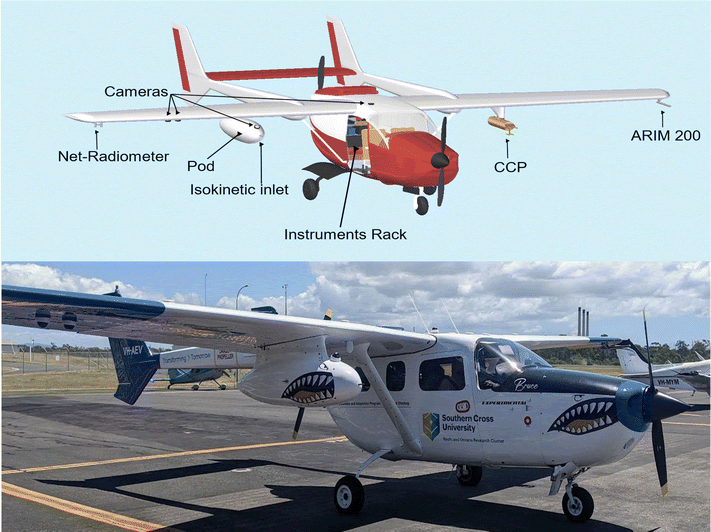
Hernandez-Jaramillo, D. C., Medcraft, C., Braga, R. C., Butcherine, P., Doss, A., Kelaher, B., ... & Harrison, D. P. (2024). New airborne research facility observes sensitivity of cumulus cloud microphysical properties to aerosol regime over the great barrier reef. Environmental science: atmospheres. Abstract Our work on aerosol–cloud–radiation interactions became hamstrung by the lack of a suitable aerosol and cloud microphysics equipped aircraft in Australia. To address this infrastructure gap, we have established a new airborne research platform, designed primarily for Marine Cloud Brightening (MCB) field studies but with broader applicability across diverse airborne research domains. This platform, comprising a Cessna 337 aircraft was outfitted with a comprehensive suite of meteorological, aerosol, and cloud microphysical instrumentation normally only found on much larger aircrafts. The aircraft has completed its first field deployment over the Great Barrier Reef (GBR) supporting the Reef Restoration and Adaptation Program. Here we present details of the platform configuration, a flight summary of its first campaign and a case study illustrating the capabilities of the new platform. In the case study presented, data was collected from two well-developed cumulus cloud cells which were similar in macrophysical properties but formed under markedly different aerosol regimes. We observed a strong difference in cloud microphysical properties. Higher aerosol concentrations led to more numerous and smaller cloud drops and suppressed warm rain. Our observations are consistent with the hypothesis that cumulus clouds, dominant over the GBR during summer, are amenable to marine cloud brightening. Our results demonstrate the practical utility of the new research aircraft through a focused case study, laying the groundwork for future scientific investigations of aerosol–cloud interactions.
Tilmes, S., Rosenlof, K. H., Visioni, D., Bednarz, E. M., Felgenhauer, T., Smith, W., ... & Thompson, C. (2024). Research criteria towards an interdisciplinary stratospheric aerosol intervention assessment. Oxford Open Climate Change, 4(1). Abstract With surface temperatures already reaching unprecedented highs, resulting in significant adverse consequences for societies and ecosystems, there is an increasing call to expand research into climate interventions, including Stratospheric Aerosol Intervention (SAI). However, research and dissemination are currently fragmented and would benefit from a comprehensive international assessment of the current state of knowledge regarding impacts, risks, and recommendations for future SAI research directions. The goals of a scientific assessment would be to describe the current state of SAI research and evaluate proposed scenario-strategy combinations through well-designed evaluation guidelines. The suggested iterative approach would integrate natural and social science considerations to guide future research toward more plausible scenarios and strategy development to reduce uncertainties and minimize the risks of SAI. Here, we outline multidisciplinary research criteria to guide the assessment process and provide an overview of the benefits and risks of proposed SAI applications. We group these criteria into three categories: 1) technical and design requirements, 2) response and impacts, and 3) societal considerations. Including all three categories in a comprehensive assessment of potential SAI applications outlined here promotes enhanced interdisciplinary and international collaborations, intentionally engaging the underrepresented Global South. The assessment structure further promotes the need for recurring reports every few years with globally representative participation and could also be applicable to other Solar Radiation Modification methods or combined approaches. Such assessments are necessary to align research with considerations for decision-makers and the public on the feasibility of SAI in reducing the impacts of climate change and its potential societal and ecological trade-offs.
Hernandez-Jaramillo, D. C., Medcraft, C., Braga, R. C., Butcherine, P., Doss, A., Kelaher, B., ... & Harrison, D. P. (2024). New airborne research facility observes sensitivity of cumulus cloud microphysical properties to aerosol regime over the great barrier reef. Environmental science: atmospheres.
WEB POSTS
REPORTS
JOB OPPORTUNITIES"Climate Now is seeking an experienced Communications and Outreach Program Manager to help start a new initiative exploring the science and issues around Sunlight Reflection Methods (SRM).SRM360 is a new independent non-profit knowledge hub which will be a source of high-quality, impartial information and analysis about SRM, serving policy-makers, the climate community, journalists, and educators. It takes no position on whether or how SRM should ever be deployed; its focus is on presenting the best science and evidence in formats that are clear and accessible to people on all sides of the debate."
UPCOMING EVENTSSolar Geoengineering Events Calendar
YOUTUBE VIDEOS UNEP Foresight Report | Solar Radiation Management | Latest Update | Drishti IAS English | Drishti IAS : English “The United Nations Environment Programme (UNEP) recently published its Foresight Report, warning that deploying Solar Radiation Management (SRM) technologies could lead to environmental disruptions within the next seven years. SRM aims to reduce global warming by reflecting some of the sun's energy back into space.”
Cooling Earth by Using Mirrors to Reflect Sunlight with Dr. Ye Tao, Founder and Executive Directo... | Synapse “Welcome to this special episode of Hardware to Save a Planet. Joining us today is Dr. Ye Tao, Founder and Executive Director of MEER, a company that uses mirrors at scale to reflect sunlight and mitigate the impact of global warming. Join us as we discuss the innovative concept of MEER and its potential to combat climate change. Dr. Tao shares his insights on the urgent need for sustainable solutions and how MEER can help transition civilization toward a more sustainable future. We delve into the fascinating world of nanoparticle research and the possibilities of dimensional reduction. Discover the limitations of renewable energy and the importance of energy ROI. Dr. Tao also explores the exciting applications of mirrors in controlling sunlight and optimizing temperature reduction. Dr. Tao has a multidisciplinary background in physics, chemistry, engineering, and material science, which is uncommon among today's scientists. He received a doctorate from the Department of Chemistry at MIT in 2015 and completed the research requirements for a doctorate in Physics at ETH Zurich. Climate change and greenhouse gas accumulation are, in essence, a three-dimensional problem because we have emitted so much gas in a three-dimensional space, Earth's atmosphere, and it is very freely mixed. To clean this enormous volume of space, we have in front of us a 3D engineering problem, and if you factor in the time needed to suck all the air out and circulate it through a filter, then it becomes a four-dimensional problem. We are obsessed with removing greenhouse gases to try to open a window so the heat from Earth can escape. What if instead of letting the heat escape from Earth, we try to find a way to stop it from developing in the first place, just by reducing the amount of heat produced on the ground as the sun shines on the planet? And in fact, this is a much more efficient way of solving the problem, reducing it from its original three dimensions to just two dimensions.”
| |