Subscribe to our newsletter to receive monthly updates on Solar Geoengineering:
CALL FOR PROPOSALS
CALL FOR FEEDBACK
RESEARCH PAPERS
Biermann, F., & Gupta, A. (2024). A paradigm shift? African countries call for the non-use of solar geoengineering at UN Environment Assembly. PLOS Climate, 3(5), e0000413.
The 6th United Nations Environment Assembly (UNEA-6), held in February 2024 in Nairobi, will be remembered as one of the first intense international negotiations about the potential role of solar radiation modification (SRM), or solar geoengineering, in addressing the climate crisis. The debate was initiated by Switzerland, which tabled a resolution that would have mandated the UN Environment Programme to establish a scientific expert group to assess information on this speculative suite of technologies that aim at cooling the planet by blocking parts of incoming sunlight.
Yet the very first deliberations on the resolution made it clear that the call for an expert group was controversial and consensus far away. Over the course of ten days, the Swiss submitted revised versions of their draft resolution, only to see these subjected to lengthy additions, deletions, and bracketed reservations by opposing groups of countries. In the end, Switzerland was compelled to withdraw the resolution, in a déjà-vu moment from 2019 when it had proposed a resolution on geoengineering that also failed to reach agreement
Schoeberl, M., Schoeberl, M. R., Wang, Y., Taha, G., Zawada, D. J., Ueyama, R., & Dessler, A. (2024). Evolution of the Climate Forcing During the Two Years after the Hunga Tonga-Hunga Ha'apai Eruption. Authorea Preprints.
Abstract
We calculate the climate forcing for the two years after the January 15, 2022, Hunga Tonga-Hunga Ha’apai (Hunga) eruption. We use satellite observations of stratospheric aerosols, trace gases and temperatures to compute the tropopause radiative flux changes relative to climatology. Overall, the net downward radiative flux decreased compared to climatology. Although the Hunga stratospheric water vapor anomaly increases the downward infrared radiative flux, the solar flux reduction due to Hunga aerosol shroud dominates the net flux over most of the two-year period. Decreases in temperature produced by the Hunga stratospheric circulation changes contributes to the decrease in downward flux; however, the Hunga induced decrease in ozone increases the net short-wave downward flux creating small sub-tropical net flux increase in late 2022. Coincident with the aerosols settling out, the water vapor anomaly disperses, and circulation changes disappear so that the contrasting forcings all decrease together. By the end of 2023, most of the Hunga induced radiative forcing changes have disappeared. There is some disagreement in the satellite stratospheric aerosol optical depth (SAOD) which we view as a measure of the uncertainty; however, SAOD uncertainty does not alter our conclusion that, overall, aerosols dominate the radiative flux changes followed by temperature and ozone.
WEB POSTS
PROGRAM THESIS
JOB OPPORTUNITIES
"ARIA funds breakthrough R&D for society. With an unprecedented level of independence and operational freedom, we are rethinking how to best support scientists and engineers whose work can change the world. We are growing our team to develop bold new approaches that can scale – from programmes to systems, processes and everything in between. If that sounds fun, come and build."
"We are looking to appoint an outstanding Research Associate to undertake research on responsible innovation and stakeholder engagement as part of the Conditions for Responsible Research of Solar Radiation Modification – Analysis, Co-Creation, and Ethos (Co-CREATE) project, funded by Horizon Europe. The post holder will undertake a range of research tasks in collaboration with the international and multidisciplinary research team, relating to public engagement on the conditions for responsible research of solar radiation modification (SRM, also called solar geoengineering), including expert and stakeholder interviews, deliberative workshops, and an international citizen survey."
BOOK
UPCOMING EVENTS
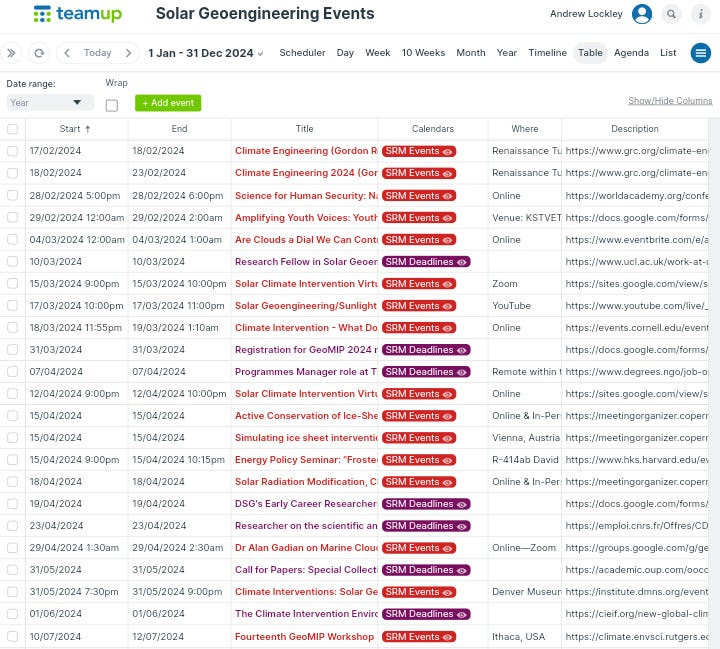
Solar Geoengineering Events Calendar
GUIDELINES:
Sync selected events to your default calendar in these simple steps:
1) Click on the event you want to sync.
2) Tap the menu icon (three vertical lines) at the top left.
3) Choose 'Share.'
4) Pick your default calendar.
5) Save the event.
Sync the entire Teamup Calendar to your default calendar with these simple steps:
1) Tap the menu icon (three vertical lines) at the top right.
2) Choose 'Preferences.'
3) Click 'iCalendar Feeds.'
4) Copy the URL shown for 'Solar Geoengineering Events / SRM Deadlines.'’
5) Paste the URL into your default calendar settings (Open Google Calendar in your web browser if you are using Gcal).
6) Click 'Subscribe' or 'Add Calendar.'
You can directly sync all Solar Geoengineering events to your default calendars by pressing the link below:
Sync SG Events to your Default Calendar
PODCASTS
"Literally blocking out the sun may sound extreme, but scientists are debating whether using dust particles to reflect sunlight away from the Earth could be a temporary solution if climate change gets out of control."
"Solar geoengineering. It's not just a question of whether or not to do it, but of how it might be done and why.
This week we are joined by Shuchi Talati, founder of The Alliance for Just Deliberation on Solar Geoengineering, to talk about who is making decisions about solar geoengineering and whether or not populations most vulnerable to climate change have a seat at the table.
Solar geoengineering or “Solar Radiation Modification/Management (SRM)” is the large-scale and intentional intervention to increase the amount of sunlight reflected back into space. The purpose is to temporarily limit temperature increase.
Shuchi walks us through why the Alliance is not for or against SRM, why refusing to discuss or research RSM is potentially an inherently privileged standpoint, and why she believes we should center voices from regions already experiencing horrific climate impacts.
Listen in to find out who is currently researching SRM, what the potential risks and benefits are, and how the Alliance plans to make such a controversial topic more open and accessible."
YOUTUBE VIDEOS
An Alternative Rationale for Solar Geoengineering | Belfer Center

An Energy Policy Seminar featuring Wake Smith, Research Fellow at the Mossavar-Rahmani Center for Business and Government and Lecturer at the Yale School of the Environment. Smith gave a talk on "Frosted Tips: An Alternative Rationale for Solar Geoengineering."
Does Cirrus Cloud Thinning Work? | ToSaveTheWorld
Understanding Climate Geoengineering -with Professor Holly J. Buck | THE GEOSTRATA
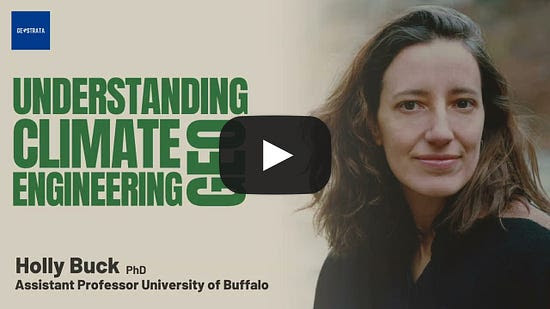
"Professor Buck is an Assistant Professor at the University of Buffalo. She talks to Team Geostrata about themes ranging from global environmental governance, and environmental policy, to public participation in emerging technologies for ensuring climate equity."
Solar radiation management could cool the planet. But at what cost? | Financial Times
"2023 was declared the hottest year ever recorded, and our planet continues to heat up. It’s cast the spotlight on one of the more niche climate cooling solutions, solar radiation management, or SRM.
SRM works on the principle that the Earth can be cooled by reflecting some of the sun’s rays back into space. But as the FT’s Aime Williams explains, it could come with significant risks."
Things I wish everyone knew about solar geoengineering | Make Sunsets
"We believe that solar geoengineering is the immediate, necessary solution to cool the planet and buy us time to transition to a more sustainable future. Efforts to fight climate change need time, a luxury only stratospheric aerosol injection can provide today."
DEADLINES