| WEEKLY SUMMARY (04 MARCH - 10 MARCH 2024)Subscribe to our newsletter to receive monthly updates on Solar Geoengineering:
RESEARCH PAPERSBaum, C. M., Fritz, L., Low, S., & Sovacool, B. K. (2024). Public perceptions and support of climate intervention technologies across the Global North and Global South. Nature Communications, 15(1), 2060. Abstract Novel, potentially radical climate intervention technologies like carbon dioxide removal and solar geoengineering are attracting attention as the adverse impacts of climate change are increasingly felt. The ability of publics, particularly in the Global South, to participate in discussions about research, policy, and deployment is restricted amidst a lack of familiarity and engagement. Drawing on a large-scale, cross-country exercise of nationally representative surveys (N = 30,284) in 30 countries and 19 languages, this article establishes the first global baseline of public perceptions of climate-intervention technologies. Here, we show that Global South publics are significantly more favorable about potential benefits and express greater support for climate-intervention technologies. The younger age and level of climate urgency and vulnerability of these publics emerge as key explanatory variables, particularly for solar geoengineering. Conversely, Global South publics express greater concern that climate-intervention technologies could undermine climate-mitigation efforts, and that solar geoengineering could promote an unequal distribution of risks between poor and rich countries.
Benner, A. K., & Rothe, D. (2024). World in the making: On the global visual politics of climate engineering. Review of International Studies, 50(1), 79-106. Abstract Proposals for large-scale technical interventions into the Earth system to mitigate global warming – or climate engineering – have sparked considerable debate about their potential implications for international security and global governance. The article furthers this debate by bringing it into dialogue with the literature on visual global politics to develop a more ‘imagistic’ concept of climate engineering imaginaries. Based on a novel visual dataset, three major visual clusters in the public discourse on climate engineering are identified: images of the human–nature relationship, of climate engineering as tangible infrastructure, and of the actors involved in climate engineering projects. The analysis shows how images and other visuals do not only shape the dominant understanding of climate engineering but also competing imaginaries of future political orders in which such approaches might be deployed. Three main results of this analysis stand out. First, dominant ways of seeing climate engineering can further reinforce already dominant discursive frames by adding ‘visual proof’ to their underlying claims. Second, climate engineering visuality can also enable the politicisation of climate engineering by rendering concrete projects visible and hence contestable. Third, climate engineering images can paradoxically limit the scope of imagination as they often revolve around powerful visual icons and symbols of the past and present.
McGraw, Z., DallaSanta, K., Polvani, L. M., Tsigaridis, K., Orbe, C., & Bauer, S. E. (2024). Severe global cooling after volcanic super-eruptions? The answer hinges on unknown aerosol size. Journal of Climate, 37(4), 1449-1464. Abstract Volcanic super-eruptions have been theorized to cause severe global cooling, with the 74 kya Toba eruption purported to have driven humanity to near-extinction. However, this eruption left little physical evidence of its severity and models diverge greatly on the magnitude of post-eruption cooling. A key factor controlling the super-eruption climate response is the size of volcanic sulfate aerosol, a quantity that left no physical record and is poorly constrained by models. Here we show that this knowledge gap severely limits confidence in model-based estimates of super-volcanic cooling, and accounts for much of the disagreement among prior studies. By simulating super-eruptions over a range of aerosol sizes, we obtain global mean responses varying from extreme cooling all the way to the previously unexplored scenario of widespread warming. We also use an interactive aerosol model to evaluate the scaling between injected sulfur mass and aerosol size. Combining our model results with the available paleoclimate constraints applicable to large eruptions, we estimate that global volcanic cooling is unlikely to exceed 1.5°C no matter how massive the stratospheric injection. Super-eruptions, we conclude, may be incapable of altering global temperatures substantially more than the largest Common Era eruptions. This lack of exceptional cooling could explain why no single super-eruption event has resulted in firm evidence of widespread catastrophe for humans or ecosystems.
Graßl, S., Ritter, C., Tritscher, I., & Vogel, B. (2024). Does the Asian Summer Monsoon Play a Role in the Stratospheric Aerosol Budget of the Arctic?. EGUsphere, 2024, 1-39. Abstract The southeast Asian monsoon has a strong convectional component, with which aerosols are able to be lifted up into the lower stratosphere. Due to usually long lifetimes and long-range transport aerosols remain there much longer than in the troposphere and are also able to be advected around the globe. Our aim of this study is a synergy between modelled tropical aerosol tracers by Chemical Lagrangian Model of the Stratosphere (CLaMS) and KARL (Koldewey Aerosol Raman Lidar) at AWIPEV, Ny-Ålesund in the Arctic, by comparing back- and forward trajectories with exemplary days of Lidar measurements as well as analyse the stratospheric aerosol background. We use global 3-dimensional Lagrangian transport simulations including surface origin tracers as well as back-trajectories to identify source regions of the aerosol particles measured over Ny-Ålesund. We analysed Lidar data for the year 2021 and found the stratosphere generally clear, without obvious aerosol layers from volcanic eruptions or forest fires. Still an obvious annual cycle of the backscatter coefficient with higher values in late summer to autumn and lower values in late winter have been found. Results from CLaMS model simulations indicate that from late summer to early autumn filaments with high fractions of air which originate in South Asia – one of the most polluted regions in the world – reach the Arctic in altitudes between 360 K and 380 K potential temperature. We found a coinciding measurement between the overpass of such a filament and Lidar observations, we estimated that backscatter and depolarisation increased by roughly 15 % during this event compared to the background aerosol concentration. Hence we demonstrate that the Asian summer monsoon is a weak but measurable source for Arctic stratospheric aerosol in late summer to early autumn.
WEB POSTSThe Solar Geoengineering Updates Newsletter (February'2024) Solar Geoengineering Updates Solar Geoengineering UpdatesThe Solar Geoengineering Updates is a reader-supported publication. To receive new posts and support my work, consider becoming a free or paid subscriber… 6 days ago · 2 comments · Andrew Lockley The Geoengineering Question (The Climate Brink) The Climate Brink The Climate BrinkThe idea of geoengineering is scary. There is a reason why the trope of human hubris creating unintended consequences is ubiquitous in literature, and humanity trying to actively manage global temperatures seems like a cautionary tale waiting to be written… 7 days ago · 58 likes · 58 comments · Zeke Hausfather How You Can Easily Delay Climate Change Today: SO2 Injection (Uncharted Territories) Uncharted Territories Uncharted TerritoriesI used to feel powerless about climate change. It’s accelerating. We might be facing tipping points that are irreversible. This might entail catastrophic crop failures, economic crashes, mass migrations, and conflict for resources. Most of what we’re doing about it is too little, too late… 6 days ago · 119 likes · 115 comments · Tomas Pueyo
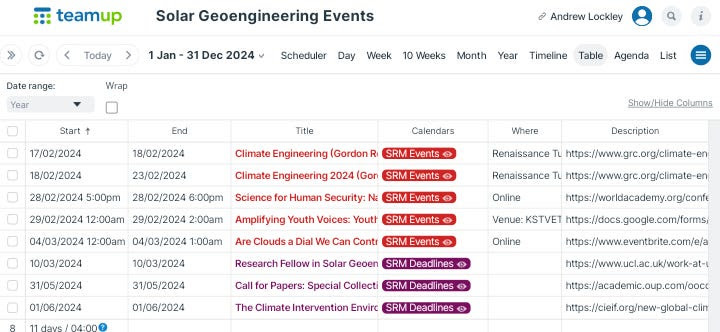
UPCOMING EVENTSSolar Geoengineering Events Calendar GUIDELINES:Sync selected events to your default calendar in these simple steps:1) Click on the event you want to sync.2) Tap the menu icon (three vertical lines) at the top left.3) Choose 'Share.'4) Pick your default calendar.5) Save the event.Sync the entire Teamup Calendar to your default calendar with these simple steps:1) Tap the menu icon (three vertical lines) at the top right.2) Choose 'Preferences.'3) Click 'iCalendar Feeds.'4) Copy the URL shown for 'Solar Geoengineering Events / SRM Deadlines.'’5) Paste the URL into your default calendar settings.6) Click 'Subscribe' or 'Add Calendar.'
Solar Geoengineering Events Calendar
JOB OPPORTUNITY“The Atmospheric Physics Group of Prof. Ulrike Lohmann at the Institute for Atmospheric and Climate Sciences at ETH Zurich (IAC-ETH) invites applications for a 3 – 3.5-year PhD position within the project "Glaciogenic seeding on mixed-phase clouds for radiation management (GLANCE)", funded by the Solar Radiation Management (SRM) programme of the Simons Foundation. Solar and terrestrial radiation management is a climate intervention approach to modify the Earth's radiation budget by cooling the planet and mitigating some of the negative impacts from global warming. As a new alternative to solar radiation management proposals such as stratospheric aerosol injection, terrestrial radiation management has the potential to also mitigate polar warming during winter. In particular, a new method of mixed-phase cloud thinning (MCT) has recently been proposed, based on seeding supercooled liquid clouds with ice-nucleating particles (INPs). This causes these clouds to glaciate and precipitate, allowing more longwave radiation emitted to space. However, cloud glaciation is still poorly represented in climate models, so the risks and potential of this and other INP-based climate solutions remain uncertain. GLANCE aims to improve our understanding of cloud glaciation and MCT in order to increase our range of options in the event of a climate emergency and to minimise their potential risks. Our group has long-standing experience in the representation of cloud glaciation and cloud ice in climate models. In addition, a wide range of computational resources for regional and climate modelling are available in our group and at ETH Zurich.”
PODCASTSStratospheric dehydration - Schwarz | Reviewer 2 does geoengineering | Stratospheric dehydration - Schwarz Reviewer 2 does geoengineering 1:22:45 |
“Joshua Schwarz explains how dispersing ice nucleating particles in one tiny region of the tropical tropopause layer off Northern Australia can address around 1pc of global warming. He also discusses his involvement in the SABRE stratospheric flights. Paper: Considering intentional stratospheric dehydration for climate benefits. Other papers discussed: -Pyrocumulonimbus affect average stratospheric aerosol composition (J. M. KATICH) -Marine-cloud brightening: an airborne concept (Christian Claudel, Andrew John Lockley, Fabian Hoffmann and Younan Xia)”
“In this episode, we speak with Dr. Benjamin Sovacool and Dr. Chad Baum, about their newly published, high-impact paper, “Public Perceptions and Support of Climate Intervention Technologies across the Global North and Global South”. Join us as we discuss the key findings of their work, and how these findings can and should influence policy and governance methods.”
“George Monbiot is a renowned British author, The Guardian Columnist and environmental activist. George is the author of more than a dozen books, the most recent of which is Regenesis: Feeding the World without Devouring the Planet, and he was awarded the Orwell Prize for Journalism in 2022. In this episode, we discuss topics of his insightful and provocative articles such as de-throning GDP, radical climate activism, the ‘wealth curse’ and contentious technologies such as nuclear energy, GMO and SRM.”
YOUTUBE VIDEOSThe Climate Solution That’s Either Brilliant or Insane | Kite & Key Media “Lots of people are worried about climate change. Some of those people think the solution is … using science to manipulate the weather. It’s an idea called geoengineering — and it’s either brilliant or insane. In recent decades, there’s been an enormous push to reduce carbon emissions. It hasn’t resulted in much progress. As a result, an increasing number of scientists and engineers have suggested we consider altering the weather to mitigate the worst effects of climate change. One of the major proposals is called “carbon capture”: literally pulling carbon dioxide back out of the atmosphere via machines or special plant life. The other is called “geosolar engineering,” which involves blocking out the Sun … a bit. By reflecting some of the Sun’s energy back into space, it’s suggested that we could stabilize temperatures until we find a more permanent fix. But while these options may be technically feasible — and while they’re surprisingly affordable — the political and moral considerations are massive. After all, who gets to determine the world’s climate?”
Satan balloon weather control | stratospheric aerosol transport and nucleation | AlideCid “In this video, we look at the Satan balloon systems "stratospheric aerosol transport and nucleation. In September of last year, researchers in the UK undertook a unique high-altitude weather balloon experiment, releasing several hundred grams of sulfur dioxide into the stratosphere. This endeavor, revealed recently by MIT Technology Review, marks a potential breakthrough in the field of solar geoengineering. Solar geoengineering involves deliberate attempts to mitigate global warming by reflecting sunlight into space. While this particular experiment was not a direct test of geoengineering, it aimed to evaluate a low-cost, recoverable balloon system for potential small-scale geoengineering research or a distributed deployment using multiple balloons.”
Luke Iseman: Stratospheric Creativity | INKtalks “How would you like to make a few clouds, asks Luke Iseman, Founder and CEO of Make Sunsets. Sounds like fantasy fiction, but deploying reflective clouds into the stratosphere is very much one of the solutions being developed to cool the Earth’s atmosphere. Luke showcases his groundbreaking approach on the stage of INK 2023: Futureverse, using balloons released into the atmosphere's stratospheric layer. Watch to learn more about his inspiring journey and the idea of 'cooling credits.'”
Benjamin Sovacool and Chad Baum on global trends in public perceptions of climate technologies | Challenging Climate “In this episode, we speak with Dr. Benjamin Sovacool and Dr. Chad Baum, about their newly published, high-impact paper, “Public Perceptions and Support of Climate Intervention Technologies across the Global North and Global South”. Join us as we discuss the key findings of their work, and how these findings can and should influence policy and governance methods.”
AMOC Collapse: Timing & Impacts, with Climate Scientist René van Westen | Climate Chat  In this Climate Chat episode, I interview Dr. René van Westen, a climate scientist whose research focuses on tipping points. Dr. Westen is a postdoctoral researcher at Utrecht University in the Netherlands. René was lead author of a recent paper titled "Physics-based early warning signal shows that AMOC is on tipping course". Here is a link to the paper:https://www.science.org/doi/10.1126/sciadv.adk1189
PRAG 25 February 2024 | Robbie Tulip “Planetary Restoration Action Group. Begins with a discussion of the work of Stephen Salter, and the role of albedo loss in global warming.”
| |
  |
|