| WEEKLY SUMMARY (18 MARCH - 24 MARCH 2024) Subscribe to our newsletter to receive monthly updates on Solar Geoengineering:
DEADLINESThe fourteenth Geoengineering Model Intercomparison Project (GeoMIP) meeting will be held in Ithaca (New York, United States) on July 10-12, 2024.
RESEARCH PAPERSZhang, Y., MacMartin, D. G., Visioni, D., Bednarz, E. M., & Kravitz, B. (2024). Hemispherically symmetric strategies for stratospheric aerosol injection. Earth System Dynamics, 15(2), 191-213. Abstract Stratospheric aerosol injection (SAI) comes with a wide range of possible design choices, such as the location and timing of the injection. Different stratospheric aerosol injection strategies can yield different climate responses; therefore, understanding the range of possible climate outcomes is crucial to making informed future decisions on SAI, along with the consideration of other factors. Yet, to date, there has been no systematic exploration of a broad range of SAI strategies. This limits the ability to determine which effects are robust across different strategies and which depend on specific injection choices. This study systematically explores how the choice of SAI strategy affects climate responses in one climate model. Here, we introduce four hemispherically symmetric injection strategies, all of which are designed to maintain the same global mean surface temperature: an annual injection at the Equator (EQ), an annual injection of equal amounts of SO2 at 15° N and 15° S (15N+15S), an annual injection of equal amounts of SO2 at 30° N and 30° S (30N+30S), and a polar injection strategy that injects equal amounts of SO2 at 60° N and 60° S only during spring in each hemisphere (60N+60S). We compare these four hemispherically symmetric SAI strategies with a more complex injection strategy that injects different quantities of SO2 at 30° N, 15° N, 15° S, and 30° S in order to maintain not only the global mean surface temperature but also its large-scale horizontal gradients. All five strategies are simulated using version 2 of the Community Earth System Model with the middle atmosphere version of the Whole Atmosphere Community Climate model, version 6, as the atmospheric component, CESM2(WACCM6-MA), with the global warming scenario, Shared Socioeconomic Pathway (SSP)2-4.5. We find that the choice of SAI strategy affects the spatial distribution of aerosol optical depths, injection efficiency, and various surface climate responses. In addition, injecting in the subtropics produces more global cooling per unit injection, with the EQ and the 60N+60S cases requiring, respectively, 59 % and 50 % more injection than the 30N+30S case to meet the same global mean temperature target. Injecting at higher latitudes results in larger Equator-to-pole temperature gradients. While all five strategies restore Arctic September sea ice, the high-latitude injection strategy is more effective due to the SAI-induced cooling occurring preferentially at higher latitudes. These results suggest trade-offs wherein different strategies appear better or worse, depending on which metrics are deemed important.
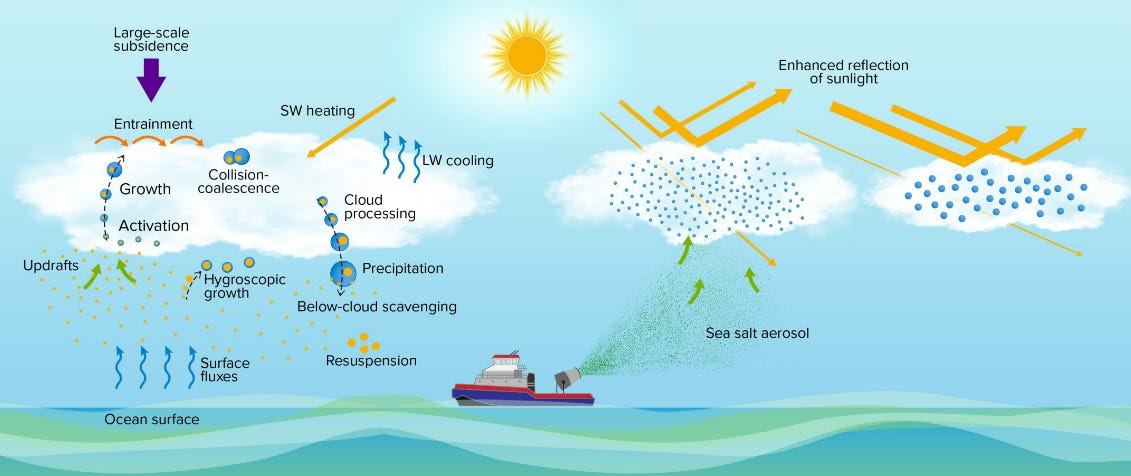
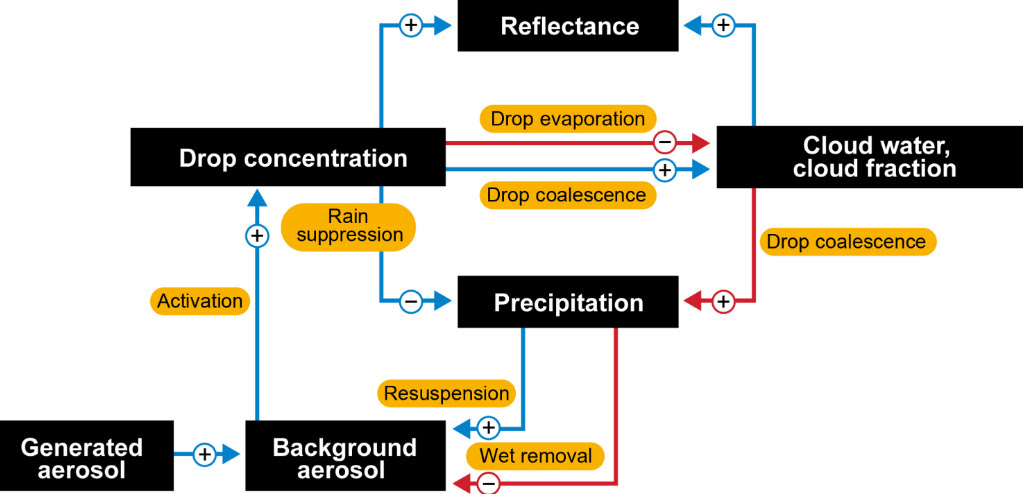
Feingold, G., Ghate, V. P., Russell, L. M., Blossey, P., Cantrell, W., Christensen, M. W., ... & Zheng, X. (2024). Physical science research needed to evaluate the viability and risks of marine cloud brightening. Science Advances, 10(12), eadi8594. Abstract Marine cloud brightening (MCB) is the deliberate injection of aerosol particles into shallow marine clouds to increase their reflection of solar radiation and reduce the amount of energy absorbed by the climate system. From the physical science perspective, the consensus of a broad international group of scientists is that the viability of MCB will ultimately depend on whether observations and models can robustly assess the scale-up of local-to-global brightening in today’s climate and identify strategies that will ensure an equitable geographical distribution of the benefits and risks associated with projected regional changes in temperature and precipitation. To address the physical science knowledge gaps required to assess the societal implications of MCB, we propose a substantial and targeted program of research—field and laboratory experiments, monitoring, and numerical modeling across a range of scales.
Baur, S., Sanderson, B. M., Séférian, R., & Terray, L. (2024). Change in Wind Renewable Energy Potential under Stratospheric Aerosol Injections. Abstract Wind renewable energy (WRE) is an essential component of the global sustainable energy portfolio. Recently, there has been increasing discussion on the potential supplementation of this conventional mitigation portfolio with Solar Radiation Modification (SRM). However, the impact of SRM on conventional mitigation measures has received limited attention to date. In this study, we explore one part of this impact, the potential effect of one type of SRM, Stratospheric Aerosol Injections (SAI), on WRE. Using hourly output from the Earth System Model CNRM-ESM2-1, we compare WRE potential under a medium emission scenario (SSP245) and a high emission scenario (SSP585) with an SRM scenario that has SSP585 baseline conditions and uses SAI to cool to approximately SSP245 global warming levels. Our results suggest that SAI may affect surface wind resources by modifying large-scale circulation patterns, such as a significant poleward jet-shift in the Southern Hemisphere. The modeled total global WRE potential is negligibly reduced under SAI compared to the SSP-scenarios. However, regional trends in wind potential are highly variable, with large increases and decreases frequently reaching up to 16 % across the globe with SAI. This study provides valuable insights into the potential downstream effects of SRM on climatic elements, such as wind patterns, and offers perspectives on its implications for our mitigation efforts.
Case, P. A., Colarco, P. R., Toon, O. B., & Newman, P. A. (2024). Simulating the volcanic sulfate aerosols from the 1991 eruption of Cerro Hudson and their impact on the 1991 ozone hole. Geophysical Research Letters, 51(5), e2023GL106619. Abstract The Chilean volcano Cerro Hudson erupted between August 8th and 15th, 1991, injecting between 1.7 and 2.9 Tg of SO2 into the upper troposphere and lower stratosphere. We simulate this injection using the Goddard Earth Observing System Earth system model with detailed sulfur chemistry and sectional aerosol microphysics, focusing on the resulting aerosols and their contribution to the 1991 Antarctic Austral Springtime ozone hole. The simulations show a column ozone deficit (12 DU) in the Southern Hemisphere vortex collar region. The majority of this effect is between 10 and 20 km and due to heterogeneous chemistry. The model shows a 26% decrease in ozone from background levels at these altitudes, compared with in-situ observations of a 50% decrease. Above 20 km, the dynamical response to the eruption also causes lower ozone values, a novel modeling result. This experiment highlights potential interactions between proposed solar radiation management geoengineering aerosols and volcanic eruptions.
CONFERENCE PAPERSAbstract In the face of rapidly growing climate harms, research into solar geoengineering promises possibilities of averting some of the risks of otherwise unavoidable climate change. Yet the technology would also bring novel risks. Risk-risk, or risk trade-off analysis has been proposed as an appropriate anticipatory approach to evaluate the desirability of development of solar geoengineering. This paper examines the discursive implications of risk-based approaches to climate policy, and deconstructs extant proposals for risk trade-off analysis of policy options. It argues that such proposals construct a false binary between climate harm and geoengineering and rely on a consequentialist ‘lesser evil’ argument. In both respects the discourse fails to anticipate interaction effects between potential responses. Further, the discourse frames solar geoengineering as an ‘exceptional response’ to climate risk, yet paradoxically advocates evaluation using technocratic utilitarian risk calculus, rather than engaging with the securitisation and pre-emption implied by exceptional or emergency circumstances. The paper then discusses the implications of these shortcomings for anticipatory and precautionary governance of solar geoengineering, suggesting practical methodological improvements to risk-risk analysis. It concludes by making a case for rigorous consideration of the risks and benefits of a wider range of exceptional responses to climate change, effective anticipatory governance for any exceptional response, and the urgent development of broad public participation mechanisms for shaping responses to growing climate risk.
Boucher, O., Määttänen, A., Lurton, T., & Ravetta, F. (2024). Idealized modeling of uncooperative two-actor SRM deployment (No. EGU24-6144). Copernicus Meetings. Abstract Potential SRM deployment scenarios are increasingly discussed in the literature and an effort to construct plausible scenarios is underway in the scientific community. Such deployment scenarios underpin the design of possible governance mechanisms of SRM. A wide range of possible scenarios can be envisaged, including unilateral deployment by one actor, uncooperative multi-actor deployment, global centralized deployment or a global moratorium. In order to inform the current dialogue on governance, we explore in this work the behavior of a system where two uncooperative actors deploy SRM. We rely on a simple four-box climate model that responds to stratospheric aerosol injection (SAI) in the northern and southern hemispheres, including the oceanic response. The stratospheric aerosol optical depth has been parameterized with impulse response functions fitted on IPSL-CM6A-LR runs with injections at different latitudes. We couple this model to a control module in order to investigate different controlled SRM deployment strategies, reflecting potential governance scenarios. The two actors inject varying amounts of aerosols in the stratosphere to reach their own climate target which is unknown by the other actor. The climate target can be a temperature target (change of the temperature with respect to the initial state) or a monsoon target (variability of the monsoon index). Depending on the objectives and the characteristics of the deployment strategies by the two actors, we construct several experiments that result in i) involuntary cooperation between the two actors, ii) conflicting behaviors, or ii) one actor taking advantage of the other (free riding). We have also constructed experiments mimicking political decision-making timescales and potential perceived failure of SRM, causing more or less random interruptions of the injections. Although the scenarios are highly idealized and do not represent a realistic implementation of SRM, they help to understand the potential, synergies, risks and challenges of a decentralized, uncooperative deployment of SRM. We will discuss how the analysis of this type of experiments can inform the discussion on potential SRM governance strategies. Our future plans include adding a parametrization of the sea level rise and of ocean acidification into the model to investigate the behavior of these parameters as a result of the different SRM deployment and governance strategies. The simple model could also be used for educational purposes, for example to inform and to train decision-makers on SRM climate intervention and its effects and consequences.
WEB POSTS
DISCUSSIONS
JOB OPPORTUNITY“The Degrees Initiative is a UK-based charity that builds the capacity of developing countries to evaluate solar radiation management geoengineering (SRM), a controversial proposal for reducing some impacts of climate change. Degrees is neutral on whether SRM should ever be used, but we believe that developing countries should be empowered to conduct their own research and to play a central role in SRM discussions. The initiative has been registered as a UK charity since 2021 but operated for ten years before that as the Solar Radiation Management Governance Initiative (SRMGI). Our work receives worldwide coverage and widespread acclaim.”
UPCOMING EVENTSSolar Geoengineering Events Calendar GUIDELINES:Sync selected events to your default calendar in these simple steps:1) Click on the event you want to sync.2) Tap the menu icon (three vertical lines) at the top left.3) Choose 'Share.'4) Pick your default calendar.5) Save the event.Sync the entire Teamup Calendar to your default calendar with these simple steps:1) Tap the menu icon (three vertical lines) at the top right.2) Choose 'Preferences.'3) Click 'iCalendar Feeds.'4) Copy the URL shown for 'Solar Geoengineering Events / SRM Deadlines.'’5) Paste the URL into your default calendar settings.6) Click 'Subscribe' or 'Add Calendar.'
You can directly sync all Solar Geoengineering events to your default calendars by pressing the link below: Sync SG Events to your Default Calendar
YOUTUBE VIDEOSClimate Intervention: What Do We Know, What Do We Need to Know, Should We Know It? | Cornell Atkinson Center for Sustainability Can You See Cosmic Rays on Hot Drinks? | The Action Lab “Could electric charges or radiation trigger cloud droplets for CCT or MCB?”
| |