
tets, "octets" and ivm - A Math Reference

Eric Marceau
The discussion of ivm vs xyz seemed to be going nowhere.
On google, I did an independent search for
"ivm coordinates" AND "cartesian coordinates" AND "converter"
and while the responses were almost nil, there appears to be a useful result:
1803.0263v1.pdf (on vixra.org)
That provides a 275 page PDF of a book entitled
QSO -- The Mathematics of Quasi-Spherical Orbits by Robert G. Chester
The discussion of IVM starts on page 18 (PDF 31).
Others might be more apt to understand. It seems a bit much for me. But then again, I have no interest for other than spherical or cartesian.Eric Marceau
There also appears to be a more generalized discussion of the QSO
book's topic at the following link:
where it is titled
OMNITOPOLOGY
For those who are more math/theory(/philosophy?) inclined.
FTR, it is not my cup of tea! I am not in a position to discuss
either this reference (omnitopology), nor the previous reference
(qso).
Eric
Eric Marceau
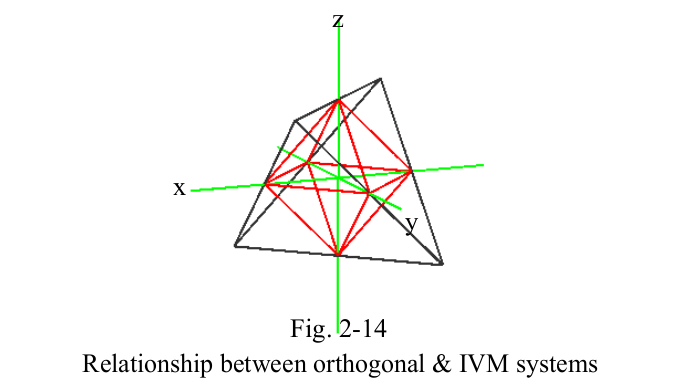
One key image in the below-referenced QSO book might help explain visually the relationship between the two systems:

That is included in the attached "photocopy" of the pages where it is referenced.
But none of that clearly identifies any sense of "coordinates" within the IVM frame of reference.
Some references point to details in
"Synergetics - Explorations in the Geometry of Thinking", 1975
https://archive.org/details/buckminster-fuller-synergetics-explorations-in-the-geometry-of-thinking/mode/1up
and
"Synergetics 2 - Explorations in the Geometry of Thinking", 1979
https://archive.org/details/synergetics2expl00full/page/n7/mode/1up
Looking at the first of those two Synergetics books, I am unable to discern (possibly my failing) any outline of a mathematical methodology for the "mapping" (aka transformation matrix or whatever) from Cartesian to IVM.
From scanning all references of IVM, I only found this one short section that hinted at what was involved:
962.00 Powering in the Synergetics Coordinate System
962.01 In the operational conventions of the XYZ-c.g t .s. coordinate system of
mathematics, physics, and chemistry, exponential powering meant the
development of dimensions that require the introduction of successively new
perpendiculars to planes not yet acquired by the system.
962.02 In synergetics, powering means only the frequency modulation of the
system; i.e., subdivision of the system. In synergetics, we have only two
directions: radial and circumferential.
962.03 In the XYZ system, three planes interact at 90 degrees (three
dimensions). In synergetics, four planes interact at 60 degrees (four dimensions).
962.04 In synergetics there are four axial systems: ABCD. There is a maximum
set of four planes nonparallel to one another but omnisymmetrically mutually
intercepting. These are the four sets of the unique planes always comprising the
isotropic vector matrix. The four planes of the tetrahedron can never be parallel to
one another. The synergetics ABCD-four-dimensional and the conventional XYZ-
three-dimensional systems are symmetrically intercoordinate. XYZ coordinate
systems cannot rationally accommodate and directly articulate angular
acceleration; and they can only awkwardly, rectilinearly articulate linear
acceleration events.
962.05 Synergetic geometry discloses the rational fourth- and fifth-powering
modelability of nature's coordinate transformings as referenced to the 60-degree
equiangular isotropic-vector equilibrium.962.06 XYZ volumetric
coordination requires three times more volume to
accommodate its dimensional results than does the 60-degree coordination
calculating; therefore, XYZ 90-degree coordination cannot accommodate the
fourth and fifth powers in its experimental demonstrability, i.e., modelability.
962.07 In the coordinate vectorial topology of synergetics, exponential powers
and physical model dimensioning are identified with the number of vectors that
may intercept the system at a constant angle, while avoiding parallelism or
congruence with any other of the uniquely convergent vectors of the system.
That still doesn't illuminate the process of
mapping
A Suggestion for a Method
If I go back to my early engineering days, I would
suggest using a FEM (Finite-Element-Method) meshing
engine that could generate a mesh where all elements are
forced to be tetrahedra of uniform size (I think that is an
option nowadays), with the exception of those on the
boundary surfaces. Then, from the mesh-generator, obtain a
report of the count of all the "full" tetrahedra and a count of
the "partial" tetrahedra (likely the count of those forming
the vertical side-walls of the pool). I would estimate
the total volume to be
count (full) + 1/2 * count (partial) = total
If the tetrahedra are sized with dimensions providing for a uniform 1 litre, then you would get a direct count of the volume required to fill the pool.
That would be my "algorithm", but I can't begin to ideate the method used for IVM. It just doesn't make sense to me.
An Alternate Method using "2-Layer" Hex-Tiles
If you set one layer of 6 tetrahedrons, with apex up, arranged to form a hexagonal profile, then arrange a similar 6 tiles with the apex facing down, this dual-layer of tets forms the equivalent of 6 tiles (trapezoid-like) whose volume is the projection of the hexagonal profile projected straight to the plan of the opposing layer's flat face.
You could then attempt to calculate the volume by
overlaying the map of best-fit hexagons, then determine the
number of layers with thickness equal to the tetrahedron apex
height, then multiply the two numbers to obtain your total water
requirement.
Tetrahedron volume = ( 20.3964890265551 cm) cubed / 6 * sqrt(2) = 1000 CCs = 1 litre
So number of hexagonal "tiles" * 6 = number of litres for the pool.
Hope the above helps in some way.
Eric

Curt McNamara
Numerical analysis
 An irregular volume in space can be approximated by an irregular triangulated surface, and irregular tetrahedral volume elements.
In numerical analysis, complicated three-dimensional shapes are commonly broken down into, or approximated by, a polygonal mesh of irregular tetrahedra in the process of setting up the equations for finite element analysis especially in the numerical solution of partial differential equations. These methods have wide applications in practical applications in computational fluid dynamics, aerodynamics, electromagnetic fields, civil engineering, chemical engineering, naval architecture and engineering, and related fields.
https://en.m.wikipedia.org/wiki/Tetrahedron
Curt
--
--
You received this message because you are subscribed to the "Geodesic Help" Google Group
--
To unsubscribe from this group, send email to GeodesicHelp...@googlegroups.com
--
To post to this group, send email to geodes...@googlegroups.com
--
For more options, visit http://groups.google.com/group/geodesichelp?hl=en
---
You received this message because you are subscribed to the Google Groups "Geodesic Help Group" group.
To unsubscribe from this group and stop receiving emails from it, send an email to geodesichelp...@googlegroups.com.
To view this discussion on the web visit https://groups.google.com/d/msgid/geodesichelp/d1a71aca-9fd6-360a-983f-3abfc720e170%40gmail.com.
Eric Marceau
Thank you, Curt.
So ... is there no FEM tool that allows you to specify a starting point/surface for the first tetrahedron, then append/replicate in all directions, maintaining uniform ideal tetrahedral shape until reaching boundaries? That's unfortunate.
I can see the "traditional" approach would be the preferred mode for actual stress analysis (or thermal expansion analysis), but for volumetric analysis, it seems excessively complicated, not lending itself to simplification by applying various rules for symmetrical shapes. I had thought that the science/math would have evolved to encompass an approach using uniform tetrahedra (predominantly) for "special" cases to reduce the compute load and time.
A quick search on google does offer a number of such references
but, to be honest, this side of engineering is a blind-spot for
me, and I don't have the time or skills to push any further.
Eric
retired
https://stackoverflow.com/users/9716110/eric-marceau?tab=profile
Thanks Eric!
One detail: tetrahedral mesh are used in software that models physical systems and electromagnetic waves, however they use irregular ones.
Numerical analysis
An irregular volume in space can be approximated by an irregular triangulated surface, and irregular tetrahedral volume elements.
In numerical analysis, complicated three-dimensional shapes are commonly broken down into, or approximated by, a polygonal mesh of irregular tetrahedra in the process of setting up the equations for finite element analysis especially in the numerical solution of partial differential equations. These methods have wide applications in practical applications in computational fluid dynamics, aerodynamics, electromagnetic fields, civil engineering, chemical engineering, naval architecture and engineering, and related fields.
https://en.m.wikipedia.org/wiki/Tetrahedron
Curt
On Tue, Aug 15, 2023, 10:14 PM Eric Marceau <eajma...@gmail.com> wrote:
...(snip)...
---
You received this message because you are subscribed to the Google Groups "Geodesic Help Group" group.
To unsubscribe from this group and stop receiving emails from it, send an email to geodesichelp...@googlegroups.com.
To view this discussion on the web visit https://groups.google.com/d/msgid/geodesichelp/CAHkq9YNxkY52S3nD8H%2Bkf6Q_Ch6X9%2BVX98R6OQ7jdqZABHTLAg%40mail.gmail.com.
Eric Marceau
If I can make a comment without being "blasted" ...
Given the "6-vector" description method for identifying any
single point (see image and text in earlier posting),
I find the IVM approach far too impractical to even want
to pursue trying to understand it.
I understand that tetrahedra are a "rigid" structure which cannot be deformed (under reasonable circumstances), and that it may be a structure that is frequently observed in the natural world, but to go from that to then attempt to define a referential-coordinate system based on a "four-plane" (non-orthogonal) dimensional conception of the 3-plane orthogonal space we live in, it seems to this "simplistic" human completely outlandish and, honestly, not worth the effort to try to understand it, especially since the most vocal of proponents, Buckminster Fuller, did not as far as I could tell, even in his published works, clearly spell out the mathematical relationship between the two spatial reference systems.
NO sarcasm intended, with all due respect to Dick
Fischbeck, for myself, that makes evident that IVM may be a useful
paradigm for conceptual/visual construction of inter-connected
components, but has no demonstrable rigorous mathematics that can
lend itself to being learned or understood, let alone applied via
reproducible methodology which is defensible. That became quite
clear by the circuitous discussion in this group trying to get
specifics about IVM.
Maybe I am completely wrong, but I couldn't find the proof to the contrary.
I invite others to do their own research to either confirm or disprove my conclusions on this matter.
Eric

Chris Belcher
Something I’ve been thinking about comparing the Cartesian and Synergetic Methods is that tetrahedrons are not all space filling, hence the IVM alternating tetrahedrons and octahedrons which seems impractical when constructing a basic grid describing all space.
This shows a basic difference in the two approaches. The Cartesian Method is the product of the Western metaphysical attempt (from Leibniz and perhaps before that the Greco-Roman wortd view) to re-present (and subjugate) the totality of the natural world. Besides not bearing much in common with Eintseinian space-time, where any parallel lines are inevitably warped by gravitation and space, I guess it works well for calculating volumes of hydrocarbons to be extracted, sold and consumed.
The Synergetic Method starts with tuning in the relevant elements to be considered:
963.13
Synergetics
is a priori nuclear; it begins at the center, the center of the
always centrally observing observer. The centrally observing observer
asks progressively, "What goes on around here?"
Vertexes are the relevant events, inter-related to form a system of consideration, tuning out the macro and micro background. Moving around uses polar coordinates as opposed to grid addresses.
The pdf addresses the change of orientation but doesn’t appear to to account for Synergetics being based upon diagonal of the square as the unit of measure, instead of the edge used in the metric (Cartesian) system.
Kirby Urner has a comparison of the two methods:
https://github.com/4dsolutions/tetravolumes/blob/master/Computing%20Volumes.ipynb
If you want to convert back to cubic terms, Fuller does provide a formula, the synergetics constant, 1.06066:
982.30 |
|
|
982.31
The
square root of 2 = 1.414214, ergo, the length of each of the cube's
edges is 1.414214. The sqrt(2)happens to be one of those
extraordinary relationships of Universe discovered by mathematics.
The relationship is: the number one is to the second root of two as
the second root of two is to two: 1:sqrt(2) = sqrt(2):2, which,
solved, reads out as 1 : 1.414214 = 1.414214 : 2.
982.32
The
cube formed by a uniform width, breadth, and height of sqrt(2) is
sqrt(23),
which = 2.828428. Therefore, the cube occurring in nature with the
isotropic vector matrix, when conventionally calculated, has a volume
of 2.828428.
982.45
Humanity's
conventional mensuration cube with a volume of one turns out in
energetic reality to have a conventionally calculated volume of
2.828428, but this same cube in the relative-energy volume hierarchy
of synergetics has a volume of 3.
3 |
= 1.06066 |
982.46
To
correct 2.828428 to read 3, we multiply 2.828428 by the synergetics
conversion constant 1.06066.
(See Chart 963.10.)
I’m not sure I understand where this constant comes from, besides the floating decimal point.
I found it interesting that even Antiprism’s native OFF format maps polyhedra based upon the Cartesian coordinates. I wonder if it would be possible to create a toolbench for FreeCad or something similar that generates polyhedra based upon the IVM.
To Chris Kittrick:
Thank you for identifying the Las Vegas structure as a lamella. I see there are some beautiful examples, though the Vegas Sphere isn’t really one of them. I guess it does do its job.
And to Dick Fischbeck, thanks, the Wanger Flange is interesting but I am going in a different direction.
Cheers,
-Chris
--
--
You received this message because you are subscribed to the "Geodesic Help" Google Group
--
To unsubscribe from this group, send email to GeodesicHelp...@googlegroups.com
--
To post to this group, send email to geodes...@googlegroups.com
--
For more options, visit http://groups.google.com/group/geodesichelp?hl=en
---
You received this message because you are subscribed to the Google Groups "Geodesic Help Group" group.
To unsubscribe from this group and stop receiving emails from it, send an email to geodesichelp...@googlegroups.com.
To view this discussion on the web visit https://groups.google.com/d/msgid/geodesichelp/621a5fd3-3cd8-9098-1946-927e044175e4%40gmail.com.

Adrian Rossiter
On Wed, 16 Aug 2023, Chris Belcher wrote:
> I found it interesting that even Antiprism’s native OFF format maps
> polyhedra based upon the Cartesian coordinates. I wonder if it would be
employs a coordinate system that many people learn at school.
One of Antiprism's goals is to provide components that support the
modelling that people do. If you start modelling with your own
coordinate system then let me know what format you are using and how
you would like to use Antiprism to process your models. A converter
from your format to OFF would likely be very easy to write, and
it would also likely be trivial to modify a program that outputs your
format to simply output OFF as an alternative.
Similarly, internally, Antiprism uses a number of coordinate systems,
as different coordinate systems are useful for solving different
problems.
Regarding polyhedra, the IVM vertices can have integer Cartesian
coordinates, and many polyhedra which can be created in the IVM can
be created in Antiprism with these integer coordinates by prefixing
the model name by 'std_', for example
off_util tetrahedron | off2crds
0.3535533905932737 0.3535533905932737 0.3535533905932737
0.3535533905932737 -0.3535533905932737 -0.3535533905932737
-0.3535533905932737 0.3535533905932737 -0.3535533905932737
-0.3535533905932737 -0.3535533905932737 0.3535533905932737
off_util std_tetrahedron | off2crds
1 1 1
1 -1 -1
-1 1 -1
-1 -1 1
Adrian.
--
Adrian Rossiter
adr...@antiprism.com
http://antiprism.com/adrian

lemondealc
--
--
You received this message because you are subscribed to the "Geodesic Help" Google Group
--
To unsubscribe from this group, send email to GeodesicHelp...@googlegroups.com
--
To post to this group, send email to geodes...@googlegroups.com
--
For more options, visit http://groups.google.com/group/geodesichelp?hl=en
---
You received this message because you are subscribed to the Google Groups "Geodesic Help Group" group.
To unsubscribe from this group and stop receiving emails from it, send an email to geodesichelp...@googlegroups.com.
To view this discussion on the web visit https://groups.google.com/d/msgid/geodesichelp/b452cf2b-6ce4-c728-922c-6933f8aa530%40antiprism.com.
Chris Belcher
The edge lengths are 1 (just about) and I am guessing that the area and volume are calculated as square and cubic units? I did see that the polyhedral models do align with IVM values in most ways, especially in figuring angles, frequency and strut lengths.[general]num_verts = 4num_faces = 4num_edges = 6vertex_centroid = (0 0 0)volume_centroid = (0 0 0)oriented = yesorientable = yesconnectivity = polyhedron, closed, even, knownnum_parts = 1convex = yes (strict)genus = 0area = 1.732050807568877volume = 0.11785113019775789...[edges]
num_edges = 6
perimeter = 5.9999999999999991
edge_length_max = 0.99999999999999989 (0,1)
edge_length_min = 0.99999999999999989 (0,1)
edge_length_avg = 0.99999999999999989
--
--
You received this message because you are subscribed to the "Geodesic Help" Google Group
--
To unsubscribe from this group, send email to GeodesicHelp...@googlegroups.com
--
To post to this group, send email to geodes...@googlegroups.com
--
For more options, visit http://groups.google.com/group/geodesichelp?hl=en
---
You received this message because you are subscribed to the Google Groups "Geodesic Help Group" group.
To unsubscribe from this group and stop receiving emails from it, send an email to geodesichelp...@googlegroups.com.
To view this discussion on the web visit https://groups.google.com/d/msgid/geodesichelp/b452cf2b-6ce4-c728-922c-6933f8aa530%40antiprism.com.
Adrian Rossiter
On Fri, 18 Aug 2023, Chris Belcher wrote:
> Reporting out the data on the default tetrahedron model:
> volume = 0.11785113019775789
...
...
> volume are calculated as square and cubic units? I did see that the
> polyhedral models do align with IVM values in most ways, especially in
> figuring angles, frequency and strut lengths.
units.
The bare "tetrahedron" model has edge length 1, but is nicely algined with
the Cartesian coordinate axes.
However, if you switch to the std_ models then they are sized and aligned
in a way that makes thm easy to use for making models that appear in
Synergetics, e.g.
off_util std_tet std_cube std_oct std_cubo std_rd | off_color -e K | antiview -x f
[image attached]

Chris Belcher
num_edges = 24
perimeter = 40.970567999999993
edge_length_max = 1.9999999999999996 (8,9)
edge_length_min = 1.4142140000000001 (0,1)
edge_length_avg = 1.7071069999999997

-Chris
--
--
You received this message because you are subscribed to the "Geodesic Help" Google Group
--
To unsubscribe from this group, send email to GeodesicHelp...@googlegroups.com
--
To post to this group, send email to geodes...@googlegroups.com
--
For more options, visit http://groups.google.com/group/geodesichelp?hl=en
---
You received this message because you are subscribed to the Google Groups "Geodesic Help Group" group.
To unsubscribe from this group and stop receiving emails from it, send an email to geodesichelp...@googlegroups.com.
To view this discussion on the web visit https://groups.google.com/d/msgid/geodesichelp/1cb1abc2-5941-5273-194e-a3603c887b20%40antiprism.com.
Adrian Rossiter
On Tue, 22 Aug 2023, Chris Belcher wrote:
> As you can see the tetrahedral edges are 2, and the cube edges are 1.414214 as
> defined in Synergetics. It would be nice to also see an exploded drawing
> with the 1/8th (if I remember correctly) octahedra pieces - something to
> work on.
>
> I guess the next step would be to lay out side by side the cubic and
> tetrahedral volume formulae (?) to see how they work and how the
> synergetics conversion constant comes in to play.
982.45 Humanity's conventional mensuration cube with a volume
calculated volume of 2.828428, but this same cube in the
relative-energy volume hierarchy of synergetics has a volume of 3.
root 2, are length 1 in "Humanity's conventional mensuration" system.
Chris Belcher
Yes, I am working from that section. On my model the tet edges (cube diagonals) are 2, while the cube edges are the square root of 2.
Incidentally I had an issue with running off_report on the combined model. When I tried to generate a text file it was empty. I ran it again without specifying output and it printed the report in the terminal window, so just copied and pasted that into the blank text file.
Next work on volume formulae.
Cheers,
-Chris
Sent from my iPhone
> On Aug 22, 2023, at 4:39 AM, Adrian Rossiter <adr...@antiprism.com> wrote:
>
> Hi Chris
> --
> You received this message because you are subscribed to the "Geodesic Help" Google Group
> --
> To unsubscribe from this group, send email to GeodesicHelp...@googlegroups.com
> --
> To post to this group, send email to geodes...@googlegroups.com
> --
> For more options, visit http://groups.google.com/group/geodesichelp?hl=en
>
> --- You received this message because you are subscribed to the Google Groups "Geodesic Help Group" group.
> To unsubscribe from this group and stop receiving emails from it, send an email to geodesichelp...@googlegroups.com.