

Tatiana Lukman
Berita tahun lalu, tapi masih aktuil. Penggusuran penduduk terus berjalan, demi pembangunan pemerintah antek imperialis dan hanya didukung oleh para penjilatnya….
Tolak Dipindahkan, Warga Komodo Tuntut 6 Hal Termasuk Permintaan Maaf Gubernur NTT
Jumat, 16 Agustus 2019 | 11:03 WIB


LABUAN BAJO, KOMPAS.com - Warga pulau Komodo, Kabupaten Manggarai Barat, Nusa Tenggara Timur (NTT) menolak rencana pemerintah untuk memindahkan mereka keluar dari wilayah tersebut.
"Kami warga Komodo sebagai warga negara dan pemilik kedaulatan atas tanah dan laut di kawasan Pulau Komodo, dengan ini menyatakan menolak rencana pemerintah untuk memindahkan kami keluar dari tanah air leluhur kami," ujar Akbar, koordinator warga Komodo dalam keterangan yang diterima Kompas.com, Jumat (16/8/2019).
Terkait rencana pemerintah untuk menutup sementara Pulau Komodo, warga Komodo menyampaikan 6 tuntutan kepada pemerintah.
Baca juga: 8 Ekor Rusa Diselundupkan dari Pulau Komodo, 7 Dalam Kondisi Mati
Pertama, warga menuntut pemenuhan hak-hak agraria sebagai warga negara, yaitu pengakuan legal dan sertifikat atas tanah dan rumah milik warga di Pulau Komodo.
Kedua, warga menuntut pengakuan Pemerintah Indonesia mulai dari pusat sampai daerah atas status kawasan Komodo sebagai "Man and The Biosphere Heritage" dan "Cultural and Natural Reserve" sebagaimana yang sudah dilakukan oleh UNESCO.
Ketiga, warga menuntut Kementerian Lingkungan Hidup dan Kehutanan (KLHK) untuk mengembalikan sebagian dari wilayah daratan dan lautan untuk ruang pemukiman dan ruang penghidupan yang layak bagi warga Komodo.
Keempat, warga mendesak KLHK dan Kementerian Pariwisata untuk mengakui dan memfasilitasi peran aktif warga dalam usaha-usaha konservasi dan pariwisata.

Dalam point empat ini, warga Komdo menuntut pengakuan lembaga adat di Komodo sebagai Dewan Pertimbangan dan/atau Dewan Pengarah dalam struktur Taman Nasional Komodo (TNK).
Kemudian, menolak segala bentuk pembangunan hotel, resort, restauran, rest area, dan sarana wisata lainnya di dalam kawasan TNK. Kemudian, menuntut pemerintah untuk tidak memberikan izin apapun kepada perusahaan yang hendak membuat bangunan fisik di dalam taman nasional, karena mengancam ruang hidup alami Komodo dan habitatnya.
Kelima, warga menuntut pemerintah untuk memperhatikan pembangunan untuk masyarakat seperti perbaikan pelayanan kesehatan, perbaikan sarana dan prasarana transportasi.
Kemudian, perbaikan layanan pendidikan, termasuk penambahan sekolah SMA dan guru-guru PNS.
Keenam, warga menuntut Gubernur NTT Viktor Laiskodat untuk menarik kembali dan meminta maaf atas pernyataannya yang menyebut warga sebagai penduduk liar dan mau menggusur warga keluar dari tanah air Komodo.
"Kami juga menuntut KLHK untuk meminta maaf atas kelambanan dalam menyikapi pernyataan-pernyataan Gubernur Laiskodat," kata Akbar.
Sent from Mail for Windows 10

Jaya Suprana
--
Anda menerima pesan ini karena berlangganan grup "GELORA45" di Google Grup.
Untuk berhenti berlangganan dan berhenti menerima email dari grup ini, kirim email ke gelora1945+...@googlegroups.com.
Untuk melihat diskusi ini di web, kunjungi https://groups.google.com/d/msgid/gelora1945/5fb2e3fb.1c69fb81.a0c30.682eSMTPIN_ADDED_MISSING%40gmr-mx.google.com.

kh djie
https://www.youtube.com/watch?v=aJ8ZTtgdQC8
Tionghoa dalam Alunan Musik Klasik, Pop, & Jazz -
Nggosipin Tionghoa Yuk! Pertemuan Keenambelas
kh djie
by redaksibm Selasa, 17 November 2020
117
SHARES
OC Kaligis (foto beritamanado)
Sukamiskin, BeritaManado.com – Salah satu Praktisi dan Pengamat Hukum, Prof Otto Conelis Kaligis menilai kepulangan Habib Rizieq ke tanah air mengancam pemerintahan Jokowi- Ma’ruf dan kesatuan NKRI.
Hal itu disampaikan OC Kaligis dalam suratnya yang ditujukan ke Panglima TNI Marsekal Hadi Tjahjanto, Minggu (15/11/2020) yang juga dirilis ke sejumlah media.
Berikut surat OC Kaligis;
Hal. “Revolusi Habib Rizieq” Adili Habib Rizieq.
Kepada yang terhormat Panglima TNI Marsekal Hadi Tjahjanto.
Dengan Hormat.
Pekenankanlah saya Prof Otto Conelis Kaligis, dalam hal ini bertindak dalam kedudukan saya Selaku Praktisi dan Pengamat Hukum menyampaikan himbauan kepada Bapak Panglima yang punya tugas utama mempertahankan NKRI, untuk hal berikut ini:
Di era Pemerintahan Bapak Presiden Soehato, disekitar tahun 1982, sebagai seorang advokat, saya pernah membela Adah Djaelani tokoh pergerakan Darul Islam yang hendak membawa Indonesia menjadi Negara Islam Indonesia.
Disaat itu Bapak Pesiden Soeharto tegas, menyapu bersih anasir-anasir yang hendak meruntuhkan NKRI. Peradilan atas Adah Djaelani berjalan lancar. Tanpa adanya pengerahan massa pendukung. Akhirnya semua anasir-anasir pemecah belah persatuan dihabisin.
Sepulangnya Ulama Habib Rizieq (yang konon dihormatinya karena dia adalah seorang keturunan Nabi), bahkan sejak Habib Rizieq diluar negeri, saya telah turut menyaksikan provokasi provokasi si Habib.
Dia tidak mengakui Pemerinahan Jokowi- Ma’ruf, menyebutnya sebagai Presiden ilegal, memprovokasi kemungkinan timbulnya perang saudara bila tentara secara resistensi melakukan perlawanan, menyerukan dilakukannya revolusi achlak (memangnya bangsa Indonesia sudah tidak lagi berachlak?), menyerukan ganti Presiden/Pemerinahan, mencap Pemerintah sebagai rezim curang. Bermaksud menjadikan NKRI yang berdasarkan Pancasila menjadi Indonesia sebagai negara Syariah.
Dari penyataan-penyataan Habib Riezieq terbukti bahwa dia benar-benar mempovokasi pengikutnya untuk melawan Pemerintahan yang sah, dan gerakan separatisnya makin menjadi, karena Penguasa Hukum melakukan Pembiaran aksi provokasi Habib yang makin berani.
Provokasi adalah awal makar. Mungkin Bapak masih ingat Provokasi Osama bin Laden. Provokasi Osama: “We-with God’s help- call on every Muslim who believes in God and wishes to be rewarded to comply with God’s order to kill the Americans and plunder their money wherever and whenever they find it” Provokasi Osama ini mengindroktinasi kaum Muslim untuk membenci orang Amerika serta mensahkan perampokan harta mereka”
Provokasi serupa untuk meruntuhkan Pemerintahan sah Jokowi kini dilancarkan oleh Habib Rizieq dengan mengjustifikasi provokasinya sebagai gerakan bela ulama, khususnya ulama besar Habib Rizieq yang katanya keturunan Nabi yang difitnah oleh Pemerintah Indonesia. Atas Dasar itu Habib Rizieq mengajak umat Islam merapatkan persatuan untuk melawan rezim Jokowi yang disebutnya sebagai rezim curang.
Apabila Provokasi itu dibiarkan berlangsung, maka menurut teori terorisme, ucapan Provokasi tersebut akan menjelma menjadi tindakan terror, sehingga tujuan mencapai kekacauan akan terjadi, yang dampaknya berlanjut kepada tindakan makar.
Sebelum runtuhnya Twin Tower di New York, dikenal dengan peristiwa 11 September 2001 semua Provokasi kelompok terorisme dibenarkan di bawah naungan kebebasan berbicara.
Hanya tindakan nyata yang dihukum. Setelah runtuhnya twin Tower di New York, Badan Intellijen Amerika mulai merobah sikap mereka terhadap kelompok terorisme, yang oleh Osama bin Laden, diperintahkan agar semua Muslim membenci Amerika dan berhak merampok kekayaannya.
Di negara tetangga kita, Malaysia dan Singapura misalnya memberlakukan “Security Act” semacam Undang Undang subversif, untuk mengatasi Provokasi pemecah belah persatuan bangsa, dan menghukum mereka yang ingin menjatuhkan pemerintahan yang sah.
Sebenarnya kalau saja Polisi berani bertindak dan tidak melakukan pembiaran atas Provokasi Provokasi Habib Rizieq, Polisi bisa menjerat Habib melalui Kitab Undang Hukum Pidana . Baca Buku Kedua mengenai Kejahatan. Bab I. Kejahatan terhadap keamanan negara mulai Pasal 104 sd. 129. Bab. II. Kejahatan Kejahatan terhadap Martabat Presiden Dan Wakil Presiden. Mulai dai Pasal 130 sampai dengan Pasal 139.
Mengapa Habib Rizieg makin besar kepala? Kepulangannya saja diamankan super ketat oleh Polisi. Kunjungan silaturahirm dilakukan oleh Gubernur DKI. Anis Baswedan, Amin Rais. Program DKI mengenai prosedur pengamanan Covid 19, dilanggar. Bahkan Masker dibagikan dalam acara perkawinan anaknya. Di acara itu Habib masih sempat melemparkan kata Lonte kepada Nikita Mirzani. Bila mendengar kata-kata Provokasi Habib, saya kira semua orang terdidik, terkaget-kaget mendengar ocehannya.
Kecendrungan menuju negara syariah makin deras didengungkan. Penghinaan terhadap agama lain, seperti ada Jin kafir disalibnya orang kristen, atau Injil itu Palsu, dibiarkan oleh Penyidik Polisi. Beda dengan adanya poster poster “jangan Pilih kafir” diera Pilkada AHOK. Padahal the founding father menolak keras dimajukannya Piagam Jakarta.
Saudara kandung Agus Salim ada yang beragama katolik, atau saudara Buya Hamka yang pendeta, tidak dicap oleh keluarga mereka sebagai Kafir. Bahkan Perdana Menteri Sjafruddin Prawiranegara, memegang Injil sebelumnya dieksekusi. Banyak pendiri NKRI bukan Islam, turut bersama membangun NKRI dalam wadah pluralisme. Presiden Soekarno tidak menghendaki Indonesia menjadi negara Agama.
Semoga dengan ditegakkannya Hukum tanpa tebang Pilih. Penghinaan Habib terhadap pemerintahan yang sah, seruan Habib untuk mengganti Presiden, dan segala bentuk Provokasi lannya yang merisaukan Masyarakat, dapat dibawa ke ranah Hukum, demi amannya negara ini.
Saya menulis Surat ini kepada Bapak Panglima, karena saya yakin melalui Doktrin Sapta Marga, Tentara bisa mengatasi Provokasi Habib Rizieq yang berniat mengganti Pemerintahan yang sah.
Sukamiskin, Minggu 15 November 2020.
Prof. Otto C. Kaligis.
Cc. Ade Armando, Denny Siregar dan para kelompok akal sehat.
Cc. Yth Arteria Dahlan.
Cc. Pertinggal
Cc. Medsos pencinta keutuhan NKRI.
[07:52, 18-11-2020] Djie: OC Kaligis Surati Panglima TNI Terkait Ancaman NKRI dari Rizieq
by redaksibm Selasa, 17 November 2020
117
SHARES Apa tidak keliru ? Syarifuddin Prawiranegara kan tokoh PRRI. Yang diexecutie atas perintah gubernur militair Gatot Subroto tanpa melewati pengadilan adalah Amir Syarifuddin Harahap, Kristen dan komunis. Ia ditembak dengan memegang kitab injil dan sebelumnya menyanyikan lagu Internatrionale. Pernah jadi menteri pertahanan, pernah jadi perdana menteri. Pernah mau ditunjuk untuk memproklamasikan Indonesia Merdeka, tetapi karena masih dalam tahanan Jepang, jadinya bung Karno dan Harta yang dipilih. Ia akan dihukum mati Jepang karena tertangkap waktu melakukan gerakan bawah tanah melawan Jepang, tetapi ditolong oleh bung Karno yang berhasil mempengaruhi Jepang. Bung Karno tidak menjawab, hanya meneteskan air mata, waktu ditanya oleh Sujoyono, pelukis istana yang terkenal, soal Amir Syarifuddin. Sujoyono sendiri dulu orang Lekra, dipecat oleh Aidit, karena menikahi Pandanwangi, sedangkan dia sudah beristri.
[08:18, 18-11-2020] : Amir Syarifuddin Harahap : https://id.wikipedia.org/wiki/Amir_Sjarifoeddin
Syarifuddin Prwawiranegara : https://id.wikipedia.org/wiki/Syafruddin_Prawiranegara
kh djie
My 2 cents soal Koopssus ngetem di depan markas FPI
Setelah gw perhatikan, munculnya video kendaraan tempur Koopssus ngetem sebentar di depan markas FPI ini, bukan berasal dari wartawan, bukan dari video amatir warga, tapi dari orang Koopssus yang menyamar di situ.
Dalam 1 tayangan video, ada 2 angle, keduanya berseberangan, tapi video yang beredar sudah dalam 1 pengambilan gambar utuh. Dan semua media memiliki video yang sama. Ga ada video yang berbeda.
Artinya insinden itu memang sengaja dilakukan Koopssus. Mengenai komentar Komandan Koopssus bahwa itu hanya protap biasa memeriksa kendaraan hanya untuk publikasi media saja.
Pergerakan Koopsus ternyata tidak bisa dideteksi oleh satuan manapun. Pangdam Jaya kemarin bahkan ga tau. Kapuspen TNI juga ga tau. Pergerakan Koopssus memang rahasia. Dan hanya bisa digerakan Panglima TNI atas diperintah presiden. Di hari yang sama Panglima TNI Marsekal Hadi Tjahjanto mengunjungi 3 matra elit TNI, Kopassus AD, Marinir AL, dan Paskhas TNI AU.
Kenapa sih cuma seorang Porn Fugitive (istilah dari medis The Australian) musti muncul komando elit TNI best of the best of the best of the best?
Koopssus ini merupakan komando elit TNI untuk mengatasi ancaman terorisme international. Bukan terorisme level kampung.
Maka pesan yang terlihat adalah bahwa ada terorisme internasional sedang nunggu di belakang pergerakan-pergerakan si onoh. Begitu FPI memulai kekacauan di masyarakat, maka kelompok terorisme internasional bakal membakar dan memporakporandakan negeri ini lebih mengerikan lagi.
Ini yang sudah tercium oleh presiden. Dan tentu aja ini semua rahasia.
Kemunculan Koopssus ngetem sebentar di depan markas FPI dan sengaja disebar ke berbagai media mainstream, medsos dan WA, adalah memang disengaja oleh Koopssus untuk publikasi “ada Koopssus lho untuk menggulung terorisme international”. Publik menjadi tau, merasa aman, dan teroris intenasional jadi berhitung kembali, ini si onoh jadi gak nih revolusinya…
Jadi pesan dari ngetem sebentarnya Koopssus di depan markas gerombolan FPI memang sengaja untuk publikasi ke dunia bahwa best of the best of the best of the best dari TNI siap menggulung teroris international yang mau memanfaatkan kekacauan yang bakal dibuat si onoh dan cecurut-cecurutnya.
https://www.sintesanews.com/ada-teroris-internasional-yang-menanti-kekacauan-yang-akan-dibuat-kadrun/
kh djie

kh djie
kh djie
1. Mengapa Prabowo ingin jadi Presiden? Tanya saya kepada teman kemarin waktu bertemu di Restaurant Metropolis Hong Kong. Teman ini saya kenal baik karena bisnisnya ada hubungan dengan Prabowo. Bukan hanya ingin tapi berambisi. Tahu kan, apa itu ambisi? Sesuatu yang sangat diharapkan dan untuk itu akan diperjuangkan dengan at all cost, katanya.
2. Tapi apa motivasinya? Apakah benar karena ingin berbuat yang terbaik untuk bangsa dan negara? tanya saya. Teman itu dengan tersenyum mengatakan kepada saya bahwa motivasi utamanya adalah karena dendam masa lalu.
3. Yang harus diketahui bahwa Prabowo lahir dari keluarga elite dan intelek. Ayahnya Soemitro Djojohadikusumo, dikenal sebagai Begawan Ekonomi dan kakeknya, Raden Mas Margono Djojohadikusumo, anggota BPUPKI, pendiri Bank Negara Indonesia dan Ketua DPA pertama. Jadi baik kakeknya maupun ayahnya adalah bangsawan dan cendekiawan.
4. Walau masa remajanya banyak diluar negeri karena harus mengikuti ayahnya yang buronan politik Orla rezim Soekarno namun ketika berangkat dewasa Prabowo berada di Ring-1 kekuasaan Soeharto. Karena ayahnya, Soemitro Djojohadikusumo sebagai arsitek pembangunan ekonomi Orde Baru, tentu sangat dipercaya oleh Soeharto.
5. Alasan rasa hormat Soeharto kepada Soemitro lah yang meminta agar putranya, Prabowo menjadi menantunya. Sejak itu Prabowo menjadi menantu dari orang nomor 1 di negeri ini dan berkuasa dengan sangat otoriter. Karier Prabowo di militer sudah dapat ditebak. Ia menjadi raising star. Pangkatnya naik cepat dan mendapat kedudukan terhormat di Militer.
6. Sebagai anak bangsawan dan cendekiawan, dan tumbuh berkembang sebagai menantu Presiden, secara psikologis telah membuat Prabowo menjadi orang yang sangat tinggi pride nya. Rasa bangga dirinya sangat tinggi. Dia tidak pernah siap untuk dilecehkan atau dikecilkan oleh orang lain.
7. Chaos Mei 1998 yang membuat Soeharto harus lengser dan sampai kini masih menjadi awan gelap siapa dibalik chaos itu. Siapa yang paling bertanggung jawab atas chaos Mei 1998?
8. Yang pasti setelah itu Prabowo diberhentikan oleh Panglima ABRI. Mungkin seumur negeri ini hanya Prabowo satu satunya Perwira Tinggi TNI yang diberhentikan oleh TNI. Namun kebijakan TNI tetap berlaku umum bahwa masalah internal TNI hanya TNI yang tahu. TNI tidak pernah membocorkan alasan pemberhentian Prabowo. Ini sudah menjadi tradisi militer, tidak hanya di Indonesia tapi juga di negara lain.
9. Namun yang pasti pemberhentian itu berkaitan dengan dokrin TNI patuh kepada pemimpin Nasional yang juga menjadi kehormatan bagi seluruh prajurit TNI. Justru karena pemberhentian sebagai Pati TNI itu membuat Prabowo sakit hati dengan atasannya. Namun dia tidak berdaya untuk melawan karena memang tidak punya nyali seperti Qaddafi sang Kolonel yang mengkudeta Raja Idris di Libya.
10. Prabowo memilih untuk menerima dan menjauh dari hiruk pikuk politik. Dia pergi ke Yordania membantu usaha adiknya (Hashim Djojohadikusumo). Kebetulan Raja Yordania, Abdullah II adalah sahabat Prabowo dulu waktu ikut training di Fort Banning yang dikenal sebagai lembaga pendidikan militer paling bergengsi di Amerika Serikat yang khusus mencetak pasukan ahli teror kota dan perang kota.
11. Menurut teman saya bahwa Hashim lah yang memotivasi Prabowo untuk mendirikan partai dan mencalonkan diri sebagai Presiden. Ini diajukan oleh Hashim setelah dia dijebak Sandiaga Uno dan Edwin Suryajaya (adik dari Edward Suryajaya, Bendahara Golkar) lewat skema Hostile Takeover dan akhirnya kalah dengan terpaksa melepas bisnis Tambang Batu Baranya di PT Adaro. Kasus ini sempat digelar di Pengadilan Singapore dan akhirnya Hashim kalah. Hashim dendam dengan kekalahan ini. Prabowo juga dendam dengan dia tersingkir sebagai Pati TNI, dan karenanya setuju dengan ide Hashim. Mungkin faktor dendam lebih dominan. Demikian teman saya menyimpulkan.
12. Sejak partai Gerindra didirikan, Hashim bertindak sebagai financial resource bagi Prabowo. Tahun 2009 pasangan Mega-Prabowo tidak berdaya menghadapi SBY yang didukung oleh ARB. Hashim tahu bahwa kekalahan Mega-Prabowo sama dengan kekalahannya atas Adaro. Semua karena ada harimau besar dibalik ARB yaitu Nathaniel Philip Rothschild (Nat).
13. Nat adalah anggota dari keluarga terkaya Yahudi. Buyutnya bernama Mayer Amschel Bauer Rothschild merupakan penggerak utama Zionist dan pendana terjadinya migrasi besar besaran bangsa Yahudi dari seluruh dunia kembali ke Tanah Palestina, dan akhirnya terbentuklah Negara Israel.
14. Nat sendiri dikenal sebagai konglomerat tambang terbesar didunia. Buyutnya juga adalah pendiri bursa emas di London dan pendiri the Fed (Bank Central Amerika). Nat didukung oleh sumber pendanaan Yahudi dari hasil menguras SDA di seluruh dunia, seperti Abu Dhabi Investment Council, Schroders Investment Management Limited, Standard Life Investments, Taube Hodson Stonex LLP, Artemis Investment Management LLP, dan Robert Friedland. Menurut cerita kalangan Fund Manager dunia, sumber pendanaan Nat itu assetnya lebih besar dari GNP Amerika. Jadi benar-benar the real power.
15. Pada September 2012 Hashim kali pertama bertemu dengan Nat di Restaurant Belvedere yang berada di Holland Park, London. Pertemuan keduanya ‘dicomblangi’ oleh teman Hashim yaitu Robert Friedland seorang konglomerat tambang AS dan pemegang saham terbesar di beberapa lembaga keuangan di Eropa dan Amerika. Setelah itu Hashim bergabung dengan Nat. Penyebabnya karena Nat bertikai dengan sohibnya ARB di Bumi Resource PLC yang listed di Bursa London.
16. Nat menguasai saham Bumi Resource PLC melalui anak perusahaannya bernama Vallar. Awalnya ARB dimanfaatkan oleh Nat untuk menguasai tambang batu bara di Indonesia dan karenanya Nat mendukung SBY sebagai Capres tahun 2004, dimana ARB di belakang SBY. Kelihatannya awal pertikaian antara ARB dan Nat terjadi ketika ARB telah menjadi Ketua Umum Golkar dan bermitra dengan China Investment Corporation (CIC). ARB tidak lagi sebagai loyalis Nat karena sudah di back up oleh CIC. Dia ingin bersama CIC menguasai tambang batu bara di Indonesia dan mendepak Nat di Bumi Resouce PLC, dan tentu ingin menguasai Freeport karena PT Bumi Resource juga adalah pemegang saham Freeport. Itu sebabnya ARB menggunakan Golkar sebagai kendaraan untuk menjadi Presiden RI.
17. Nat tidak bisa menerima sikap ARB tersebut. Maka perang tidak bisa dielakkan. Awalnya ARB tersingkir dari Bumi Resource PLC namun ARB melawan. Setelah 13 bulan peperangan berlangsung, berakhir dengan ARB berhak menguasai kembali PT Bumi Resource namun harus membayar sebesar U$ 501 juta. Mungkin karena inilah ARB harus rela mendukung Prabowo sebagai Capres.
18. The Actual Winner is Rothschild Family. Ya bagi ARB dan Hashim, kekuasaan formal tidaklah penting, yang penting adalah UANG. Dengan uang maka kekuasaan bisa diperalat. Ingat apa kata Mayer Amschel Bauer Rothschild “Give me control of a nation’s money and I care not who makes it’s laws”.
19. Kini Hashim dan ARB akan menjadi settlor dari Rothschild untuk mendukung Prabowo jadi RI-1. Bersamanya juga ada barisan Partai berbendera Islam yang ikut bergabung untuk menjadi icon melawan kekuatan ideologi kaum Marhaen (sosialis nasionalis). Rothschild membeli jiwa mereka semua dengan uang dan mereka loyal karena itu … tentu untuk kepentingan Rothschild, bukan kepentingan nasional apalagi kepentingan agama.
20. Teman saya dengan sinis berkata kepada saya “Yeah, I do know about the Rothschild’s. So what? What the hell is your point? You don’t think that having control of the money is more power than making laws? If you control all the money do you not have the maker of laws at your disposal? The only thing you would fear is a socialist in power”.
21. Makanya PDIP harus tidak boleh berkuasa, kemenangan Jokowi adalah nightmare bagi capitalism …
Tambahan kuliah malam tahun ini. Mungkin nyambung ya.
Mohon Serius Doakan NKRI Khususnya Jokowi
Perlawanan Kapitalis Kroni pada Jokowi
Skandal Melengserkan Jokowi
[Kultweet @Joxzin_Jogja]
1. Semua analisis terkait aksi 411 dan Pilkada DKI hanya menekankan soal revivalis gerakan Islam radikal. https://t.co/DQMeJF3Stf
2. Sangat sedikit analisis yg mengarah pada penjelasan modus ekonomi politik dibalik berbagai aksi yg menyerang legitimasi Jokowi.
3. Semuanya dimulai dari keseimbangan baru dari kemenangan Jokowi dalam pilpres 2014.
4. Siapapun tak menyangka Jokowi akan sanggup menandingi Prabowo yg didukung kekuatan oligarki bisnis besar di Indonesi.
5. Dukungan oligarki bisnis ke Prabowo tidak bisa terlepas dari patron2 politik mereka yg merapat ke kubu Prabowo.
7. Ini signal bahwa oligarki bisnis yg berpatron 10 tahun ke SBY akan berada di kubu Prabowo. https://t.co/BpELPgeq1P
8. Selain itu ada Aburizal Bakrie, ada Hasyim Djojohadikusumo, Harry Tanoe, dan dinasti Cendana. https://t.co/0G0epmF9m4
9. Jaringan bisnis yg berpatron pada para Jenderal juga banyak berada di kubu. Prabowo https://t.co/87yA4T2qt3
10. Praktis, sebagian besar konglomerat kelas kakap merapat ke Prabowo. Prabowo jadi jagoan oligarki bisnis besar.
11. Dengan kekuatan modal yg besar, Prabowo yg disokong oleh sebagian besar konglomerat kelas kakap berada di atas angin.
12. Dana kampanye Prabowo tidak terbatas ditambah dengan sokongan diam-diam dari Cikeas. https://t.co/ck3T9Zkmd4
13. Kekalahan Prabowo dalam Pilpres membuyarkan harapan mereka.
Mereka mulai bermanuever.
14. Segala cara dilakukan untuk merapat ke Jokowi. Pintu utk masuk dicari, tapi Jokowi tetap lempeng.
15. Kepentingan kroni-kroni lama dibabat habis oleh Jokowi, mulai dari Mafia Migas sampai Mafia impor. https://t.co/S1bQZWC5i3
16. Selain itu kaki-kaki para patron juga dipotong, sehingga patron politik juga kelimpungan.
17. Bakrie kelimpungan dengan bisnisnya Lapindo-Brantas harus bayar dana talangan. TV One jadi lebih banyak siaran sinetron
Pasang Surut Kuasa Politik & Bisnis Bakrie: 2003-05 vs 2014-15. https://t.co/i6Jd7cpBoz
18. Hasyim sudah tidak mau lagi membiayai kegiatan politik kakaknya, mas Prabowo.
19. Sehingga jaringan kroni Prabowo juga berupaya mengais dari jatah impor daging dan gula. https://t.co/cHJokhiMUA
20. Artinya aktivitas bisnis kroni sangat tergantung pada patron politiknya Ketika patron tersungkur, bisnispun ikut tersungkur.
21. Dalam kondisi seperti itu, strategi yg digunakan adalah mundur selangkah untuk terus mencari cara jungkalkan Jokowi.
22. Ical Bakrie akhirnya nyerah sebagai veto player di Golkar.
23. Konstelasi di Golkar akhirnya diserahkan ke elite Golkar di rezim Jokowi: JK dan Luhut B. Panjaitan. https://t.co/00BN9xBBoM
24. Prabowo pun lebih dekat dengan LBP. Sehingga berapa kepentingan Prabowo bisa tetap diakomodasi.
25. Dengan cara merapat ke pilar-pilar kekuasaan, mereka berharap tetap mendapatkan sumber ekonomi untuk biayai aktivitas politiknya. https://t.co/SB0kIHHphN
26. Inilah yg menghidupkan mereka untuk selanjutnya mulai bermanuever untuk goyang-goyang rezim Jokowi.
27. Banyak orang SBY dan Prabowo diantaranya masih bersembunyi jadi komisaris-komisaris di BUMN sampai sekarang Kemen BUMN.
28. Dan dengan tantiem (pembagian bonus ke manajemen) Komisaris2 itu digunakan untuk membiayai aksi2 oposisi. https://t.co/93m8HATwJq
29. Artinya berbagai aksi itu dibiayai dengan rente ekonomi dari para elite. Dan mereka menunggu durian runtuh apabila aksi mereka itu berhasil.
30. Jadi aksi-aksi itu punya basis material di elite yg tidak puas pada kepemimpinan Jokowi.
31. Elite politik yg tidak puas pada kepemimpinan Jokowi menggalang pengusaha kroni mereka untuk biayai aktivitas politiknya.
32. Mereka pernah merancang rapat diatas sebuah kapal pesiar, merancang turunnya Jokowi paling lambat 2 tahun stlh dilantik Presiden.
33. Transisi kekuasaan diatur Jokowi akan dilengserkan diganti dengan Pak_JK
Rancangan awalnya melalui jalur konstitusional lewat Parlemen (DPR).
34. Setelah 2 tahun, Jokowi tidak jatuh juga. Dicari cara baru untuk jatuhkan Jokowi.
35. Momentumnya tersedia menjelang pilkada DKI. Politisasi agama dilakukan secara masing.
Aksi massa digerakan untuk menekan Jokowi.
36. Pada saat yg bersamaan tentara didorong dorong mengambil alih kekuasaan.
https://t.co/igKDLHwvux
37. Jokowi bergerak cepat, garis batas ditarik dengan tegas sehingga momentum pengambilalihan kekuasaan bisa menyurut.
38. Gagal dengan skenario pengambil-alihan kekuasaan dengan gunakan massa dengan disokong tentara, skenario bergeser lagi.
39. Jokowi praktis punya waktu 1,5 tahun sebelum proses pemilu 2019 mulai digelar.
Pengambilalihan kekuasaan tidak akan berhasil.
40. Mereka mulai merancang skenario baru utk mengalahkan Jokowi, yg mengulang skenario mengalahkan Ahok.
41. Dalam hal prestasi Ahok sangat populer dan disukai. Sebagian besar warga puas dengan kinerja Ahok. https://t.co/Kx8IjNvV9g
42. Walaupun tingkat kepuasannya tinggi tapi Ahok bisa ditumbangkan dengan gunakan politisasi agama. https://t.co/IHQ379e2GD
43. Skenario Jakarta inilah yg akan digunakan utk melawan Jokowi mulai dari sekarang.
44. Politisasi agama mulai digulirkan di masjid-masjid untuk menyerang Jokowi.
https://t.co/HwmTBygnwT
45. Jokowi disebut sebagai antek China dan keturunan PKI Ini akan gencar dilakukan sampai 2024. https://t.co/4eGKFxp4LF
47. Konglomerat hitam dan oligarki bisnis itu menunggu waktu untuk kembali berkuasa.
https://t.co/3MA5Jucv1y
48. Konglomerat hitam dan oligarki bisnis itu masih tetap ingin berkuasa dengan memanfaatkan patron2 politik yg masih suka berburu rente.
49. Dan yg perlu diperhatikan sederek sedoyo…..
Hati-hati dibalik serigala berjenggot ada kekuatan hitam yg tetap ingin berkuasa
50. Mereka tidak peduli dengan jualan NKRI ber-syariah atau apalah itu, karena yg penting bagi mereka pundi-pundi uang mereka tetap terisi.
Matur nuwun sederek sedoyo masyarakat twitterland.
Ada 9 Naga, membayar 9 Onta utk membodohi 9 juta Keledai
Jika kita diam, Indonesia habis!!
copas: http://www.infomenia.net/2017/05/gak-nyangka-inilah-orangnya-dibalik.html
kh djie

kh djie
POLRI, SEGERALAH TINDAK TEGAS RIZIEQ DAN PENDUKUNGNYA I Kata Akhmad Sahal
https://www.youtube.com/watch?v=r9YNbodZNT4&feature=youtu.be
kh djie
Singgung Chaplin, Ini Isi Rekaman Danny Pomanto Tuding JK Soal Edhy Prabowo
kh djie
Nggèr anakku...
Sawangen kaé dagelan jagat..
Sing lagi rebutan donya lan pangkat..
Rumangsané wis paling kuat..
Nganti lali yèn donya iki bakalé kiamat..
Nggèr anakku...
Sawangen kaé dagelan jagat..
Padha lali ngrumat wasiat..
Gaman aji kanggo donya lan akhirat..
Nggèr anakku...
Sing kok sawang kaé ojo ditiru..
Rungokno lan élinga karo pesenku..
Kanggo ugeman lakon uripmu..
Nggèr anakku...
Bagusmu dudu saka awak lan sandanganmu, luwih-luwih bondomu ... dudu anakku!!
Ayumu dudu saka wedak pupur kang gampang luntur..
Nanging kabeh mau saka resiké atimu sing nampa pitutur luhur..
Sugihmu dudu emas picis raja brana sing gampang sirna..
Nanging jembaré atimu sing koyo segara..
Sing iso nampa pesthining kang maha kuwasa.
Nggèr anakku,
Eling ta di éling-éling..
Ojo nganti imanmu nggoling..
Nggèr anakku
Sekarat pati iku banget larané..
Sebab nalika jaman uripé..
Akeh dosané lali marang taubaté..
Ngumbar terus hawa nafsu lan murkané..
Saiki cedakno atimu lawan Gusti Kang Murbeng Dumadi.
Mesti uripmu bakal mukti ing donya lan akherat.
kh djie
Chan CT
Anda menerima pesan ini karena berlangganan grup "GELORA45" di Google Grup.
Untuk berhenti berlangganan dan berhenti menerima email dari grup ini, kirim email ke gelora1945+...@googlegroups.com.
kh djie
kh djie
Chan CT
kh djie
Oleh: Vinna Melwanti
(Jurnalis)
Saya teramat dingin. Pucat pasi. Tak berdarah lagi muka ini. Jalan sudah goyang. Dada amatlah sesaknya. Napas satu-satu, berat sekali. Saya sangat disiplin, ternyata kena juga. Saya positif corona di tengah kampanye gelombang kedua yang besar. Ya Tuhan.
Ini kali pertama saya naik dan rebah dalam ambulance, menggigil. Ini pertama kali, paru-paru saya bagai diremas. Makin lama kian kuat. Ini pertama kali saya demam, yang membuat seluruh tubuh mandi keringat. Dua kali per jam ganti baju.
Ketika naik ambulance, saya seperti dilarikan ke dunia lain, sirinenya meraung panjang, membelah kota Jakarta yang sepi menjelang dinihari. Saya yang lahir di Jakarta, tak pernah setakut ini di kota yang sama.
Malam telah memanjat jauh ke depan. Sebentar lagi dinihari. Paru-paru ini, serasa pecah semenjak pagi tadi terbujur di IGD Rumah Sakit MMC Jakarta Selatan. Ya, rumah sakit inilah yang menyatakan saya positif corona. Sebelumnya juga ditemukan bintik putih dari hasil CT Scan paru. Saya divonis pneumonia. Jenis penyakit yang sedang hits meranggas landai di paru saya yang tak punya riwayat perokok, jantung dan paru ini.
“Maaf bu Vinna. Kamar rawat khusus covid kami penuh. Lebih baik ibu mencari rumah sakit lainnya saja,” kata suster sembari memperbaiki infus saya yang mengeluarkan darah. Dalam keadaan terhenyak saya hubungi belasan rumah sakit khusus covid atau pun tidak, hasilnya full over kapasitas. Sementara waktu dengan kejam terus merangkak. Saya seperti disisihkan di lorong rumah sakit.
Akhirnya, dalam kalut dengan suhu tubuh 39 derajat, saya gunakan link jurnalistik. Saya hubungi narasumber yang berlatarbelakang BUMN. Dia segera menyuruh saya ke Rumah Sakit Pusat Pemerintah (RSPP). Katanya, ini merupakan rumah sakit pemerintah khusus covid yang dikebut 3 bulan lalu.
“Ada kamar, tapi tetap masuk list tunggu ya. Diperiksa saja dulu di RSPP Kyai Maja, baru nanti ke Simprug Modular Extension,” katanya yang saya ikuti dengan ucapan terimakasih banyak. Saya tak bisa bayangkan, privilege jurnalis inilah yang bisa menyelamatkan. Lalu, kalau masyarakat biasa yang tak punya jejaring, tak terbayangkan apa yang terjadi. Ironi.
Sambil menunggu jemputan ambulance, lamunan saya terbang. Saya kena covid dimana ya? Padahal hidup di Jakarta dengan bekerja di digital platform news, saya khatam dengan semua protokol kesehatan. Ya, sebagai penyebar informasi berita, tentu harus paham sebelum sharing, harus praktikan sebelum meminta pembaca melakukannya. Tapi, nasib berkata lain, saya kena juga. Entah dimana.
Tetiba ambulance yang membawa saya, berhenti. Saya tak tahu telah sampai atau singgah menjemput pasien covid lainnya. Yang pasti, oksigen di hidung ini membuat penglihatan saya terus memudar. Ini pertama kali saya pakai oksigen. Pertama pula di atas ambulance. Baju ini makin basah karena demam.
Masuk IGD
Dua petugas di ambulance yang menggunakan baju layak astronot, menurunkan saya di RSPP Modular Ekstension Simprug. Keduanya dengan hati-hati mendorong saya masuk IGD yang sedingin kulkas. Inilah ruangan terdingin yang pernah saya masuki. Tubuh memang meriang tapi ini dinginnya beda. Saya benar-benar ringkih karenanya.
Saya diberi tempat sebuah dipan. Di sebelah sejarak 2 meter, ada seorang bapak berkacamata, memakai levis. Sendirian. Di tangannya terpasang infus dan batuknya mengganggu ruang IGD berukuran 8x5 meter. Ia kedinginan meminta AC diturunkan, tapi tak bisa, sebab AC-nya sentral.
“Tak bisa pak, alat-alatnya harus dalam kondisi dingin,” jawab petugas medis yang ternyata wanita, karena baju APD yang seragam susah membedakannya jika mereka belum bersuara.
Saya ditidurkan di sini, langsung diinfus, diambil darah lalu disuruh menunggu 3 jam, sebab kamar belum tersedia. Saat menunggu itulah batuk berbusa putih, kini sudah berdarah. Tiap batuk, tiap berdarah. Tiap berdarah berlembar-lembar tisu habis. Sehabis batuk, dada serasa mau pecah. Sakitnya masih ada, batuk terjadi lagi, demikian seterusnya.
Walau sakit yang tak tertahankan, saya memperhatikan sekeliling. Hanya ada dua petugas medis malam dini hari. Satu suster perempuan dan satunya dokter jaga. Dia duduk di meja, di tengah-tengah 8 tempat tidur IGD. Semua pandangan pasien IGD tanpa tirai itu tepat memandang keduanya yang duduk memainkan laptop.
Dua jam berlalu. Saya menunggu dengan pasrah. Tak bisa tidur, batuk terus saja bertalu. Dinginnya tak usah disebut. Dua selimut yang melekat di tubuh saja tak mampu meredam. Di sisi lain, walau dingin, anehnya baju ini sudah basah lagi. Keringat demam mengucur tak henti. Sudah hampir hal sepekan seperti ini saya alami.
Akhirnya sekitar pukul 03.00 WIB, kamar saya tersedia. Saya pasien terakhir di ruangan IGD. Sejak tadi, satu persatu pasien sudah pergi. Mereka mungkin sudah menunggu sejak pagi. Saya dibantu turun ranjang dan didorong dengan kursi roda. Perawat IGD itu bernama Shinta, sebagaimana tertulis di punggung baju APD nya. Dia meletakan botol infus dan tabung oksigen di pangkuan saya dengan cekatan.
Sambil mendorong kursi roda, dia juga menggotong semua bawaan saya. Sendirian. Padahal ransel saya dan dua tentengan besar yang isinya random itu agak berat. Kok tidak ada petugas lain ya yang membantu, kata saya dalam hati. Bukankah perawat IGD harus tetap standby di IGD. Atau setidaknya begitu pengetahuan saya yang selalu langganan rawat di RS tiap tahunnya. “Tidak kak, sudah SOP tim medis covid ya seperti ini. one person multy duty,” kata Shinta yang terlihat kesusahan membuka pintu koridor ruangan dengan semua bebannya. Luar biasa, bisik saya.
Sepanjang lorong Rumah Sakit, semuanya berwarna putih. Saya seperti masuk labirin. Lurus, belok kiri, belok kanan, lurus, belok kiri. Kursi roda berbunyi berderik dan bergoyang. Kala saya perhatikan lantai ini, ternyata papan. Begitupula dengan semua pembatasnya, semua dari papan yang dicat putih. Sama putihnya dengan baju hazmat tim medis yang berlalu lalang. Saya seperti masuk ke sebuah laboratorium NASA.
Tiba-tiba dorongan kursi terhenti. Saya yang sesak nafas teramat dalam berpikir sudah sampai di depan kamar rawat. Ternyata saya diserahterimakan oleh petugas berseragam sama di tengah lorong. Sembari menunggu keduanya berdiskusi, saya perhatikan labirin ini seperti pabrik yang terorganisir. Banyak petugas medis yang bergerak cepat. Ada yang meletakan barang di pinggir koridor. Sesaat dia berlalu, petugas lainnya dari lorong sebelah mengambil barang tersebut. Persis seperti semut bekerja. Mereka bekerja dalam diam. Sistematis.
Saya lihat ada tumpukan air mineral. Ada tumpukan kantong limbah medis dan lainnya. Setiap mereka mempunyai HP tablet yang telah disarungi plastik. Kadang mereka mengetik namun acap berkomunikasi dengan mode laudspeaker. “Ini ibu Vinna langsung masuk kamar wing dua. Atau digabung 3 pasien lainnya pak?” sayup-sayup terdengar saat mereka berkoordinasi, tapi tubuh ini sudah tak bisa diajak kompromi. Sebentar lagi masuk subuh. Dingin, kantuk dan sesak. Saya terus didorong, pintunya susah dikuak. Saya makin batuk, jalan kian jauh. Sepi.
Makin Memburuk
Saya dirawat dengan kapasitas untuk 3 pasien. Di sini, di ruangan yang sepi. Tak ada sesiapa. Yang ada mikrofon dan CCTV. Langit-langit putih, kaca tembus pandang tanpa tirai sebagai pengganti dinding dipasang mati. Seperti tahanan namun bak aquarium bisa dipandang dari luar.
AC kembali menusuk. Badan saya tetap basah. Kerongkongan kering, bibir pecah. Batuk bertalu-talu. Dada perih, napas tersengal, amat sesak. Lalu pengecap rasa hilang. Lengkap sudah ciri-ciri covid.
Oksigen yang terpasang statis di dinding harus 24 jam terpasang di hidung. Karena itu, saya takkan bisa turun ranjang. Maka, kini saya pakai kateter dan pampers. Pertama dalam sejarah hidup. Perawatan pasien covid ternyata memang intensif, di luar dugaan.
Infus saya ditambah. Obat-obatan diberi tanpa jarak. Tensi diukur, detak jantung, dikeker berulang-ulang. Suhu tubuh. Semua. Ditanyai, apa yang terasa. Suster mencatat. Jika ada 3 orang berbaju hazmat datang, itu dokter. Dokter umum, atau dokter spesialis. Pasien diperhatikan sejak pukul 06.00 sampai pukul 01.00. Bahkan menjelang subuh pun mereka datang ke ruang perawatan kembali mencatat tensi, suhu dan saturasi darah.
Namun kadang Dokter masuk hanya lewat speaker pengeras suara kamar. “Pagi Ibu Vinna, saya dokter Anda bagaimana kondisi ibu hari ini?” Suaranya terdengar lantang dari intercom yang dipasang diatas dinding. Tapi, saya agak susah menjawabnya sebab suara saya parau. Saya jawab saja sekuat yang bisa.
Saya juga harus jeli membedakan, suster, pria, wanita, dokter, pemberi makanan, tukang sampah atau pembersih kamar. Ini, karena pakaian mereka sama. Putih dan menutupi sekujur tubuh, tak terlihat perbedaan profesi karena seragam. Pandangan mereka pun terhalang karena kacamata tukang las itu, berembun pula.
Hari berikutnya kondisi saya malah kian memburuk. Saturasi darah saya menunjukkan, 80 persen, sehingga saya membutuhkan oksigen bukan di hidung lagi tapi di mulut. Batuk kian berdarah padahal saya tak ada riwayat TBC, jantung, paru. Saya pasrah, tak boleh menangis, tapi ambruk ketika dokter menyebut saya harus masuk ICU. Air mata berderai, jatuh menimpa badan saya. Saya berusaha menolak, tapi dijelaskan dengan rinci. ICU itu berbeda dengan kamar perawatan. Ini satu ruangan untuk satu pasien.
Rawat ICU
Saya di sini ditemani oleh alat-alat pendeteksi nadi, paru, jantung, saturasi, tensi dipasang 24 jam. Tubuh saya ditempeli banyak kabel, suara mesin menimpali setiap detik. Nyaris tak bisa bergerak. Tubuh ini, dipasung oleh semua alat itu. Memegang HP pun hanya bisa dilakukan dengan susah payah.
Darah saya berkali-kali diambil. Hampir tak ada lagi tempat untuk menusukkan jarum di tangan dan di kaki. Kini giliran mengambil darah vena. Lama suster mencari-cari dimana akan diambil. Tiap dicoba, tiap gagal. Bagian-bagian tak lazim, seperti di kaki, juga gagal. Beberapa bekas tusukan jarum sudah membiru dan membengkak. Dapat. Darah vena saya harus diambil, metodenya beda. Jarum harus tegak lurus, menusuk ke dalam. Jauh. Yang terjadi? Inilah sakit yang tak terkatakan. Tangan serasa kena sentrum. Pertama dalam sejarah darah vena diambil.
Tiga jam kemudian: seorang suster tiba-tiba datang. Ia datang dengan mendorong sebuah kotak. “Kita foto rontgen paru ya Kak?”
Refleks saya bersiap-siap karena berpikir akan dibawa ke ruangan lab. Paling awal saya ambil kacamata yang kemudian asal pasang saja. Saya terkejut, sebab suster itu membuka kotak portable. Bagai crane di gedung-gedung bangunan, kerangka besinya naik tinggi. Ternyata foto rontgennya ada dalam kotak ini. Saya didatangi, bukan saya yang pergi ke laboratorium. Pertama saya alami.
Belum habis kaget saya, berselang datang lagi seorang suster. Ia membawa kotak lain. Ini untuk merekam jantung dan paru. Meski para wanita, mereka sesuai job, melaksanakan tugas dengan professional. Tak peduli alatnya sebesar dan seberat apapun. Sambil dirontgen dan sambil rekam jantung, saya memberikan pujian kepada perempuan muda hebat ber APD itu. Tak lama keduanya pergi, meninggalkan saya yang nyaris tak percaya. Ada wanita muda bekerja seperti ini. Siapa yang tahu?
Sepi lagi. Inilah rasa sepi yang paling dalam. Saya ditemani bunyi alat-alat medis penyambung hidup. Batuk saya tetap mengeluarkan darah. Dada seperti dikukus. Tiap batuk, bunyi alat monitor itu berbunyi kencang pula. Alat itu mengikuti irama jantung saya. Saya berharap tak ada bunyi panjang dan garis datar dalam grafik monitor itu. Huft saya melamun terlalu jauh.
Tiba-tiba HP yang berbunyi. Meraihnya di meja dengan tangan terpasung alat saja susah bukan main. Namun, saya sangat merasa “tertolong”. Sebuah video call kawan-kawan SMA. Saya “terisi”, disaat sedang galau dalam ruang sempit yang putih. HP saya pegang bergantian dengan dua tangan. Tangan saya sudah bertali-tali infus, satu lagi, pakai saturasi, alat ukur detak jantung. Genggaman tangan tak sekokoh waktu sehat.
“Tetap semangat ya Pien. Elu yang biasa kuat, pasti bisa lalui ini. Kita punya agenda kumpul lagi bersama yang harus dieksekusi dan itu harus bersama-sama elu,” papar semua teman sekolah bergantian dengan whatsaap video. Saya seperti sedang berlari-lari di halaman sekolah dulu, tiba-tiba seperti bergandengan ke masa muda yang semangat dan riang. Bahkan ada yang mengirimkan makanan dan jus buah merah papua. Terima kasih kawan-kawan yang baik.
Tak hanya teman, abang saya pun memberikan apa yang bisa dia berikan. Termasuk barang-barang yang tak terbawa. Karena ini rumah sakit pemerintah, tak seluruh keperluan pasien disediakan. Selimut tambahan, sendok, tisu basah, pampers, dan peralatan mandi.
Di ICU, botol infus saya lima sekali digantung. Lima, bukan satu. Ambil darah makin intens, suntik pengencer darah dan antibiotik juga makin tak berjarak. Setiap setengah jam sekali. Alat pengukur tensi yang dilekatkan di tubuh saya bekerja sendiri. Tiba-tiba meremas kaki kanan saya. Pengukur tensi yang biasanya di lengan. Kini malah di kaki, karena akan menghambat infus dan saturasi yang diletakan di tangan kanan dan kiri.
Di ICU ini juga demam saya sudah diangka 36 dan 37. Obat sirup batuk yang diberikan, sepertinya membantu menghilangkan darah di batuk. Kalaupun berlendir kembali kuning yang basah dan berbusa. Mungkin inilah inti dari virus covid. Segala hal tentang batuk di paru.
Di hari ketiga ICU, saya tiba-tiba diberikan kabar bisa kembali ke ruang perawatan. Dua petugas tiba-tiba datang. Keduanya mengambil semua barang bawaan. Mereka yang tak bisa saya bedakan karena memakai baju hazmat itu meletakan semua barang saya di kasur. “Kita pindah ya Bu, balik ke ruang perawatan,” katanya. Saya sendiri bingung antara senang atau lega. Ya kembali di dorong bukan untuk pulang, tapi untuk kembali dirawat. Masih lamakah saya di sini?
Di lorong ini, saya menahan sesak. Ini karena oksigen saya tak terpasang. Dalam sesak itu saya mengobservasi lorong RS dadakan ini. Rumah sakit yang awalnya ialah lahan sepak bola simprug. Lantainya bukan di cor tapi di tutup dengan papan. Sehingga jika berjalan membuat bergelombang dibuatnya. “Ini wing 2 lewat mana? Kanan atau kiri?,” ujar mereka yang sepertinya masih belum terbiasa dengan rumah sakit yang dikebut siap dari April.
Balutan Jepang
Saat menuju ruang rawat saya melewati lorong administrasi dan farmasi. Klop rasanya tebakan saya, bahwa rumah sakit ini berkerjasama dengan konsulat Jepang. Ada beberapa konsultan Jepang yang sedang memberi arahan pada tenaga medis di ruang itu. Dan jika diperhatikan di semua baju tenakes terdapat stiker Jepang di depan baju Hazmat. Tak hanya itu, jika membunyikan bel ke perawat, kalimat awal bunyi sapaan Bahasa Jepang dulu baru tersambung.
Sampai di ruang rawat, saya di datangi dokter. Dan, diberikan pilihan untuk mendapatkan obat dari Jepang. Bukan vaksin bukan pula obat antivirus yang sedang diuji. Kata dokter ini obat yang biasanya digunakan pasien covid dan memang hasilnya berbeda-beda bagi pasien. Maka kita diberikan pilihan mau atau tidak.
Saya yang menyatakan kesediaan. “Mau dok.” Lalu diberikan obat tersebut 5 atau 8 butir. Obat yang saya tak tahu namanya tapi ada cap Jepang, bercampur dengan obat lainnya. Saya minum obat tiga kali sehari, namun kwantitasnya puluhan butir tiap hari.
Tenakes Nusantara
Di sini, di rumah sakit darurat bautan Jepang ini, memang rapi. Bersih dan hening. Nyaman (kalau kita tak sakit). Semua limbah medis, bekas makan, tisu kita, bungkus roti dan sebagainya, dibakar habis. Rumah sakit dengan 300 tempat tidur terdiri dari lorong-lorong seperti lorong labor.
Paramedis wanita dan pria itu, adalah sukarelawan yang bekerja sepenuh hati. Mereka dengan baik hati membantu saya bangun. “Bu mandinya kita bantu lap ya.” Badan saya dilap. Ganti pakaian. Buang isi kantong kemih plastik.
Dengan tepat waktu antar makanan 3 kali sehari. Kalau mau bicara tekan bel tapi datangnya memang agak lama, karena ruangan mereka jauh. Tak pernah mengeluh, yang sering malah saya. Mereka tak hanya mengganti pakaian saya, tapi juga alas kasur sarung bantal dan selimut.
Tenaga medis ini, adalah anak-anak Nusantara karena memang datang dari berbagai provinsi dan kota di Indonesia, termasuk dari Padang. Ada yang baru empat hari bekerja. “Saya sebelumnya di M Djamil kak. Ada lowongan ya saya isi aja, ternyata ditempatkan di sini,” ungkap Lia sembari menyuntikan obat pengencer darah ke perut saya.
Lia mengumbar dirinya ditidurkan di sebuah hotel dan dijaga kesehatannya. Bersama dengan perawat lainnya mereka diantar jemput untuk dinas, bekerja dengan sift pagi dan malam. Mereka adalah remaja yang demi sesama, membiarkan ibundanya menangis di kampung demi cinta anaknya. “Teman sekamar Lia kemarin kena covid kak, sedih padahal kita baru kerja seminggu lalu,” tukuknya.
Para perawat tiap hari bercanda dengan saya. Berkisah, walau ada yang tergesa, sebab tugas mereka berat, pasien banyak, tenaga kurang. Bahkan mereka bercerita bisa membuka baju APD setelah 4 jam. Harus menahan ke belakang, shalat pun jadinya dijamak. “Belum pernah jalan-jalan di Jakarta kak. Sejak dari Makasar, dilatih dan karantina, langsung dinas sebulan ini,” kata Ratih yang awalnya dia pikir akan ditempatkan di wisma atlet.
Di sini tak ada televisi, entah kalau di ruang VIP. Jika Anda dirawat di ruang VIP itu artinya biaya bayar sendiri. Jika Anda dirawat di ruang biasa, Anda dibayar negara. Biaya perawatan korban Covid 19 itu kata orang bisa Rp150 juta sampai Rp200 juta. Betapa banyaknya orang dirawat dan itu ditanggung negara. Karena itu taatilah protokol kesehatan.
Saya yang bertubuh imun rentan ini, sudah berhari-hari dirawat di sini. Masuk ICU, keluar, berangsur sehat. Tubuh ini memang rentan.
Sering demam, pernah malaria, pernah typus, lelah saja demam. Berpanas-panas saja demam, kena hujan saja demam. Manusia demam. Ini makanan empuk corona. Yang terjadi? Saya berangsung pulih. Mukjizat Tuhan.
Tetap Positif
Masih positif covid. Entah hari keberapa saya diswab oleh dokter. Ya Allah, masih positif. Padahal sudah menunggu hasilnya dua hari. Udara pakai slang masih ke hidung. Batuk masih memukul dada. Obat segenggam sekali makan. Infus bertali-tali masih tergantung. Apakah saya akan sehat?
Kata orang, jika positif covid dan Anda punya penyakit suka demam, tubuhnya rentan seperti saya, biasanya sulit ditolong. Saya lawan asumsi itu, saya harus sehat. Saya segera hubungi Mama yang saat itu berada di Payakumbuh. Etek juga. Saya menangis minta maaf dan tangis mama, ternyata membuat saya tegar. Mama yang dijemput si uda, lalu sampai di Jakarta. Mama mengawal saya dengan doa-doanya.
Alhamdulillah empat hari kemudian, hasil swab negatif. Saya sudah negatif, tapi ini corona. Corona itu, menikam jantung manusia. Membuat sarang di sana, melilitnya. Hingganya dokter punya protokol, saya harus swab sekali lagi, untuk mengkonfirmasi bahwa saya sudah sehat dan bebas covid.
PSBB ke Dua
Menunggu hasil swab kedua rasanya menanti pengumuman kelulusan hidup. Bahkan untuk melakukan swab ke dua harus direntang 10 hari dari swab pertama. Lama, dan saya mulai bosan. Perawatan saya memang beda dengan pasien yang pernah saya lihat di laman-laman medsos. Jangankan berjemur matahari atau olahraga, saya bahkan tak bisa turun dari ranjang.
Hingga di suatu hari, jadwal swab kedua tiba-tiba dipercepat. Kejutan tak sampai disitu, esoknya saya diminta agar pulang saja. Diisolasi di rumah sambil menunggu hasil swab yang akan dikirimkan via email. “Maaf ibu Vinna. Gelombang kedua ini menyebabkan semua rumah sakit kewalahan menerima pasien covid. Semuanya menumpuk di IGD dan menunggu ruang inap kosong. Jadi kita minta ibu siap kemas-kemas ya, malam ini bisa pulang,” kata dokter jaga ditemani dua suster yang hanya diam saat saya mengatakan keberatan.
Dengan hati yang rusuh saya kembali menghubungi “orang dalam”. Dia kemudian memberikan nomor direktur rumah sakit. Tidaklah mungkin saya pulang dengan tubuh yang lemah dan belum dapat kepastian sudah bersih covid atau tidak. “Maaf ya ibu. Saya hubungi dokter dan kita pastikan ibu sudah terima swab negatif kedua, baru dirumahkan,” kata direktur wanita itu.
Saat menunggu itu beberapa teman mengirim link berita membludaknya pasien covid di Jakarta. Ada juga video ramainya antrian pasien masuk wisma atlet. Bahkan menggunakan bus sekolah. Lima belas hari lalu saja saya kewalahan mencari rumah sakit, kini tak terbayang betapa sengkarutnya situasi. Ah, saya terjebak dalam waktu yang salah dengan penyakit yang salah.
Protokol Pulang
Swab saya kedua Alhamdulillah negatif. Saya pulang. Masuk dari pintu berbeda, keluar di pintu berbeda pula. Keluar dari kamar, bekas-bekas makanan, tisu, obat dan lainnya semua dibakar. Saya diantar keluar, berbelok ke kanan, Mandi!
Bukan di kamar mandi tempat saya dirawat, tapi mandi di pintu keluar.
Ya, satu ruangan disulap menjadi kamar mandi. Pintu masuk dari dalam dan pintu keluarnya ada ruangan transisi sebelum keluar halaman rumah sakit. Sepertinya inilah pintu exit semua penghuni rumah sakit yang akan keluar, mungkin juga para tenakes.
Ransel yang saya bawa dan semua isinya disemprot disinfektan, masuk kantong plastic besar. Ikat. Dan pakaian usai mandi harus dari rumah, bukan dari tas yang saya bawa. Ini protokol jika keluar dari zona merah rumah sakit.
Selesai mandi, saya masuk sebuah ruangan kosong. Saat buka pintu di depannya. Melangkah. Tiba di luar. Tak boleh lagi masuk. Di luar seorang suster menunggu. “Ini obat ibu, ini rekam medis, pulang, sampai di rumah mandi lagi dan jangan kemana-mana 14 hari.”
Sebuah percakapan yang biasanya terjadi di dalam gedung rumah sakit terjadi di halaman belakang parkiran. Dengan rambut yang masih basah, saya mendengar seksama penjelasan suster. Dia hanya memberikan obat dan tak ada tagihan uang apapun. Luar biasa semua pengalaman ini. Saya mantan pasien covid.
Makna
Kini saya diisolasi di rumah. Harus menunggu 14 hari baru bisa kontak dengan publik. Saya temui hari baru. Kata orang bekas pasien covid takkan bisa sesehat dulu lagi. Bukan itu masalahnya, tapi ini : Mohon jaga Kesehatan Anda semua, jangan pernah mencoba seperti apa yang saya alami. Jika pun mengalaminya, jangan sampai Anda kehilangan semangat hidup. Jangan sampai tak kebagian tempat tidur di rumah sakit.
Manjauhlah dari asumsi ini konspirasi. Kalau Anda sakit, tak ada konspirasi, tak ada politik, tak ada debat. Jika pulang tinggal nama? Ini wabah. Di dunia wabah covid bukan yang pertama. Flu adalah wabah yang vaksinnya belum ditemukan sampai sekarang.
Percayalah, membuat berita covid lebih mudah daripada menjalaninya. Percayalah, tenakes itu berjuang dengan lelah dan payah. Maka sekarang, saya telah di rumah. Berbagi kisah untuk semua. Yang sehat tetaplah sehat. Menjaga dirimu, sama dengan menjaga diri keluarga.
Saya sudah sembuh. Syukur ya Allah***

BILLY GUNADIE

Sunny ambon
Untuk melihat diskusi ini di web, kunjungi https://groups.google.com/d/msgid/gelora1945/541643557.3536952.1607429226764%40mail.yahoo.com.
BILLY GUNADIE
On Tue., Dec. 8, 2020 at 9:43 a.m., Sunny ambon<ilmes...@gmail.com> wrote:
Untuk melihat diskusi ini di web, kunjungi https://groups.google.com/d/msgid/gelora1945/CAGjSX2DSBETAoO3iG2tF7%2BMwJ_KeC7sLAOau%3D9cnr0kUkrT35A%40mail.gmail.com.
Chan CT
kh djie
Chan CT
Sunny ambon

Untuk melihat diskusi ini di web, kunjungi https://groups.google.com/d/msgid/gelora1945/AEA7F99BCCEA410B918673E896BEB705%40A10Live.
kh djie
Van: kh djie <dji...@gmail.com>
Date: wo 9 dec. 2020 om 06:51
Subject:
To: Kiong Hoo Djie <dji...@gmail.com>
kh djie
TINDAKAN TEGAS POLRI KEPADA 6 LASKAR KHUSUS FPI ADALAH UPAYA NEGARA MELINDUNGI H.A.M MASYARAKAT LUAS
kh djie
|

kh djie
Sunny ambon


kh djie
BILLY GUNADIE
kh djie
kh djie
https://id.wikipedia.org/wiki/Budi_Gunadi_Sadikin
Budi Gunadi Sadikin
Dari Wikipedia bahasa Indonesia, ensiklopedia bebas
Loncat ke navigasiLoncat ke pencarian
|
Budi Gunadi Sadikin |
|
|
|
|
|
Mulai menjabat |
|
|
Presiden |
|
|
Wakil Presiden |
|
|
Pendahulu |
|
|
Mulai menjabat |
|
|
Presiden |
|
|
Wakil Presiden |
|
|
Pendahulu |
|
|
Informasi pribadi |
|
|
Lahir |
|
|
Kebangsaan |
|
|
Profesi |
Pengusaha |
Ir. Budi Gunadi Sadikin, CHFC, CLU. (lahir 8 Juli 1964; umur 56 tahun) adalah seorang pengusaha asal Indonesia. Ia pernah menjabat sebagai Direktur Utama PT Inalum (Persero). Pada 2019, ia diangkat menjadi wakil menteri oleh Presiden Joko Widodo.[1] Pada 22 Desember 2020, ia diangkat oleh Presiden Joko Widodo menjadi Menteri Kesehatan.[2][3]
Kehidupan[sunting | sunting sumber]
Dia meraih gelar sarjana di Bidang Fisika Nuklir dari Institut Teknologi Bandung (ITB) pada 1988, Sertifikasi sebagai Chartered Financial Consultant (CHFC) dan Chartered Life Underwriter (CLU) dari Singapore Insurance Institute (2004).
Budi sempat menjadi Staf Teknologi Informasi di IBM Asia Pasifik, Tokyo, Jepang (1988–1994), General Manager Electronic Banking - Chief GM Jakarta - Chief GM HR PT Bank Bali Tbk (1994–1999), dan Senior VP Consumer dan Commercial Banking ABN Amro Bank Indonesia & Malaysia (1999–2004).
Dia juga pernah menjabat Executive VP Consumer Banking PT Bank Danamon Tbk (2004–2006), Direktur of Micro and Retail Banking PT Bank Mandiri Tbk (2006–2013), Direktur Utama PT Bank Mandiri Tbk (2013–2016), Staf Khusus Menteri BUMN (2016–2017).[4]
kh djie

Sunny ambon
kh djie
https://jabar.pojoksatu.id/nasional/2020/12/23/aksi-risma-jadi-mensos-hapus-bantuan-tunai-semua-ditransfer-langsung-ke-rekening-penerimanya/
Aksi Risma Jadi Mensos, Hapus Bantuan Tunai, Semua Ditransfer Langsung ke Rekening Penerimanya
kh djie
kh djie
1. Dulu IMAN yang harus kuat, sekarang IMUN yang jadi Fokus. ( Dunia sedang waspada )
2. Dulu kalau orang Bersin bilang Alhamdulillah, Umur panjang. Sekarang orang bersin....., dianggap sedang Sakit dan membawa Malapetaka ( Dunia sedang terguncang ).
3. Dulu Bersatu kita Teguh. Sekarang berkumpul kita Runtuh. ( Dunia sudah lain )
4. Dulu ada Tamu, senang karena dianggap bawa Berkah. Sekarang ada tamu dianggap bawa Penyakit. ( Dunia Sudah Payah )
5. Dulu kalau ketemu Jabat tangan. Sekarang ketemu angkat kaki ( cepat pergi ). ( Dunia sedang sakit )
6. Dulu Parfum yang kita bawa di tas, sekarang Hand sanitizer spray yang dibawa ( Dunia sedang dilanda ketakutan )
7. Dulu Senyum yang dibagikan, sekarang Masker yang dibagikan.( Dunia dilanda kesulitan )
8. Dulu kata "NEGATIF" tidak Bagus, sekarang kata "POSITIF" tidak bagus.
( Dunia sedang Galau )
9. Dulu pulang membesuk Orang Tua membawa Kebahagiaan. Sekarang membesuk orang tua disangka membawa Penderitaan.
( Dunia Sudah Aneh )
10. Dulu cuci Tangan untuk Makan, sekarang di mana-mana di suruh cuci tangan tetapi tidak dikasih makan....🤣
( Dunia sudah terbalik )
DUNIA SUDAH BERUBAH....!
Benar juga, tiada yang Abadi dalam hidup ini 🙏
Lusi D.
Am Sun, 27 Dec 2020 05:22:43 +0100
schrieb kh djie <dji...@gmail.com>:
BILLY GUNADIE
On Sun., Dec. 27, 2020 at 5:08 a.m., Lusi D.<lus...@rantar.de> wrote:
--
Anda menerima pesan ini karena Anda berlangganan grup "GELORA45" dari Google Grup.
Untuk berhenti berlangganan dan berhenti menerima email dari grup ini, kirim email ke gelora1945+unsub...@googlegroups.com.
Untuk melihat diskusi ini di web, kunjungi https://groups.google.com/d/msgid/gelora1945/20201227110820.125c96a7%40lilik-ThinkPad-T420s.
Sunny ambon
Intelligence and Vietnam (II): Return of The Top Secret 1969 State Department Study
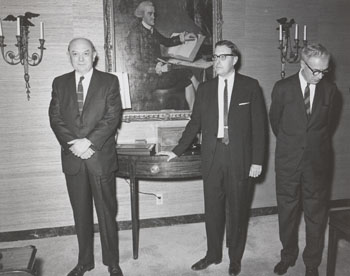
Left to Right: Secretary of State Dean Rusk with Bureau of Intelligence and Research (INR) Director Thomas L. Hughes, and INR Deputy Director Allan Evans (Photo courtesy Thomas L. Hughes)
Edited by Tom Blanton
Updated by John Prados
For more information, contact John Prados:
202-994-7000 or nsar...@gwu.edu
INR study re-released on appeal under FOIA restores redacted text and hundreds of pages of references
INR was highly attuned to Chinese aid to North Vietnam; first in US government to recognize significance of the Buddhist crisis in the South
RELATED LINKS
Bangor Daily News
"State Secrets"
June 16, 2004
National Security Archive
INR’s Nuclear Watch, 1959-1967
By William Burr
May 18, 2016
Association for Diplomatic Studies and Training
Foreign Affairs Oral History Project
Interview with Thomas L. Hughes
Initial date: July 7, 1999
DNSA COLLECTIONS
(subscription required)
U.S. Policy in the Vietnam War, Part I: 1954-1968
U.S. Policy in the Vietnam War, Part II: 1969-1975
SPECIAL EXHIBIT

SUGGESTED READING

by John Prados
Vietnam: The History of an Unwinnable War, 1945-1975
Lawrence: University of Kansas Press, 2009
ISBN: 978–0–7006–1634–3

by John Prados and Margaret Pratt Porter, eds.
Inside the Pentagon Papers
Lawrence: University of Kansas Press, 2004
ISBN: 0–7006–1325–0
Washington, DC, December 27, 2020—The National Security Archive is today posting an update to a 2004 E-book featuring a landmark but still relatively little-known State Department study of the Vietnam War from 1969. Commissioned by Thomas L. Hughes, the head of the Bureau of Intelligence and Research, it was a more modest account of the war than its more famous cousin, the Pentagon Papers. Yet in some ways it was more insightful and is considered essential to understanding the Department’s role in the conflict.
The Archive’s original posting presented a sometimes heavily redacted version of the document – all that was available at the time. However, after an Archive appeal under the Freedom of Information Act, the State Department released a much more complete version – most notably including an entire 275-page section consisting of specific references to INR's contributions to various government reporting, including its own papers, CIA estimates, and other records.
Today’s posting includes that section (part B), plus related materials by the document’s authors from that time as well as lengthy prefatory essays by Hughes and the Archive’s John Prados that also appeared as part of the original E-book.
* * * * *
Preface to the Updated Posting
By John Prados
The “Pentagon Papers,” a top secret Department of Defense inquiry into the background and conduct of the Vietnam war, became famous when leaked by Daniel Ellsberg in July 1971. A landmark Supreme Court case upheld First Amendment rights, prohibiting then-president Richard M. Nixon from preventing their publication. For years the Pentagon Papers furnished the ultimate documentary source for studies of the war. But there was another, equally secret, review of the Vietnam war, one that did not leak.
Time Magazine revealed its existence in August 1971 (see excerpt below) but that was virtually the only public mention of the State Department's study, which remained locked away for decades. In the 1990s both the National Security Archive and Clemson University professor Edwin E. Moise filed Freedom of Information Act requests for release of the INR study, much of which was declassified in 2003. The Archive then asked former Bureau of Intelligence and Research (INR) Director Thomas L. Hughes to contribute an essay that introduced the Bureau and discussed its work. I went over the same ground as an historian and supplied a paper that focused directly on INR's intelligence output. The Archive posted the package as Electronic Briefing Book no. 121 in May 2004.
At that time an entire section of the INR study, plus many passages throughout, remained secret and were under appeal. We subsequently got most of that material released. It is included in this new posting. There are currently perhaps a dozen short excisions left out of the study for classification purposes. We have also checked with Dr. Moise, who had also appealed the secret texts, and found we both held identical copies of the document. Because the INR study is a seminal resource, and because the previous electronic briefing book appears in an old format (without endnotes), we are reposting this package here.
* * * * *
Original Posting
Intelligence and Vietnam: The Top Secret 1969 State Department Study
National Security Archive Electronic Briefing Book No. 121
Retrospective Preface by Thomas L. Hughes (Former Director, Bureau of Intelligence and Research, U.S. Department of State)
Contextual Introduction by John Prados (Senior Fellow, National Security Archive)
Edited by Thomas S. Blanton (Director, National Security Archive)
Embargoed for release, Sunday, May 2, 2004
Two months after the leak of the Pentagon Papers generated front page headlines and a landmark Supreme Court case, TIME magazine reported:
"State's Secrets. The Pentagon, it seems, was not the only Government department to make a top-secret retrospective study of the nation's decisions in Vietnam. In 1968 Tom Hughes, then director of the State Department's Bureau of Intelligence and Research, ordered another report, far less voluminous and ambitious but with considerable potential impact.
"Composed by two State Department Asia analysts, the study compared the Kennedy and Johnson Administrations' key Vietnam decisions with the bureau's own major judgments during the same period. In almost every case, the intelligence reports called the shots perfectly about such matters as the ineffectiveness of the bombing campaign, Vietnamese political upheavals and North Vietnamese troop buildups. Daniel Ellsberg is said to have read the study as a consultant for Henry Kissinger in 1969 and reacted: 'My God, this is astonishing. I thought the CIA stuff was great, but these papers are even more accurate.'
"After publication of the Pentagon papers, the two known copies of the State study have been locked away. Ray Cline, the intelligence bureau's current director, has forbidden subordinates to admit their existence."
-- TIME magazine, August 9, 1971, p. 16
Secrecy and bureaucratic inertia kept this historic study hidden in State Department vaults for nearly 35 years, until Freedom of Information Act requests by Clemson University professor Edwin E. Moise and the George Washington University's National Security Archive forced the release of the bulk of the study in November 2003. Missing from that initial release because of a processing mistake was a significant part of the sources for section A-VI, which the National Security Archive obtained from the State Department on April 27, 2004. Still missing from the 596-page study are a number of questionable deletions on national security grounds, which the Archive has appealed.
In late 1968, Thomas L. Hughes, the director of the State Department's Bureau of Intelligence and Research (INR), commissioned this study, intended as an in-house classified review and evaluation of INR's performance on the subject of Vietnam during the eight years of the Kennedy and Johnson presidencies. As Mr. Hughes explains in the retrospective preface he generously provided for this posting, he tasked two former INR analysts who were intimately familiar with INR's product but no longer serving in the Bureau - W. Dean Howells and Dorothy Avery - to produce the study. They wrote the chronological review of INR reporting, compiled the annexes of source material, and wrote the thematic summaries as well. Recently retired INR staffer Fred Greene then reviewed the material and wrote the critique section. Mr. Hughes refrained from supervising or editing the results. All of this material except for the "B" section, the 265-page "Annexes Quoting Sources," is included in this posting.
Then-INR director Hughes comments in his retrospective preface for this posting: "INR's analysis on Vietnam stood out as tenaciously pessimistic from 1963 on, whether the question was the viability of the successive Saigon regimes, the Pentagon's statistical underestimation of enemy strength, the ultimate ineffectiveness of bombing the North, the persistence of the North Vietnamese and the Vietcong, or the danger of Chinese intervention." Mr. Hughes contrasts INR's consistency with that "of leading actors who were hawks by day and doves by night." Mr. Hughes laments that "while we [in INR] were heeded, we were unable to persuade, sway, or prevail when it came to the ultimate decisions."
Archive senior fellow John Prados, who edited the Archive's forthcoming documentary collection on Vietnam, gives INR more credit in his contextual introduction, calling the Bureau "the mouse that roared." Dr. Prados concludes that INR "helped hone U.S. intelligence conclusions, called attention to the poor data and inadequate intelligence collection taking place in Vietnam, saved the CIA and other agencies from going even farther out on a limb than they climbed, and … also helped limit the war by contributing to the reluctance of top officials to escalate too far."
Archive director Thomas Blanton commented that "Lessons from the Vietnam experience with intelligence run directly counter to today's reform proposals for the U.S. intelligence community. Instead of a centralized 'czar,' this history suggests we need a multiplicity of competing agencies and analyses. Instead of policymakers who cherry-pick only the intelligence they want to hear, we need to encourage dissents and force closer examination of contrary findings. Instead of covering up with the cloak of secrecy, we need to open the insider critiques in real time and enrich the public debate."
Preface: INR'S Vietnam Study in Context
A Retrospective Preface Thirty-five Years Later
by Thomas L. Hughes, Director of INR 1963-69
Since the completion of this study in 1969, dozens of books and memoirs on Vietnam have appeared. A striking pattern has emerged from their disclosures. To a far greater extent than was imagined in the 1960's, prominent officials in Washington engaged in a combined patriotic, political, and careerist suppression of their strong personal doubts about the war. Cumulatively, another tragic dimension has thus been added to the Vietnam tragedy itself-the unveiling of a dramatis personnae of split personalities, of leading actors who were hawks by day and doves by night-a plethora of public hawks who were private doves.
Introduction: The Mouse That Roared
State Department Intelligence in the Vietnam War
by John Prados, Senior Fellow, National Security Archive
One of the untold stories of the Vietnam era, a tale that lies at the very heart of the nexus of Washington's war decisions and its appreciations of that conflict, is how America's own diplomatic intelligence service contributed to United States understanding of affairs in Vietnam and their likely consequences. This is a story of steady efforts to piece together a wide range of unknowns into a coherent vision of how things appeared to Hanoi and its allies and what those parties would do about Vietnam themselves. It is an account of sometimes breathtaking, sometimes frustrating efforts to speak truth to power in a situation of primary importance to the United States, its leaders, and its people.
THE DOCUMENTS
Note: This version of the INR study was released to the National Security Archive after the original posting in 2004, in response to a Freedom of Information Act appeal.
VIETNAM, 1961 – 1968
Interpreted in INR’s Production
By W. Dean Howells, Dorothy Avery, and Fred Greene
A. Review of Judgments in INR Reports
Introductory Note: Note on Sources
A-I - The Problem Confronted, January 1961-February 1962
A-II - Looking for Progress, February 1962-May 1963
A-III - The Trouble with Diem, May-November 1963
A-IV - Time of Decision, November 1963-March 1965
A-V - Trial by Force, March 1965-February 1966
A-VI - A Massive Effort to Turn the Tide, February 1966-April 1968
A-VII - The Search for Peace, April-December 1968
B. Annexes Quoting Sources (Multiple Vietnam Analyses, annotated)
C-I - Communist Intentions and Response to U.S. Actions
C-IV – Prospects for Beginning Talks and Negotiating a Settlement
D. Critique of INR Interpretations in the Light of Contemporary Events
D-I - The Political Situation in South Vietnam
D-II - The Course of the War in the South
D-III - The War Against the North and the Role of China
E. Special Annexes Available as Authorized by the Director
E-III - Chinese Military Activity, September 1964-January 1965
E-IV - Sino-DRV Air and Ground Action, February 1965-February 1966
E-V - DRV Planes receive Sanctuary, 1967
Related Contemporaneous Materials
Letter, Fred Greene-Dean Howells, Feb. 2, 1969, Next Stages in the Vietnam Project
Note, Fred Greene to file, Feb 2, 1969, Illustrating categories
Memorandum, Allen S. Whiting-Thomas L. Hughes, Feb. 10, 1969, INR Estimates and the Vietnam War
Paper, Fred Greene, Random Observations on INR's Record, March 5, 1969
National Security Archive letters appealing questionable deletions in the INR study:
Lusi D.
“Apakah FPI tidak berketuhanan yang maha esa?”
Laporan: Deni Muhtarudin -
Minggu, 3 Januari, 2021 / 10:02 WIB
https://monitor.co.id/2021/01/03/roger-bandingkan-kasus-fpi-dengan-dua-eks-menteri-korupsi/
MONITOR, Jakarta – Pengamat Sosial dan Politik, Rocky Gerung, menilai
bahwa tidak ada yang salah apabila publik membandingkan kasus
pelarangan pembubaran Front Pembela Islam (FPI) oleh pemerintah dengan
kasus dugaan korupsi yang menjerat mantan Menteri Kelautan dan
Perikanan Edhy Prabowo dan Menteri Sosial Juliari P. Batubara.
Pasalnya, Rocky menjelaskan, publik menganggap landasan hukum yang
digunakan pemerintah dalam melarang dan membubarkan FPI karena dianggap
bertentangan dengan Pancasila dan UUD 1945 hingga dinyatakan sebagai
ormas terlarang tidak masuk akal.
Sedangkan, menurut Rocky, dua menteri yang terjerat kasus korupsi di
atas yang masing-masing berasal dari Partai Gerindra dan PDI Perjuangan
itu jelas-jelas telah mengangkangi Pancasila serta UUD 1945 harusnya
lebih mendapat perhatian serius dari pemerintah ketimbang FPI.
“Itu yang menyebabkan orang mikir kok enggak adil?. Partai-partai
politik yang koruptor itu justru yang memecah belah bangsa, memecah
belah keadilan. Kok bukan mereka yang dibubarin? Kan itu logika publik
gampang aja hal semacam itu,” ungkapnya saat berbincang dengan Wartawan
FNN Senior Hersubeno Arief dalam kanal Youtube Rocky Gerung Official
seperti dikutip pada Minggu (3/1/2021).
Namun, Rocky yakin, pemerintah akan berkilah dan menyebut bahwa antara
kasus FPI dan kasus dua menteri yang terjerat korupsi itu lain soal.
Meskipun, Rocky menegaskan, kasus menteri korupsi justru lebih
prioritas dibanding mengurusi FPI.
“Kan disebutin dasar pembubaran FPI adalah karena FPI bertentangan
dengan Pancasila. Sila mana? Sila pertama, apakah FPI tidak
berketuhanan yang maha esa? Sila kedua, kemanusiaan yang adil dan
beradab, apakah FPI tidak membantu proses-proses kemanusiaan bencana
segala macam. Sila kelima keadilan sosial bagi seluruh rakyat
Indonesia, apakah FPI tidak membagi-bagi bansos hasil sumbangan mereka
sendiri?,” ujarnya.
Pria yang kini akrab disapa Roger itu pun meminta pemerintah
menunjukkan dan menjelaskan Sila mana yang telah dilanggar oleh FPI.
“Jadi kan mesti ditunjukkan. Kalau tidak sesuai dengan Pancasila yang
mana?,” katanya.
Sunny ambon
https://asiatimes.com/2021/01/death-knell-tolls-for-indonesias-oil-and-gas/
Death knell tolls for Indonesia’s oil and gas
Indonesia lacks the foreign investment and domestic expertise needed to keep its fast-declining oil and gas industry afloat
By JOHN MCBETHJANUARY 5, 2021
JAKARTA – With Chevron and perhaps ExxonMobil heading for the exits, active exploration at a virtual standstill and production on an increasingly downward spiral, Indonesia’s government needs to conduct radical regulatory surgery before its oil and gas industry is doomed by the onrushing era of renewable energy.
Analysts say the nationalist tide that has swept over the industry in the past six years has left Indonesia on the bottom rung of prospective foreign investment and without the financial and technical means to explore for and develop new fields independently.
“The government needs to consider a major paradigm shift to spur investment if the country is to realize its geological potential before it becomes too late and its many remaining resources are left in the ground forever,” says one American oil expert with long experience in Indonesia.
That’s also because major oil companies, many with a previously long history in Indonesia, including BP, Royal Dutch Shell and Total, are signaling a shift to renewables as they start to scale back investment in traditional oil and gas projects.
“Globally, renewables are moving very fast, technology-wise, infrastructure-wise and cost-wise,” a former senior Indonesian energy official told Asia Times. “Renewables are now in head-on confrontation with oil and gas. As always, we (Indonesia) are behind the eight-ball.”
With most low-risk resources in Indonesia already being exploited, oil and gas output will continue to decline as state-owned Pertamina struggles to come up with the increased investment required to fund enhanced recovery technology in mature fields.
Exploration has fallen by an average of 23% over the past decade. According to government data, the number of exploratory wells plunged from 64 in 2014 to 26 in 2019 and only 18 last year, partly because of the impact of the Covid-19 pandemic and partly as a result of sagging global oil and gas prices.
Chevron is walking away after its failure to renew the contract to Sumatra’s long-producing Rokan oil block led to it relinquishing its 62% stake in the US$9 billion Indonesian Deepwater Development (IDD) project in Kalimantan’s Kutai Basin.
Italian oil company ENI, which operates one of the four fields to be merged under the IDD venture, is expected to replace Chevron, although officials said last week they were still in negotiations with ENI over commercial aspects of the five-year development.
ExxonMobil is also reportedly close to relinquishing its Cepu, East Java, oil block as it seeks to ditch projects with the lowest profit margins to focus on Papua New Guinea and the Gorgan liquified natural gas (LNG) project on Australia’s Northwest Shelf.
The oil giant is laying off 14,000 employees, or about 15% of its global work force, after the impact of the pandemic saw it lose its position as America’s top energy company to NextEra Energy Inc, which specializes in solar and wind power.
Cepu, an onshore block that went onstream in East Java in 2008, produced an average of 215,000 barrels of oil a day last year, edging ahead of Rokan’s 176,000 barrels, Indonesia’s largest producing field for more than five decades.
State oil company Pertamina estimates that Rokan’s Duri, Minas and Bekasap fields will need $70 billion in investment over the next 20 years to maintain production at acceptable levels and save an annual $4 billion in oil and product imports.
Since the 1980s, Chevron has employed the technologically challenging and capital intensive technique of steam-driven enhanced oil recovery (EOR), which has allowed it to achieve a 60% recovery rate to extend the life of the fast-maturing block.
But given the complexity of the operation, there are fears Rokan will follow the same pattern as East Kalimantan’s Mahakam gas block, where production has fallen away since Total was compelled to hand over control to Pertamina in early 2018.
Upstream regulator SSKMigas revealed last week that output fell by 20% in 2020 — from 605.5 million to 485 million standard cubic feet a day (MMSCFD) – because the number of wells drilled fell short of the target. It predicted a similar decline this year.
ExxonMobil’s departure would leave ENI, BP and ConocoPhillips as the only active petroleum majors in Indonesia. BP is adding a third production train to its Tanggu LNG complex in western Papua; delayed by Covid infections, it is now expected to be completed by early 2022.
Sources familiar with the project say promising results from exploratory drilling at BP’s new offshore Ubadari field, 70 kilometers southeast of Tanggu, will extend the facility’s life well beyond 2035 when the company’s current contract expires.
Japan’s Inpex will be hard-pressed to find a partner with the deep pockets and technical expertise to replace Royal Dutch Shell, which after a year of speculation has announced it is pulling out of the $19 billion Marsela gas venture in the remote Arafura Sea.
Inpex turned down an overture from the China National Overseas Oil Corp (CNOOC) for political, technical and what one source describes as “bad business chemistry issues,” leaving the company to contemplate at least a decade-long delay in developing Marsela’s Abadi field.
Last month, Inpex signed an MoU with state-owned Perusahaan Gas Negara (PGN) for a long-term supply contract in an effort to entice interest from a new partner. It had previously signed MoUs with power utility Perusahaan Listrik Negara (PLN) and a state fertilizer company.
Some experts question whether the Abadi field, 2,800 kilometers east of Jakarta on Indonesia’s maritime border with Australia, will ever be developed given its position high on the LNG cost curve in a commoditizing market.
Still, it is one of four so-called National Strategic Projects, including Tanggu, IDD and Pertamina’s Cepu-associated Jambaran-Tiung gasfield, which the Mines and Energy Ministry hopes will deliver on its 2030 target of one million barrels of oil and 12 billion standard cubic feet of gas a day.
Industry sources insist that can only be accomplished with material EOR capital and extensive exploration – and that means providing a raft of unprecedented incentives and other measures that will help put Indonesia back on the map of desirable investment targets.
Indonesia has 128 geological basins, only half of which have been explored. Oil production has fallen from 1.6 million to 700,000 barrels a day since 1995, the contribution of oil and gas to GDP has plummeted from 9% to 3.3% and foreign investment is at its lowest-ever point.
Experts say only deep-water exploration in prospective areas like offshore northern Sumatra, northern Papua and the Makassar Strait, separating Kalimantan and Sulawesi, have the potential to move the needle to any significant degree.
As things stand now, Indonesia’s greatest hope lies in the Andaman Sea, northwest of Aceh, where Abu Dhabi-based Mubadala Petroleum, Spain’s Repsol, BP and Malaysian state oil company Petronas have stakes in four adjacent blocks all under active exploration at depths of 1,000-1,500 meters.
Industry sources say high-quality 3D seismic shows the existence of several natural gas fields in the 3-4 trillion cubic feet range, all located in close proximity to the mothballed Arun LNG plant and its pipeline infrastructure.
Elsewhere, Pertamina is exploring around Tarakan, an island off northeast Kalimantan close to the Malaysian border, and other companies are drilling wildcat wells in a handful of far-flung blocks, including near Seram, the main island in southern Maluku.
“The opportunity is huge, but it cannot be met solely by risk-averse domestic and state-owned companies who also lack the balance sheets and necessary technology,” says the American expert. “The desire to nationalize the country’s resources, along with a woeful fiscal policy and bureaucracy, has dampened foreign investment.”
Ministry of Mines and Energy oil and gas director-general Tutuka Ariadji said in a year-end assessment that the government was considering a range of new incentives, among them investment credit, accelerated depreciation, value-added tax exemption and a streamlining of the licensing process.
“The government is very eager for a better oil and gas investment climate,” he said, adding that the government was open to “win-win” discussions with stakeholders on changes to regulations. But as in past years, officials may not be prepared to bite the bullet.
Foreign oil executives say they want to see an end to SSKMigas’ micro-management of exploration budgets. Oversight, they say, should only be confined to ensuring a production sharing contractor’s (PSC) work plan conforms with contract commitments and other laws.
Critics say apart from the government’s minute scrutiny of budgets, which often does not match the strict accounting procedures of most large international companies, it is also time to end the “archaic” tendering of exploration blocks.
In particular, they want to see significant changes to the cost recovery scheme, under which the government reimburses companies for upstream-related costs in exchange for a higher share – up to 85% — for each company’s earnings from oil and gas blocks.
Over the years, the government’s take, at least in share of revenue, has shrunk because of the higher costs associated with maintaining aging fields. That led to the introduction of an alternative gross split scheme, under which firms bore all the upstream costs, but the state received a smaller cut of up to 57% of revenue.
Once seen as a panacea to the deteriorating investment climate, the three-year experiment has now been abandoned by new Mines and Energy Minister Arifin Tasrif. Investors see the scheme as a victim of the Joko Widodo administration’s failure to consult with stakeholders.
“The mindset that foreign investors ‘overspend’ to take advantage of the cost recovery system is illogical,” says one consultant, echoing widespread complaints about a micro-management policy that also compels firms to buy overpriced Indonesian goods and services and favors cost over quality.
Apart from removing the limit on expatriate employees during the exploration phase, companies say SSKMigas oversight of a plan of development (POD) should be conceptual, instead of focusing on the money a PSC is spending from its own resources to develop a promising discovery.
“The main problem with POD evaluation is that the people doing the evaluation are incompetent,” says the consultant. “They may have the skill set to evaluate an onshore development, for example, but not a deep-water project.”
Other suggested changes include
· Remove ring-fencing for producing PSCs and also allow cost recovery for those engaged in active exploration.
· Allow failed exploration PSCs to sell any excess inventory to recover costs, instead of it automatically becoming the property of the Indonesian government.
· Sweeping improvements to the budget/authorization for expenditure (AFE) process, particularly the requirement for time-consuming layers of bureaucratic approval.
· Why, the industry asks, does it take years to relinquish a PSC, or months to get a PSC transfer approved?
Timing is one factor Indonesian regulators have never recognized, despite its impact on returns and investment attractiveness. It currently takes up to two years for exploration companies to open an office, secure financial and technical approvals, tender for goods and services and finally drill a well.
If the well is dry or the block is relinquished, it still takes another two and a half years to close out AFE, a puzzling anomaly when cost recovery only applies to the production phase, not during exploration when all the risk falls on companies.
Risk is something cash-strapped Pertamina and domestic companies have never been ready to take, mindful of the fact that only one in nine wildcat, or exploratory wells, yield results – and then not necessarily in commercial quantities.
The costliest example of that was the $1 billion spent by ExxonMobil, Marathon, ConocoPhillips, Norway’s Statoil and three smaller foreign companies in an unsuccessful search for oil and gas in 2,000-meter deep waters on the eastern side of the Makassar Strait between 2006 and 2011.
Most of the mature fields Pertamina has inherited as part of the same nationalist model Saudi Arabia adopted in the 1970s require the sort of enhanced recovery techniques and technology Indonesia does not possess.
“So the dilemma is does Indonesia wait until matters get worse, or do they take bold and drastic steps now,” says one foreign executive. “It is akin to a patient waiting whether to undergo treatment now or wait until a doctor decides on a prescription.
“In other words, Indonesia can choose to implement incentives and measures which it believes will make it more attractive (as countries like Egypt and Columbia have done in recent years), or wait to negotiate with foreign investors from an increasingly weak bargaining position.”
Sunny ambon
US Nuclear Weapons in the Netherlands: A First Appraisal
During the Cold War, Dutch units had responsibility for nuclear-capable Honest John rockets that were deployed in West Germany. This is an Honest John on display in the National Military Museum at the site of the former airbase at Soesterberg. (Photo from Wikipedia Commons).
Edited by Cees Wiebes and William Burr
For more information, contact:
202-994-7000 or nsar...@gwu.edu
January 1960 Agreement Led to Nuclear Sharing Arrangements
Public Access to Key Historical Records in Doubt after Dutch Courts Affirm Secrecy Regime for U.S. Nukes

RELATED LINKS
The U.S. Nuclear Presence in Western Europe, 1954-1962, Part II
September 16, 2020
The U.S. Nuclear Presence in Western Europe, 1954-1962, Part I
July 21, 2020
U.S. Government Debated Secret Nuclear Deployments in Iceland
August 15, 2016
United States Secretly Deployed Nuclear Bombs In 27 Countries and Territories During the Cold War
October 20, 1999
COURT BATTLE IN THE NETHERLANDS
by Cees Wiebes
One of the compilers of this publication, Dr. Cees Wiebes, had his own personal experience with the secrecy regime that blankets nuclear deployments in the Netherlands. On 3 April 2015 he filed a Freedom of Information Act (FIOA) request with the Netherlands Ministry of Defense (MoD). His request was for copies of historical documents from the Ministry’s archives relating to technical agreements with the United State government or the U.S. Department of Defense or other official U.S. bodies concerning the stationing of U.S. nuclear weapons on Dutch territory dating from the 1960s. The Ministry rejected the request after long internal deliberations and consultations with the office of the Prime Minister and the Ministry of Foreign Affairs.
Full text >>
Washington, D.C., January 15, 2021 – The stationing of U.S. nuclear weapons in Europe remains a controversial issue on both sides of the Atlantic. One of the less well-known cases involves the Netherlands, which first accepted atomic weapons shortly after the two governments signed a secret stockpile agreement in January 1960. That accord is part of a compilation of declassified documents posted today – most for the first time – by the National Security Archive.
That the U.S. has authorized deployments to numerous NATO states is one of those secrets everybody knows – Dutch former Prime Minister Ruud Lubbers acknowledged the facts of the matter involving his own country in 2013. Nevertheless, the arrangements are an official secret, as is the number of weapons currently in the Netherlands, and obtaining access to the historical record is a major challenge for historians. Recently the Dutch government confirmed its stance when scholar Cees Wiebes went to court to induce the declassification of documents on the origins of the deployments. Wiebes lost his case but in the process raised legitimate questions about excessive secrecy, which he addresses in a sidebar to this E-book.
The main body of today’s posting consists of records Wiebes obtained in the course of his research. The materials trace the story of the U.S. deployments from the inception of the nuclear stockpile plan in the late 1950s to their restructuring in the mid-1970s. While only a small piece of the larger history, the documents help provide a clearer picture of a still-controversial matter.
* * *
US Nuclear Weapons in the Netherlands: A First Appraisal
by Cees Wiebes and William Burr
The controversial deployments of U.S. nuclear weapons in NATO countries had their roots in the policies of the allies that associated with U.S. government plans to deploy the weapons on their territories for use in the event of war. From the beginning, according to documents published today by the National Security Archive, the government of the Netherlands has been a partner in the nuclear weapons enterprise. Since 1960, Washington and the Hague have had an agreement governing the deployments of U.S. nuclear weapons in the Netherlands, one of several documents published here for the first time. Since they began in 1960, the deployments have varied, from Honest John missiles to nuclear bombs for Dutch fighters and nuclear mines for anti-submarine war aircraft. Now, only nuclear bombs are deployed.
The fact of the agreement and the nuclear deployments remains an official secret from the standpoints of both the U.S. and the Dutch governments. Yet, over the years, archives in both countries have released, mostly inadvertently, significant documents that shed light on the interesting history of the Dutch-U.S. nuclear relationship. In the Netherlands, Cees Wiebes tested the secrecy in court proceedings and the courts ruled against him. Horrified by the archival releases and supported by U.S. importuning, the ministries and the courts united to defend the secrecy of the nuclear agreements with Washington and tried to reclassify the documents. Such incidents may reoccur until such time as Washington and its NATO partners develop a more reasonable policy governing disclosure of the history of a truly open secret.
Background
Of the 150 or so U.S. nuclear weapons that are believed to be currently deployed to NATO countries, some of them are stored in the Netherlands, as well as Germany, Italy, Belgium, and Turkey. Today’s National Security Archive publication focuses on the case of the Netherlands using primary sources to detail major phases of the U.S. nuclear weapons deployments in the Netherlands and the Dutch-U.S. nuclear relationship.
When and how did U.S. nuclear weapons arrive in Holland? Whether the U.S. deployed some weapons during the mid-1950s, before the stockpile program began, as it did in the instances of Italy and West Germany, is an unknown. In any event, the first step in the process began with a virtual invitation by Defense Minister Cornelis Staf during a NATO meeting in late 1956 [Document 1]. The arrival of the weapons during and after 1960, however, was a predicate of country-to-country agreements. From 1959 forward, the government of the Netherlands reached several technical agreements with U.S. government agencies, including the Department of Defense, concerning the stationing of U.S. nuclear weapons on its territory. The first one was the 6 May 1959 Dutch-U.S. nuclear cooperation agreement entitled “Agreement between the Government of the Kingdom of the Netherlands and the Government of the United States of America for cooperation on the uses of atomic energy for mutual defense purposes.” It was published officially in the Netherlands. [Document 2]
The May 1959 agreement was broader than the original “Agreement between the Parties to the North Atlantic Treaty for co-operation regarding atomic information” signed in Paris on 22 June 1955. The 6 May 1959 agreement contained a secret ‘technical annex’ dealing with information that the U.S. would transfer to Dutch military forces and a ‘security annex’ detailing security measures. The latter was an annex to a NATO agreement on the security measures that the members states would have to follow to safeguard atomic information.[1]
The basic idea behind the atomic stockpile arrangements was to give European allies such as the Netherlands confidence that nuclear weapons would be immediately available if a military crisis broke out. Accordingly, the stockpile agreements that participating governments signed made that possible. The secret 26 January 1960 technical agreement, signed by Ambassador Philip Young and the Dutch foreign minister, permitted the U.S. to store nuclear weapons in the Netherlands. Article 6 of the agreement stipulated that the Dutch government would be responsible for the external security of these weapons as well as during their transport by road or train in the Netherlands.
The stockpile agreement did not provide for Dutch forces deployed in West Germany to use nuclear weapons stored there. The stationing of a Netherlands Tactical Group in Germany had been negotiated in 1958 as part of a plan to support NATO’s forward strategy if war suddenly broke out. In that event, to make nuclear weapons available to those Dutch units it was necessary to negotiate an additional exchange of notes to provide that support [Document 6].[2]
Another major agreement applied to air dropped weapons. This was in a secret agreement signed 15 February 1960 between the USAF and the Royal Dutch Air Force allowing the USAF to deploy nuclear bombs to Volkel Air Base. The bombs arrived in the Netherlands in April 1960.
Arrival of the Weapons and Delivery Systems
The nuclear delivery systems that the United States provided to the Netherlands and other NATO members were in accordance with alliance military planning and the burden sharing agreements embodied in NATO’s force requirements strategy, MC-70. According to a December 1957 NATO communiqué:
“The deployment of these stocks and missiles and arrangements for their use will accordingly be decided in conformity with NATO defence plans and in agreement with the states directly concerned.”
The first nuclear weapon systems in the Netherlands were a battery of Honest John missiles to the Royal Netherlands Army (RNA); they would be on loan within the framework of the Mutual Defense Assistance Program (MDAP). The actual deployments took place during 1959/1960. According to a SHAPE official history, the Netherlands had made a request to SACEUR [Supreme Allied Commander Europe] General Lauris Norstad for a nuclear weapons storage site to support an Honest John unit.[3]
During the early 1960s, nuclearization for the Royal Netherlands Air Force (RNAF) began with plans to make tactical aircraft and their pilots ready for nuclear missions. One squadron with F-84F fighters was tasked for nuclear missions. The fighters could be deployed day or night, but they lacked all weather capability. The F-84s were replaced by two squadrons of F-104G Starfighter, which the U.S. and the Netherlands agreed would have nuclear capabilities.[4]
Concurrently the Royal Netherlands Army readied itself to operate air defense missile systems deployed to West Germany. RNA units first operated the NIKE system and then its replacement NIKE/HERCULES. In addition, during the early 1960s, the Army deployed two units each of the Honest John missiles (each with 4 launchers) and two mixed units of Honest Johns (each with two launchers). Between 1966 and 1967, 28 pieces of M107 were purchased by the Royal Netherlands Army to replace the cannon 155mm-M59 (the “Long Tom”). A further 11 pieces of 203mm howitzer M110 were also acquired for nuclear artillery tasks in 1966 and 1967. Sharing the air defense task with the Army, the RNAF would get 6 NIKE batteries for defense against incoming enemy planes.
The Royal Netherlands Navy would have nuclear missions under the direction of the Supreme Allied Commander Atlantic (SACLANT), whose role was written into the January 1960 agreement. The initial plan was to outfit Neptune planes assigned to the aircraft carrier Karel Doorman with nuclear depth charges. The nuclear depth charges were originally to be stored at Volkel, but they ended up at RAF St. Mawgan in Cornwall (U.K.). With the phasing out of the Karel Doorman in 1963 (sold to Argentina, which used it during the Falkland war), however, that project came to a halt. Nevertheless, detailed agreements with London and Washington would provide for a naval nuclear role. In an exchange of letters in 1965 President Johnson confirmed to U.K. Prime Minister Harold Wilson that the United States would release nuclear weapons to the Neptunes. Search for other instances and synchronize] only after a joint U.S.-U.K. agreement.[5] In keeping with this exchange of letters, the U.S. Navy and the Dutch Navy signed a technical agreement on 14 February 1968. Following that was a Dutch agreement with the British on 23 July 1970, which covered the use of the ‘Special Ammunitions Storage Site’ in St. Mawgan. Nuclear depth charges were permanently stored there which could be used by the 6 Dutch Neptunes that would fly from St. Mawgan beginning in 1974.
During the mid-to-late 1960s, budget cuts reduced the number of 8-inch Howitzers for nuclear tasks and lowered the number of Honest Johns to two 2 batteries (each with two launchers). The army also planned to make one unit of 155 mm Howitzers ‘nuclear capable’. Finally, the army made a transition to the NIKE/HERCULES program with a total of 7 squadrons of which 6 had a nuclear capability.
By 1975, the number of nuclear delivery vehicles assigned to the Dutch army remained the same, but nuclear modernization plans were in the works. While plans were underway to replace the Honest John with the Lance missile, the Army had two Honest John units with four launchers each and a battery of 8-inch Howitzers with 8 cannons. The initial plan for Lance was for it to have a nuclear capability but later military planners decided that it would have a conventional role. On the plan to make the 155 mm Howitzers nuclear capable, nothing had happened. The Army, however, had access to atomic demolition munitions (ADMs) under U.S. control and stored in West Germany. Their total number was about 30 of various yields. There was some uneasiness in the Dutch government that the Germans could control these nuclear devices. As for the Air Force, it had two squadrons of Lockheed F-104 Starfighters with a total of 36 fighters, which came into service in 1964.
The Netherlands also purchased the Nike Ajax missile and its successor the NIKE HERCULES for defending against medium high-flying planes. For low-flying targets the smaller Hawk was purchased. Much was delivered within the MDAP program. To manage these weapons, 5 Guided Weapons Groups (GWGs) were established in the Federal Republic of Germany. Two of the GWGs operated the Nikes and the other three had responsibility for the Hawk system.. Each group consisted of four scattered squadrons. The personnel strength of a NIKE group consisted of 1900 troops, of which about 40 percent were conscripts. A Hawk group had a strength of 1500 troops, of which about 30 percent were conscripts.
Nuclear weapons deployments in the Netherlands greatly changed after the Cold War ended. Except for nuclear bombs, the U.S. removed whatever weapons and delivery systems remained. According to a recent study by Hans Kristensen, some 150 bombs are now deployed at six bases in five countries: Aviano and Ghedi airbases in Italy; Incirlik in Turkey; Büchelin Germany, Kleine Brogel AB in Belgium, and Volkel AB in the Netherlands. In the Netherlands, there are an estimated 20 B61 bombs. The weapons are earmarked for delivery by Dutch F-16A/Bs of the 1st Fighter Wing and are under custody of the U.S. Air Force 703rd MUNSS. The base has 11 shelters equipped with underground bomb vaults (for a maximum capacity of 44 weapons).[6] Incursions by anti-nuclear activists have raised questions about base security and debate over the need for the deployments continues in both the United States and the Netherlands.[7]
Evidence from the Times
Some of the documentary record confirms the presence of nuclear weapons in the Netherlands during the 1960s and 1970s. In light of growing concern about international terrorism, the U.S. Embassy in the Hague became worried about the security of U.S. nuclear warheads at Volkel. On 1 July 1974, the U.S. ambassador in The Hague, Kingdon Gould, Jr, spoke with Dutch Foreign Minister Max van der Stoel on the “Retrieval of Nuclear Weapons. According to Gould’s top-secret memorandum of conversation, he spoke of the U.S. “desire … to develop contingency plans in the event that a nuclear device is stolen in the Netherlands or having been stolen elsewhere is moving towards or within Netherlands territory or territorial waters.” Van der Stoel did not have an answer to this delicate question but suggested that the Embassy discuss the matter with the Defense Ministry. [See Document 15]
Further confirmation of the presence of U.S. nuclear weapons on Dutch soil may be found in a memorandum, sent in June 1975 from the chief of the RNAF, Lt. General J. H. Knoop, to the minister of defense. His report provided a comprehensive picture for army, navy, and air force weapons during the period.
As noted earlier, U.S. modernization plans were an important part of U.S. nuclear planning. According to Knoop, the U.S. Air Force had proposed to the Belgian, Italian, German, and Netherlands air force a new generation of nuclear bombs to be provided beginning in early 1977. The USAF found that new weapons were safer, had lower maintenance costs, and had a better aerodynamic shape. The new weapons would have the same ‘yield range’ compared to the nukes presently ‘stored in The Netherlands’. Thus, there would be no enlargement of nuclear capabilities but only a routine modernization in the technical and logistical sense.
The two dual-capable squadrons of F-104 Starfighter were to be phased out in 1982 and 1983 and replaced by the F-16 which in principle was nuclear-capable. However, no final decision had been made as regards its nuclear tasks. According to Knoop, the nuclear-armed QRA Starfighters could be airborne in 15 minutes, clear evidence that the weapons were stored at Volkel air base. [See Document 17]
After the End of the Cold War, the U.S. continues to store nuclear bombs at Volkel Air Base but under broader, NATO auspices.[8] The nuclear weapons are stockpiled in the Netherlands is one of those badly kept secrets or open secrets. In 2013, former Prime Minister Ruud Lubbers openly spoke about the deployments in an interview, noting that when he was in the Dutch Air Force in the early 1960’s he had devised a way to inventory U.S. nuclear weapons to ensure their secrecy. Decades later, in the post-Cold War environment, Lubbers saw the weapons as an “an absolutely pointless part of a tradition in military thinking.” The next year, in 2014, anti-nuclear activists made a widely publicized foray into Volkel Airbase, showing the lax security arrangements for the nuclear bombs stored there.
The Challenge of Over-classification
The early history of the atomic stockpile in Europe ought to be in the declassified public record, while keeping details about weapons and related sensitive matters classified. But the rest, even the numbers of weapons in say 1960 or 1999, can be declassified without harm to U.S. or European security. To continue the present state of affairs does not make sense. Admittedly getting NATO, not to mention the U.S. Defense Department, to agree to a new declassification policy would be no easy task, but that does not mean that it should not be discussed.
Certainly, more needs to be learned about the story of the U.S. nuclear presence in the Netherlands and other European countries and its broader diplomatic, military, and socio-political implications although excessive secrecy may hinder the acquisition of more knowledge. Dutch and American military forces provided security for the nuclear weapons storage sites and learned how to use nuclear weapons, while U.S. custodial units had administrative control over the weapons themselves. What exactly that work involved and how orders for nuclear use would have been relayed remain untold and may remain so for many years. The story of Dutch-U.S. diplomatic negotiations over nuclear deployments is another untold story. Finally, the implications of the presence of nuclear weapons on nearby Dutch towns and villages as well as for Dutch political and social movements are issues that historians have begun to address but remain to be fully explored.[9]
* * * * *
Cees Wiebes studied international relations at the Department of Political Science at the University of Amsterdam. He served as a Senior Lecturer at the Department of International Relations, Faculty of Social and Behavioral Sciences, University of Amsterdam (1981-2005). He was a senior researcher at the Netherlands Institute of War Documentation (NIOD) in Amsterdam from 1989 to 2002. During this period he was a member of the team that researched the circumstances preceding, during and after the fall of the enclave of Srebrenica in Bosnia. He wrote the groundbreaking study Intelligence and the war in Bosnia, 1992-1995 (Münster: LIT Verlag, 2003). From 2005 to 2013 he worked as a senior analyst at the Expertise and Analysis Department of the Dutch National Coordinator for Counterterrorism. Wiebes has published extensively in intelligence history and the history of international relations.
Note: Thanks for assistance from Frank Klaassen, www.thunderstreaks.com; and Dario Fazzi, Roosevelt Institute for American Studies, the Netherlands.
READ THE DOCUMENTS
1957-03-15
Source: Records of the State Department (RG 59), Alpha-Numeric Files of the Swiss-BENELUX Desk, 1951-1963, box 11, N.22. Staf Visits (Defense Minister)
With Dutch Defense Minister Cornelis Staf slated to visit Washington, Dunham wrote to Lancaster about some of the key agenda items. One issue was the plans for supplying the Dutch with “modern weapons” and implementing the NATO atomic stockpile proposal, which were already under discussion with the Dutch. In particular, the Embassy and the Dutch had been discussing Honest John rockets and “conversion kits,” probably to make F-84 fighter-bombers nuclear-capable. Dunham noted that at a NATO meeting in December 1956, Staf had proposed that for dual-use weapons stationed in NATO countries “atomic weapons also be stored there under U.S. control for use by the Dutch and other NATO members should an emergency require.”
1959-05-06
Source: Tractatenblad of the Kingdom of the Netherlands 1959 Volume No. 3
Under Section 144b of the Atomic Energy Act, Restricted Data could not be shared with allies absent the negotiation of an agreement. The 144B agreement with the Netherlands was reached in May 1959, establishing the groundwork for the atomic stockpile system in the Netherlands. A major highlight of the agreement was the communication of information and the transfer of “non-nuclear parts of atomic weapons systems involving Restricted Data.” Information to be transferred would include defense plans and the use of atomic weapons and nuclear-capable delivery systems. Specifically, the United States would transfer to the Netherlands Government the “non-nuclear parts of atomic weapons systems involving Restricted Data” when it was determined that it was necessary to improve operational readiness and the state of training for Dutch forces.
Training in the use of nuclear weapons would require familiarity with their components, even those parts that would reveal atomic information.
1959-07-27
Source: RG 59, Office of the Special Assistant to the Secretary for Atomic Energy, Atomic Energy Matters 1948-1962
This exchange of notes brought into force the 144b agreement with the Netherlands that the two governments signed on 6 May 1959.
1959-12-11
Source: Records of Foreign Service Posts, Record Group 84 (RG 84), Records of the Hague Embassy, Classified General Records, 1945-1963
It had taken months to carry out the U.S.-Netherlands atomic cooperation agreement, as Russell Fessenden explained, because of a backlog of work. Before the agreement could be implemented there had to be a “statutory determination that communicating the pertinent Restricted Data to the Dutch would not endanger the common defense and security.” Such a determination would be prepared by the Joint Atomic Information Exchange Group, which would then be cleared by Defense and then the Atomic Energy Commission. Originally, it was thought that the determination on Germany had greater priority but with the delay on the Netherlands, the JAIEG decided to accelerate the timetable. According to Fessenden, the determination would be made within a month, although the holidays could cause a slight delay.
Note from U.S. Embassy, 26 January 1960, Secret
1960-01-26
Source: Archives of the Cabinet Office of the Netherlands
As Fessenden had anticipated, the JAEIG moved forward toward a favorable determination for the Netherlands fairly quickly and the two government finalized the stockpile agreement through an exchange of notes in January 1960. Given the NATO mission for the nuclear weapons, both the Hague and Washington agreed that SACEUR and SACLANT [Supreme Allied Commander Atlantic] would designate the location of the stockpiles “in accordance with approved NATO military plans” and the two governments. That SACLANT was involved suggested that naval nuclear weapons, such as anti-submarine weapons, would be involved in the program.
Other issues covered by the agreement were such matters as costs, U.S. custody, the role of “appropriate authority” in weapons release (the U.S. president), the role of U.S. forces for weapons assembly and other matters, provision of external security by Dutch forces, and the division of labor for transporting the weapons. The annex to the note provided for the deployment of U.S. custodial units in the Netherlands.
1960-03-28
Source: RG 59, Central Decimal Files, 1960-1963, 611.567/3-2860
The stockpile agreement with the Netherlands only provided for atomic weapons that would be assigned to Dutch forces in country. Separate agreements were necessary for Dutch access to atomic weapons elsewhere in NATO Europe, such as SACEUR’s plans for a Dutch NIKE battalion in West Germany. The proposed agreement would be similar to the one being negotiated for French forces in West Germany in that it would also include language about release authority and use in accordance with SACEUR plans. The stockpile agreement that had been negotiated with the Germans made provision for atomic support for third countries.
U.S. Embassy The Netherlands Telegram 1531 to Department of State, 31 May 1960, Secret
1960-05-31
Source: RG 59, Central Decimal Files, 1960-1963, 611.5673/5-3160
One aspect of the third-country agreement that was under consideration was the possible deployment of nuclear weapons to Dutch naval forces, probably for anti-submarine warfare purposes. The State Department wanted to make provision for that, apparently through the concept of a “floating” stockpile, but the Embassy saw that as a side issue unless the U.S. envisioned “Dutch personnel on a non-US, non-Dutch vessel.” In any event, the January 1960 agreement took into account naval considerations by accepting the authority of the Supreme Allied Commander Atlantic (SACLANT) to determine stockpile locations. As the Embassy noted, it might be a “stretch” to interpret that as meaning a Dutch ship, but it would be easier to amend the January agreement to make that possible. The Netherlands would probably be amenable to that because SACLANT was included in the agreement at their initiative.
1963-10-23
Source: RG 59, Central Decimal Files, 1960-1963
In a series of written questions and answers, Visser confirmed Van Der Deen’s inquiry about the deployment of Honest John rockets in the Netherlands and further acknowledged that they could be fitted with conventional or atomic weapons. Visser would not say whether atomic weapons were stored in the Netherlands but argued that “weapons of this type are necessary and useful for the Netherlands because NATO defense plans are in part based upon arming with tactical nuclear weapons.”
When Van Der Deen questioned whether the deployment of nuclear weapons would make the Netherlands “a direct target …. In the event of war,” Visser responded that possession of “said weapons” is “the best guarantee to prevent war.” He refused to consider removing the weapons from the Netherlands because “this defense exclusively serves the peace and the security.”
19-03-1961
Source: Dwight D. Eisenhower Library, Lauris Norstad Papers, box 85, Policy File Serie, Atomic Nuclear Policy 1961
With the stockpile agreement in place, by 1961, Volkel Air Base in the Netherlands would become a well-known site for U.S. nuclear weapons storage that enabled the Dutch Air Force to participate in the atomic weapons stockpile plan. With nuclear storage arrangements a new thing in the Netherlands, SACEUR General Lauris Norstad visited Volkel for a briefing. This heavily excised report of the briefing does not mention Volkel or the Netherlands, but the information on the withdrawals sheet at the Eisenhower Library includes those details.[10]
Further confirming the scene of the Norstad visit is the reference near the top of page 2 to Squadron Leader Bosch, who gave a briefing on security arrangements and the arming of nuclear weapons for the F-84s. A distinctly Dutch name, the only Bosch in the Royal Dutch Air Force that can be identified is J.L. Bosch who had become commander of Leeuwarden Air Base in 1960, which was not a nuclear storage site. Yet, because Bosch was an important figure in the development of the RNAF after World War II it is possible that Air Force leaders brought him to Volkel to give the briefing to Norstad (and the notetaker mistakenly titled him Major).
Some interesting details remain in the record of the briefing. It appears that a fairly rigorous process of command and control over the weapons and their released had been established. Norstad did not mention the ad hoc JCAE group that had visited the nuclear bases and was quite critical of custody arrangements, but he was interested in additional security, such as a “double check on each person issuing a command.” Unless this was done, he warned his audience, in an indirect reference to the JCAE and the White House, “our political masters will do it for us and this might involve the imposition of delays which would render the system ineffective.”
1963-03-07
Source: Dutch National Archives. Records of the Dutch Air Force, File 2.13.185
Volkel Air Base remained the sole site for U.S. nuclear bombs in the Netherlands, but the possibility of expanding the storage sites to Soesterberg Airfield was under consideration in early 1960. Apparently, consideration of Soesterberg began with a request by the United States Air Forces in Europe (USAFE), which the RNAF followed up with a formal proposal. For reasons that remain to be learned, the matter evidently went no further.
1962-04-05
Source: RG 59, Central Decimal Files, 1960-1962, 740.5611.4-562
State Department officials Farley and Tyler briefed U. Alexis Johnson on the ongoing plans by the Defense Department and the Atomic Energy Commission to survey nuclear weapons storage sites in NATO countries and check on the adequacy of custody arrangements for weapons that would be made available to non-nuclear NATO countries in a military emergency. The Netherlands was one of the NATO countries that would be surveyed, along with Italy, Germany, and Greece.
One of the purposes of the survey was to address the concerns raised by a subcommittee of the congressional Joint Committee on Atomic Energy (JCAE) in its major report on nuclear weapons arrangements in NATO Europe. Toward that end, the survey group would include a JCAE staffer, John Conway, who could determine how much progress had been made in following up recommendations made in its report.
It is not clear whether the survey group actually visited the Netherlands because its report focused on the Jupiter missiles in Italy and nuclear weapons arrangements in West Germany. Nevertheless, on page 24 of the report there is a reference to Dutch personnel, probably one of the battalions in West Germany that had trained for the use of Honest John missiles deployed there.
1965-03-23
Source: RG 59
The nuclear stockpile agreement with the British provided for storage of weapons in the U.K. by the U.S. and other NATO countries. At the time, the agreement was being ironed out the negotiators had in mind ASW nuclear weapons to be assigned to the Netherlands. The agreement did not provide for consultation on nuclear use because that was already a subject of previous Anglo-American understandings at the head-of-state level going back to the 1950s. Those understandings did not, however, include “third country” forces that could be stationed in the United Kingdom. The British, therefore, proposed that the consultative arrangements be expanded to do so. That was done later in the 1965, with exchanges of letters between Prime Minister Harold Wilson and President Lyndon B. Johnson.
1967-04-06
Source: MDR request to Defense Department; release by Interagency Security Classification Appeals Panel
The Netherlands participated in the first meeting of NATO’s Nuclear Planning Group (NPG), which became the alliance’s top-ranking body on nuclear policy. A special NATO committee to share sensitive nuclear information had been proposed by Secretary General Dirk Stikker earlier in the decade and Secretary of Defense Robert McNamara, along with other senior U.S. officials, believed that a permanent planning group could solve several problems. First, by sharing sensitive information on U.S. nuclear war plans and nuclear weapons effects, it would help educate the NPG’s members into the “realities” of nuclear weapons and discourage support for early use of the weapons. Second, it would help meet West Germany’s desire for a role in making policy on nuclear matters while avoiding further consideration of “hardware solutions” such as the Multilateral Force. While the Eisenhower administration had kept its European allies in the dark about nuclear weapons, the Kennedy and the Johnson administrations realized that they could not go on that way without causing deep strains within the alliance.[11]
Attending the meeting were the then permanent members—the U.S., Italy, the United Kingdom, and West Germany. Other NATO countries (limited to those participating in integrated military activities) participated on a rotating basis for one year, with Canada, the Netherlands, and Turkey in this group. Minister of Defense Lt. General Willem den Toom led the Dutch delegation.
McNamara led off the meeting with a briefing on the U.S.-Soviet strategic balance that was followed by a presentation on U.S. policy on anti-ballistic missiles. Following that were discussions of nuclear use and tactical weapons in the NATO area and then presentations by the Turks on Atomic Demolition Munitions and by the Germans on arrangements by host countries for nuclear weapons that was premised on Bonn’s interest in a greater voice over decisions that had an impact on German interests. During the discussion of McNamara’s first briefing den Toom asked a question about plans for the limited use of nuclear weapons, which led into a discussion of possible Soviet responses to U.S. nuclear use.
Van Dijl to Arthur Hockaday, NATO, Planning and Policy Division, 8 November 1967, Secret
1967-11-08
Source: Cees Wiebes Personal Collection
Van Dijl informed Hockaday that the Dutch Army’s nuclear forces would be organized in Army corps artillery units as of 1 October 1967. The corps would include two Honest John battalions with four launcher each and one battalion of eight-inch Howitzers comprising two batteries with four pieces in each. That would mean that two Honest John battalions would be abolished.
1967-12-15
Source: Netherlands National Archives, Cabinet Office, 2.03.01, Box 6935
This paper includes more detail on the army units with responsibilities for the Honest John and nuclear-capable artillery. The Honest Johns were deployed at Army Camp Steenwijkerwold, while nuclear artillery was deployed at Army camp ‘t Harde.
1969-10-08
Source: Mandatory declassification review released by Department of Defense
In 1968, Deputy Assistant Secretary of Defense for International Security Affairs Morton Halperin tasked officials in his bureau to prepare a comprehensive study of the arrangements that the United States had with governments around the world concerning nuclear weapons deployments and transit, including ship visits and overhead flights. The compendium was massively sanitized with names of countries and related details excised, but it was organized alphabetically making it not too difficult to find clues that could identify specific countries.
The section on the Netherlands is identifiable, not least because it includes the date 26 January 1960 for the formal exchange of notes between the Hague and Washington for the stockpiling of nuclear weapons in the Netherlands. It also includes other salient points, such as the fact that in December 1967 the U.S. began sharing data on the types, numbers, yields, and locations of nuclear weapons deployed at various bases in the Netherlands. The latter would have included the U.S. bases at Havelterberg and ‘t Harde along with the Dutch base at Volkel. Such disclosures McNamara had promised earlier in the year, at the Nuclear Planning Group meeting in April 1967.
1974-07-01
Source: RG 59, Records Relating to the Netherlands, 1965-1975, box 1, DEF 2 General
With terrorism becoming a greater concern, U.S. senior officials worried a bit about the security of the U.S. nuclear weapons that had been stockpiled in the Netherlands and other NATO countries. Meeting with the Dutch foreign minister, Gould spoke of the need for contingency plans in the event a nuclear weapon was stolen in the Netherlands, or, having been stolen elsewhere, was heading in the direction of the Netherlands. Van Der Stoel agreed on the need for planning as well as holding the matter very closely. The best person to bring in was van der Valk, head of the Foreign Ministry’s NATO section. Gould suggested that van der Valk get in touch with Deputy Chief of Mission Charles Tanguy.
Chief of the RNAF, lt. General J.H. Knoop to the Dutch ministry of Defense, No. 75-085/7419, 23 June 1975 [Translation Attached]
1975-06-23
Source: Cees Wiebes personal collection
With U.S. plans to modernize theater nuclear weapons in the works, General Knoop informed the defense minister of a U.S. Air Force proposal to the Belgian, Italian, German, and Netherlands air forces to replace nuclear bombs with a new type in 1977. In paragraph 4, Knoop stated that the new weapon would have the same explosive yield as the ones presently stored in the Netherlands.
1975-12-12
Source: Cees Wiebes personal collection
Dutch Minister of Defense Henk Vredeling (Labour party) wanted to know more about U.S. nuclear weapons stationed in the Netherlands. He forwarded his request to the Dutch Combined Chiefs of Staff. The official drafter of the memorandum to the minister was Lt. General A.J.W. Wijting who presented his overview to the minister on 11 December 1975 in a lengthy memorandum of more than 30 pages.
Wijting’s overview included a short historical sketch of the nuclear weapons developments, a numerical summary of all of these weapons and aspects of future developments in this field. It sketched out developments regarding the stationing of U.S. nuclear weapons on Dutch soil, with a brief factual account of the origins of the weapons stockpile; a numerical overview of the stockpile; and aspects relating to its future development. The crucial decision was made in 1957. Wijting portrayed 1957-1959 as the start-up period and 1959-1975 as the deployment phase.
In a separate appendix Wijting presented an overview of the nuclear activities of the Netherlands Armed Forces within the framework of the alliance, broken down by sections on the Royal Navy, Honest John, 155 mm. howitzer, the Royal Netherlands Air Force, and QRA. Most of the appendix was on “Future developments and possible problems”, where Wijting presented a wide tour d’horizon regarding developments in the different elements of the Netherlands armed forces. A translation of the part of the annex is attached to the end of the Wijting report.
2017-04-28
Source: Cees Wiebes personal collection
With this memorandum, sent to Wiebes by a government lawyer, the U.S. government weighed in on the case of whether documents he requested under Dutch FOIA could be declassified The essence of their position was that the presence of nuclear weapons in “specific foreign locations was a matter for which the U.S has been following a policy of “neither confirming nor denying.” Moreover, the Atomic Energy Act and national security information regulations control the release of such information. The same types of rules and procedures govern Dutch official access to nuclear weapons information, which is also regulated by NATO policy. Moreover, “past [archival] releases that were not properly authorized do not affect the classification level of the information, nor do they serve as precedent for continued public dissemination.”

The transfer of four F-84 Thunderstreaks fighter-bombers to the Netherlands Air Force, at Volkel Air Base, December 1955. The F-84s would become nuclear capable when they were provided with special conversion kits. By 1960-1961, nuclear bombs were stored at Volkel for use in a military emergency. (Photo from Dutch National Archives)
U.S Air Force General Lauris Norstad, who was simultaneously the Supreme Allied Commander Europe and Commander-in-Chief European Command during 1955-1962, presided over the development of the NATO nuclear stockpile program, including the provision of nuclear weapons for use by the Netherlands armed forces. (Photo from NATO Web site)
Two nuclear-capable “Nike Hercules” air defense systems assigned to Dutch forces, shown in a military parade, 5 May 1965. (Photo from Dutch National Archives)
A Lockheed P2V Neptune, used for maritime patrol and anti-submarine warfare missions by the Royal Netherlands Navy during 1961-1984. In the event of a U.S-Soviet war, the Dutch Neptunes would have carried nuclear depth charges stored at the British airbase at St. Magwan. (Photo from Ronald’s Web site, maintained by Ronald de Roij)
Entrance to the area at St.Magwan Air Base where, during the Cold War, the U.S. Navy had a storage installation for nuclear depth charges, for use by the U.S., United Kingdom, and the Netherlands navies. (Photo by Gregory Martin from CornwallLive)
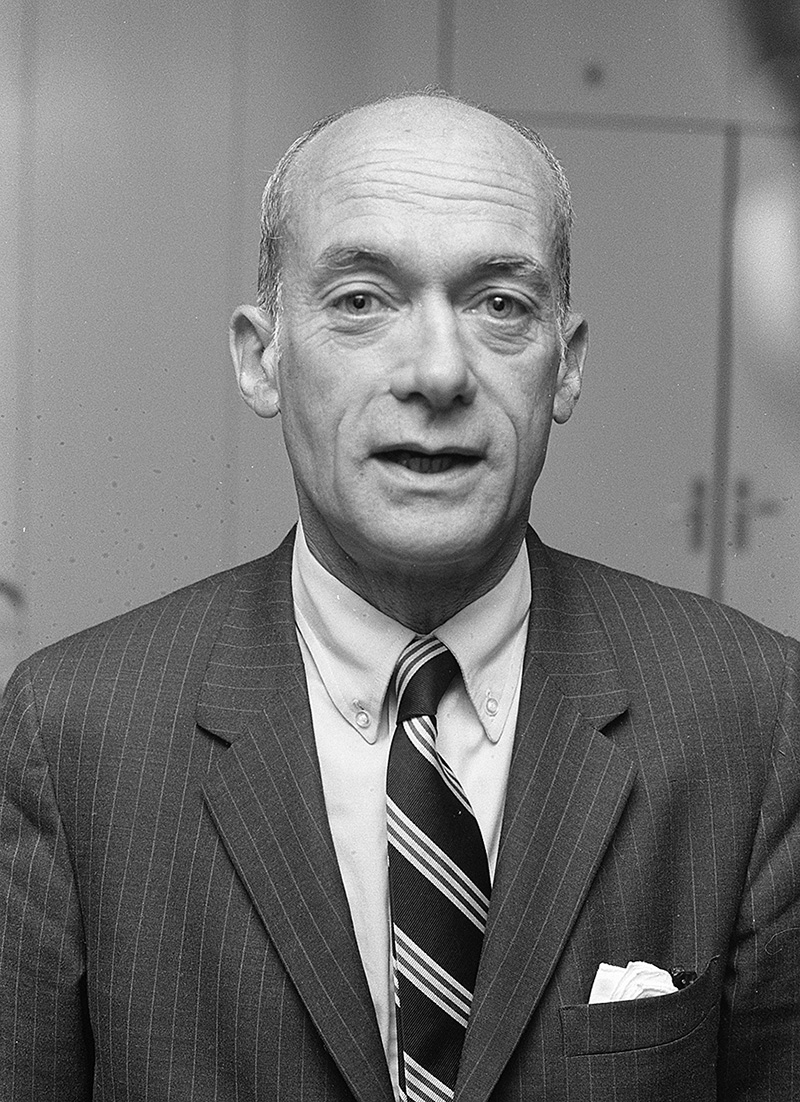
Kingdon Gould, the U.S. Ambassador to the Netherlands, discussed the problem of security for nuclear weapons in a top-secret discussion with the Dutch Foreign Minister Max Van Der Stoel on 1 July 1974 (See Document 17). Gould, a fund-raiser for the Republican Party, was a descendant of Jay Gould, reputedly one of the 19th century “Robber Barons.” (From photo collections at Dutch National Archives)
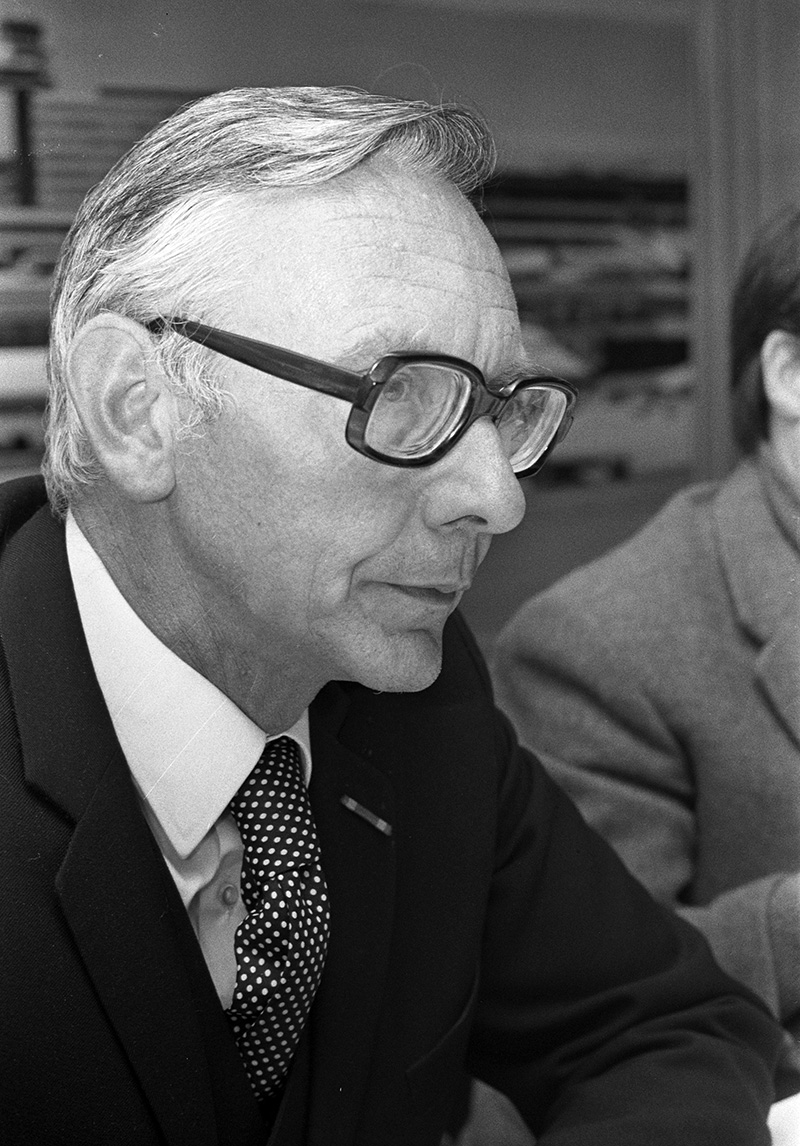
Max Van Der Stoel, a member of the Labor Party and Dutch Foreign Minister during 1973-1977, had a top-secret discussion of nuclear weapons security with U.S. Ambassador Kingdon Gould on 1 July 1974. (From photo collection at Dutch National Archives).
General Robbie Wijting (1925-1986) served as Chief of the Defense Staff of the Netherlands Armed Forces during 1973-1976. He signed off on a major study [See Document 19] of the nuclear weapons systems that were assigned to Dutch armed forces in the event of a military crisis. (Photo and information from Wikia)
A nuclear-capable F-104 fighter-bomber at Volkel Air Base. The photo was taken by Hans Engel during an air-spotters gathering at Volkel in September 1983. (Photo courtesy of Thunderstreaks.com)

Ruud Lubbers, a member of the Catholic People’s Party, served as Dutch Prime Minister during 1982-1994. In 2013, he acknowledged in an interview that his country remained a deployment site for U.S. nuclear weapons. (Photo from Dutch National Archives)
General Roger Brady, United States Air Forces in Europe Commander, watches disarming procedures on a “dummy” B61 nuclear weapon in an underground Weapons Security and Storage System (WS3) vault at Volkel Air Base, The Netherlands, on June 11, 2008. (U.S. Air Force photo, from Federation of American Scientists)
NOTES
[1]. Dutch National Archives, Cabinet Office, 2.03.01, Box 6935, Luns to the Prime Minister, 4 May 1964.
[2]. Supreme Allied Powers Europe History 1958 SHAPE 58/67, at 32-32.
[3]. Supreme Allied Powers Europe History 1958 SHAPE 58/67, at page 71.
[4]. Nils Ørvik, editor, Semialignment and Western Security (London: Routledge, 1986), 156.
[5]. NA, London, DEFE24/691, E 28, Top secret, no date.
[6]. For a major study, see Hans M. Kristensen, U.S. Nuclear Weapons in Europe A Review of Post-Cold War Policy, Force Levels, and War Planning (Washington, D.C., Natural Resources Defense Council, 2005). For a recent update see Kristensen, U.S. Nuclear Weapons in Europe, Federation of American Scientists, 1 November 2019. See also, Kristensen, “Nukes in Europe: Secrecy Under Siege,” Federation of American Scientists, 13 June 2013.
[7]. Jon Wolfsthal, “America Should Welcome a Discussion about NATO Nuclear Strategy,” The Bulletin of the Atomic Scientists, 29 June 2020.
[8]. Kjølv Egeland, “Spreading the Burden: How NATO Became a ‘Nuclear’ Alliance,” Diplomacy and Statecraft 31 (2020): 143-167.
[9]. On issues during the period of the Euromissile crisis, see, for example, Giles Scott-Smith, “The Netherlands between East and West: Dutch Politics, Dual Track, and Cruise Missiles,” in F. Bozo et al., eds, The Euromissile Crisis and the End of the Cold War. Stanford: Stanford University Press, 2015), and various publications by Ruud van Dijk, including Prelude to the Euromissile Crisis: The Neutron Bomb Affair, the Netherlands, and the "Defeat of the Strangeloves," 1977-1978, Nuclear Proliferation International History Project Working Paper No. 8 (2015). Dario Fazzi with the Roosevelt Institute is working on a larger study of the U.S. military presence in the Netherlands. See “Embodying the American Century: The Long-Lasting U.S. Military Presence in Europe and the Case of Schinnen,” International Journal for History, Culture and Modernity (2019, No. 9): 653-672l
[10]. This is confirmed in Timothy J. Botti, Ace in the Hole: Why the U.S. Did Not Use Nuclear Weapons in the Cold War, 1945 to 1965 (Westport, CT: Greenwood Press, 1996, at 274, note 12.
[11]. For a helpful recent overview of the NPG’s origins, see Timothy Andrews Sayle, “A Nuclear Education: The Origins of NATO’s Nuclear Planning Group,” The Journal of Strategic Studies, forthcoming. See also a study by State Department intelligence, Thomas L. Hughes to the Acting Secretary, “The Special Committee: Can It Satisfy European Aspirations,” REU-66, 22 September 1966, available on the Digital National Security Archive.
COURT BATTLE IN THE NETHERLANDS
by Cees Wiebes
One of the compilers of this publication, Dr. Cees Wiebes, had his own personal experience with the secrecy regime that blankets nuclear deployments in the Netherlands. On 3 April 2015 he filed a Freedom of Information Act (FIOA) request with the Netherlands Ministry of Defense (MoD). His request was for copies of historical documents from the Ministry’s archives relating to technical agreements with the United State government or the U.S. Department of Defense or other official U.S. bodies concerning the stationing of U.S. nuclear weapons on Dutch territory dating from the 1960s. The Ministry rejected the request after long internal deliberations and consultations with the office of the Prime Minister and the Ministry of Foreign Affairs.
In May 2017 after his initial FOIA request was rejected, Wiebes took his case to the lower court in Amsterdam. The MoD was represented by the Country Counsellor and nine advisers. Wiebes represented himself. The judges made clear from the start that the Dutch FOIA was not applicable to NATO documents. Wiebes argued that he was not asking for NATO documents. He was asking for Dutch official documents dealing with internal deliberations between three ministries (MoD, Foreign Affairs and the Cabinet Office). He requested official papers dealing with bilateral negotiations by the Dutch government with the U.S. government leading up to the treaties for storage of nuclear weapons on Dutch soil. In that case the Dutch FOIA was absolutely fully applicable.
The lower court ignored Wiebes’ argument. The judges concluded that in this case they were solely dealing with NATO documents. But how could they know? As a matter of fact, they did not take the opportunity to inspect the relevant documents themselves and simply embraced the statement by the government. In the archives of the MoD, Cabinet Office and Foreign Office Dutch official documents can be found that do not have a NATO classification. By ignoring Wiebes’s argument, the judges blatantly violated the law, which stipulates that the Lower Court must inspect the documents themselves. The judges also pointed to earlier verdicts by the Council of State, the highest appeals court in The Netherlands, regarding the release of NATO documents. These earlier verdicts were all negative: no release of NATO materials.
Wiebes argued that those earlier verdicts were irrelevant because those older FOIA requests were completely different cases. The case of Wiebes was unique and therefore needed a unique approach, which the lower court did not grant him. The judges also stated that it was not appropriate or necessary for the MoD to forward the original FOIA request to the Ministry of Foreign Affairs and the Cabinet Office because the Dutch FOIA was not applicable. They were flat wrong in this stance: the Dutch FOIA was fully applicable because Wiehes was asking for official internal deliberations, such as discussions with officials from other ministries. The MoD was obliged by law to forward his request to the other ministries but they did not. The MoD should have consulted NATO as to whether relevant documents in this matter could be declassified. However, the MoD did not. Finally, the judges of the Lower Court unquestioningly embraced the statement of the MoD that all documents which Wiebes found in the Dutch National Archives were released by a sloppy archivist who declassified the documents by mistake.
At the Council of State, the highest appeals court in the Netherlands, the battle continued. The U.S. Embassy delivered a strongly worded memorandum to the Ministry of Foreign Affairs declaring that the released archival documents about nuclear weapons deployments contravened both U.S. and NATO regulations as well as agreements with the Netherlands. The Foreign Ministry had probably alerted the Embassy. At the same time State Department officials were calling colleagues and friends of Wiebes in Washington D.C. to make inquiries. They wanted to know what Wiebes was up to and what documents he had found. Most friends flatly refused to cooperate.
At the Council of State in July 2018 the Country Counsellor plus 11 advisers stuck to the position that the government could “neither confirm nor deny” the existence of Dutch-USA treaties about the presence of U.S. nuclear weapons in the Netherlands. They did so even though during the proceedings Wiebes provided copies of relevant Dutch-U.S. agreements to the Council of State judges. The Country Counsellor even claimed the concept of her plea was leaked to Wiebes, which was not true. The latest batch of documents Wiebes had mailed to the court shocked the counselor. Where did Wiebes find these documents? His answer: in the Dutch National Archives around the corner. All three departments involved immediately started a thorough search in the National Archives for these documents and treaties.
Wiebes was unwilling to disclose the exact location but in the end government officials removed some documents from the National Archives. This was to no avail because Wiebes had already copied them. Dutch officials asked the U.S. Embassy in the Hague whether the nuclear agreements could be declassified. The answer was again a flat no. Also, NATO was opposed to a release. Wiebes, assisted by a former advisor of the Dutch Cabinet, pleaded again for the release of the materials but in the end to no avail. The Council of State tacitly held to the U.S. position that inadvertent or accidental release of information about the U.S. nuclear presence did not change the officially secret status of the information.
Wiebes’ experience was somewhat Kakfaesque but the real problem is the policy. As long as important details of the history of the U.S. nuclear presence in Western Europe are classified, archival releases, inadvertent or otherwise, may conflict with high-level policy.[A] Plainly, the Dutch archivists did not know what the policy was or had poor instructions from their supervisors. The information collected from the Dutch archives was useful for historians because they know more than they would have otherwise about an important issue. Nevertheless, the policy should be questioned, especially when it concerns an open secret.
NOTE
[A]. Accidental releases of information the authorities believe to be classified are not uncommon. The most notorious case in the United States was the “reclassification” scandal earlier this century. See Matthew M. Aid, ed., “Declassification in Reverse: The U.S. Intelligence Community's Secret Historical Document Reclassification Program,”, National Security Archiver Electronic Briefing Book 179, 7 February 2006, and various follow-up postings.

3
kh djie
Dosen Unismuh Makassar Arqam Azikin Tantang Anggota Fraksi PDIP Ribka Tjiptaning yang Tolak Vaksin
kh djie
Sunny ambon
Kalau menurut Al Quran orang Nasrani , Yahudi dan kafir tidak boleh jadi pemimpin
https://asiatimes.com/2021/01/widodo-has-no-fear-with-christian-police-chief-pick/
Widodo has no fear with Christian police chief pick
Indonesian leader thumbs nose at rising Islamic political pressure with Christian Listyo Sigit's elevation as Muslim-majority nation's top cop
By JOHN MCBETHJANUARY 19, 2021

Listyo Sigit is Indonesia's first Christian police chief in decades, significantly at a time of rising Islamic extremism. Image: Twitter
JAKARTA – President Joko Widodo’s nomination of a Christian to serve as the first head of the Indonesia National Police in 46 years signals further pushback against the Islamic conservatives who have given him his biggest political headaches during his six years in power.
Currently chief of the powerful Criminal Investigation Agency, often the stepping stone to the top job, Maluku-born Commander-General Listyo Sigit, 51, is the sole candidate chosen from among five three-star generals to replace General Idham Azis, 57, who retires at the end of this month.
Given his relative youth, Sigit could be in office for more than six years, a period that will span the 2024 general and presidential elections in which the 590,000-strong police force will have an important role to play.
Widodo can’t seek a third term, but as nominal head of the police and therefore internal security operations he will oversee one of the world’s largest single-day elections and also be in a position to defend his legacy and influence the choice of a successor.
When rumors began to circulate last November that Sigit was favored for the job, Muhyiddin Junaidi, deputy chairman of the Indonesian Ulema Council (MUI), the nation’s top Muslim clerical body, was quoted as saying the post should be filled by someone from the country’s Muslim majority.
Members of the Police Commission, which advised Widodo on the nomination, rejected Junaidi’s comments, saying religion should not be a factor in an 88% Muslim-majority country struggling to fight off rising intolerance.
Indonesian
President Joko Widodo prays at the Presidential Merdeka Palace in Jakarta, June
5, 2018. Photo: NurPhoto via AFP Forum
Government sources say the president secured the approval of the Indonesia’s two mass Muslim organizations, Nahdlatul Ulama (NU) and Muhammadiyah, before making his choice. He is expected to have little trouble winning parliamentary approval for the pick.
The nomination has already been defended by lawmakers from the National Awakening Party, (PKB) the political wing of NU which now controls the religious affairs portfolio after last month’s Cabinet reshuffle.
Widodo’s relations with NU took a dip when he overlooked its help in his 2019 re-election and instead chose retired general Fachrul Razi as religious affairs minister in his second-term team. Without NU’s support, Razi proved to be ineffective.
Religion aside, loyalty appears to have been the key factor. Sigit was police chief of Widodo’s hometown of Solo in 2011-2012 at the time he was mayor. Two years later he was handpicked by the newly-elected president to be his adjutant.
Similarly, current armed forces commander Air Chief Marshal Hadi Tjahjanto, 57, built a friendship with Widodo as commander of Solo’s Adisumarmo airbase between 2010 and 2011, subsequently serving as his military secretary in 2015.
Tjahjanto is due to retire in November after an unusually long four years in the top post, leaving Widodo with the difficult task of choosing between politically-wired army chief General Andika Perkasa, 56, and navy commander Admiral Yudo Margono, 55, who if the service rotation system is followed is next in line.
Anti-terror
policemen stand guard following a bomb blast at a police office in Surabaya,
Indonesia May 14, 2018. Photo: Agencies
The only other Christian police chief, Widodo Budidarmo, held the position between 1974 and 1978 during President Suharto’s New Order, an era when religion was not such a deciding factor for leadership positions as it is today. He died in 2017 at the age of 89.
During that same era, two Christians also commanded the Indonesian armed forces – General Maraden Panggabean, Suharto’s successor when he relinquished the post in 1973, and strongman General Benny Moerdani, who served from 1983 until he fell out of favor with the president in 1988.
Moerdani fueled resentment among senior Muslim officers by gathering a strong following of Christians around him, among them Luhut Panjaitan, now Widodo’s right-hand man as the current coordinating minister for maritime affairs and investment.
That all came to a boil on May 22, 1998, when the highly-regarded Lieutenant General Johny Lumintang was appointed commander of the Army Strategic Reserve (Kostrad), the two-division formation that forms Indonesia’s regular combat force.
A Christian from North Sulawesi, Lumintang’s time in the job lasted barely 17 hours before he was abruptly replaced by Lieutenant General Djamiri Chaniago, one of the so-called “green generals” who came to the fore in the wake of Suharto’s May 21 resignation.
Two years later, a controversy developed over president Abdurrahman Wahid’s appointment of General Suryo Bimantoro as police chief because of suspicions he was a closet Christian. That speculation was finally cleared up and he went on to spend 14 months in the job.
But the campaign against Christian leaders came to a head in 2016-2017 when Islamic conservatives staged massive protests in downtown Jakarta to bring down ethnic Chinese-Christian governor Basuki Purnama, a Widodo ally, on blasphemy charges.
Part of that so-called 212 Movement was the hard-line Islamic Defenders Front (FPI), recently outlawed after its leader Rizieq Shihab, 55, was arrested and charged with breaking health protocols on his return from exile in Saudi Arabia.
Muslim cleric
Rizieq Shihab (C), leader of the Indonesian hardline Islamic Defenders Front,
gestures to supporters as he arrives to inaugurate a mosque in Bogor on
November 13, 2020 Photo: Rangga Firmansyah/NurPhoto via AFP
Sigit will take over as police chief at a time when the force’s leadership is under pressure from the Human Rights Commission to explain the killings of six of Shihab’s FPI bodyguards during a December 6 pursuit on Jakarta’s eastern expressway.
The commission initially said there were indications that four of the men were victims of an unlawful killing, but its chairman, Ahmad Taufan Damanik, appeared to tone that down after a meeting with the president last week.
Sources in the human rights community claim he did seek to persuade – “even demand” – that the president order a more thorough investigation of the incident overseen by Chief Security MinisterMahfud MD.
That now seems increasingly unlikely. “No-one is pushing the envelope, the envelope is pushing them,” says one senior human rights figure. “My worry is that a lot of the muted unhappiness will go underground.”
Earlier this month, an undaunted Widodo pressed on with his crackdown by issuing a decree aimed at preventing “violent extremism that leads to “terrorism,” whichfeeds into the government narrative that the FPI is a breeding ground for groups loyal to the Islamic State (ISIS).
The preamble to the so-called national action plan, belatedly announced on January 17, said a “comprehensive strategy is needed to ensure systematic, planned and integrated steps involving the active role of all stakeholders.”
That includes the training of selected residents under a community policing program, apparently with the objective of creating a network of neighborhood informants who will report on extremist activities to police and the National Counter-Terrorism Agency.
TAGGED:Block 3IndonesiaIndonesia Ulema CouncilIslamic Defenders FrontJoko WidodoListyo SigitMuhammadiyahNahdlatul Ulama
Sunny ambon
.
https://www.ba-bamail.com/content.aspx?emailid=38700
Covid-19: What’s Known
About the New Common Variants By: Helena M. Add to Favorites Font Size:A+ A-
Join Us Share Tweet Send to friends Just when it seemed like we are at the
final stretch of the Covid-19 pandemic, with the Moderna and Pfizer vaccines being
approved and administered in countries around the world, multiple new strains
of the virus were discovered. This, in turn, is causing yet another wave
of lockdowns. If you’re a bit confused with the overflow of information, here
is a breakdown of the four new strains that pose the biggest threat and
what experts currently know about them.
1. The California strain Like This is the most recently-discovered Covid-19 variant on the list, and it is believed to have originated in California. A study from Cedars Sinai published on January 18, 2021, claims that this new strain was found in more than one-third of Covid-19 cases in Los Angeles, and it may be contributing to the acceleration of the recent surge of cases across Southern California. It isn’t clear whether the new variant is more contagious or just becoming more easily identifiable as laboratories perform genome sequencing.
Wenjuan
Zhang, Ph.D., assistant professor at the Department of Pathology and Laboratory
Medicine at Cedars-Sinai, said that the research team is "not sure what
the new findings mean in terms of the infectivity and antibody resistance of
the CAL.20C strain, which is important for follow-up studies that will need to
be completed." Related: Should You Abstain From Alcohol Around
a Covid-19 Vaccine?
3. The South Africa strain Like This particular strain is believed to have originated in South Africa, and it is possibly the most concerning one, as experts fear that it has the potential to evade vaccines. This variant has a new pattern of mutation, which causes more physical alterations in the structure of the spike protein compared to the UK strain. Vaccine makers and academic researchers are currently testing samples of this variant to verify these claims and see if it can indeed evade the immune response caused by vaccination. It should be noted that many experts have an optimistic view and think that the vaccine will ultimately work against it. We will have to wait until more research is available. As of now, the South African variant is yet to be detected in the US
4. The Brazil strain Like Two new strains were detected in Brazil, too. One variant was found in almost half of the people in one survey done in Manaus, Brazil, according to the CDC, while the other variant is far less widespread. The second variant did, however, make its way to the UK and was found in at least 11 people there. As far as the transmissibility rates, scientists say that the new strains from Brazil are likely to be more infectious, just as the strains from the UK and South Africa have proven to be. However, Felipe Naveca, a researcher in the Amazonas branch of Fiocruz, Brazil’s national medical research body, pointed out to Time magazine that there are other possible factors for the surge in Covid-19 cases in Manaus. Namely, he referred to a lack of social distancing and a change in the season that probably helped COVID-19 to spread in the recent weeks. “We still can’t confirm what is the role of this new variant in the recent explosion of cases, we need to do more work to confirm how common it is,” he said. Share this information with friends and family
https://www.ba-bamail.com/content.aspx?emailid=38700