
Prismatic coefficient (Cp)
488 views
Skip to first unread message

David Everett
Apr 12, 2014, 3:23:28 AM4/12/14
to catal...@googlegroups.com
Dear Group,
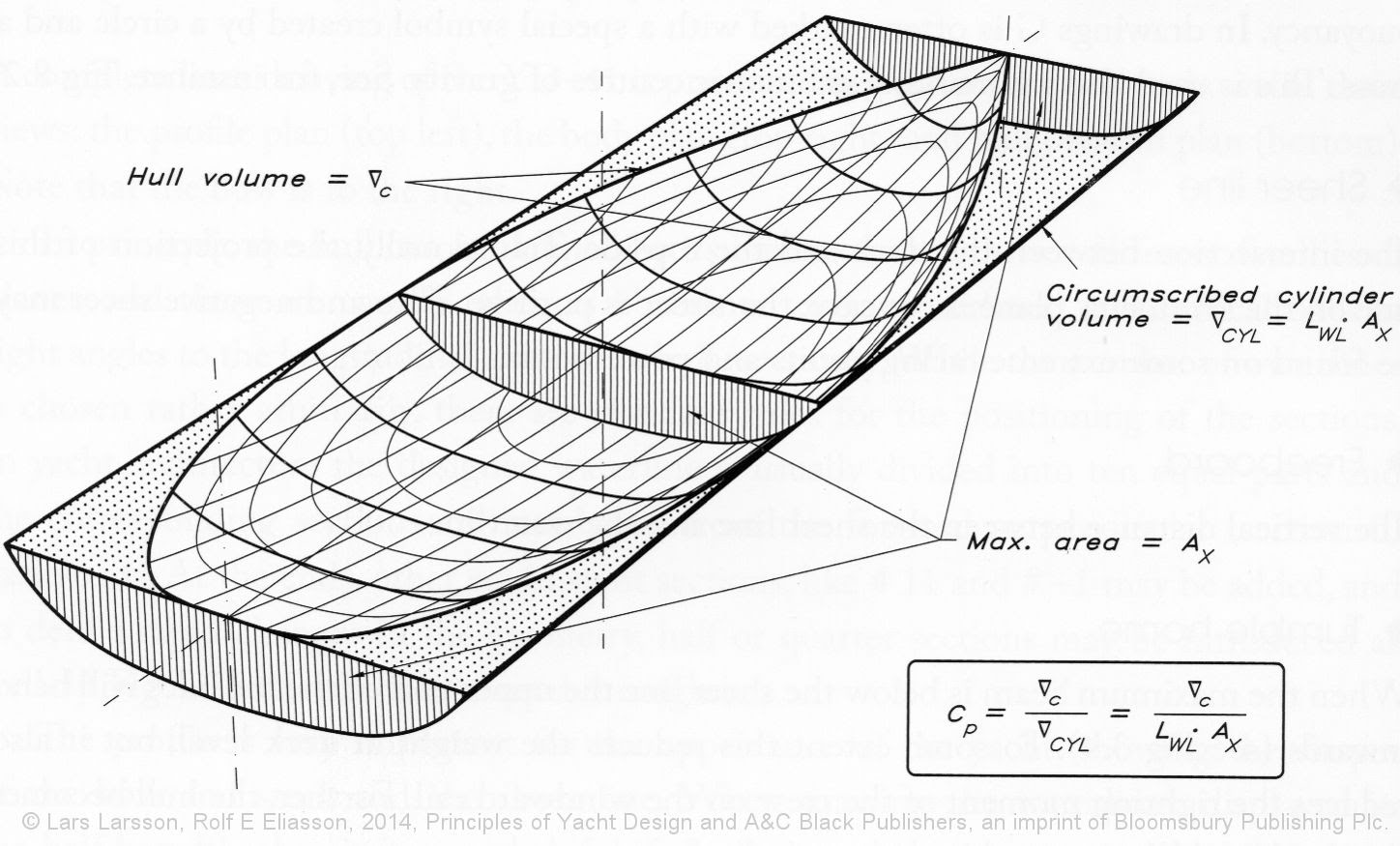
was reading some material on hull design, whilst cruising the islands in western south Australia, and the how small differences in design (especially the "modern trend" to maximise interior volume for a given length) can make a big difference between an easily driven hull Vs a slug. One measure of this is Cp, the prismatic co-efficient, which kind of measures how 'pointy' a boat is, with finer ends leading to a lower Cp. If a displacement hull is a cylinder with blunt ends, Cp = 1.0. If it was a fine needle it would be virtually zero (but would sink, and would be of zero volume, therefore not comfy!). An easily driven hull has a Cp close to 0.50, and a slug up around 0.6+.
Has any body encountered the Cp for our C355's? Or can work it out from the formula (would have to know our Hull Volume, and the maximum cross sectional area).
By the way, I'm reading a lot from a great website on cruising boats, which was recommended by a couple that have circumnavigated both the planet and Australia ( http://jackandjude.com/ ) -
Attainable Adventure Cruising, and you can take a look at http://www.morganscloud.com/
Cheers,
David

Mark Reeve
Apr 12, 2014, 12:34:25 PM4/12/14
to catal...@googlegroups.com
David: Interesting question and sorry that I don't have Catalina numbers. But I did dig up this discussion with Glen Henderson about a Hunter 41DS design, which is probably in the ballpark.
And I've also liked the Morgan's Cloud postings, thanks for reminding me of them!
Mark
--
You received this message because you are subscribed to the Google Groups Catalina355 group. To post to this group, send email to catal...@googlegroups.com. To unsubscribe from this group, send email to catalina355...@googlegroups.com. For more options, visit this group at https://groups.google.com/d/forum/catalina355?hl=en
If changing the topic, please start a new message and send to catal...@googlegroups.com, rather than clicking "reply" to an existing message.
---
You received this message because you are subscribed to the Google Groups "Catalina355" group.
To unsubscribe from this group and stop receiving emails from it, send an email to catalina355...@googlegroups.com.
To post to this group, send email to catal...@googlegroups.com.
To view this discussion on the web visit https://groups.google.com/d/msgid/catalina355/9512412c-c77a-4ad4-acfe-13e4faed8201%40googlegroups.com.
For more options, visit https://groups.google.com/d/optout.
Please note my new email address; mree...@gmail.com

Sam Paul
Apr 12, 2014, 1:23:30 PM4/12/14
to catal...@googlegroups.com, catal...@googlegroups.com
Interesting topic. In 2011, I asked Catalina for the polars and they suggested I use the Catalina 34 numbers. I wonder if someone has the C34 Cp number.

Stu Jackson
Apr 12, 2014, 4:03:04 PM4/12/14
to catal...@googlegroups.com
As far as I know we don't have that information.
Stu C34IA Secretary
Stu C34IA Secretary
David Everett
Apr 12, 2014, 10:27:30 PM4/12/14
to catal...@googlegroups.com
Spending a colder, greyer day at anchor, and too uninviting to spear-fish. So thought I'd do some maths! We aussies have to use both our fingers and our toes, so don't take these as gospel - in fact posting to see if anybody has already made these calculations and could compare notes. I also hope Gerry Douglas can let us know if we're wildly off the mark.
Before I start, does anybody know these two things - our beam-at-waterline, and is our length overall of 35'5" (35.417') exclusive of any over-hangs, especially the anchor sprit?
These calculations are based on the Basic Weight for the wing keel version (14,800 lbs), and a boat in salt water (though the difference for fresh water is quite tiny). Extra weight (displacement) will vary a lot; number of people usually on board, are tanks usually full or light, and how much gear you've accumulated. My estimate for my boat is an extra 700 kg in cruising mode (tanks full). I also searched for some of the values, rather than being my own calculations, so let's start with those.
Ballast Ratio = 42%
Sail Area:Displacement ratio (SAD) = 17.76 (motor sailer < 14, ocean cruisers 14-17, racing yachts 18-20 plus)
STIX ( a stability index used by the EU and IMCI) = 34.3. EU Catagory 1, Ocean Sailing, has a STIX > 32 and EU Catagory 2, Off-shore, has a STIX > 23. As far as I can work out the CE Cat 1 (our boat's USA catagory) is the same as the EU Cat 1.
Angle of vanishing stability (AVS) = 115 degrees (not as high as I was hoping).
Here's what turned up on fingers + toes:
Speed/Length ratio (V in knots divided by square root of LWL in feet). A pure displacement hull ( a cruising yacht like ours aiming for cruising speeds i.e. Not trying to plane or get that extra 0.01kn by keeping up dangerous amounts of sail in higher winds) has a Speed/Length ratio limit of 1.34. Beyond that the stern squats as the trailing wave tries to fall further behind, or something; anyway, its 1.34, which is probably the same as ' design hull speed'. The average cruising yacht aims to cruise at a ratio of around 0.9-1.0; that is making good speed but with conservative, safe, comfortable sail area up.
At 5kn, ratio is 0.91 or 68% 'hull speed'.
5.5kn is 1.001, 75%
6.0kn is 1.09, 81%
6.5kn is 1.18, 88%
7.0kn is 1.27, 95%
The limit of 1.34 is reached at 7.36kn. (On the odd occasion broad reaching way over-canvassed and some surfing action, and seeing 7.5-8.0kn did feel like we were exceeding designed hull speed and always coincided with " we really should reef!")
Displacement/Lenght ratio (heavy Vs light boats). Displacement in tons divided by 0.01LWL cubed. C355 = 244. Light racer/cruiser is around 150-200, average cruiser is around 250-300.
Our displacement in cubic feet salt water for 14800 lbs = 231 cubic feet
Capsize Screening Formula (CSF). Compares beam to displacement - excess beam contibutes to capsize, heavy displacement reduces capsize. CSF = Beam in feet divided by the displacement in cubic feet to 1/3 power, and is 1.959. Lower is better, and less than 2.0 is acceptable. For example, a 40 footer with heavy 60,000lbs displacement and narrow 12' beam has a CSF of 1.23, and a modern light boat like a Beneteau 311 has a CSF of 2.14 and would therefore not be a good choice for ocean sailing! Ours, just acceptable.
The Ted Brewer "Comfort Index". An attempt to quantify the forces that make a boat comfortable or violent at sea - pitching, pounding etc. Comfort Index = diplacement in pounds divided by 0.65 times the sum of 0.7LWL plus 0.3LOA, multiplied by Beam to power of 1.333. Our C355 is 26.21. Compare to blue water yachts like a Valiant 40 or Whitby 42 which are low to mid 30's, and a traditional heavy cruiser like a Collin Archer ketch at around 60.
Pounds per Inch Immersion (PPI), or how many pounds weight to sink the boat another inch into water. PPI = Waterline Area times 5.33 = 1295lbs, or 587kg. (Waterline area is usually 0.67 times LWL times Beam = 243 sq.ft)
Cp - prismatic ratio. Don't know, hence this post. Would love to know, or know someone (with extra fingers/toes) who can work it out! According to Ted Brewer, for a desired Speed/Lenght ratio of 1.18-1.27 (that's cruising at 6.5-7.0 knots, which would be lovely if all the time!) the ideal Cp would be around 0.56-0.58.
So, what did I learn, apart from its now lunchtime and the sun is trying to come out? It all confirms my impression of the C355 - a bit heavier and with more sea-worthiness than some of the euro production boats, and therefore fits my purpose of being a comfy coastal cruiser that can make longer passages of some days but where the likely conditions will be known, but is not quite a blue-water boat that one would choose for ocean crossing where one has to accept whatever weather is thrown at the boat. I've said to a few people now, in response to 'are you happy with her?', 'why did you chosse a C355', that yes I'm very happy with her, confident in moderate to fresh conditions, but if I intended to sail across oceans or around the world I'd have chosen a different and more traditional heavier design. Of course she could sail perfectly well across oceans or around the world, and some people have done it in much less sea-worthy craft, just with a bit less of a margin of stability, comfortable sea-motion and ultimate safety than some. For example, the boat 'only just' makes it into the CE Catagory 1 (but at least it does).
Lastly, sorry for not typing formulae mathematically - using an iPad.
Cheers, all
David
Before I start, does anybody know these two things - our beam-at-waterline, and is our length overall of 35'5" (35.417') exclusive of any over-hangs, especially the anchor sprit?
These calculations are based on the Basic Weight for the wing keel version (14,800 lbs), and a boat in salt water (though the difference for fresh water is quite tiny). Extra weight (displacement) will vary a lot; number of people usually on board, are tanks usually full or light, and how much gear you've accumulated. My estimate for my boat is an extra 700 kg in cruising mode (tanks full). I also searched for some of the values, rather than being my own calculations, so let's start with those.
Ballast Ratio = 42%
Sail Area:Displacement ratio (SAD) = 17.76 (motor sailer < 14, ocean cruisers 14-17, racing yachts 18-20 plus)
STIX ( a stability index used by the EU and IMCI) = 34.3. EU Catagory 1, Ocean Sailing, has a STIX > 32 and EU Catagory 2, Off-shore, has a STIX > 23. As far as I can work out the CE Cat 1 (our boat's USA catagory) is the same as the EU Cat 1.
Angle of vanishing stability (AVS) = 115 degrees (not as high as I was hoping).
Here's what turned up on fingers + toes:
Speed/Length ratio (V in knots divided by square root of LWL in feet). A pure displacement hull ( a cruising yacht like ours aiming for cruising speeds i.e. Not trying to plane or get that extra 0.01kn by keeping up dangerous amounts of sail in higher winds) has a Speed/Length ratio limit of 1.34. Beyond that the stern squats as the trailing wave tries to fall further behind, or something; anyway, its 1.34, which is probably the same as ' design hull speed'. The average cruising yacht aims to cruise at a ratio of around 0.9-1.0; that is making good speed but with conservative, safe, comfortable sail area up.
At 5kn, ratio is 0.91 or 68% 'hull speed'.
5.5kn is 1.001, 75%
6.0kn is 1.09, 81%
6.5kn is 1.18, 88%
7.0kn is 1.27, 95%
The limit of 1.34 is reached at 7.36kn. (On the odd occasion broad reaching way over-canvassed and some surfing action, and seeing 7.5-8.0kn did feel like we were exceeding designed hull speed and always coincided with " we really should reef!")
Displacement/Lenght ratio (heavy Vs light boats). Displacement in tons divided by 0.01LWL cubed. C355 = 244. Light racer/cruiser is around 150-200, average cruiser is around 250-300.
Our displacement in cubic feet salt water for 14800 lbs = 231 cubic feet
Capsize Screening Formula (CSF). Compares beam to displacement - excess beam contibutes to capsize, heavy displacement reduces capsize. CSF = Beam in feet divided by the displacement in cubic feet to 1/3 power, and is 1.959. Lower is better, and less than 2.0 is acceptable. For example, a 40 footer with heavy 60,000lbs displacement and narrow 12' beam has a CSF of 1.23, and a modern light boat like a Beneteau 311 has a CSF of 2.14 and would therefore not be a good choice for ocean sailing! Ours, just acceptable.
The Ted Brewer "Comfort Index". An attempt to quantify the forces that make a boat comfortable or violent at sea - pitching, pounding etc. Comfort Index = diplacement in pounds divided by 0.65 times the sum of 0.7LWL plus 0.3LOA, multiplied by Beam to power of 1.333. Our C355 is 26.21. Compare to blue water yachts like a Valiant 40 or Whitby 42 which are low to mid 30's, and a traditional heavy cruiser like a Collin Archer ketch at around 60.
Pounds per Inch Immersion (PPI), or how many pounds weight to sink the boat another inch into water. PPI = Waterline Area times 5.33 = 1295lbs, or 587kg. (Waterline area is usually 0.67 times LWL times Beam = 243 sq.ft)
Cp - prismatic ratio. Don't know, hence this post. Would love to know, or know someone (with extra fingers/toes) who can work it out! According to Ted Brewer, for a desired Speed/Lenght ratio of 1.18-1.27 (that's cruising at 6.5-7.0 knots, which would be lovely if all the time!) the ideal Cp would be around 0.56-0.58.
So, what did I learn, apart from its now lunchtime and the sun is trying to come out? It all confirms my impression of the C355 - a bit heavier and with more sea-worthiness than some of the euro production boats, and therefore fits my purpose of being a comfy coastal cruiser that can make longer passages of some days but where the likely conditions will be known, but is not quite a blue-water boat that one would choose for ocean crossing where one has to accept whatever weather is thrown at the boat. I've said to a few people now, in response to 'are you happy with her?', 'why did you chosse a C355', that yes I'm very happy with her, confident in moderate to fresh conditions, but if I intended to sail across oceans or around the world I'd have chosen a different and more traditional heavier design. Of course she could sail perfectly well across oceans or around the world, and some people have done it in much less sea-worthy craft, just with a bit less of a margin of stability, comfortable sea-motion and ultimate safety than some. For example, the boat 'only just' makes it into the CE Catagory 1 (but at least it does).
Lastly, sorry for not typing formulae mathematically - using an iPad.
Cheers, all
David

Rory McGuinness
Apr 12, 2014, 11:57:39 PM4/12/14
to catal...@googlegroups.com
David, this is very valuable when trying to talk in real terms about
just how a 355 fits into that seemingly infinite spectrum of other boats
new and old, large and small that we inevitably end up comparing it to.
And I haven't even taken delivery of mine yet!
Thanks for the post!
Rory
--
Rory McGuinness
+61 (0) 417 554 226
just how a 355 fits into that seemingly infinite spectrum of other boats
new and old, large and small that we inevitably end up comparing it to.
And I haven't even taken delivery of mine yet!
Thanks for the post!
Rory
Rory McGuinness
+61 (0) 417 554 226

mgreen19
May 23, 2014, 3:58:41 PM5/23/14
to catal...@googlegroups.com
The Hull Volume can be calculated from the displacement (weight) of the boat (and hence the water it displaces). Density of water is 62.4 lbs/cu ft. Salt water is about 2.5% more dense. So divide weight of boat in lbs by 62.4 lbs/cu ft to get cu ft of water displaced.
Maybe Catalina could help with max cross sectional area.
Cheers,
Mike
Maybe Catalina could help with max cross sectional area.
Cheers,
Mike
David Everett
May 23, 2014, 6:48:51 PM5/23/14
to catal...@googlegroups.com
Mike, I worked out in my April 13 post that "Our displacement in cubic feet salt water for 14800 lbs = 231 cubic feet "
So, we've got that, just need that Max Cross Sectional area.
Those still having face-face with factory, and Gerry, could ask?
So, we've got that, just need that Max Cross Sectional area.
Those still having face-face with factory, and Gerry, could ask?
One thing I left out of my April post - I wonder what the difference in Angle of Vanishing Stability is between the shallow draft and the fin keel?
115 degrees for my shallow draft is slightly worrying, so I've decided not to capsize, not even for fun!
Cheers,
David
Reply all
Reply to author
Forward
0 new messages