
Differences between rstanarm and brms?

Travis Riddle
library(languageR) #for data
library(rstanarm)
library(brms)
library(dplyr)
library(ggplot)
library(tidyr)

stan.pen <- stan_lmer(RT ~ list*priming + (priming|subjects) + (1|items), data=splitplot,                       prior=normal(0,250), prior_intercept=normal(500,200))p <- c(set_prior('normal(0,250)', class='b'),       set_prior('normal(500,200)', class='Intercept', coef=''))
brm.pen <- brm(RT ~ list*priming + (priming|subjects) + (1|items),                data=splitplot, prior=p)
newdat <- expand.grid(list = rownames(table(splitplot$list)),                      priming = rownames(table(splitplot$priming)),                      subjects='0',                      items = rownames(table(splitplot$items)))
temp <- as.data.frame(  rstanarm::posterior_linpred(stan.pen, re.form = NA,                     newdata = newdat, allow_new_levels=T)) #the linear predictortemp$sample <- seq(1, length(temp$`1`))newdat$index <- as.character(seq(1, length(newdat$list)))
temp %>%  gather(index, prediction, -sample) %>%  left_join(newdat) %>%  group_by(list, priming) %>%  summarise(est = mean(prediction), #mean of the linear predictor            lower = quantile(prediction, .025),            upper = quantile(prediction, .975)) %>% #upper and lower 95% uncertainty intervals  mutate(model='rstanarm') -> plot.dat

temp <- as.data.frame(  brms::posterior_linpred(brm.pen, re.form = NA,                               newdata = newdat, allow_new_levels=T)) #linear predictortemp$sample <- seq(1, length(temp$`V1`))newdat$index <- as.character(paste('V', seq(1, length(newdat$list)), sep=''))
temp %>%  gather(index, prediction, -sample) %>%  left_join(newdat) %>%  group_by(list, priming) %>%  summarise(est = mean(prediction), #mean of the linear predictor            lower = quantile(prediction, .025),            upper = quantile(prediction, .975)) %>% #upper and lower 95% uncertainty intervals  mutate(model='brms') %>%  rbind(plot.dat) -> plot.dat
ggplot(plot.dat, aes(x=list, y=est, group=model, color=model)) +  geom_point(position=position_dodge(width=.5)) +   geom_errorbar(aes(ymin=lower, ymax=upper), position=position_dodge(width=.5)) +  facet_wrap(~priming)
This produces the following figure:

So it seems the mean is correct, but the uncertainty intervals do not match. Why not?
I've looked at some of the actual parameters estimated, and I think there's some differences in the covariance matrix:
stan.df <- data.frame(stan.pen)
brm.df <- data.frame(brm.pen)


df <- data.frame(model = c(rep('rstanarm', 4000),
                           rep('brms', 4000)),
                 sample = c(seq(1:4000), seq(1:4000)),
                 intercept = c(stan.df$X.Intercept., brm.df$b_Intercept),
                 b_listlistB = c(stan.df$listlistB, brm.df$b_listlistB),
                 b_primingunprimed = c(stan.df$primingunprimed,
                                       brm.df$b_primingunprimed),
                 b_list_priming = c(stan.df$listlistB.primingunprimed,
                                    brm.df$b_listlistB.primingunprimed),
                 sigma = c(stan.df$sigma, brm.df$sigma),
                 sigma.items_int = c(stan.df$Sigma.items..Intercept...Intercept..,
                                     brm.df$sd_items__Intercept),
                 sigma.subjects_int = c(stan.df$Sigma.subjects..Intercept...Intercept..,
                                        brm.df$sd_subjects__Intercept),
                 sigma.subjects_priming.int = c(stan.df$Sigma.subjects.primingunprimed..Intercept..,
                                                brm.df$cor_subjects__Intercept__primingunprimed),
                 sigma.subjects_priming = c(stan.df$Sigma.subjects.primingunprimed.primingunprimed.,
                                            brm.df$sd_subjects__primingunprimed))

df %>%
  gather(parameter, value, intercept:sigma.subjects_priming) %>%
  ggplot(aes(x=value, group=model, color=model)) +
  geom_density() +
  facet_wrap(~parameter, scales='free')
Sorry if I've missed something obvious in the documentation. What explains this behavior? Even if I'm misunderstanding the parameters (or something), I would expect the function `posterior_linpred` to perform identically in these situations, unless I've misspecified the model...

Paul Buerkner
--
You received this message because you are subscribed to the Google Groups "brms-users" group.
To unsubscribe from this group and stop receiving emails from it, send an email to brms-users+unsubscribe@googlegroups.com.
To post to this group, send email to brms-...@googlegroups.com.
To view this discussion on the web visit https://groups.google.com/d/msgid/brms-users/4c5e36a1-dd48-497c-8419-8680f2f3985d%40googlegroups.com.
For more options, visit https://groups.google.com/d/optout.
Paul Buerkner
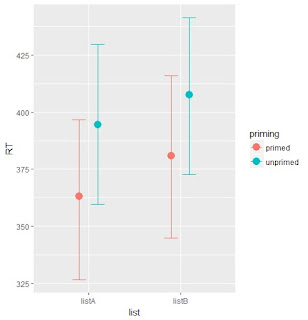
The lines pretty much look like the blue lines in your plot, which you labled as belonging to rstanarm.
Paul Buerkner
Travis Riddle
Paul Buerkner
--
You received this message because you are subscribed to the Google Groups "brms-users" group.
To unsubscribe from this group and stop receiving emails from it, send an email to brms-users+unsubscribe@googlegroups.com.
To post to this group, send email to brms-...@googlegroups.com.
To view this discussion on the web visit https://groups.google.com/d/msgid/brms-users/197e08f8-24f9-41bd-a0c1-5f0886fc5d29%40googlegroups.com.
Travis Riddle
library(rstanarm)
library(brms)
library(dplyr)
library(ggplot2)


testing_data <- read.csv('testing_data.csv')


p <- c(set_prior('normal(2,2)', class='Intercept', coef=''),
       set_prior('normal(0,1)', class='b'))


m.brm <- brm(gpa ~ Condition*Ethnicity + (1|ID) +
               (Condition*Ethnicity|site), data=testing_data,
             control=list(adapt_delta=.9999, max_treedepth=15), prior=p)
m.rstanarm <- stan_glmer(gpa ~ Condition*Ethnicity + (1|ID) +
                           (Condition*Ethnicity|site),
                         prior_intercept=normal(2,2), prior=normal(0,1),
                         data=testing_data, adapt_delta = .9999999)
There are some differences in the mean for each of these parameters, but they're sufficiently small that I suspect they would converge in the limit. The variance, however, I have no explanation for, and seems much too great to be due to sampling variability (plus, this recurs with new fits and different samples of the data).
summary(m.brm)

 ...(truncated)...


Population-Level Effects:

                                  Estimate Est.Error l-95% CI u-95% CI Eff.Sample Rhat

Intercept                             2.35      0.29     1.73     2.88       1504 1.00

ConditionTreatment                    0.20      0.30    -0.40     0.79       1011 1.00

EthnicityWhite                        0.84      0.30     0.16     1.38       1377 1.00

ConditionTreatment:EthnicityWhite    -0.24      0.39    -0.97     0.55       1223 1.00


Family Specific Parameters:

      Estimate Est.Error l-95% CI u-95% CI Eff.Sample Rhat

sigma     0.44      0.01     0.42     0.47       4000 1.00


Samples were drawn using sampling(NUTS). For each parameter, Eff.Sample

is a crude measure of effective sample size, and Rhat is the potential

scale reduction factor on split chains (at convergence, Rhat = 1).summary(m.rstanarm)[1:4,c(1,3,4,8,9,10)]
mean sd 2.5% 97.5% n_eff Rhat
(Intercept) 2.3478353 0.2047021 1.9469587 2.7573228 552 1.003772
ConditionTreatment 0.2405582 0.2505187 -0.2488431 0.7221305 472 1.008159
EthnicityWhite 0.9094795 0.2283877 0.4650232 1.3454927 465 1.005876
ConditionTreatment:EthnicityWhite -0.3137621 0.3100872 -0.9194833 0.2908425 385 1.005505Any insight would be extremely valuable to me. Thanks,
On Monday, November 20, 2017 at 1:47:12 PM UTC-5, Paul Buerkner wrote:
Yes they included the uncertainty of the random effects.
Am 20.11.2017 19:42 schrieb "Travis Riddle" <rid...@gmail.com>:
Ah! This is great. Thanks a lot Paul. So the values given by posterior_linpred in brms included all random effects?--Also, amazing work on the package.
On Monday, November 20, 2017 at 7:56:54 AM UTC-5, Paul Buerkner wrote:I get it now. In brms, the argument is called re_formula not re.form. This is unfortunate and I will introduce the re.form alias in the next version of brms.
You received this message because you are subscribed to the Google Groups "brms-users" group.
To unsubscribe from this group and stop receiving emails from it, send an email to brms-users+...@googlegroups.com.
Paul Buerkner
Estimate
Intercept 0.4496999
ConditionTreatment 0.3888073
EthnicityWhite 0.4617288
ConditionTreatment:EthnicityWhite 0.5834659
Groups Name Std.Dev. Corr
ID (Intercept) 0.75533
site (Intercept) 0.27836
ConditionTreatment 0.22673 -0.097
EthnicityWhite 0.23986 0.085 -0.099
ConditionTreatment:EthnicityWhite 0.25943 0.033 -0.083 -0.184
Residual 0.44043
I have to investigate this in more detail, but this might be the result of narrower priors on the group-level SDs of site in rstanarm as compared to brms. Since larger values of the group-level SDs imply larger variation in the population-level effects, this might explain the differences you observed.
[1] 0.7569105
[1] 0.4405743
To unsubscribe from this group and stop receiving emails from it, send an email to brms-users+unsubscribe@googlegroups.com.
To post to this group, send email to brms-...@googlegroups.com.
To view this discussion on the web visit https://groups.google.com/d/msgid/brms-users/50740ef1-fa8c-42c7-b027-04b736940d62%40googlegroups.com.
Paul Buerkner
Travis Riddle
My guess would be the LKJ prior, but both packages say that zeta is set to 1 by default, and some mild adjustments to the brms model have not changed the patterns here.
  target += student_t_lpdf(sd_2 | 3, 0, 10)
    - 5 * student_t_lccdf(0 | 3, 0, 10);
Paul Buerkner
 target += student_t_lpdf(sd_2 | 3, 0, 10)
    - 5 * student_t_lccdf(0 | 3, 0, 10);
is simply a half-student-t prior with df = 3 and scale = 10 and only the first of the two lines is relevant for our purposes. The
- 5 * student_t_lccdf(0 | 3, 0, 10) is nothing you should worry about. It simply makes sure that Bayes factors based on brms models can be computed correctly.--
You received this message because you are subscribed to the Google Groups "brms-users" group.
To unsubscribe from this group and stop receiving emails from it, send an email to brms-users+unsubscribe@googlegroups.com.
To post to this group, send email to brms-...@googlegroups.com.
To view this discussion on the web visit https://groups.google.com/d/msgid/brms-users/031291b7-a50f-48e3-8ddb-427a6d1eabe1%40googlegroups.com.
Travis Riddle
I would expect this to be a problem of too narrow priors of the SDs in rstanarm, but only for correlated group-level effects
To unsubscribe from this group and stop receiving emails from it, send an email to brms-users+...@googlegroups.com.
Paul Buerkner
To unsubscribe from this group and stop receiving emails from it, send an email to brms-users+unsubscribe@googlegroups.com.
To post to this group, send email to brms-...@googlegroups.com.
To view this discussion on the web visit https://groups.google.com/d/msgid/brms-users/70c58017-bded-48ce-99d6-7d809dec79cf%40googlegroups.com.
Travis Riddle
Paul Buerkner
To unsubscribe from this group and stop receiving emails from it, send an email to brms-users+unsubscribe@googlegroups.com.
To post to this group, send email to brms-...@googlegroups.com.
To view this discussion on the web visit https://groups.google.com/d/msgid/brms-users/ec2671a5-831a-4f88-9a99-310d59dd7264%40googlegroups.com.