
Farming with crops and rocks to address global climate, food and soil security | Nature Plants

Greg Rau
https://www.nature.com/articles/s41477-018-0108-y
“The magnitude of future climate change could be moderated by immediately reducing the amount of CO2 entering the atmosphere as a result of energy generation and by adopting strategies that actively remove CO2 from it. Biogeochemical improvement of soils by adding crushed, fast-reacting silicate rocks to croplands is one such CO2-removal strategy. This approach has the potential to improve crop production, increase protection from pests and diseases, and restore soil fertility and structure. Managed croplands worldwide are already equipped for frequent rock dust additions to soils, making rapid adoption at scale feasible, and the potential benefits could generate financial incentives for widespread adoption in the agricultural sector. However, there are still obstacles to be surmounted. Audited field-scale assessments of the efficacy of CO2 capture are urgently required together with detailed environmental monitoring. A cost-effective way to meet the rock requirements for CO2 removal must be found, possibly involving the recycling of silicate waste materials. Finally, issues of public perception, trust and acceptance must also be addressed.”

Leon Di Marco

John Nissen
I just saw James Hansen has just published a paper on
rock crushing as well! I've not had time to read it.
http://www.columbia.edu/~jeh1/mailings/2018/20180219_RockDustInFarming_NewsRelease.pdf
https://www.nature.com/articles/s41477-018-0108-y
“The magnitude of future climate change could be moderated by immediately reducing the amount of CO2 entering the atmosphere as a result of energy generation and by adopting strategies that actively remove CO2 from it. Biogeochemical improvement of soils by adding crushed, fast-reacting silicate rocks to croplands is one such CO2-removal strategy. This approach has the potential to improve crop production, increase protection from pests and diseases, and restore soil fertility and structure. Managed croplands worldwide are already equipped for frequent rock dust additions to soils, making rapid adoption at scale feasible, and the potential benefits could generate financial incentives for widespread adoption in the agricultural sector. However, there are still obstacles to be surmounted. Audited field-scale assessments of the efficacy of CO2 capture are urgently required together with detailed environmental monitoring. A cost-effective way to meet the rock requirements for CO2 removal must be found, possibly involving the recycling of silicate waste materials. Finally, issues of public perception, trust and acceptance must also be addressed.”
--
You received this message because you are subscribed to the Google Groups "Carbon Dioxide Removal" group.
To unsubscribe from this group and stop receiving emails from it, send an email to CarbonDioxideRemoval+unsub...@googlegroups.com.
To post to this group, send email to CarbonDioxideRemoval@googlegroups.com.
Visit this group at https://groups.google.com/group/CarbonDioxideRemoval.
To view this discussion on the web visit https://groups.google.com/d/msgid/CarbonDioxideRemoval/D5F7876A-FB69-4ED3-AA84-84A6CC095DE2%40sbcglobal.net.
For more options, visit https://groups.google.com/d/optout.

Ronal W. Larson
On Feb 19, 2018, at 3:37 PM, John Nissen <johnnis...@gmail.com> wrote:Hi Greg,I just saw James Hansen has just published a paper on rock crushing as well! I've not had time to read it.
http://www.columbia.edu/~jeh1/mailings/2018/20180219_RockDustInFarming_NewsRelease.pdf
Perhaps we need to combine rock crushing with biochar which may be obtained in the necessary large quantities by pyrolysis of marine biomass, e.g. from kelp farms.
Ron, has the biochar community considered obtaining biomass from the sea and/or combining biochar with crushed rock? farms.
Cheers, JohnOn Mon, Feb 19, 2018 at 6:02 PM, Greg Rau <gh...@sbcglobal.net> wrote:
https://www.nature.com/articles/s41477-018-0108-y
“The magnitude of future climate change could be moderated by immediately reducing the amount of CO2 entering the atmosphere as a result of energy generation and by adopting strategies that actively remove CO2 from it. Biogeochemical improvement of soils by adding crushed, fast-reacting silicate rocks to croplands is one such CO2-removal strategy. This approach has the potential to improve crop production, increase protection from pests and diseases, and restore soil fertility and structure. Managed croplands worldwide are already equipped for frequent rock dust additions to soils, making rapid adoption at scale feasible, and the potential benefits could generate financial incentives for widespread adoption in the agricultural sector. However, there are still obstacles to be surmounted. Audited field-scale assessments of the efficacy of CO2 capture are urgently required together with detailed environmental monitoring. A cost-effective way to meet the rock requirements for CO2 removal must be found, possibly involving the recycling of silicate waste materials. Finally, issues of public perception, trust and acceptance must also be addressed.”
--
You received this message because you are subscribed to the Google Groups "Carbon Dioxide Removal" group.
To unsubscribe from this group and stop receiving emails from it, send an email to CarbonDioxideRemoval+unsub...@googlegroups.com.
To post to this group, send email to CarbonDioxideRemoval@googlegroups.com.
Visit this group at https://groups.google.com/group/CarbonDioxideRemoval.
To view this discussion on the web visit https://groups.google.com/d/msgid/CarbonDioxideRemoval/D5F7876A-FB69-4ED3-AA84-84A6CC095DE2%40sbcglobal.net.
For more options, visit https://groups.google.com/d/optout.
--
You received this message because you are subscribed to the Google Groups "Carbon Dioxide Removal" group.
To unsubscribe from this group and stop receiving emails from it, send an email to CarbonDioxideRem...@googlegroups.com.
To post to this group, send email to CarbonDiox...@googlegroups.com.
To view this discussion on the web visit https://groups.google.com/d/msgid/CarbonDioxideRemoval/CACS_FxrKmrMgaCgS08dvenrOf2XayCUi8_wX4b2XLM2ZK4KLKQ%40mail.gmail.com.

David Yarrow
David:Apologies. I sent this to the wrong address.RonBegin forwarded message:
From: Ronal W. Larson <rongre...@comcast.net>Subject: Re: [CDR] Farming with crops and rocks to address global climate, food and soil security | Nature PlantsDate: February 19, 2018 at 3:56:44 PM MSTTo: John Nissen <johnnis...@gmail.com>, Carbon Dioxide Removal <CarbonDioxideRemoval@googlegroups.com>, Greg Rau <ra...@llnl.gov>Cc: David Yarrow <dya...@nycap.rr.com>, Thomas Goreau <gor...@bestweb.net>
John, cc Greg and list, adding 2 new ccsSee inserts below.
On Feb 19, 2018, at 3:37 PM, John Nissen <johnnis...@gmail.com> wrote:Hi Greg,I just saw James Hansen has just published a paper on rock crushing as well! I've not had time to read it.
http://www.columbia.edu/~jeh1/mailings/2018/20180219_RockDustInFarming_NewsRelease.pdf
[RWL: I haven't found a free copy yet. Hope someone can send.Perhaps we need to combine rock crushing with biochar which may be obtained in the necessary large quantities by pyrolysis of marine biomass, e.g. from kelp farms.Ron, has the biochar community considered obtaining biomass from the sea and/or combining biochar with crushed rock? farms.[RWL: There are two (at least) active in combined rock dust and biochar (they being cc’d): David Yarrow and Tom Goreau. Both have reported success.Michael Hayes has been very strong on this list re biochar from ocean biomass. I am unaware anyone doing ocean-based biochar commercially - but it seems likely that is happening.Ron
Cheers, John
On Mon, Feb 19, 2018 at 6:02 PM, Greg Rau <gh...@sbcglobal.net> wrote:
https://www.nature.com/articles/s41477-018-0108-y
“The magnitude of future climate change could be moderated by immediately reducing the amount of CO2 entering the atmosphere as a result of energy generation and by adopting strategies that actively remove CO2 from it. Biogeochemical improvement of soils by adding crushed, fast-reacting silicate rocks to croplands is one such CO2-removal strategy. This approach has the potential to improve crop production, increase protection from pests and diseases, and restore soil fertility and structure. Managed croplands worldwide are already equipped for frequent rock dust additions to soils, making rapid adoption at scale feasible, and the potential benefits could generate financial incentives for widespread adoption in the agricultural sector. However, there are still obstacles to be surmounted. Audited field-scale assessments of the efficacy of CO2 capture are urgently required together with detailed environmental monitoring. A cost-effective way to meet the rock requirements for CO2 removal must be found, possibly involving the recycling of silicate waste materials. Finally, issues of public perception, trust and acceptance must also be addressed.”
--
You received this message because you are subscribed to the Google Groups "Carbon Dioxide Removal" group.
To unsubscribe from this group and stop receiving emails from it, send an email to CarbonDioxideRemoval+unsubscrib...@googlegroups.com.
To post to this group, send email to CarbonDioxideRemoval@googlegroups.com.
Visit this group at https://groups.google.com/group/CarbonDioxideRemoval.
To view this discussion on the web visit https://groups.google.com/d/msgid/CarbonDioxideRemoval/D5F7876A-FB69-4ED3-AA84-84A6CC095DE2%40sbcglobal.net.
For more options, visit https://groups.google.com/d/optout.
--
You received this message because you are subscribed to the Google Groups "Carbon Dioxide Removal" group.
To unsubscribe from this group and stop receiving emails from it, send an email to CarbonDioxideRemoval+unsub...@googlegroups.com.
To post to this group, send email to CarbonDioxideRemoval@googlegroups.com.
Visit this group at https://groups.google.com/group/CarbonDioxideRemoval.
Leon Di Marco
Guest post: How ‘enhanced weathering’ could slow climate change and boost crop yields
Prof David Beerling, director of the Leverhulme Centre for Climate Change Mitigation, and Prof Stephen Long from the Department of Crop Sciences and Plant Biology at theUniversity of Illinois at Urbana–Champaign.
Achieving the Paris Agreement goals of keeping global warming to “well below” 2C, or to 1.5C, above pre-industrial levels will require rapid decarbonisation of human society.
But national commitments to rein in greenhouse gas emissions are currently insufficient to meet these agreed limits. It is increasingly likely that “negative emissions”, or “carbon dioxide removal”, technologies will be needed to take up the slack.
These techniques involve extracting CO2 from the atmosphere and storing it indefinitely. Scientists have proposed a range of different approaches and we now need realistic assessment of these strategies, what they might be able to deliver, and what the challenges are.
In a new paper for Nature Plants, we tackle an under-discussed technique of CO2 removal called “enhanced rock weathering”. Our research highlights the potential wider benefits for crop yields and soil health, and sets out a research agenda for the next steps.
What is enhanced weathering?
As you might remember from geography classes at school, chemical weathering is a natural process that continuously erodes away rocks in our landscapes and sequesters atmospheric CO2 over millions of years.
The process begins with rain, which is usually slightly acidic having absorbed CO2 from the atmosphere on its journey to the ground. The acidic rain reacts with the rocks and soils it lands on, gradually breaking them down into minute rock grains and forming bicarbonate in the process. Eventually, this bicarbonate washes into the oceans, where the carbon is stored in dissolve form for hundreds of thousands of years or locked up on the sea floor.
Enhanced weathering scales up this process. It involves pulverising silicate rocks such as basalt – left over from ancient volcanic eruptions – to bypass the slow weathering action. The resulting powder, with a high reactive surface area, is then spread on large areas of agricultural land where plant roots and microbes in the soil speed up the chemical reactions.
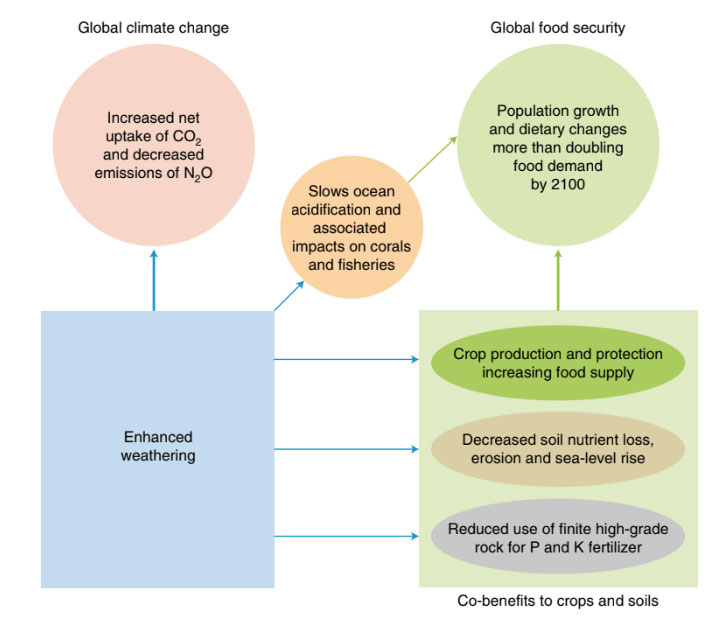
As natural rock weathering absorbs around 3% of global fossil fuel emissions, enhanced weathering can provide a boost to remove even more CO2 from our atmosphere.
But the potential benefits do not end there. As enhanced weathering makes water more alkaline, it can help counteract ocean acidification.
And adding minerals to soils can boost nutrient levels, improving crop yields and helping restore degraded agricultural soils.
Food demand
The need to cut CO2 emissions is unfolding alongside an unprecedented increase in food demand – linked to dietary changes and a growing population that may surpass 11 billion by 2100 (pdf). At the same time, farming itself a growing contributor to climate change.
Critically, enhanced rock weathering works together with existing managed croplands. Unlike other negative emissions techniques under consideration, it doesn’t compete for land used to grow food or increase the demand for freshwater.
While enhanced weathering can be applied to any soils, arable land is the most obvious candidate as it is worked and planted throughout the year. It covers some 12m square kilometres – 11% of the global land area.
In fact, arable farms already apply crushed rock in the form of limestone to reverse acidification of soils caused by farming practices, such as the use of fertilisers. And there is a long history of small-scale farming using silicate rocks to improve crop yields in highly-weathered soils in Africa, Brazil and Malaysia.
Swapping silicate for limestone, and increasing the application rate, would do the same job to help tackle acidification, but help capture CO2 from the atmosphere at the same time.
Managed cropland, therefore, has the logistical infrastructure, such as road networks, and the machinery needed to undertake this approach at scale. These considerations could make enhanced weathering potentially straightforward to adopt.
You can see this in action in the video below from the Leverhulme Centre for Climate Change Mitigation.
Using silicate rocks as a resource in this way could also have a number of important wider benefits. These include supplying silica back into soils to improve crop health and protection from pests and diseases, and supplying nutrients to increase yields.
If realised, these benefits would reduce the usage of agricultural fertilisers and pesticides, lowering the cost of food production, increasing the profitability of farms and reducing the barriers to take up enhanced weathering for the agricultural sector.
Estimates and challenges
So, in theory, there are a lot of potential upsides for using enhanced weathering. However, like many negative emissions technologies, implementation is still in its very early stages. It needs further research, development and demonstration – not just across a range of crops and soil types, but also different climates and spatial scales.
There have been some successful field tests of using enhanced weathering – though for purposes other than capturing CO2.
For example, in a 12-year study conducted in a New Hampshire forest, scientists measured the effect of spreading silicate powder as a method of accelerating recovery from acid rain. The results confirmed some of the main impacts of enhanced weathering – a rapid increase in dissolved silicate and calcium making it into streams, and alleviation of acidification in the ecosystem.
Similarly, in Mauritius, sugarcane trials as far back as 1961 added crushed basalt to soils and increased yields by 30% over five successive harvests.
There are other challenges too. The process of mining, grinding and spreading rocks on a large-scale would likely have negative environmental and ecological impacts, and would therefore require careful management. Depending on the size of the grains of powder the rocks are pulverized down to, the energy demand could account for 10-30% of the amount of CO2 sequestered. Using renewable energy sources would minimise this.
Costs, too, need to be considered. Current cost estimates are uncertain and vary widely. The most detailed analysis to date puts operational costs at $52-480 per tonne of CO2 sequestered – though these estimates are poorly constrained and improvements in crop yields and lower fertiliser needs will offset some of these costs. This compares with a$39-100 per tonne of CO2 for another, more talked-about negative emissions technology, bioenergy with carbon capture and storage (BECCS).

Credit: Dr Ilsa Kantola, University of Illinois, Champaign-Urbana
But the potential is significant. For example, applying 50 tonnes of basalt powder per hectare per year to 70m hectares of the corn belt of North America might sequester as much as 1.1bn tonnes of CO2 in the long run – equivalent to 13% of the global annual emissions from agriculture.
Countries with considerable productive farmland have the largest potential to sequester CO2 through enhanced weathering. These include the US, China, India and Russia, which all grow crops on a massive scale and make up the highest emitters of CO2.
Scaling estimates up to a global level is tricky, but – for example – adding 10-30 tonnes of silicate per hectare per year to two-thirds of the world’s most productive cropland could take 0.5-4bn tonnes of CO2 out of the atmosphere per year by 2100. But current estimates are highly uncertain and require more research.
Putting theory into practise
Human societies have long known that volcanic plains are fertile; ideal places for growing crops without adverse human health effects but, of course, with little consideration for how adding additional rocks to soils might capture carbon.
We now need to take the theory and laboratory tests out into real crop fields to see how enhanced weathering fits – practically and economically – in the wider portfolio of options for removing CO2 from the atmosphere.
However, there is still a long way to go and research in this area remains in its infancy. Improved assessments are required to understand how much CO2 the approach would capture, how much rock is required, how much energy is required to crush and distribute the rock, and to better understand the long-term effects on soils and water courses.
We need to undertake carefully monitored assessments on arable land. For example, can we demonstrate the expected benefits to crops amidst the seasonal and annual variations in the weather?
And finally, we need to better understand the public perception of enhanced rock weathering as a strategy for carbon capture, communicate the process, benefits and risks, and understand any public concerns about what this means for our landscapes and farmlands.
Beerling, D. J. et al. (2018) Farming with crops and rocks to address global climate, food and soil security, Nature Plants, doi:10.1038/s41477-018-0108-y
Ronal W. Larson
To unsubscribe from this group and stop receiving emails from it, send an email to CarbonDioxideRem...@googlegroups.com.
To post to this group, send email to CarbonDiox...@googlegroups.com.
To view this discussion on the web visit https://groups.google.com/d/msgid/CarbonDioxideRemoval/CAB5EiYA2P1HgRhiS%2Br-8iMLDN9xKc8EtRxNrpJaBYjsvN2JXgg%40mail.gmail.com.
David Yarrow
Kevin,This idea from David Yarrow to extract and use rock dust already produced by crushing operations seems much more of an economic and ecological goer than crushing new basaltic/silicate rock just for the purpose. I also like his idea of blending it with biochar, but would add manure to prevent/minimise both the former materials from blowing or being taken away by surface runoff, before spreading the mixture (preferably in aqueous form) over fields or ripping it into deeper soil for forestry and tree crop purposes. I am much less enthused with generating biochar from seaweed, as seaweed has many higher-value uses. There is enough low-grade terrestrial biomass, in the form of dirty bark, twigs and weed species, to generate large quantities of biochar using the energy-efficient and relatively non-polluting WHC process.SevWilliam S. Clarke BA, BSc, (Melb) MBA (Stanford)T: +613 5426 1330 M: 0431 488 506Skype: willow7777777P: PO Box 16, Mt Macedon, VIC 3441, AustraliaManaging Director, Winwick Business Solutions Pty Ltd.
Begin forwarded message:From: David Yarrow <dyar...@gmail.com>
Subject: Re: [CDR] Farming with crops and rocks to address global climate, food and soil security | Nature Plants
Date: 20 February 2018 at 11:09:09 am AEDTTo: "Ronal W. Larson" <rongre...@comcast.net>, John Nissen <johnnis...@gmail.com>, Carbon Dioxide Removal <CarbonDioxideRemoval@googlegroups.com>, Greg Rau <ra...@llnl.gov>, Thomas Goreau <gor...@bestweb.net>
Begin forwarded message:
From: Ronal W. Larson <rongre...@comcast.net>Subject: Re: [CDR] Farming with crops and rocks to address global climate, food and soil security | Nature PlantsDate: February 19, 2018 at 3:56:44 PM MSTTo: John Nissen <johnnis...@gmail.com>, Carbon Dioxide Removal <CarbonDioxideRemoval@googlegroups.com>, Greg Rau <ra...@llnl.gov>Cc: David Yarrow <dya...@nycap.rr.com>, Thomas Goreau <gor...@bestweb.net>
John, cc Greg and list, adding 2 new ccsSee inserts below.
On Feb 19, 2018, at 3:37 PM, John Nissen <johnnis...@gmail.com> wrote:Hi Greg,I just saw James Hansen has just published a paper on rock crushing as well! I've not had time to read it.
http://www.columbia.edu/~jeh1/mailings/2018/20180219_RockDustInFarming_NewsRelease.pdf
[RWL: I haven't found a free copy yet. Hope someone can send.Perhaps we need to combine rock crushing with biochar which may be obtained in the necessary large quantities by pyrolysis of marine biomass, e.g. from kelp farms.Ron, has the biochar community considered obtaining biomass from the sea and/or combining biochar with crushed rock? farms.[RWL: There are two (at least) active in combined rock dust and biochar (they being cc’d): David Yarrow and Tom Goreau. Both have reported success.Michael Hayes has been very strong on this list re biochar from ocean biomass. I am unaware anyone doing ocean-based biochar commercially - but it seems likely that is happening.Ron
Cheers, John
https://www.nature.com/articles/s41477-018-0108-y
“The magnitude of future climate change could be moderated by immediately reducing the amount of CO2 entering the atmosphere as a result of energy generation and by adopting strategies that actively remove CO2 from it. Biogeochemical improvement of soils by adding crushed, fast-reacting silicate rocks to croplands is one such CO2-removal strategy. This approach has the potential to improve crop production, increase protection from pests and diseases, and restore soil fertility and structure. Managed croplands worldwide are already equipped for frequent rock dust additions to soils, making rapid adoption at scale feasible, and the potential benefits could generate financial incentives for widespread adoption in the agricultural sector. However, there are still obstacles to be surmounted. Audited field-scale assessments of the efficacy of CO2 capture are urgently required together with detailed environmental monitoring. A cost-effective way to meet the rock requirements for CO2 removal must be found, possibly involving the recycling of silicate waste materials. Finally, issues of public perception, trust and acceptance must also be addressed.”
--
You received this message because you are subscribed to the Google Groups "Carbon Dioxide Removal" group.
To unsubscribe from this group and stop receiving emails from it, send an email to CarbonDioxideRemoval+unsub...@googlegroups.com.
To post to this group, send email to CarbonDioxideRemoval@googlegroups.com.
Visit this group at https://groups.google.com/group/CarbonDioxideRemoval.
To view this discussion on the web visit https://groups.google.com/d/msgid/CarbonDioxideRemoval/D5F7876A-FB69-4ED3-AA84-84A6CC095DE2%40sbcglobal.net.
For more options, visit https://groups.google.com/d/optout.
--
You received this message because you are subscribed to the Google Groups "Carbon Dioxide Removal" group.
To unsubscribe from this group and stop receiving emails from it, send an email to CarbonDioxideRemoval+unsubscr...@googlegroups.com.
To post to this group, send email to CarbonDioxideRemoval@googlegroups.com.
Visit this group at https://groups.google.com/group/CarbonDioxideRemoval.
To view this discussion on the web visit https://groups.google.com/d/msgid/CarbonDioxideRemoval/CACS_FxrKmrMgaCgS08dvenrOf2XayCUi8_wX4b2XLM2ZK4KLKQ%40mail.gmail.com.
For more options, visit https://groups.google.com/d/optout.
--
You received this message because you are subscribed to the Google Groups "Carbon Dioxide Removal" group.
To unsubscribe from this group and stop receiving emails from it, send an email to CarbonDioxideRemoval+unsub...@googlegroups.com.
To post to this group, send email to CarbonDioxideRemoval@googlegroups.com.
Visit this group at https://groups.google.com/group/CarbonDioxideRemoval.
To view this discussion on the web visit https://groups.google.com/d/msgid/CarbonDioxideRemoval/CAB5EiYA2P1HgRhiS%2Br-8iMLDN9xKc8EtRxNrpJaBYjsvN2JXgg%40mail.gmail.com.

David J Beerling
Congratulations on publishing "Farming with crops and rocks to address global climate, food and soil security" in Nature Plants. As part of the Springer Nature Content Sharing Initiative, you can now publicly share full-text access to a view-only version of your paper by using the following SharedIt link:
https://www.nature.com/articles/s41477-018-0108-y
“The magnitude of future climate change could be moderated by immediately reducing the amount of CO2 entering the atmosphere as a result of energy generation and by adopting strategies that actively remove CO2 from it. Biogeochemical improvement of soils by adding crushed, fast-reacting silicate rocks to croplands is one such CO2-removal strategy. This approach has the potential to improve crop production, increase protection from pests and diseases, and restore soil fertility and structure. Managed croplands worldwide are already equipped for frequent rock dust additions to soils, making rapid adoption at scale feasible, and the potential benefits could generate financial incentives for widespread adoption in the agricultural sector. However, there are still obstacles to be surmounted. Audited field-scale assessments of the efficacy of CO2 capture are urgently required together with detailed environmental monitoring. A cost-effective way to meet the rock requirements for CO2 removal must be found, possibly involving the recycling of silicate waste materials. Finally, issues of public perception, trust and acceptance must also be addressed.”
--
You received this message because you are subscribed to the Google Groups "Carbon Dioxide Removal" group.
To unsubscribe from this group and stop receiving emails from it, send an email to CarbonDioxideRemoval+unsub...@googlegroups.com.
To post to this group, send email to CarbonDioxideRemoval@googlegroups.com.
Visit this group at https://groups.google.com/group/CarbonDioxideRemoval.
To view this discussion on the web visit https://groups.google.com/d/msgid/CarbonDioxideRemoval/D5F7876A-FB69-4ED3-AA84-84A6CC095DE2%40sbcglobal.net.
For more options, visit https://groups.google.com/d/optout.
Professor David Beerling FRS,
Department of Animal and Plant Sciences
University of Sheffield
Sheffield S10 2TN, UK
Tel. +44(0)114-222-4359


Thomas Goreau
President, Global Coral Reef Alliance
President, Biorock Technology Inc.
Thomas Goreau
President, Global Coral Reef Alliance
President, Biorock Technology Inc.
On Feb 20, 2018, at 6:11 AM, Joanna Campe <joanna...@gmail.com> wrote:Hi Tom and everyone,
Thank you so much for your comment! I really appreciate David's response, as well as Steve Diver. About a week ago I felt a strong need to speak further about placing remineralization within this listserv and movement as a pioneer of regenerative agriculture. I also wanted to mention it's importance, acknowledge it's success particularly in Brazil in agroecology as well as the most sophisticated work from scientists and policymakers. Two laws have been passed through Congress.There is so much I would like to say and share, and for the last week in Brazil, I've been having some internet and computer issues and my dictation program which I rely on. I have been wanting to take a leap and jump into the discussion since the discussion began between Tom and Paul Hawken.While I am here I will be meeting with the World Agroforestry Centre around collaboration and finding a team that could potentially set up workshops in the post hurricane Caribbean, Africa and elsewhere based on the work of Ernst Gotsch.Only one application of rock dust or minerals is needed to jumpstart food forests that grow all fruits and vegetables, coffee and cacao in one system, with no outside inputs thereafter. It is the most inspiring agroforestry model that I have seen and we will be advocating through RTE. Please see the documentary, From Garden to Forest...We are also looking for funding for a project in Cameroon that has a product called QuikGro that is a very highly successful project using a combination of biotar and rock dust. The rock dust is from the area of Mount Cameroon, a pyroclastic ash that is locally available. We hope to send a new small portable innovative rock grinder when we have funding that would greatly increase the output and their production. This project is headed up by a professor from the University of Georgia. Dr. Valentine Nzengung They have a contract with the Cameron Development Corporation and the demand for increased production is great.We have a large collection of studies from Brazil in our research database on the website, unfortunately we do not have a coordinator for the English studies at this time. We have about 100 studies from recent conferences that need to be translated, but there is a tremendous amount of ongoing research in Brazil through EMBRAPA in 12 locations and the universities.As far as industrial farming, Tom Vanacore and I were in Indiana in the fall and I think he would have a lot to share as well as the research going on at the university of Illinois with the UK team which is now focused on sequestering carbon with basalt.I work with about 20-30 volunteers on a project management system, Basecamp: mainly graduate students, some scientists and other professionals. This year I hope to focus on bringing us larger funding to fulfill our mission.I am not able to touch in on everything we are working on here.Dan Kittredge would be very welcome here in this discussion as well! Dr Ingram has mentioned that minerals are not necessary as an amendment for many years now and I would love to see that addressed in another discussion. There are many people out there combining compost teas and rock dust, including a large farm cooperative in Mexico that has a yearly conference. There is a very large part of the earth not touched by glaciers and volcanic eruptions, etc. At the University of Copenhagen, scientists are looking to see how they can get the Greenland mud to the tropics to address social inequities and create food security. Rich countries have rich soils and poor countries have poor soils normally. They have a great Ted Talk, but without my computer I can't put the link here. Sorry, I don't want to get carried away, especially because I can't organize this very well on my iPhone and please forgive any editing that I was not able to do.
My very best to all of you!
Joanna on iPhoneJoanna Campe, Executive DirectorRemineralize the Earth152 South StreetNorthampton, MA 01060 USATel +1 413 563 9938email: jca...@remineralize.org

Renaud de RICHTER
Cheers, John
To unsubscribe from this group and stop receiving emails from it, send an email to CarbonDioxideRemoval+unsubscr...@googlegroups.com.
To post to this group, send email to CarbonDioxideRemoval@googlegroups.com.
Visit this group at https://groups.google.com/group/CarbonDioxideRemoval.
To view this discussion on the web visit https://groups.google.com/d/msgid/CarbonDioxideRemoval/D5F7876A-FB69-4ED3-AA84-84A6CC095DE2%40sbcglobal.net.
For more options, visit https://groups.google.com/d/optout.
--
You received this message because you are subscribed to the Google Groups "Carbon Dioxide Removal" group.
To unsubscribe from this group and stop receiving emails from it, send an email to CarbonDioxideRemoval+unsubscr...@googlegroups.com.
To post to this group, send email to CarbonDioxideRemoval@googlegroups.com.
Visit this group at https://groups.google.com/group/CarbonDioxideRemoval.
To view this discussion on the web visit https://groups.google.com/d/msgid/CarbonDioxideRemoval/CACS_FxrKmrMgaCgS08dvenrOf2XayCUi8_wX4b2XLM2ZK4KLKQ%40mail.gmail.com.
For more options, visit https://groups.google.com/d/optout.
--
You received this message because you are subscribed to the Google Groups "Carbon Dioxide Removal" group.
To unsubscribe from this group and stop receiving emails from it, send an email to CarbonDioxideRemoval+unsubscr...@googlegroups.com.
To post to this group, send email to CarbonDioxideRemoval@googlegroups.com.
Visit this group at https://groups.google.com/group/CarbonDioxideRemoval.
To view this discussion on the web visit https://groups.google.com/d/msgid/CarbonDioxideRemoval/CAB5EiYA2P1HgRhiS%2Br-8iMLDN9xKc8EtRxNrpJaBYjsvN2JXgg%40mail.gmail.com.
For more options, visit https://groups.google.com/d/optout.
--
You received this message because you are subscribed to the Google Groups "Carbon Dioxide Removal" group.
To unsubscribe from this group and stop receiving emails from it, send an email to CarbonDioxideRemoval+unsub...@googlegroups.com.
To post to this group, send email to CarbonDioxideRemoval@googlegroups.com.
Visit this group at https://groups.google.com/group/CarbonDioxideRemoval.
To view this discussion on the web visit https://groups.google.com/d/msgid/CarbonDioxideRemoval/26248F0D-E8AC-4E2B-A72F-C9BBC32BC104%40bestweb.net.

voglerlake
The prior work on crushed rock CDR has been viewed through the perspective of land resources. Yet seafloor mining is underway and should be factored in to the equation as the seafloor mining industry has far greater potential than land mining.
The mid-oceanic mountain range is 40000 miles long and olivine is continuously produced in many places along that range, along with a wide spectrum of other valuable minerals.
This type of mining is not my specialty yet I have reviewed the industry.
Also, your concern about scale can possibly be addressed by comparing the global sand industry tonnage figures. That industry currently moves ~40 Gt/y.
The technologies, across these various mineral related industrial fields, are well known as they are well used today and they are both profitable and scalable. There is no fundamental need for research to expand what is already in practice.
On the issue of biomass, there are a wide range of CDR related biotechnologies which can be quickly scaled up if:
1) the oceanic space and resources are used
2) the biotech is confined to well regulated high throughput bioreactors stationed in the marine space
Here is a resources reference work which I often post and I often update.
https://docs.google.com/document/d/1rKV9RDyt0VAUWonqmcZ_FPktgrtsgIm6SYjh9xUqATI/edit?usp=drivesdk&ouid=104123587495980221759
I did not take a reductionist view while compiling the work as what is needed is a system of systems approach. The systems approach is what is being recommended by many high level groups, such as the Pew Trust and the United Nations.
Many of the contributors to this discussion group champion individual technologies and the expertise that comes with those technologies is important and greatly appreciated. However, it is widely known now that no one technology should be relied upon, we need a basket of technologies.
My effort in the BlueBiochar Initiative is primarily focused upon, at a minimum, outlining the most prevalent technologies that should be in that basket and how they might be used in a mutually supportive way.
Geoengineering, CDR, or what is known as Geotherapy should never be viewed as a one-trick pony, that is my opinion and the opinion of many others.
I encourage you to take the time to study the discussion between Drs. Lackner and Solomon in the following debate, starting around 1:30.
https://youtu.be/_pKZLHNYPbM
In my view, Solomon is the wisest.
I hope this has helped inform you on the basics.
Best regards,
Renaud de RICHTER
To unsubscribe from this group and stop receiving emails from it, send an email to CarbonDioxideRemoval+unsubscrib...@googlegroups.com.
To post to this group, send email to CarbonDioxideRemoval@googlegroups.com.
Visit this group at https://groups.google.com/group/CarbonDioxideRemoval.
Thomas Goreau
President, Global Coral Reef Alliance
President, Biorock Technology Inc.
To unsubscribe from this group and stop receiving emails from it, send an email to CarbonDioxideRem...@googlegroups.com.
To post to this group, send email to CarbonDiox...@googlegroups.com.
To view this discussion on the web visit https://groups.google.com/d/msgid/CarbonDioxideRemoval/CAHodn99yDzqtg8NEf_Nv88N%3DUYsud3yXB1J8kduRrB1BbB1WHg%40mail.gmail.com.
Renaud de RICHTER
Innovative Methods of Marine Ecosystem Restoration, Thomas J. Goreau, Robert Kent TrenchReef Restoration Using Seawater Electrolysis in Jamaica, Thomas J. Goreau and Wolf Hilbertz
Electrically Stimulated Corals in Indonesia Reef Restoration Projects Show Greatly Accelerated Growth Rates, Jamaludin Jompa, Suharto, Eka Marlina Anpusyahnur, Putra Nyoman Dwjja, Jobnico Subagio, Ilham Alimin, Rosihan Anwar, Syarif Syamsuddin, Thri Heni Utami Radiman, Heri Triyono, R. Ahmad Sue, and Nyoman Soeyasa
Biorock Reef Restoration in Gili Trawangan, North Lombok, Indonesia, Lalu Arifin Aria Bakti, Arben Virgota, Luh Putu Ayu Damayanti, Thri Heni Utami Radiman, Ambar Retnowulan, Hernawati, Abdus Sabil, and Delphine RobbeElectrical Current Stimulates Coral Branching and Growth in Jakarta Bay, Neviaty P. Zamani, Khalid I. Abdallah, and Beginer Subhan
Electricity Protects Coral from Overgrowth by an Encrusting Sponge in Indonesia, Jens Nitzsche
Gorgonian Soft Corals Have Higher Growth and Survival in Electrical Fields, Diannisa Fitri and M. Aspari Rachman
Suitability of Mineral Accretion as a Rehabilitation Method for Cold-Water Coral Reefs, Susanna M. Strömberg, Tomas Lundälv, and Thomas J. Goreau
Utilization of Low-Voltage Electricity to Stimulate Cultivation of Pearl Oysters Pinctada maxima (Jameson), Prawita Tasya Karissa, Sukardi, Susilo Budi Priyono, N. Gustaf F. Mamangkey, and Joseph James Uel Taylor
Increased Oyster Growth and Survival Using Biorock Technology, Nikola Berger, Mara Haseltine, J. T. Boehm, and Thomas J. Goreau
Electrical Stimulation Increases Oyster Growth and Survival in Restoration Projects, Jason Shorr, James Cervino, Carmen Lin, Rand Weeks, and Thomas J. Goreau
Restoration of Seagrass Mats (Posidonia oceanica) with Electrical Stimulation, Raffaele Vaccarella and Thomas J. Goreau
Electrical Fields Increase Salt Marsh Survival and Growth and Speed Restoration in Adverse Conditions, James Cervino, Dajana Gjoza, Carmen Lin, Rand Weeks, and Thomas Goreau
Fish Postlarval Capture and Culture for Restoring Fisheries, Gilles Lecaillon
Mariculture Potential of Gracilaria Species [Rhodophyta] in Jamaican Nitrate-Enriched Back-Reef Habitats: Growth, Nutrient Uptake, and Elemental Composition, Arlen Havenner Macfarlane
Sustainable Reef Design to Optimize Habitat Restoration, Mara G. Haseltine
Marine Ecosystem Electrotherapy: Practice and Theory, Thomas J. Goreau
To unsubscribe from this group and stop receiving emails from it, send an email to CarbonDioxideRemoval+unsub...@googlegroups.com.
To post to this group, send email to CarbonDioxideRemoval@googlegroups.com.
Visit this group at https://groups.google.com/group/CarbonDioxideRemoval.
Thomas Goreau
President, Global Coral Reef Alliance
President, Biorock Technology Inc.
Renaud de RICHTER
Thomas Goreau
President, Global Coral Reef Alliance
President, Biorock Technology Inc.
On Feb 22, 2018, at 10:26 AM, Albert Bates <alb...@thefarm.org> wrote:Tom, et al.
This thread did not include me when it began but I gather by the subject line it mentioned James Hansen's latest. The journal of publication does not allow the common practice of authors paying additional page charge for open access, but they do allow free viewing (no downloading) of the article: http://rdcu.be/HlCp
Answering Renaud's earlier question the article says:
"Co-deployment of enhanced weathering with other strategies such as reforestation and afforestation, and with feedstock crops used in BECCS and biochar, could also reduce costs and significantly enhance the combined carbon sequestration potential of these methods."
This is an important theme which addresses the question of how to scale all the geotherapies — with clever cascades they can be both carbon negative (drawdown) and cash negative (profitable). My next book, due out later this year from Chelsea Green, Carbon Cascades, describes about 90 of these processes in greater detail.
Cheers,
Albert
On 2018-02-22 09:15, Thomas Goreau wrote:
We have used the Biorock marine electrolysis method for more than 42
years to grow limestone structures of any size or shape in the sea.
Besides being the only marine construction material that grows
stronger with age and is self repairing if damaged, we also greatly
increase the settlement, growth, survival, and resistance to
environmental stresses of all marine organisms, so we keep whole
ecosystems alive when they would die, and grow them back at record
rates where there is no natural recovery (we also grow back severely
eroded beaches in a few months).
We also produce large amounts of limestone sand by accelerating growth
of calcareous algae.
The book is mainly about work on restoring coral reefs, but also
contains chapters showing that we greatly increase seagrass and salt
marsh growth both above and below ground, so we can grow them where
all other methods of restoration fail, due to the plants being washed
out by waves before their roots grow.
We are planning to use the method to restore mangroves in Borneo and
plan to quantify the carbo sequestration, as we think this will prove
to be the most cost-effective carbon sink.
Thomas J. F. Goreau, PhD
President, Global Coral Reef Alliance
President, Biorock Technology Inc.
COORDINATOR, SOIL CARBON ALLIANCE
COORDINATOR, UNITED NATIONS COMMISSION ON SUSTAINABLE DEVELOPMENT
SMALL ISLAND DEVELOPING STATES PARTNERSHIP IN NEW SUSTAINABLE
TECHNOLOGIES
37 PLEASANT STREET, CAMBRIDGE, MA 02139
gor...@bestweb.net
www.globalcoral.org
Skype: tomgoreau
Tel: (1) 617-864-4226
BOOKS:
GEOTHERAPY: INNOVATIVE METHODS OF SOIL FERTILITY RESTORATION, CARBON
SEQUESTRATION, AND REVERSING CO2 INCREASE
http://www.crcpress.com/product/isbn/9781466595392
Innovative Methods of Marine Ecosystem Restoration
http://www.crcpress.com/product/isbn/9781466557734
THE GREEN DISC, NEW TECHNOLOGIES FOR A NEW FUTURE: INNOVATIVE METHODS
FOR SUSTAINABLE DEVELOPMENT
http://www.greenthindisc.org
NO ONE CAN CHANGE THE PAST, EVERYONE CAN CHANGE THE FUTURE
WHEN LIES TRUMP TRUTH, THE DARK AGES BEGIN
On Feb 22, 2018, at 8:55 AM, Renaud de RICHTER
<renaud.d...@gmail.com> wrote:
Thanks Thomas, I saw that in one of your books, almost all chapters
talk about REEFS OR MARINE RESTORATION BY Electrolysis, Electrically
Stimulated, Electrical Current Electrical Fields. Can you explain
in a few words how it works? I'm new in this topic and ignorant in
this field.
Innovative Methods of Marine Ecosystem Restoration, Thomas J.
Goreau, Robert Kent TrenchReef Restoration Using SEAWATER
ELECTROLYSIS In Jamaica, Thomas J. Goreau and Wolf Hilbertz
ELECTRICALLY STIMULATED CORALS in Indonesia Reef Restoration
Projects Show Greatly Accelerated Growth Rates, _Jamaludin Jompa,
Suharto, Eka Marlina Anpusyahnur, Putra Nyoman Dwjja, Jobnico
Subagio, Ilham Alimin, Rosihan Anwar, Syarif Syamsuddin, Thri Heni
Utami Radiman, Heri Triyono, R. Ahmad Sue, and Nyoman
Soeyasa_Biorock Reef Restoration in Gili Trawangan, North Lombok,
Indonesia, Lalu Arifin Aria Bakti, Arben Virgota, Luh Putu Ayu
Damayanti, Thri Heni Utami Radiman, Ambar Retnowulan, Hernawati,
Abdus Sabil, and Delphine Robbe
ELECTRICAL CURRENT Stimulates Coral Branching and Growth in Jakarta
Bay, Neviaty P. Zamani, Khalid I. Abdallah, and Beginer Subhan
ELECTRICITY PROTECTS Coral from Overgrowth by an Encrusting Sponge
in Indonesia, Jens Nitzsche
Gorgonian Soft Corals Have Higher Growth and Survival in ELECTRICAL
FIELDS, Diannisa Fitri and M. Aspari Rachman
Suitability of Mineral Accretion as a Rehabilitation Method for
Cold-Water Coral Reefs, Susanna M. Strömberg, Tomas Lundälv, and
Thomas J. Goreau
Utilization of LOW-VOLTAGE ELECTRICITY to Stimulate Cultivation of
Pearl Oysters _Pinctada maxima _(Jameson), Prawita Tasya Karissa,
Sukardi, Susilo Budi Priyono, N. Gustaf F. Mamangkey, and Joseph
James Uel Taylor
Increased Oyster Growth and Survival Using Biorock Technology,
Nikola Berger, Mara Haseltine, J. T. Boehm, and Thomas J. Goreau
ELECTRICAL STIMULATION Increases Oyster Growth and Survival in
Restoration Projects, Jason Shorr, James Cervino, Carmen Lin, Rand
Weeks, and Thomas J. Goreau
Restoration of Seagrass Mats (_Posidonia oceanica_) with ELECTRICAL
STIMULATION, Raffaele Vaccarella and Thomas J. Goreau
ELECTRICAL FIELDS Increase Salt Marsh Survival and Growth and Speed
Restoration in Adverse Conditions, James Cervino, Dajana Gjoza,
Carmen Lin, Rand Weeks, and Thomas Goreau
Fish Postlarval Capture and Culture for Restoring Fisheries, Gilles
Lecaillon
Mariculture Potential of _Gracilaria _Species [Rhodophyta] in
Jamaican Nitrate-Enriched Back-Reef Habitats: Growth, Nutrient
Uptake, and Elemental Composition, Arlen Havenner Macfarlane
Sustainable Reef Design to Optimize Habitat Restoration, Mara G.
Haseltine
Marine Ecosystem ELECTROTHERAPY: Practice and Theory, _Thomas J.
Goreau_
2018-02-22 14:12 GMT+01:00 Thomas Goreau <gor...@bestweb.net>:
Most of the best work by soil fertility regenerators, like David
Yarrow, is not published in academic journals.
Thomas J. F. Goreau, PhD
President, Global Coral Reef Alliance
President, Biorock Technology Inc.
COORDINATOR, SOIL CARBON ALLIANCE
COORDINATOR, UNITED NATIONS COMMISSION ON SUSTAINABLE DEVELOPMENT
SMALL ISLAND DEVELOPING STATES PARTNERSHIP IN NEW SUSTAINABLE
TECHNOLOGIES
37 PLEASANT STREET, CAMBRIDGE, MA 02139
gor...@bestweb.net
www.globalcoral.org [1]
Skype: tomgoreau
Tel: (1) 617-864-4226 [2]
BOOKS:
GEOTHERAPY: INNOVATIVE METHODS OF SOIL FERTILITY RESTORATION, CARBON
SEQUESTRATION, AND REVERSING CO2 INCREASE
http://www.crcpress.com/product/isbn/9781466595392 [3]
Innovative Methods of Marine Ecosystem Restoration
http://www.crcpress.com/product/isbn/9781466557734 [4]
THE GREEN DISC, NEW TECHNOLOGIES FOR A NEW FUTURE: INNOVATIVE
METHODS FOR SUSTAINABLE DEVELOPMENT
http://www.greenthindisc.org [5]
NO ONE CAN CHANGE THE PAST, EVERYONE CAN CHANGE THE FUTURE
WHEN LIES TRUMP TRUTH, THE DARK AGES BEGIN
COORDINATOR, SOIL CARBON ALLIANCE
COORDINATOR, UNITED NATIONS COMMISSION ON SUSTAINABLE DEVELOPMENT
SMALL ISLAND DEVELOPING STATES PARTNERSHIP IN NEW SUSTAINABLE
TECHNOLOGIES
37 PLEASANT STREET, CAMBRIDGE, MA 02139
gor...@bestweb.net
www.globalcoral.org [1]
Skype: tomgoreau
Tel: (1) 617-864-4226 [2]
BOOKS:
GEOTHERAPY: INNOVATIVE METHODS OF SOIL FERTILITY RESTORATION, CARBON
SEQUESTRATION, AND REVERSING CO2 INCREASE
http://www.crcpress.com/product/isbn/9781466595392 [3]
Innovative Methods of Marine Ecosystem Restoration
http://www.crcpress.com/product/isbn/9781466557734 [4]
THE GREEN DISC, NEW TECHNOLOGIES FOR A NEW FUTURE: INNOVATIVE
METHODS FOR SUSTAINABLE DEVELOPMENT
http://www.greenthindisc.org [5]
NO ONE CAN CHANGE THE PAST, EVERYONE CAN CHANGE THE FUTURE
WHEN LIES TRUMP TRUTH, THE DARK AGES BEGIN
Tel +1 413 563 9938 [6]
email: jca...@remineralize.org
http://www.remineralize.org [7]
On Feb 20, 2018, at 9:04 AM, Thomas Goreau <gor...@bestweb.net>
wrote:
I don’t know why you are having this discussion without Joanna
Campe of Remineralize the Earth, and Tom Vanacore of Rock Dust Local
(both cc’d on this message), as all these aspects are discussed in
detail in their web sites, and also in about half a dozen chapters
in the Geotherapy book.
Thomas J. F. Goreau, PhD
President, Global Coral Reef Alliance
President, Biorock Technology Inc.
COORDINATOR, SOIL CARBON ALLIANCE
COORDINATOR, UNITED NATIONS COMMISSION ON SUSTAINABLE DEVELOPMENT
SMALL ISLAND DEVELOPING STATES PARTNERSHIP IN NEW SUSTAINABLE
TECHNOLOGIES
37 PLEASANT STREET, CAMBRIDGE, MA 02139
gor...@bestweb.net
www.globalcoral.org [1]
Skype: tomgoreau
Tel: (1) 617-864-4226 [2]
BOOKS:
GEOTHERAPY: INNOVATIVE METHODS OF SOIL FERTILITY RESTORATION, CARBON
SEQUESTRATION, AND REVERSING CO2 INCREASE
http://www.crcpress.com/product/isbn/9781466595392 [3]
Innovative Methods of Marine Ecosystem Restoration
http://www.crcpress.com/product/isbn/9781466557734 [4]
THE GREEN DISC, NEW TECHNOLOGIES FOR A NEW FUTURE: INNOVATIVE
METHODS FOR SUSTAINABLE DEVELOPMENT
http://www.greenthindisc.org [5]
NO ONE CAN CHANGE THE PAST, EVERYONE CAN CHANGE THE FUTURE
WHEN LIES TRUMP TRUTH, THE DARK AGES BEGIN
On Feb 19, 2018, at 10:38 PM, David Yarrow <dyar...@gmail.com>
wrote:
On Mon, Feb 19, 2018 at 4:44 PM, Sev Clarke <sevc...@me.com>
wrote:
Kevin,
This idea from David Yarrow to extract and use rock dust already
produced by crushing operations seems much more of an economic and
ecological goer than crushing new basaltic/silicate rock just for
the purpose. I also like his idea of blending it with biochar, but
would add manure to prevent/minimise both the former materials from
blowing or being taken away by surface runoff, before spreading the
mixture (preferably in aqueous form) over fields or ripping it into
deeper soil for forestry and tree crop purposes. I am much less
enthused with generating biochar from seaweed, as seaweed has many
higher-value uses. There is enough low-grade terrestrial biomass, in
the form of dirty bark, twigs and weed species, to generate large
quantities of biochar using the energy-efficient and relatively
non-polluting WHC process.
Sev
_WILLIAM S. CLARKE __BA, BSC, (MELB) MBA (STANFORD)_
T: +613 5426 1330 [8] M: 0431 488 506
FROM: David Yarrow <dyar...@gmail.com>
SUBJECT: RE: [CDR] FARMING WITH CROPS AND ROCKS TO ADDRESS GLOBAL
CLIMATE, FOOD AND SOIL SECURITY | NATURE PLANTS
DATE: 20 February 2018 at 11:09:09 am AEDT
TO: "Ronal W. Larson" <rongre...@comcast.net>, John Nissen
<johnnis...@gmail.com>, Carbon Dioxide Removal
<CarbonDiox...@googlegroups.com>, Greg Rau <ra...@llnl.gov>,
FROM: Ronal W. Larson <rongre...@comcast.net>
SUBJECT: RE: [CDR] FARMING WITH CROPS AND ROCKS TO ADDRESS GLOBAL
CLIMATE, FOOD AND SOIL SECURITY | NATURE PLANTS
DATE: February 19, 2018 at 3:56:44 PM MST
TO: John Nissen <johnnis...@gmail.com>, Carbon Dioxide Removal
<CarbonDiox...@googlegroups.com>, Greg Rau <ra...@llnl.gov>
CC: David Yarrow <dya...@nycap.rr.com>, Thomas Goreau
<gor...@bestweb.net>
John, cc Greg and list, adding 2 new ccs
See inserts below.
On Feb 19, 2018, at 3:37 PM, John Nissen <johnnis...@gmail.com>
wrote:
Hi Greg,
I just saw James Hansen has just published a paper on rock crushing
as well! I've not had time to read it.
http://www.columbia.edu/~jeh1/mailings/2018/20180219_RockDustInFarming_NewsRelease.pdf[9]
[RWL: I HAven't found a free copy yet. Hope someone can send.
Perhaps we need to combine rock crushing with biochar which may be
obtained in the necessary large quantities by pyrolysis of marine
biomass, e.g. from kelp farms.
Ron, has the biochar community considered obtaining biomass from the
sea and/or combining biochar with crushed rock? farms.
[RWL: THERE ARE TWO (AT LEAST) ACTIVE IN COMBINED ROCK DUST AND
BIOCHAR (THEY BEING CC’D): DAVID YARROW AND TOM GOREAU. BOTH
HAVE REPORTED SUCCESS.
MICHAEL HAYES HAS BEEN VERY STRONG ON THIS LIST RE BIOCHAR FROM
OCEAN BIOMASS. I AM UNAWARE ANYONE DOING OCEAN-BASED BIOCHAR
COMMERCIALLY - BUT IT SEEMS LIKELY THAT IS HAPPENING.
RON
Cheers, John
On Mon, Feb 19, 2018 at 6:02 PM, Greg Rau <gh...@sbcglobal.net>
wrote:
“The magnitude of future climate change could be moderated by
immediately reducing the amount of CO2 entering the atmosphere as a
result of energy generation and by adopting strategies that actively
remove CO2 from it. Biogeochemical improvement of soils by adding
crushed, fast-reacting silicate rocks to croplands is one such
CO2-removal strategy. This approach has the potential to improve
crop production, increase protection from pests and diseases, and
restore soil fertility and structure. Managed croplands worldwide
are already equipped for frequent rock dust additions to soils,
making rapid adoption at scale feasible, and the potential benefits
could generate financial incentives for widespread adoption in the
agricultural sector. However, there are still obstacles to be
surmounted. Audited field-scale assessments of the efficacy of CO2
capture are urgently required together with detailed environmental
monitoring. A cost-effective way to meet the rock requirements for
CO2 removal must be found, possibly involving the recycling of
silicate waste materials. Finally, issues of public perception,
trust and acceptance must also be addressed.”
--
You received this message because you are subscribed to the Google
Groups "Carbon Dioxide Removal" group.
To unsubscribe from this group and stop receiving emails from it,
send an email to CarbonDioxideRem...@googlegroups.com.
To post to this group, send email to
CarbonDiox...@googlegroups.com.
Visit this group at
https://groups.google.com/group/CarbonDioxideRemoval [11].
To view this discussion on the web visit
--
You received this message because you are subscribed to the Google
Groups "Carbon Dioxide Removal" group.
To unsubscribe from this group and stop receiving emails from it,
send an email to CarbonDioxideRem...@googlegroups.com.
To post to this group, send email to
CarbonDiox...@googlegroups.com.
Visit this group at
https://groups.google.com/group/CarbonDioxideRemoval [11].
To view this discussion on the web visit
--
You received this message because you are subscribed to the Google
Groups "Carbon Dioxide Removal" group.
To unsubscribe from this group and stop receiving emails from it, send
an email to CarbonDioxideRem...@googlegroups.com.
To post to this group, send email to
CarbonDiox...@googlegroups.com.
Visit this group at
https://groups.google.com/group/CarbonDioxideRemoval [11].
To view this discussion on the web visit
--
You received this message because you are subscribed to the Google
Groups "Carbon Dioxide Removal" group.
To unsubscribe from this group and stop receiving emails from it, send
an email to CarbonDioxideRem...@googlegroups.com.
To post to this group, send email to
CarbonDiox...@googlegroups.com.
Visit this group at
https://groups.google.com/group/CarbonDioxideRemoval [11].
To view this discussion on the web visit
https://groups.google.com/d/msgid/CarbonDioxideRemoval/26248F0D-E8AC-4E2B-A72F-C9BBC32BC104%40bestweb.net
[16].
For more options, visit https://groups.google.com/d/optout [13].
--
You received this message because you are subscribed to the Google
Groups "Carbon Dioxide Removal" group.
To unsubscribe from this group and stop receiving emails from it, send
an email to CarbonDioxideRem...@googlegroups.com.
To post to this group, send email to
CarbonDiox...@googlegroups.com.
Visit this group at
https://groups.google.com/group/CarbonDioxideRemoval [11].
To view this discussion on the web visit
https://groups.google.com/d/msgid/CarbonDioxideRemoval/CAHodn99yDzqtg8NEf_Nv88N%3DUYsud3yXB1J8kduRrB1BbB1WHg%40mail.gmail.com
[17].
For more options, visit https://groups.google.com/d/optout [13].
Links:
------
[1] http://www.globalcoral.org/
[2] tel:(617)%20864-4226
[3] http://www.crcpress.com/product/isbn/9781466595392
[4] http://www.crcpress.com/product/isbn/9781466557734
[5] http://www.greenthindisc.org/
[6] tel:(413)%20563-9938
[7] http://www.remineralize.org/
[8] tel:+61%203%205426%201330
[9]
http://www.columbia.edu/%7Ejeh1/mailings/2018/20180219_RockDustInFarming_NewsRelease.pdf
[10] https://www.nature.com/articles/s41477-018-0108-y
[11] https://groups.google.com/group/CarbonDioxideRemoval
[12]
https://groups.google.com/d/msgid/CarbonDioxideRemoval/D5F7876A-FB69-4ED3-AA84-84A6CC095DE2%40sbcglobal.net
[13] https://groups.google.com/d/optout
[14]
https://groups.google.com/d/msgid/CarbonDioxideRemoval/CACS_FxrKmrMgaCgS08dvenrOf2XayCUi8_wX4b2XLM2ZK4KLKQ%40mail.gmail.com?utm_medium=email&utm_source=footer
[15]
https://groups.google.com/d/msgid/CarbonDioxideRemoval/CAB5EiYA2P1HgRhiS%2Br-8iMLDN9xKc8EtRxNrpJaBYjsvN2JXgg%40mail.gmail.com?utm_medium=email&utm_source=footer
[16]
https://groups.google.com/d/msgid/CarbonDioxideRemoval/26248F0D-E8AC-4E2B-A72F-C9BBC32BC104%40bestweb.net?utm_medium=email&utm_source=footer
[17]
https://groups.google.com/d/msgid/CarbonDioxideRemoval/CAHodn99yDzqtg8NEf_Nv88N%3DUYsud3yXB1J8kduRrB1BbB1WHg%40mail.gmail.com?utm_medium=email&utm_source=footer
--
Global Village Institute for Appropriate Technology
Global Ecovillage Network • Gaia University
_http://gvix.org_
_http://albertbates.cool_
_http://medium.com/@albertbates_
_http://eco2.cool_
The Farm POB 90 Summertown TN 38483-0090 USA
931-964-4324 (o) • 52-1998-116-5532 (mex) • 931-242-3796 (usa) •
44-782-764-6237 (uk) • 13-867-154-171 (prc)
Facebook/WhatsApp/WeChat/LinkedIn/GooglePlus
_I would also like to see us evolve beyond blandly accepting that there is
a difference between an individual who violates women and children and
members of a government whose political philosophy approves the violation
of women and children in some other country to “make America more
secure.” All traumatized women and children are our traumatized women and
children. All traumatized ecosystems are the one we have to live in._ —
Martin Holsinger, _Deep Green Perspective_
-------------------------
--
Also on Facebook at https://www.facebook.com/groups/Soil4Climate/
--- You received this message because you are subscribed to the Google Groups "soil-age" group.
To unsubscribe from this group and stop receiving emails from it, send an email to soil-age+u...@googlegroups.com.
To post to this group, send email to soil...@googlegroups.com.
Visit this group at https://groups.google.com/group/soil-age.
To view this discussion on the web visit https://groups.google.com/d/msgid/soil-age/421479670183e4a14bfbd7314802e701%40thefarm.org.
Thomas Goreau
President, Global Coral Reef Alliance
President, Biorock Technology Inc.
On Mar 5, 2018, at 10:14 AM, Benoit Lambert <benoit....@gmail.com> wrote:Thomas,Following these amazing exchanges, here I am reading Geotherapy for a second time !!, including on rock dust and David Yarrow's.
You write:"That’s exactly why we advocate rock powder, biochar, compost, and beneficial microorganisms as a one time, long lasting, slow release natural fertilizer, to increase carbon storage and recycling."
Rock powder, biochar, compost... sounds as THE powerful approach combining minerals, structure and life. Can we green deserts if we put those together, with water?Just to make sure I am not missing something, what do you refer to when adding 'and beneficial microorganism'? Aren't they coming with the compost?
<CarbonDioxideRemoval@googlegroups.com>, Greg Rau <ra...@llnl.gov>,
<CarbonDioxideRemoval@googlegroups.com>, Greg Rau <ra...@llnl.gov>
send an email to CarbonDioxideRemoval+unsub...@googlegroups.com.
To post to this group, send email to
Visit this group at
https://groups.google.com/group/CarbonDioxideRemoval [11].
To view this discussion on the web visit
[12].
For more options, visit https://groups.google.com/d/optout [13].
--
You received this message because you are subscribed to the Google
Groups "Carbon Dioxide Removal" group.
To unsubscribe from this group and stop receiving emails from it,
send an email to CarbonDioxideRemoval+unsub...@googlegroups.com.
To post to this group, send email to
Visit this group at
https://groups.google.com/group/CarbonDioxideRemoval [11].
To view this discussion on the web visit
https://groups.google.com/d/msgid/CarbonDioxideRemoval/CACS_FxrKmrMgaCgS08dvenrOf2XayCUi8_wX4b2XLM2ZK4KLKQ%40mail.gmail.com[14].--
For more options, visit https://groups.google.com/d/optout [13].
You received this message because you are subscribed to the Google
Groups "Carbon Dioxide Removal" group.
To unsubscribe from this group and stop receiving emails from it, send
an email to CarbonDioxideRemoval+unsub...@googlegroups.com.
To post to this group, send email to
Visit this group at
https://groups.google.com/group/CarbonDioxideRemoval [11].
To view this discussion on the web visit
https://groups.google.com/d/msgid/CarbonDioxideRemoval/CAB5EiYA2P1HgRhiS%2Br-8iMLDN9xKc8EtRxNrpJaBYjsvN2JXgg%40mail.gmail.com
[15].
For more options, visit https://groups.google.com/d/optout [13].
--
You received this message because you are subscribed to the Google
Groups "Carbon Dioxide Removal" group.
To unsubscribe from this group and stop receiving emails from it, send
an email to CarbonDioxideRemoval+unsub...@googlegroups.com.
To post to this group, send email to
Visit this group at
https://groups.google.com/group/CarbonDioxideRemoval [11].
To view this discussion on the web visit
https://groups.google.com/d/msgid/CarbonDioxideRemoval/26248F0D-E8AC-4E2B-A72F-C9BBC32BC104%40bestweb.net
[16].
For more options, visit https://groups.google.com/d/optout [13].
--
You received this message because you are subscribed to the Google
Groups "Carbon Dioxide Removal" group.
To unsubscribe from this group and stop receiving emails from it, send
an email to CarbonDioxideRemoval+unsub...@googlegroups.com.
To post to this group, send email to
To unsubscribe from this group and stop receiving emails from it, send an email to soil-age+unsubscribe@googlegroups.com.
To post to this group, send email to soil...@googlegroups.com.
Visit this group at https://groups.google.com/group/soil-age.
To view this discussion on the web visit https://groups.google.com/d/msgid/soil-age/421479670183e4a14bfbd7314802e701%40thefarm.org.
For more options, visit https://groups.google.com/d/optout.
--
Also on Facebook at https://www.facebook.com/groups/Soil4Climate/
---
You received this message because you are subscribed to the Google Groups "soil-age" group.
To unsubscribe from this group and stop receiving emails from it, send an email to soil-age+unsubscribe@googlegroups.com.
To post to this group, send email to soil...@googlegroups.com.
Visit this group at https://groups.google.com/group/soil-age.
To view this discussion on the web visit https://groups.google.com/d/msgid/soil-age/CD270C72-9C4F-43F0-A7A4-7083270C639C%40bestweb.net.
--
Also on Facebook at https://www.facebook.com/groups/Soil4Climate/
---
You received this message because you are subscribed to the Google Groups "soil-age" group.
To unsubscribe from this group and stop receiving emails from it, send an email to soil-age+u...@googlegroups.com.
To post to this group, send email to soil...@googlegroups.com.
Visit this group at https://groups.google.com/group/soil-age.
To view this discussion on the web visit https://groups.google.com/d/msgid/soil-age/CAEJ8%2BcptbSmtvhPE8XyRcF3zeJp8RKydtcQssB6ShvYhOaSV8w%40mail.gmail.com.
Thomas Goreau
President, Global Coral Reef Alliance
President, Biorock Technology Inc.
To unsubscribe from this group and stop receiving emails from it, send an email to CarbonDioxideRem...@googlegroups.com.
To post to this group, send email to CarbonDiox...@googlegroups.com.
Visit this group at https://groups.google.com/group/CarbonDioxideRemoval.
To view this discussion on the web visit https://groups.google.com/d/msgid/CarbonDioxideRemoval/74F581A0-2EF3-4271-B15A-8C1D8A451A4F%40bestweb.net.
Greg Rau
--
You received this message because you are subscribed to the Google Groups "Carbon Dioxide Removal" group.
To unsubscribe from this group and stop receiving emails from it, send an email to CarbonDioxideRem...@googlegroups.com.
To post to this group, send email to CarbonDiox...@googlegroups.com.
To view this discussion on the web visit https://groups.google.com/d/msgid/CarbonDioxideRemoval/CAHodn9_Eb0yxSpR%2BLTfZCwWF_dN_FGVJhsah5ZUTLKk9D_eKVg%40mail.gmail.com.
<phys.org-Protecting our coasts naturally.pdf>