
"Silver bullet to suck CO2 from air and halt climate change ruled out"

Greg Rau

Leon Di Marco
Negative emission technologies
What role in meeting Paris Agreement targets?
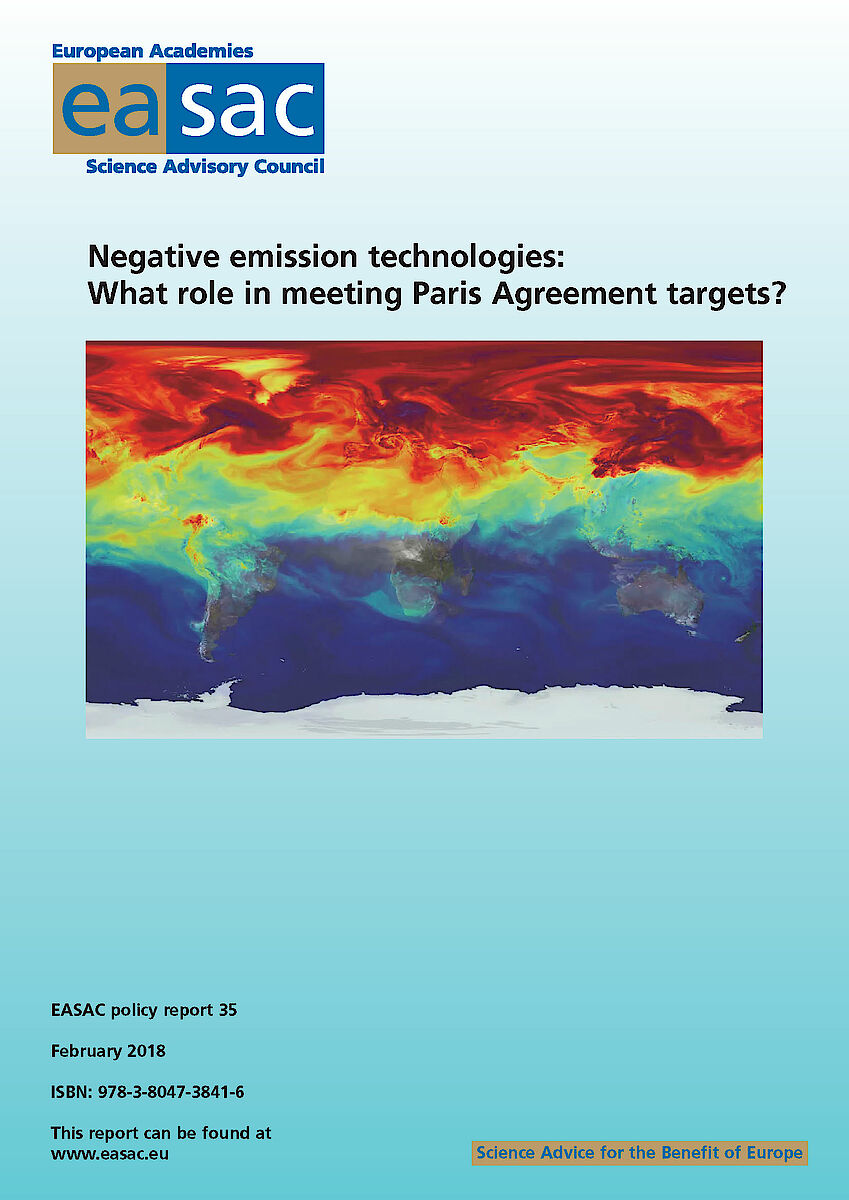

In a new report by the European Academies’ Science Advisory Council (EASAC), senior scientists from across Europe have evaluated the potential contribution of negative emission technologies (NETs) to allow humanity to meet the Paris Agreement’s targets of avoiding dangerous climate change. They find that NETs have “limited realistic potential” to halt increases in the concentration of greenhouse gases in the atmosphere at the scale envisioned in the Intergovernmental Panel on Climate Change (IPCC) scenarios. This new report finds that none of the NETs has the potential to deliver carbon removals at the gigaton (Gt) scale and at the rate of deployment envisaged by the IPCC, including reforestation, afforestation, carbon-friendly agriculture, bioenergy with carbon capture and storage (BECCs), enhanced weathering, ocean fertilisation, or direct air capture and carbon storage (DACCs).
“Scenarios and projections that suggest that NETs’ future contribution to CO2 removal will allow Paris targets to be met appear optimistic on the basis of current knowledge and should not form the basis of developing, analysing, and comparing scenarios of longer-term energy pathways for the EU. Relying on NETs to compensate for failures to adequately mitigate emissions may have serious implications for future generations," state the European science academies.
Leon Di Marco
Negative emissions have ‘limited potential’ to help meet climate goals
The potential for using negative emissions technologies to help meet the goals of the Paris Agreement could be more “limited” than previously thought, concludes a new report by European science advisors.
Negative emissions technologies (NETs) describe a variety of methods – many of which are yet to be developed – that aim to limit climate change by removing CO2 from the air.
Some of these techniques are already included by scientists in modelled “pathways” showing how global warming can be limited to between 1.5C and 2C above pre-industrial levels, which is the goal of the Paris Agreement.
However, the new report says there is no “silver bullet technology” that can be used to solve the problem of climate change, scientists said at a press briefing held in London.
Instead, “the primary focus must be on mitigation, on reducing emissions of greenhouse gases,” they added.
Zero emissions
The 37-page report was produced by the European Academies Science Advisory Council (EASAC), an independent group made up of staff from the national science academies of EU member states, Norway and Switzerland, which offers scientific advice to EU policymakers.
Drawing on the results of recently published research papers, the report assesses the feasibility and possible impacts of NETs.
The report splits these “technologies” into six categories:
- Afforestation and reforestation
- Land management to increase soil carbon
- Bioenergy with carbon capture and storage (BECCS)
- Enhanced weathering
- Direct capture of CO2
- Ocean fertilisation.
A Carbon Brief article published in 2016 explained how these proposed technologies might work.
Though differing in approach, all of the proposed NETs aim to slow climate change by removing CO2 from the atmosphere and storing it underground or in the sea.
Some scientists argue that such technologies could be used to soak up some of the CO2 that is released by human activity, which could, in turn, help the world to achieve “net-zero” greenhouse gas emissions.
Net-zero emissions is a term used to describe a scenario where the amount of greenhouse gases released by humans is balanced by the amount absorbed from the atmosphere.
Achieving net-zero emissions within this century will be key to limiting global warming to between 1.5C and 2C above pre-industrial levels, says Prof Michael Norton, EASAC environment programme director and member of the expert group behind the report. At a press briefing, he said:
“Indeed, without assuming that technologies can remove CO2 on a large, that’s gigatonne [billion tonne] scale, IPCC scenarios have great difficulty in envisaging an emission reduction pathway consistent with the Paris targets.”
However, the new report suggests that there is currently no “silver bullet” technology that can absolve the world of its greenhouse gas emissions, scientists said at a press briefing. The report concludes:
“We conclude that these technologies offer only limited realistic potential to remove carbon from the atmosphere and not at the scale envisaged in some climate scenarios.”
The report also shows that many of the NETs could have large environmental impacts, says Prof John Shepherd FRS, emeritus professor of ocean and Earth sciences at the University of Southampton and member of the expert group behind the report. He told the press briefing:
“Some of these techniques would have adverse environmental impacts, including some of the ones that appear to be natural. There is an emotional response in most people to prefer natural appearing solutions, but, in many cases, the environmental are as great as the more engineering-type applications.”
The “pros and cons” of each proposed technology are summed up on the table below. The top half of the table includes: the technical status of each technology; the amount of carbon that could be removed if the technology were to be implemented on a wide scale; the potential cost of implementing the technology (low/medium/high); and the likely efficacy of each method.
The bottom half of the table assesses: the relative security of the carbon storage of each technology; the possibility that the technology may actually contribute to climate change; and the possibility that the technology could have environmental impacts.

A summary of the strengths, weaknesses and uncertainties of negative emissions technologies (NETs). Technologies include afforestation and reforestation (AR), land management (LM), bioenergy with carbon capture and storage (BECCS), enhanced weathering (EW), direct air capture and storage (DACCS), ocean fertilisation (OIF) and carbon capture and storage (CCS). Source: EASAC (2018)
Blow for BECCS?
One of the techniques under scrutiny in the new report is BECCS. Put simply, BECCS involves burning biomass – such as trees and crops – to generate energy and then capturing the resulting CO2 emissions before they are released into the air.
BECCS has been labelled one of the “most promising” NETs and is already included by scientists in many of the modelled “pathways” showing how global warming can be limited to 2C above pre-industrial levels.
However, BECCS has yet to be demonstrated on a commercial basis, the report finds, and its ability to effectively store large amounts of carbon is still “uncertain”.
Recent research has revealed a number of “drawbacks” to using BECCS on a wide scale, Norton said:
“These include the reality that even if all the carbon emitted when the biomass is burnt were to be captured, extensive emissions across the supply chain will not be captured, thus severely limiting its effectiveness as a negative carbon technology.”
In other words, the emissions resulting from the different stages of BECCS, including on transportation and on applying nitrogen fertilisers, may significantly reduce the technology’s overall ability to reduce the amount of CO2 in the atmosphere. In some cases, biomass energy might have higher emissions than fossil fuels.
On top of this, implementing BECCS on a large scale would require large amounts of land to be converted to biomass plantations, which could have considerable environmental impacts, the report notes. Carbon Brief recently covered new research investigating how using BECCS could affect different aspects of the natural world.
Forest fall out
- Explainer: 10 ways ‘negative emissions’ could slow climate change
- In-depth: Experts assess the feasibility of ‘negative emissions’
- Timeline: How BECCS became climate change’s ‘saviour’ technology
- Guest post: Do we need BECCS to avoid dangerous climate change?
- Analysis: Is the UK relying on ‘negative emissions’ to meet its climate targets?
The report also assesses the potential of afforestation, creating new forests on land that was not previously forest, and reforestation, planting new trees on land that was once forest, to remove carbon from the atmosphere.
Trees absorb carbon from the atmosphere during photosynthesis and then use it to build new leaves, shoots and roots. By doing this, trees are able to store carbon for long periods.
However, implementing afforestation on a large scale could have “significant” environmental impacts, the new report finds. This is because growing new forests would require a large amount of land-use change and the application of nitrogen fertilisers. The production of nitrogen fertilisers releases a group of potent greenhouse gases known as nitrous oxides, along with CO2.
On top of this, new trees take many years to grow and so will not be able to immediately absorb large amounts of carbon from the atmosphere, Norton said:
“We can also see many scenarios in which the land-use change involved in extending forestry would be counterproductive for decades or even centuries.”
Norton said that curbing the rate of deforestation, which is causing the release of large stores of carbon from the world’s tropical regions, should be a priority for policymakers. He added:
Forestation and reforestation offer simple ways of increasing carbon stocks, but it would be a mistake to be distracted from the reality of the current situation which is that…carbon is being lost by continuing deforestation.
Cutting to the chase
Despite potential drawbacks, there may be some scenarios where the use of NETs will be “necessary” to balance the release of greenhouse gases, said Shepherd:
“They are especially likely to be necessary to deal with intractable sources of greenhouse gases, in particular aviation and agriculture.”
In other words, NETs may be needed to compensate for industries that are unable to radically cut their rate of greenhouse gas emissions.
Such industries could include cattle ranching and rice production, says Dr Phil Williamson, associate fellow at the University of East Anglia, who was not an author of the new report. At the sidelines of the press briefing, he told Carbon Brief:
“There’s a whole lot of things that are going to be very difficult to control, including methane from cattle and methane from rice. We’re not going to stop growing rice, so we’re still going to have methane emissions. In order to have that balance, we’re still going to need some negative emissions technologies.”
However, the “primary focus” of policymakers should be on rapidly cutting greenhouse gas emissions, said Prof Gideon Henderson FRS, professor of Earth sciences at the University of Oxford and reviewer of the report. He told the press briefing:
“The primary focus must be on mitigation, on reducing emissions of greenhouse gases. That’s not going to be easy, but it’s undoubtedly going to be easier than doing NETs at a substantial scale.”
On Friday, February 2, 2018 at 4:05:03 AM UTC, Greg Rau wrote:
Greg Rau
possible policy options may be appropriate to
climate policy. For instance, by considering:
• supporting initiatives such as ‘4 per mille’ by
incentivising agriculture to increase SOC;
• providing greater incentives to increase carbon
stocks in forests (EASAC, 2017);
• reviewing and updating CCS development and
demonstration programmes;
• conducting research on reducing energy and
resource costs of DAC;
• maintaining a watching brief for other options
to remove CO2 to compensate for sectors such
substituted; and
• addressing the weakness of market forces to fund
deployment of CCS (and ultimately viable NETs)
owing to the low carbon price and questions over
the eligibility of NETs within the Emissions Trading
Scheme."
From: Leon Di Marco <len...@gmail.com>
To: Carbon Dioxide Removal <CarbonDiox...@googlegroups.com>
Sent: Thursday, February 1, 2018 8:40 PM
Subject: [CDR] Re: "Silver bullet to suck CO2 from air and halt climate change ruled out"
You received this message because you are subscribed to the Google Groups "Carbon Dioxide Removal" group.
To unsubscribe from this group and stop receiving emails from it, send an email to CarbonDioxideRem...@googlegroups.com.
To post to this group, send email to CarbonDiox...@googlegroups.com.
Visit this group at https://groups.google.com/group/CarbonDioxideRemoval.
To view this discussion on the web visit https://groups.google.com/d/msgid/CarbonDioxideRemoval/346b26ed-31f7-4f8d-a51b-fa431c4bc499%40googlegroups.com.
For more options, visit https://groups.google.com/d/optout.

Peter Eisenberger
To view this discussion on the web visit https://groups.google.com/d/msgid/CarbonDioxideRemoval/1620423527.1703790.1517551713110%40mail.yahoo.com.
Leon Di Marco
On Friday, February 2, 2018 at 4:05:03 AM UTC, Greg Rau wrote:
Greg Rau
From: Peter Eisenberger <peter.ei...@gmail.com>
To: Greg Rau <gh...@sbcglobal.net>
Cc: Leon Di Marco <len...@gmail.com>; Carbon Dioxide Removal <CarbonDiox...@googlegroups.com>
Sent: Friday, February 2, 2018 1:31 AM
Subject: Re: [CDR] Re: "Silver bullet to suck CO2 from air and halt climate change ruled out"
On Friday, February 2, 2018 at 4:05:03 AM UTC, Greg Rau wrote:
"“You can rule out a silver bullet,” said Prof John Shepherd, at the University of Southampton, UK, and an author of the report. “Negative emissions technologies are very interesting but they are not an alternative to deep and rapid emissions reductions. These remain the safest and most reliable option that we have.”The new report is from the European Academies Science Advisory Council (EASAC), which advises the European Union and is comprised of the national science academies of the 28 member states. It warns that relying on NETs instead of emissions cuts could fail and result in severe global warming and “serious implications for future generations”.”"The report assesses the range of possible technologies, including “bioenergy with carbon capture and storage” (BECCS), on which the IPCC scenarios rely heavily. BECCS involves growing trees, which take CO2 from the atmosphere, and then burning them to produce electricity while capturing the emissions and burying them.But Prof Michael Norton, EASAC’s programme director and another author of the report, said: “There are severe drawbacks.” These include the huge amount of land needed and the energy need to produce and deliver the fuel. Furthermore, it could worsen the enormous loss of wildlife – the sixth mass extinction – already occurring. “The biodiversity impact at the colossal scale envisaged would be severe,” Norton said.”GR- Few have suggested NETs are going to singlehandedly solve the climate problem, but then apparently neither will emissions reduction. So we need both to succeed; if NETs fails so does effective atmospheric (and ocean) C management (IPCC et al.). Under these dire circumstances it is time to more broadly and open-mindedly solicit and evaluate our options (e.g., geochemistry, marine, hybrid bio-geochem approaches, etc), instead of assuming that current favorites like BECCS are/will be the only game in town. Relative to R&D investment, CCS has seriously failed to deliver it's share of emissions reduction. Why can we expect a different outcome when it’s applied to negative emissions?
--
You received this message because you are subscribed to the Google Groups "Carbon Dioxide Removal" group.
To unsubscribe from this group and stop receiving emails from it, send an email to CarbonDioxideRem...@googlegroups.com.
To post to this group, send email to CarbonDiox...@googlegroups.com.
Visit this group at https://groups.google.com/group/CarbonDioxideRemoval.
To view this discussion on the web visit https://groups.google.com/d/msgid/CarbonDioxideRemoval/346b26ed-31f7-4f8d-a51b-fa431c4bc499%40googlegroups.com.
For more options, visit https://groups.google.com/d/optout.
--
You received this message because you are subscribed to the Google Groups "Carbon Dioxide Removal" group.
To unsubscribe from this group and stop receiving emails from it, send an email to CarbonDioxideRem...@googlegroups.com.
To post to this group, send email to CarbonDiox...@googlegroups.com.
Visit this group at https://groups.google.com/group/CarbonDioxideRemoval.
To view this discussion on the web visit https://groups.google.com/d/msgid/CarbonDioxideRemoval/1620423527.1703790.1517551713110%40mail.yahoo.com.
For more options, visit https://groups.google.com/d/optout.
You received this message because you are subscribed to the Google Groups "Carbon Dioxide Removal" group.
To unsubscribe from this group and stop receiving emails from it, send an email to CarbonDioxideRem...@googlegroups.com.
To post to this group, send email to CarbonDiox...@googlegroups.com.
Visit this group at https://groups.google.com/group/CarbonDioxideRemoval.

voglerlake
https://scholar.google.com/scholar?as_ylo=2017&q=seaweed,+biochar&hl=en&as_sdt=0,48
Thanks,
Peter Eisenberger
Peter,Am all for creating wealth while solving the CO2 problem, but that requires markets where the C products made can outcompete conventional products and do so at a scale that makes a climate difference. While making products from CO2 concentrated from combustion or from air at $50/tonne CO2 (I appreciate your calculation of DAC cost (at what global capacity?), but am still standing by for a citeable reference of this) is one way to go, we should not ignore biotically or abiotically making products that don't require starting with conc CO2. So in the absence of large commercial markets driving R&D, the pre-commercial R&D agenda should be one that invites, encourages and competes alternative ideas against current favorites in addition to trying to improve those favorites. This is clearly not EASAC's recommendation, nor is it in other recent reports I've seen. One can only hope that the upcoming NAS CDR agenda will be more open minded at this early stage of tech development, but I'm not holding my breath.Greg
Cc: Leon Di Marco <len...@gmail.com>; Carbon Dioxide Removal <CarbonDioxideRemoval@googlegroups.com>
To unsubscribe from this group and stop receiving emails from it, send an email to CarbonDioxideRemoval+unsub...@googlegroups.com.
To post to this group, send email to CarbonDioxideRemoval@googlegroups.com.
Visit this group at https://groups.google.com/group/CarbonDioxideRemoval.
To view this discussion on the web visit https://groups.google.com/d/msgid/CarbonDioxideRemoval/346b26ed-31f7-4f8d-a51b-fa431c4bc499%40googlegroups.com.
For more options, visit https://groups.google.com/d/optout.
--
You received this message because you are subscribed to the Google Groups "Carbon Dioxide Removal" group.
To unsubscribe from this group and stop receiving emails from it, send an email to CarbonDioxideRemoval+unsub...@googlegroups.com.
To post to this group, send email to CarbonDioxideRemoval@googlegroups.com.
Visit this group at https://groups.google.com/group/CarbonDioxideRemoval.
To view this discussion on the web visit https://groups.google.com/d/msgid/CarbonDioxideRemoval/1620423527.1703790.1517551713110%40mail.yahoo.com.
For more options, visit https://groups.google.com/d/optout.
--
You received this message because you are subscribed to the Google Groups "Carbon Dioxide Removal" group.
To unsubscribe from this group and stop receiving emails from it, send an email to CarbonDioxideRemoval+unsub...@googlegroups.com.
To post to this group, send email to CarbonDioxideRemoval@googlegroups.com.
Visit this group at https://groups.google.com/group/CarbonDioxideRemoval.
To view this discussion on the web visit https://groups.google.com/d/msgid/CarbonDioxideRemoval/8C3BED29-287B-431D-BBD2-3CF2783E3967%40gmail.com.
For more options, visit https://groups.google.com/d/optout.
Leon Di Marco
The list of CDR approaches to be examined would include land and coastal (i.e., tidal wetlands, seagrass meadows, and mangroves) ecosystems management, accelerated weathering, bioenergy with capture, direct air capture, geologic sequestration, and other approaches deemed by the study committee to be of similar viability in terrestrial and coastal environments.
 Among the many valuable ecosystems services of coastal environments is their ability to take up some of the excess carbon from the atmosphere. This new publication summarizes a workshop that explored the potential to restore and manage coastal habitats, particularly coastal wetlands, as a viable carbon dioxide removal approach (often termed coastal blue carbon). Workshop speakers described their relevant work including the state of knowledge and research needs related to understanding carbon capacity and flux in coastal systems, the processes driving sustainability of coastal wetland carbon storage in the future, potential incentives for coastal blue carbon, and policy and governance challenges.
Description
Coastal environments provide many valuable ecosystem services. Their role as carbon sinks has been a topic of exploration to evaluate the potential for the restoration and management of coastal habitats as a viable carbon dioxide removal (CDR) approach. To explore the state of knowledge, technical research needs, costs, co-benefits, and societal and governance constraints of CDR in coastal ecosystems (often termed coastal blue carbon), the Committee on Developing a Research Agenda for Carbon Dioxide Removal and Sequestration convened its first workshop on July 26, 2017, in Woods Hole, Massachusetts. Invited speakers described their relevant work in order to provide the committee with an overview of the state of knowledge and research needs related to understanding carbon capacity and flux in coastal systems, the processes driving sustainability of coastal wetland carbon storage in the future, potential incentives for coastal blue carbon, and policy and governance challenges. The workshop was preceded by an introductory webinar on July 19, 2017, where invited speakers provided an overview of the ecosystems under consideration for coastal carbon removal and sequestration, as well as the costs and other considerations of restoring them. This publication summarizes the presentations from both the webinar and workshop.
On Friday, February 2, 2018 at 4:05:03 AM UTC, Greg Rau wrote:
Greg Rau
Sent: Saturday, February 3, 2018 4:38 PM
Subject: [CDR] Re: "Silver bullet to suck CO2 from air and halt climate change ruled out"
Among the many valuable ecosystems services of coastal environments is their ability to take up some of the excess carbon from the atmosphere. This new publication summarizes a workshop that explored the potential to restore and manage coastal habitats, particularly coastal wetlands, as a viable carbon dioxide removal approach (often termed coastal blue carbon). Workshop speakers described their relevant work including the state of knowledge and research needs related to understanding carbon capacity and flux in coastal systems, the processes driving sustainability of coastal wetland carbon storage in the future, potential incentives for coastal blue carbon, and policy and governance challenges.Description
On Friday, February 2, 2018 at 4:05:03 AM UTC, Greg Rau wrote:
"“You can rule out a silver bullet,” said Prof John Shepherd, at the University of Southampton, UK, and an author of the report. “Negative emissions technologies are very interesting but they are not an alternative to deep and rapid emissions reductions. These remain the safest and most reliable option that we have.”The new report is from the European Academies Science Advisory Council (EASAC), which advises the European Union and is comprised of the national science academies of the 28 member states. It warns that relying on NETs instead of emissions cuts could fail and result in severe global warming and “serious implications for future generations”.”"The report assesses the range of possible technologies, including “bioenergy with carbon capture and storage” (BECCS), on which the IPCC scenarios rely heavily. BECCS involves growing trees, which take CO2 from the atmosphere, and then burning them to produce electricity while capturing the emissions and burying them.But Prof Michael Norton, EASAC’s programme director and another author of the report, said: “There are severe drawbacks.” These include the huge amount of land needed and the energy need to produce and deliver the fuel. Furthermore, it could worsen the enormous loss of wildlife – the sixth mass extinction – already occurring. “The biodiversity impact at the colossal scale envisaged would be severe,” Norton said.”GR- Few have suggested NETs are going to singlehandedly solve the climate problem, but then apparently neither will emissions reduction. So we need both to succeed; if NETs fails so does effective atmospheric (and ocean) C management (IPCC et al.). Under these dire circumstances it is time to more broadly and open-mindedly solicit and evaluate our options (e.g., geochemistry, marine, hybrid bio-geochem approaches, etc), instead of assuming that current favorites like BECCS are/will be the only game in town. Relative to R&D investment, CCS has seriously failed to deliver it's share of emissions reduction. Why can we expect a different outcome when it’s applied to negative emissions?
You received this message because you are subscribed to the Google Groups "Carbon Dioxide Removal" group.
To post to this group, send email to CarbonDiox...@googlegroups.com.
Leon Di Marco
On Friday, February 2, 2018 at 4:05:03 AM UTC, Greg Rau wrote:
Peter Eisenberger
Thanks Leon. From their website and some webcasts I'm aware of what the committee has done. Their holding of informational meetings on all of the usual CDR suspects such as Blue Carbon is an appropriate place to start. But what also needs to happen at this early stage of tech development is to solicit input from others who are not working on the current favorites, who don't (yet) have a large constituency, but whose ideas could prove to be cost-effective and cost-competitive with further R&D.We are at the beginning not the end of the search for CDR methods, so in addition to R&Ding current favorites, let's not do so at the expense of stifling innovation and assuming that we know now what CDR will look like 30 or even 5 years hence. Technology doesn't advance by ignoring unpopular and unfamiliar ideas.Yes, I have communicated this to Steve Pacala and a few others on the committee.Greg
From: Leon Di Marco <len...@gmail.com>
To: Carbon Dioxide Removal <CarbonDioxideRemoval@googlegroups.com>
To unsubscribe from this group and stop receiving emails from it, send an email to CarbonDioxideRemoval+unsubscrib...@googlegroups.com.
To post to this group, send email to CarbonDioxideRemoval@googlegroups.com.
Visit this group at https://groups.google.com/group/CarbonDioxideRemoval.
To view this discussion on the web visit https://groups.google.com/d/msgid/CarbonDioxideRemoval/00bb250e-8021-488e-90f4-ee9bf133592d%40googlegroups.com.
For more options, visit https://groups.google.com/d/optout.
--
You received this message because you are subscribed to the Google Groups "Carbon Dioxide Removal" group.
To unsubscribe from this group and stop receiving emails from it, send an email to CarbonDioxideRemoval+unsubscrib...@googlegroups.com.
To post to this group, send email to CarbonDioxideRemoval@googlegroups.com.
Visit this group at https://groups.google.com/group/CarbonDioxideRemoval.
To view this discussion on the web visit https://groups.google.com/d/msgid/CarbonDioxideRemoval/217568421.2990047.1517711706301%40mail.yahoo.com.
Greg Rau
Sent: Saturday, February 3, 2018 8:01 PM
Subject: Re: [CDR] Re: "Silver bullet to suck CO2 from air and halt climate change ruled out"
To view this discussion on the web visit https://groups.google.com/d/ms gid/CarbonDioxideRemoval/21756 8421.2990047.1517711706301% 40mail.yahoo.com.
You received this message because you are subscribed to the Google Groups "Carbon Dioxide Removal" group.
To post to this group, send email to CarbonDiox...@googlegroups.com.
Greg Rau
Sent: Saturday, February 3, 2018 7:30 PM
Subject: [CDR] Re: "Silver bullet to suck CO2 from air and halt climate change ruled out"
On Friday, February 2, 2018 at 4:05:03 AM UTC, Greg Rau wrote:
"“You can rule out a silver bullet,” said Prof John Shepherd, at the University of Southampton, UK, and an author of the report. “Negative emissions technologies are very interesting but they are not an alternative to deep and rapid emissions reductions. These remain the safest and most reliable option that we have.”The new report is from the European Academies Science Advisory Council (EASAC), which advises the European Union and is comprised of the national science academies of the 28 member states. It warns that relying on NETs instead of emissions cuts could fail and result in severe global warming and “serious implications for future generations”.”"The report assesses the range of possible technologies, including “bioenergy with carbon capture and storage” (BECCS), on which the IPCC scenarios rely heavily. BECCS involves growing trees, which take CO2 from the atmosphere, and then burning them to produce electricity while capturing the emissions and burying them.But Prof Michael Norton, EASAC’s programme director and another author of the report, said: “There are severe drawbacks.” These include the huge amount of land needed and the energy need to produce and deliver the fuel. Furthermore, it could worsen the enormous loss of wildlife – the sixth mass extinction – already occurring. “The biodiversity impact at the colossal scale envisaged would be severe,” Norton said.”GR- Few have suggested NETs are going to singlehandedly solve the climate problem, but then apparently neither will emissions reduction. So we need both to succeed; if NETs fails so does effective atmospheric (and ocean) C management (IPCC et al.). Under these dire circumstances it is time to more broadly and open-mindedly solicit and evaluate our options (e.g., geochemistry, marine, hybrid bio-geochem approaches, etc), instead of assuming that current favorites like BECCS are/will be the only game in town. Relative to R&D investment, CCS has seriously failed to deliver it's share of emissions reduction. Why can we expect a different outcome when it’s applied to negative emissions?
You received this message because you are subscribed to the Google Groups "Carbon Dioxide Removal" group.
To unsubscribe from this group and stop receiving emails from it, send an email to CarbonDioxideRem...@googlegroups.com.
To post to this group, send email to CarbonDiox...@googlegroups.com.
Visit this group at https://groups.google.com/group/CarbonDioxideRemoval.
voglerlake
Here is a response to your comment:
Best regards,
Michael

Michael MacCracken
Dear Peter--A bit belated in my response, but my answer to your query would be that the problem is too serious and urgent to be attacking it in series rather than with a parallel effort involving a diverse set of approaches is what is needed.
And the efforts need to span from efficiency to the range of alternative energy technologies to adaptation as well as across CDR and SRM. The only way we'll be able to keep from very serious climate, sea level, and acidification consequences is with a comprehensive approach--the costs of doing this will be far less than the impacts. So, in my view, this circling of the wagons and shooting in is just not going to get us to a solution.
Mike
To unsubscribe from this group and stop receiving emails from it, send an email to CarbonDioxideRem...@googlegroups.com.
To post to this group, send email to CarbonDiox...@googlegroups.com.
Visit this group at https://groups.google.com/group/CarbonDioxideRemoval.
To view this discussion on the web visit https://groups.google.com/d/msgid/CarbonDioxideRemoval/CANx_M7Rfefm7btspb8mL%3DoPso2TaK1ug9nhfNU4eRTiQge3r2g%40mail.gmail.com.
Leon Di Marco
There should really not be an issue with DAC being the front runner as it will be the benchmark and pathfinder. If other proposals are said to match DAC at scale or have other benefits then they will have to offer a similar level of disclosure and techno economic analysis. There are other schemes around, as Greg has outlined, but they have been publicised and usually belong to the class of versions of a given technique rather than being original.
Although R&D are usually lumped together, both R and D cover a wide range, and, as with other technologies, the requirement for further R into DAC etc is a separate issue to their need for D. The program / study should recognise that.
On Friday, February 2, 2018 at 4:05:03 AM UTC, Greg Rau wrote:
Peter Eisenberger
--
You received this message because you are subscribed to the Google Groups "Carbon Dioxide Removal" group.
To unsubscribe from this group and stop receiving emails from it, send an email to CarbonDioxideRemoval+unsub...@googlegroups.com.
To post to this group, send email to CarbonDioxideRemoval@googlegroups.com.
Visit this group at https://groups.google.com/group/CarbonDioxideRemoval.
To view this discussion on the web visit https://groups.google.com/d/msgid/CarbonDioxideRemoval/07feff8a-8175-47db-8e49-8cdfb40014d4%40googlegroups.com.
voglerlake
I ask that you spell out your specific objections to using perpetual salt fountains as a CDR method.
Best regards,
Michael
Peter Eisenberger
--
You received this message because you are subscribed to the Google Groups "Carbon Dioxide Removal" group.
To unsubscribe from this group and stop receiving emails from it, send an email to CarbonDioxideRemoval+unsub...@googlegroups.com.
To post to this group, send email to CarbonDioxideRemoval@googlegroups.com.
Visit this group at https://groups.google.com/group/CarbonDioxideRemoval.
To view this discussion on the web visit https://groups.google.com/d/msgid/CarbonDioxideRemoval/f8d7b660-4df1-4102-a470-42aff7759fad%40googlegroups.com.
For more options, visit https://groups.google.com/d/optout.
voglerlake
Cost is no more than cheap plastic tubes. There is no need for power plants. Are you up to speed on the tech?
If not, https://scholar.google.com/scholar?hl=en&as_sdt=0%2C48&q=Perpetual+salt+fountain&oq=per
Best regards,
Michael.
voglerlake
I think the Ocean can afford the water use.
M
Greg Rau
Subject: Re: [CDR] Re: "Silver bullet to suck CO2 from air and halt climate change ruled out"
I think the Ocean can afford the water use.
M
You received this message because you are subscribed to the Google Groups "Carbon Dioxide Removal" group.
To unsubscribe from this group and stop receiving emails from it, send an email to CarbonDioxideRemoval+unsub...@googlegroups.com.

Andrew Lockley
Hi All,I am no way saying that we should not do research on CDR -we should and the more the better - what I am saying similr to Leon that we have at the moment only one CDR that has the capability to scale to level and low if non existent risks of unintended consequences with plausible claims it can even stimulate economc development and help the developing countries meet the needs of their people. So all I am saying is that work done by DAC companies and the great need and potential means we should move into the development phase of DAC with both public and private support. It makes no sense to me in the presence of a threat to wait for other option to emerge, When that happens I will be the first to support moving those to the development stage as well. The one I feel is the closest is mineral sequestration but it's net cost impact will be greater if the DAC capability to sequester in valuable materials construction right where they are needed. So I would support increased research on that option which I note currently gets more pulic support than DAC because Dac gets zero.Peter
On Tue, Feb 6, 2018 at 3:13 AM, Leon Di Marco <len...@gmail.com> wrote:
As part of his disclosure, Peter may be prepared to open his Columbia course tools to allow others to explore his analysis - that would be very beneficial not only for the CDR Study but also for the wider global R&D discussion, and could be in the form of a teaching paper
There should really not be an issue with DAC being the front runner as it will be the benchmark and pathfinder. If other proposals are said to match DAC at scale or have other benefits then they will have to offer a similar level of disclosure and techno economic analysis. There are other schemes around, as Greg has outlined, but they have been publicised and usually belong to the class of versions of a given technique rather than being original.
Although R&D are usually lumped together, both R and D cover a wide range, and, as with other technologies, the requirement for further R into DAC etc is a separate issue to their need for D. The program / study should recognise that.LDM
On Friday, February 2, 2018 at 4:05:03 AM UTC, Greg Rau wrote:
"“You can rule out a silver bullet,” said Prof John Shepherd, at the University of Southampton, UK, and an author of the report. “Negative emissions technologies are very interesting but they are not an alternative to deep and rapid emissions reductions. These remain the safest and most reliable option that we have.”The new report is from the European Academies Science Advisory Council (EASAC), which advises the European Union and is comprised of the national science academies of the 28 member states. It warns that relying on NETs instead of emissions cuts could fail and result in severe global warming and “serious implications for future generations”.”"The report assesses the range of possible technologies, including “bioenergy with carbon capture and storage” (BECCS), on which the IPCC scenarios rely heavily. BECCS involves growing trees, which take CO2 from the atmosphere, and then burning them to produce electricity while capturing the emissions and burying them.But Prof Michael Norton, EASAC’s programme director and another author of the report, said: “There are severe drawbacks.” These include the huge amount of land needed and the energy need to produce and deliver the fuel. Furthermore, it could worsen the enormous loss of wildlife – the sixth mass extinction – already occurring. “The biodiversity impact at the colossal scale envisaged would be severe,” Norton said.”GR- Few have suggested NETs are going to singlehandedly solve the climate problem, but then apparently neither will emissions reduction. So we need both to succeed; if NETs fails so does effective atmospheric (and ocean) C management (IPCC et al.). Under these dire circumstances it is time to more broadly and open-mindedly solicit and evaluate our options (e.g., geochemistry, marine, hybrid bio-geochem approaches, etc), instead of assuming that current favorites like BECCS are/will be the only game in town. Relative to R&D investment, CCS has seriously failed to deliver it's share of emissions reduction. Why can we expect a different outcome when it’s applied to negative emissions?
--
You received this message because you are subscribed to the Google Groups "Carbon Dioxide Removal" group.
To unsubscribe from this group and stop receiving emails from it, send an email to CarbonDioxideRemoval+unsubscrib...@googlegroups.com.
To post to this group, send email to CarbonDioxideRemoval@googlegroups.com.
Visit this group at https://groups.google.com/group/CarbonDioxideRemoval.
To view this discussion on the web visit https://groups.google.com/d/msgid/CarbonDioxideRemoval/07feff8a-8175-47db-8e49-8cdfb40014d4%40googlegroups.com.
--CONFIDENTIAL INFORMATION: This email message and all attachments contain confidential and privileged information that are for the sole use of the intended recipients, which if appropriate applies under the terms of the non-disclosure agreement between the parties.
--
You received this message because you are subscribed to the Google Groups "Carbon Dioxide Removal" group.
To unsubscribe from this group and stop receiving emails from it, send an email to CarbonDioxideRemoval+unsub...@googlegroups.com.
To post to this group, send email to CarbonDioxideRemoval@googlegroups.com.
Visit this group at https://groups.google.com/group/CarbonDioxideRemoval.
To view this discussion on the web visit https://groups.google.com/d/msgid/CarbonDioxideRemoval/CANx_M7RcOkMYfRffENp1%3D3zbbRwzAxPK%2B%3Dp1Y6kFFAruk79J0g%40mail.gmail.com.
voglerlake
Regrettably, my phone does not allow replies to specific posts, just to the thread itself. I will be careful to quote the post that I'm responding to. Funding for better equipment will be available soon.
You asked for a brief description of how a Perpetual Salt Fountain removes atmospheric CO2.
The Perpetual Salt Fountain, or a powered intake tube, only needs to go down to the nutricline for BlueBiochar cultivation needs which, in colder water, is at the surface, not at depth. In such waters, the BlueBiochar operations' water discharge flow will have significantly lower pCO2 levels than the local surface water as the biomass cultivation inside the BlueBiochar bioreactors converts the CO2 into biomass. The low pCO2 content of the discharged water will increase local atmospheric/ocean CO2 surface exchange throughput rates. High pCO2 water in, low to no pCO2 water out.
This is OTEC with grow tanks attached and with biological throughput volumes equal to or better than OIF. The equipment ROI is estimated to be 5-7 years with an indefinite LCA time frame on equipment service life.
For the general reader, here is a brief overview of the nutricline within a paper's summary section. The paper is warning about ocean stratification which the BlueBiochar system can also help address:
http://www.pnas.org/content/105/51/20344
Greg, thanks for the feedback and question.
Michael