
New Massively Parallel Reporter Assay (MPRA) tracks on hg38

Luis Nassar
We are pleased to announce a new MPRAs container track on the human genome assembly (GRCh38/hg38), gathering results from massively parallel reporter assays (MPRAs). MPRAs are high-throughput methods that measure the regulatory activity of thousands of candidate DNA sequences in parallel by linking each fragment to a barcoded reporter gene and quantifying the resulting reporter RNA.
The container brings together two complementary data sources: tested enhancer elements and allele-resolved variant effects. MPRA Base captures element-level activity, identifying which candidate DNA fragments function as regulatory elements in a given cell line. MPRAVarDB captures variant-level allelic effects, quantifying how individual SNPs change reporter activity between reference and alternate alleles, useful for fine-mapping GWAS signals and prioritizing causal regulatory variants.
The MPRA Base subtrack displays 40,938 experimentally tested cis-regulatory elements curated from the MPRA Base database (Zhao et al., 2023), drawn from 10 MPRA, STARR-seq, and related reporter experiments across six cell lines (HepG2, HUES64, mESC, NPC, HEK293FT, and UACC903). Each item is colored by within-experiment percentile rank: red for the top quartile, orange for the 50–74th percentile, and blue for the bottom half. The track also exposes the assayed oligo sequence and a variant-allele-type field (reference / alternate / NA) so users can distinguish standard enhancer-element tests from allelic comparisons.
The MPRAVarDB subtrack displays 239,028 variants tested for allelic regulatory effects across 18 MPRA studies, more than 30 cell lines, and more than 30 human diseases or traits (curated by MPRAVarDB; Jin et al., 2024). Variants come from GWAS fine-mapping for neurodegenerative, autoimmune, oncologic, and other disease loci, eQTL fine-mapping in lymphoblastoid cells, saturation mutagenesis of 20 disease-associated regulatory elements, and several focused screens. Items are colored by statistical significance: dark red for variants with FDR < 0.05, orange for nominal p < 0.05 but FDR ≥ 0.05, and grey for the rest.
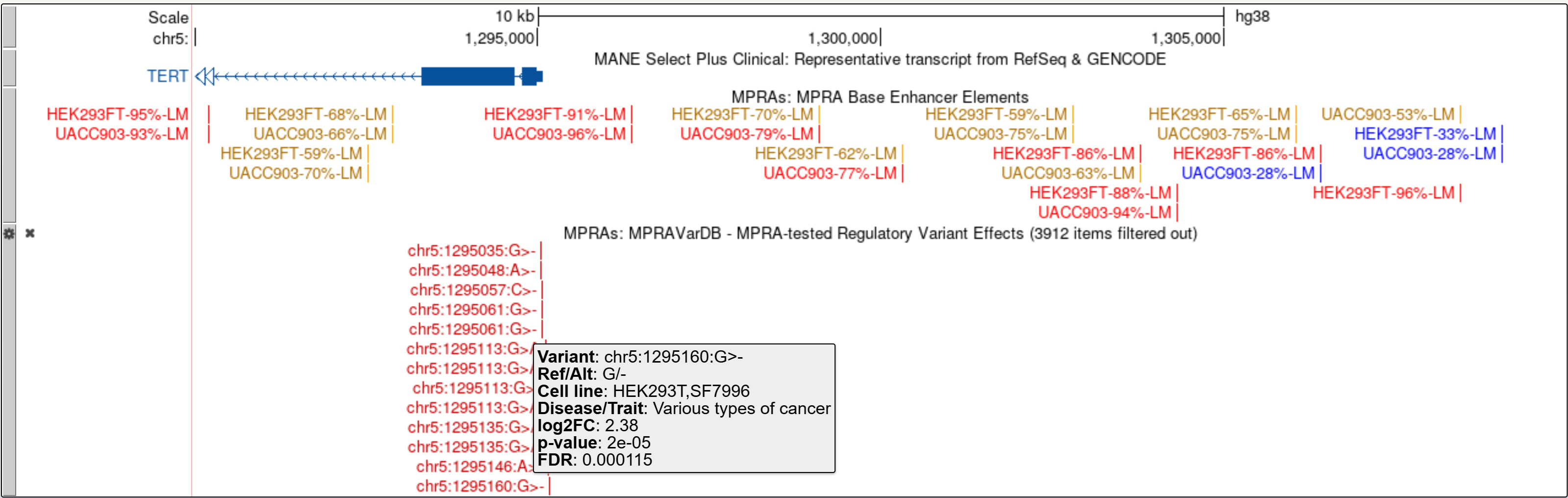
MPRA Base elements and MPRAVarDB variants at the TERT promoter (chr5, GRCh38/hg38). MPRA Base (top) shows reporter activity for melanoma risk variants tested in HEK293FT and UACC903 cells (Choi et al., 2020). MPRAVarDB (bottom) highlights high-confidence allelic effects from saturation mutagenesis of the TERT promoter (Kircher et al., 2019).
See the MPRA Base and MPRAVarDB track description pages for the full list of contributing studies, per-study scoring methodology, and notes on how to interpret raw scores and log2 fold change across studies that use different statistical frameworks.
We would like to thank Varda Singhal, Jianyu Zhao, and the Ahituv Lab at UCSF for creating and curating the MPRA Base database, and Weijia Jin and the MPRAVarDB team at the University of Florida for the variant-effect resource.