
New paper on global assessments

Tom Dietz
Bennett, Elena Michele, Walter Reid, Stephen Carpenter, Tom Dietz, Garry Peterson, Neville Ash, T. Doug Beard, Silke Beck, Reinette Biggs, Noel Castree, John Ehrmann, Tim Forsyth, Keisha Garcia, Blane Harvey, Zuzana Harmáčková, Pushpam Kumar, Myanna Lahsen, Marcus Lee, Clark Miller, Richard Norgaard, Laura Pereira, Klaudia Prodani, Janet Ranganathan, Ciara Raudsepp-Hearne, Lisen Schultz, Esther Turnhout, Coleen Vogel, and Monika Zurek. 2026. “The Future of Global Environmental Assessments: 20 Years after the Millennium Ecosystem Assessment.” Current Opinion in Environmental Sustainability 79:101618. doi:10.1016/j.cosust.2026.101618.
Open access: https://authors.elsevier.com/sd/article/S187734352600014X
Abstract: Global Environmental Assessments (GEAs) are intended to gather expert knowledge on a topic of global importance and present it in a useful format to those who could use the knowledge in decisionmaking. GEAs have disseminated new knowledge, influenced environmental policy, changed the evolution of science, and furthered many careers. The GEA community has always adapted to changing circumstances, often by increasing the complexity of the assessment process. The current level of complexity of most GEAs, alongside today’s increasingly polarized societies, changes in international trade, biophysical changes to the planet, greater interest in cross-sectoral problems and solutions, enhanced technological capacity, and increasingly contested nature of some aspects of environmental science may indicate that we’ve reached a point where further adaptation cannot be achieved merely by adding more complexity. It may be time for more fundamental changes to the GEA scope, process, and delivery. We use the MA as a touchstone in exploring how GEAs have evolved, considering both challenges and possible paths forward to retain legitimacy, credibility, and salience in a changing world. One strong possibility is for GEAs to reorient to serve as support structures for a broader diversity of levels and types of decision-making and a broader array of decisionmaking actors. In a rapidly changing world, a diverse ecosystem of assessment approaches is likely to be more robust, have more impact, and evolve more quickly. Continuing to experiment with different models for delivering multi-scale environmental information will help GEAs fit the needs of the 21st century
Thomas Dietz
-University Distinguished Professor of Environmental Science and Policy, Sociology and Animal Studies Emerit
Michigan State University
-Gund Affiliate, Gund Institute for the Environment, University of Vermont
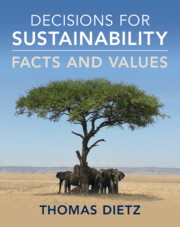
Blog on the book: https://www.cambridgeblog.org/2023/05/what-should-we-do/
Winner of the 2023 Gerard R Young Book Award of the Society for Human Ecology