
Social Science Research Methods - Comprehensive List

Kerry Grimm
Kerry
Kerry Grimm, PhD
Director, Conservation Social Science
National Audubon Society
www.audubon.org

Vivian Nguyen
Sent: Monday, April 14, 2025 12:23:27 PM
To: SSWG Working Group List <sswg...@conbio.org>
Cc: Kerry Grimm <kerry...@audubon.org>
Subject: {SSWG} Social Science Research Methods - Comprehensive List
--
-------------------------------------------------------------------------------------------
This is the SCB Social Science Working Group Listserv.
Follow SCB on Twitter: @Society4ConBio, and Facebook: https://www.facebook.com/Society4ConBio/ and visit our website: scbsocialscience.org
Thank you for your participation in SCB!
Not a member? Join SCB now: http://conbio.org/membership/become-a-member.
You received this message because you are subscribed to the
Society for Conservation Biology's "SSWG Working Group List" group.
To post to this group, send email to SSWG...@conbio.org
To unsubscribe from this group, send email to
SSWGlist+u...@conbio.org
For more options, visit this group at
http://groups.google.com/a/conbio.org/group/SSWGlist
-------------------------------------------------------------------------------------------
To unsubscribe from this group and stop receiving emails from it, send an email to SSWGlist+u...@conbio.org.

Michael Schoon
Hi Kerry,
A nice place to start is a book and website that some colleagues put together called “SES Methods”. Check out the website at: https://sesmethods.org/
That should give a quick start.
Mike
From:
sswg...@conbio.org <sswg...@conbio.org> on behalf of Kerry Grimm <kerry...@gmail.com>
Date: Monday, April 14, 2025 at 9:23 AM
To: SSWG Working Group List <sswg...@conbio.org>
Cc: Kerry Grimm <kerry...@audubon.org>
Subject: {SSWG} Social Science Research Methods - Comprehensive List
--
Kerry Grimm
This is a great idea! I am
replying to the whole list because once I compile my existing resources and new
ones, I will put the list in a google doc so people can use it for reference
(and add if they want).
(PS If people want to email me my Audubon email is best--I just can't email from it since it's a non-gmail account)

Craig Severance

Tom Dietz
I’d like to offer some big picture thoughts about methods.
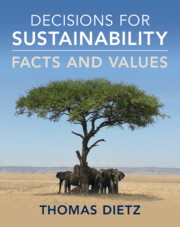
First, there is a lot of good work, much of it reviewed in my “Decision for Sustainability: Facts and Values" book, arguing for linking scientific analysis meant to inform decisions with ongoing deliberation with interested and impacted parties (Dietz 2023). Literature reviews conclude that this helps get the science right, get the right science and build trust. (Book is free online at many libraries.)
Second, we are very often trying to get at causality. If we want to change things for the better, we have to move beyond identification of correlations to find levers of change and that requires thinking about causal relationships. Both experiments with randomization and observational analyses have strengths and limits in striving for understanding real world causality. Ken Frank has written great work on how to assess the strength of our conclusions (Frank et al. 2022). And looking for causality implies having a model, something we emphasize in our stat text (Dietz and Kalof 2009). All this makes me very hesitant about data search and AI methods that are likely to capitalize on spurious relationships.
Third, we should not expect results to generalize universally. I suspect that much of the “replication crisis” in psychology comes from assuming away contextual effects. I would not expect a study done with a sample of folks from, say Michigan, to produce the same results as a study with a sample of folks from, say, Colombia. And as we move from general findings to applications to specific contexts, uncertainty increases. Thus the importance of deliberative processes. (Again, issues discussed in Decisions for Sustainability.)
Finally, I always argue we should think of science/research as a conversation. A study is a turn in the conversation. In the areas in which we work there are seldom studies that close off the discussion, but there are studies that influence where the conversation goes next.
So I would hope any methods training would engage these issues.
Best,
Tom
Cites
Dietz, Thomas. 2023. Decisions for Sustainability: Facts and Values. Cambridge: Cambridge University Press.
Dietz, Thomas, and Linda Kalof. 2009. Introduction to Social Statistics: The Logic of Statistical Reasoning. New York: Wiley-Blackwell.
Frank, Kenneth A., Qinyun Lin, Ran Xu, Spiro Maroulis, and Anna Mueller. 2022. “Quantifying the Robustness of Causal Inferences: Sensitivity Analysis for Pragmatic Social Science.” Social Science Research 102815. doi: https://doi.org/10.1016/j.ssresearch.2022.102815.
Thomas Dietz
-University Distinguished Professor of Environmental Science and Policy, Sociology and Animal Studies Emerit
Member: Center for Systems Integration and Sustainability, Center for Global Change and Earth Observation, Great Lakes Integrated Sciences and Assessments Center
Michigan State University
-Gund Affiliate, Gund Institute for the Environment, University of Vermont
Blog on the book: https://www.cambridgeblog.org/2023/05/what-should-we-do/
Winner of the 2023 Gerard R Young Book Award of the Society for Human Ecology
Michigan State University occupies
the ancestral, traditional, and contemporary Lands of the
Anishinaabeg – Three Fires Confederacy of Ojibwe, Odawa,
and Potawatomi peoples. The University resides on Land ceded in the
1819 Treaty of Saginaw.

Will Allen
Thanks for pulling this together—it’s always helpful to share resources that reflect the diversity of social science methods being used in practice.
Since 2003, I’ve curated the Learning for Sustainability website – https://learningforsustainability.net – as an international knowledge hub bringing together resources on collaboration, adaptive management, and participatory research. It includes practical guidance on planning, evaluation, and learning—covering topics like theory of change, evaluation approaches, and indicators. While not a traditional social science methods guide, the site brings together approaches that reflect participatory, systems-based, and reflective ways of working.
Feel free to include it—or draw from it—in the shared list.
Best,
Will
E-mail: willal...@gmail.com
Mobile: +64 274 934 213

Tom Dietz
Kalof, Linda, Joe Zammit-Lucia, Jessica Bell, and Gina Granter. 2016. “Fostering Kinship with Animals: Animal Portraiture in Humane Education.” Environmental Education Research 22(2):203–28.
Kalof, Linda, Joe Zammit-Lucia, and Jennifer Rebecca Kelly. 2011. “The Meaning of Animal Portraiture in a Museum Setting: Implications for Conservation.” Organization & Environment 24(2):150–74.
While not focused on methods, many on this list might find of use the curated animal studies bibliography at animalstudies.msu.edu
The site is also home to resources from the Looking at Animals in National Geographic series of studies, including the teaching modules developed by the project: