
Ibrahim Waziri: From HND in Nigeria to PhD in America

Farooq A. Kperogi
What you will read below is the inspirational story of a 29-year-old Nigerian from Bauchi who graduated with an HND in Electronics Engineering from the Federal Polytechnic, Bauchi, in 2009 and wound up getting a PhD in Information Security from Purdue University last month.
His journey started when he sent me an email in late 2009. He wanted to know if his HND would qualify him to study for a master’s degree in the US. I told him yes, and sent him links to two articles I wrote about studying in the US. I also guided him on how to take the GRE and TOEFL, how to apply to US universities, and how to get funding for his studies.
I didn’t think what I did would amount to anything. I have rendered countless such mentorships to several people. But two years later, I got an email from Ibrahim (now Dr. Waziri) that he was enrolled in a master’s program at a university here in Georgia thanks entirely to my guidance, which I frankly didn’t even remember until I searched my email archive. He even visited me in my home.
A few years later, he was accepted to the prestigious Purdue University to study for a Ph.D. He graduated a month ago with high honors and has accepted a well-paying job in Washington DC. To say I am delighted and proud of this energetic, passionate young man’s success is to understate the incredibly overwhelming joy I feel.
I requested Dr. Waziri to write a short piece detailing his journey to serve as an inspiration to many young people with HNDs who think their educational journeys have ended. Enjoy it:
|
Dr. Ibrahim Waziri |
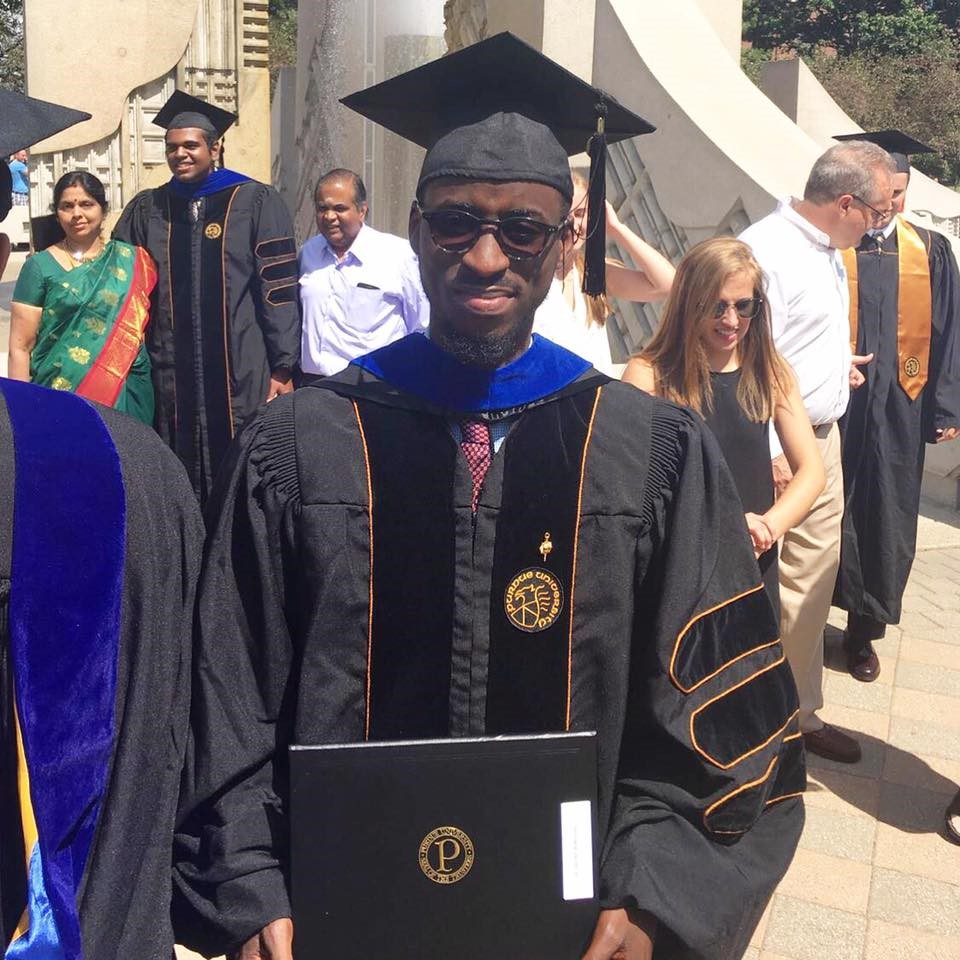
Getting a Ph.D. from an American university has always been dream. But like many HND graduates, I always wondered if I would be able to continue with my studies in the US with a Nigerian HND. Would the HND be recognized as the equivalent of a bachelor’s degree? I had no clue until I came across Prof. Farooq Kperogi’s Weekly Trust column and blog.
In November 2009, I read Prof. Kperogi’s article titled “Studying in America: What you need to know.” After reading the article, and understanding how the process of getting accepted into an American University was, I emailed him to inquire whether my HND was equivalent to an American bachelor’s degree. He answered my questions, provided in-depth guidance, and later published another article titled “HND and American Universities,” which provided a step-by-step guide on how an HND graduate can continue studying in the US.
Following guidance from Prof. Kperogi’s article, I submitted my OND and HND transcripts to the Word Education Services (WES) for evaluation. (WES is the largest international credential evaluation service in America and Canada). The evaluation results said my HND was equivalent to an American bachelor’s degree.
At the time my transcripts were under evaluation, I prepared for and took my Graduate Records Exams (GRE) and benefitted from the resources Prof. Kperogi generously shared with me. I got impressive scores. I applied for the master’s program at Georgia Tech, Southern Poly State University, and Georgia Southern University. I got accepted into Georgia Southern.
In August 2012, I started my Masters of Science degree in Applied Engineering (with a focus in Information Technology) at Georgia Southern University. It is at Georgia Southern that I met my mentor and amazing professor by the name of Prof. Jordan Shropshire, who is now a Professor of Computer Science at the University of South Alabama. I worked in Prof. Shropshire’s lab as a Research and Teaching assistant were I learned how to conduct research and mentor students. For my work, I got a tuition waiver and a monthly stipend.
I worked on different projects relating to Network Security and Cloud Computing, which resulted in my first academic publication. My performance during my master’s program was really impressive to the point that I got inducted into the Phi Kappa Phi Honor Society, the oldest and most selective honor society in the US. This is what my mentor, Prof. Shropshire, said about me:
“Ibrahim was my best graduate assistant at Georgia Southern University. He is intelligent, professional, and responsive. He completes complicated projects on time and under budget. A patient man, he excels at explaining complex subjects to non-technical persons. Even under the most stressful conditions I don't think I've ever seen him lose his cool. For these reasons (and many others) I wouldn't hesitate to hire him again.”
– Source: Ibrahim Waziri’s LinkedIn profile.
In May 2014, I graduated with my master’s degree. Immediately after, in August 2014, I started my Ph.D. in Information Security at Purdue University, one of the best universities in the world. I worked extremely hard, taking more classes than required per semester. Because of the rigor of the research training I got from my master’s degree program, I was able to work on my dissertation while doing my course work. This enabled me to complete my 90 hours coursework and dissertation in 2 years. This is unusual. Ph.D. education in US universities typically lasts a minimum of 4 years.
I graduated with my Ph.D. in August 2016. My research areas are Network Security, Cloud Computing, and Virtualization Security. I have published and presented papers relating to Firewalls, Phishing Attacks, Cyber Forensics, etc.
While at Purdue University, I worked as a Cyber Anti-Fraud Analyst for RSA, the Security Division of EMC. And I also interned as a Cyber Security Analyst for the US Federal Government, working with USITC in Washington DC. This is what Prof. Sam Liles, one of my professors during my Ph.D. program, said about me:
“Ibrahim showed exceptional understanding of how to analyze malware and problem solve in a class he took with me. His work with volatile malware samples and structured laboratory problems shows a lot of promise. If you are looking for a savvy thinker and capable individual, he is the right person. I enjoyed watching his thinking processes and following along as he solved several complex problems. Almost always forgotten when recommending somebody, but very important is that Ibrahim is simply a nice guy and easy to get along with.”
– Source: Ibrahim’s LinkedIn profile.
I currently work as a Security Research Engineer in Washington, DC. I still consider myself a student and want to gain more in-depth hands-on experience in the ever-changing Cyber Security field. But, ultimately, I want to come back home (Nigeria) to help tackle the Cyber Security issues Nigeria faces. You can look me up on LinkedIn or on my personal page at iiwaziri.com.
Dr. Waziri can be reached at iiwa...@gmail.com
Related Articles:
School of Communication & Media
Kennesaw State University
Cell: (+1) 404-573-9697
Personal website: www.farooqkperogi.com
"The nice thing about pessimism is that you are constantly being either proven right or pleasantly surprised." G. F. Will

Bitrus Gwamna
Prof Kperogi: many thanks for this inspiring story, and for your mentorship of this brilliant individual. I am also grateful to you for your excellent essays on language.
Bitrus Gwamna
From: usaafric...@googlegroups.com [mailto:usaafric...@googlegroups.com] On Behalf Of Farooq A. Kperogi
Sent: Sunday, September 04, 2016 11:58 AM
To: usaafric...@googlegroups.com
Subject: USA Africa Dialogue Series - Ibrahim Waziri: From HND in Nigeria to PhD in America
This first appeared in my "Notes from Atlanta" column in the Daily Trust on Saturday. It was republished on my blog: http://www.farooqkperogi.com/2016/09/ibrahim-waziri-from-hnd-in-nigeria-to.html
What you will read below is the inspirational story of a 29-year-old Nigerian from Bauchi who graduated with an HND in Electronics Engineering from the Federal Polytechnic, Bauchi, in 2009 and wound up getting a PhD in Information Security from Purdue University last month.
His journey started when he sent me an email in late 2009. He wanted to know if his HND would qualify him to study for a master’s degree in the US. I told him yes, and sent him links to two articles I wrote about studying in the US. I also guided him on how to take the GRE and TOEFL, how to apply to US universities, and how to get funding for his studies.
I didn’t think what I did would amount to anything. I have rendered countless such mentorships to several people. But two years later, I got an email from Ibrahim (now Dr. Waziri) that he was enrolled in a master’s program at a university here in Georgia thanks entirely to my guidance, which I frankly didn’t even remember until I searched my email archive. He even visited me in my home.
A few years later, he was accepted to the prestigious Purdue University to study for a Ph.D. He graduated a month ago with high honors and has accepted a well-paying job in Washington DC. To say I am delighted and proud of this energetic, passionate young man’s success is to understate the incredibly overwhelming joy I feel.
I requested Dr. Waziri to write a short piece detailing his journey to serve as an inspiration to many young people with HNDs who think their educational journeys have ended. Enjoy it:
|
Dr. Ibrahim Waziri |
--
Listserv moderated by Toyin Falola, University of Texas at Austin
To post to this group, send an email to USAAfric...@googlegroups.com
To subscribe to this group, send an email to USAAfricaDial...@googlegroups.com
Current archives at http://groups.google.com/group/USAAfricaDialogue
Early archives at http://www.utexas.edu/conferences/africa/ads/index.html
---
You received this message because you are subscribed to the Google Groups "USA Africa Dialogue Series" group.
To unsubscribe from this group and stop receiving emails from it, send an email to usaafricadialo...@googlegroups.com.
For more options, visit https://groups.google.com/d/optout.

Kenneth Harrow
I’d like to second the praise of Farooq Kperogi for his fine mentorship, and the happy results
ken
Kenneth Harrow
Dept of English and Film Studies
From: usaafricadialogue <usaafric...@googlegroups.com> on behalf of Bitrus Gwamna <bgw...@gmail.com>
Reply-To: usaafricadialogue <usaafric...@googlegroups.com>
Date: Sunday 4 September 2016 at 17:35
To: usaafricadialogue <usaafric...@googlegroups.com>
Subject: RE: USA Africa Dialogue Series - Ibrahim Waziri: From HND in Nigeria to PhD in America
Prof Kperogi: many thanks for this inspiring story, and for your mentorship of this brilliant individual. I am also grateful to you for your excellent essays on language.
Bitrus Gwamna
From: usaafric...@googlegroups.com [mailto:usaafric...@googlegroups.com] On Behalf Of Farooq A. Kperogi
Sent: Sunday, September 04, 2016 11:58 AM
To: usaafric...@googlegroups.com
Subject: USA Africa Dialogue Series - Ibrahim Waziri: From HND in Nigeria to PhD in America
This first appeared in my "Notes from Atlanta" column in the Daily Trust on Saturday. It was republished on my blog: http://www.farooqkperogi.com/2016/09/ibrahim-waziri-from-hnd-in-nigeria-to.html
What you will read below is the inspirational story of a 29-year-old Nigerian from Bauchi who graduated with an HND in Electronics Engineering from the Federal Polytechnic, Bauchi, in 2009 and wound up getting a PhD in Information Security from Purdue University last month.
His journey started when he sent me an email in late 2009. He wanted to know if his HND would qualify him to study for a master’s degree in the US. I told him yes, and sent him links to two articles I wrote about studying in the US. I also guided him on how to take the GRE and TOEFL, how to apply to US universities, and how to get funding for his studies.
I didn’t think what I did would amount to anything. I have rendered countless such mentorships to several people. But two years later, I got an email from Ibrahim (now Dr. Waziri) that he was enrolled in a master’s program at a university here in Georgia thanks entirely to my guidance, which I frankly didn’t even remember until I searched my email archive. He even visited me in my home.
A few years later, he was accepted to the prestigious Purdue University to study for a Ph.D. He graduated a month ago with high honors and has accepted a well-paying job in Washington DC. To say I am delighted and proud of this energetic, passionate young man’s success is to understate the incredibly overwhelming joy I feel.
I requested Dr. Waziri to write a short piece detailing his journey to serve as an inspiration to many young people with HNDs who think their educational journeys have ended. Enjoy it:
|
Dr. Ibrahim Waziri |

Abdulbasit Kassim

Mxolisi Toti
--
Listserv moderated by Toyin Falola, University of Texas at Austin
To post to this group, send an email to USAAfricaDialogue@googlegroups.com
To subscribe to this group, send an email to USAAfricaDialogue+subscribe@googlegroups.com
Current archives at http://groups.google.com/group/USAAfricaDialogue
Early archives at http://www.utexas.edu/conferences/africa/ads/index.html
---
You received this message because you are subscribed to the Google Groups "USA Africa Dialogue Series" group.
To unsubscribe from this group and stop receiving emails from it, send an email to usaafricadialogue+unsubscribe@googlegroups.com.
Adewole Atere
Sent from my iPad
To post to this group, send an email to USAAfric...@googlegroups.com
To subscribe to this group, send an email to USAAfricaDial...@googlegroups.com
Current archives at http://groups.google.com/group/USAAfricaDialogue
Early archives at http://www.utexas.edu/conferences/africa/ads/index.html
---
You received this message because you are subscribed to the Google Groups "USA Africa Dialogue Series" group.
To unsubscribe from this group and stop receiving emails from it, send an email to usaafricadialo...@googlegroups.com.

