
Fwd: Thursday Message From Shri Sai Satcharitra.
1 view
Skip to first unread message

Sai.Manisha
Jul 17, 2013, 9:26:57 PM7/17/13
to shirdi-sai-baba...@googlegroups.com
Thursday Message:
Sai as Sagun Brahman
There are two aspects of God or Brahman : (1) the Unmanifested (Nirgun) and (2) the Manifested (Sagun). The Nirgun is formless, while the Sagun is with form, though both denote the same Brahman. Some prefer to worship the former, some the latter. As stated in the Gita (chapter XII) the worship of the latter is easy and preferable. As man has got a form (body, senses, etc.), it is natural and easy for him to worship the God with form. Our love and devotion do not develop unless we worship Sagun Brahman for a certain period of time, and as we advance; it leads us to the worship (meditation) of Nirgun Brahman. So let us start with Sagun worship.
Image, altar, fire, light, sun, water, Brahman are the seven objects of worship, but Sadguru is better than all these. Let us, on this occasion, bring to our mind the form of Sai, Who was non-attachment Incarnate, and Who was a resting-place for His whole-hearted devotees. Our faith in His words is the seat of Asan; and our Sankalpa (determination to start and finish the Puja) is the abandonment of all our desires. Some say that Sai was a Bhagwad-bhakta (devotee of the Lord), others say He was a Maha-Bhagwat (a great devotee), but to us He is God Incarnate. He was extremely forgiving, never irritable, straight, soft, tolerant and content beyond comparison. Though He looked embodied (as having the form), He was really dis-embodied, emotionless, unattached and internally free. The Ganges on its way to the sea, cools and refreshes the creatures affected with heat, gives life to the crops and trees, and quenches the thirst of many. Similarly Saints (Souls)
like Sai, while they live their own life, give solace and comfort to all. Lord Krishna has said that 'the Saint is My soul, My living image, I am He or He is My pure form (Being).' This in-describable Shakti or Power of God, known as Pure Existence, Knowledge and Bliss, incarnated in the form of Sai in Shirdi. The Shruti (Taitiriya Upanishad) describes Brahman as Bliss. This we read or hear daily in the books, but the devout people experienced this Brahman or Bliss in Shirdi. Baba, the support of all, required no prop or support (Asan) from anybody. He always used a piece of sack-cloth for His seat, which was covered with a small beautiful bed by His bhaktas and has a bolster placed by them, as a rest to His back. Baba respected the feelings of His devotees and allowed them to worship Him as they liked. Some waved Chamara or fans before Him, some played on musical instruments, some washed His hands and Feet, some others applied scent and chandan, some
gave betel nut with leaves and other things, and some others offered naivedya. Though He looked like living in Shirdi, He was present everywhere. This all-pervasiveness of His way daily experienced by His devotees. Our humble prostration to this all-pervasive Sadguru.
Dr. Pandit's Worship
One Dr. Pandit, a friend of Tatyasaheb Noolkar, once came to Shirdi for Baba's darshana. After saluting Baba, he stayed in the Masjid for some time. Baba asked him to go to Dadabhat Kelkar. He went to Dadabhat, by whom he was well received. Then Dababhat left his house for Puja and Dr. Pandit accompanied him. Dadabhat worshipped Baba. Nobody until then dared to apply sandal paste to Baba's forehead. Only Mhalsapati used to apply it to His throat. But this simple-hearted devout, Dr. Pandit, took Dabadhat's dish containing Puja-materials and taking sandal-paste out of it, drew a Tripundra, i.e. there horizontal lines on Baba's forehead. To the
surprise of all, Baba kept silent without uttering a single word. Then Dababhat that evening asked Baba, "How is it, that though You object to the sandal-paste being applied by others to Your forehead, but You allowed Dr. Pandit to do so now?" Baba replied that Dr. Pandit believed Him to be the same as his Guru, Raghunath Maharaja of Dhopeshwar, known as Kaka Puranik, and he applied the paste to His forehead, as he was doing to his Guru. Hence He could not object. On enquiry, Dr. Pandit told Dadabhat that he took Baba as his Guru Kaka Puranik, and hence he marked the Tripundra on Baba's forehead, as he did on his Guru's head.
Though Baba allowed the devotees to worship Him as they pleased, still sometimes, He acted in a strange way. Sometimes, He threw away the Puja-dish and was wrath Incarnate, then who could approach Him? Sometimes, He scolded the devotees, at times, He looked softer than wax, a statue of peace and forgiveness. Though He seemed to shake with anger and His red eyes rolled round and round, still, He was internally a stream of affection and motherly love. Immediately, He called out His devotees and said, that He ever angry with His devotees; that if mothers kicked their children and if the sea turned back the rivers, He would neglect the devotees' welfare: that He, the slave of His devotees, always stood by them, and responded
to them, whenever they called upon Him, and that He always longed for their love.
Haji Sidik Falke
There was no knowing, when Baba would accept a devotee. That depended on His sweet will. Sidik Falke's story is to the point. One Mahomedan gentleman by name Sidik Falke of Kalyan, after making a pilgrimage to Mecca and Madina, came to Shirdi. He lived in a Chavadi, facing north, and sat in the open court-yard of the Masjid. For nine months, Baba ignored him, and did not allow him to step into the Masjid. Falke felt much disconsolate, and did not know what to do. Somebody advised him not to be disappointed; but to try to approach Baba through Shama (Madhavarao Deshpande), a close and intimate devotee of Baba. He told him that as they approach the
God Shiva through his servant and devotee, Nandi, so Baba should be approached through Shama. Falke liked the idea and implored Shama to intercede for him. Shama agreed and on a convenient occasion spoke to Baba about him thus:- "Baba, why don't You allow the old Haji to step into the Masjid, while so many persons freely come and go, after taking Your darshan; why not bless him once?" Baba replied "Shama, you are too young to understand things. If the Fakir (Allah) does not allow, what can I do? Without His grace, who will climb into the masjid? Well, go to him and ask him whether he will come to the narrow footpath near the Barvi well." Shama went and returned with an affirmative answer. Again Baba said to Shama,"Ask him whether he is willing to pay me the sum of Rs. 40,000/- in four instalments." Shama went and returned with the answer that he was willing to pay even 40 lacs. Again Baba said to Shama- "We are going to butcher a goat in the Masjid, so
ask him, whether he would like to have mutton, haunch or testicles of the goat." Shama returned with the answer that the Haji would be happy to receive a small crumb from Baba's kolamba (mudpot). Hearing this Baba got excited and with His hands threw away the earthen jars and kolamba and straightway advanced to the Haji and lifting His Kafni up with His hands said - "Why do you brag and fancy yourself great and pose yourself as an old Haji? Do you read Koran like this? You are proud of your pilgrimage to Macca, but you do not know Me." Being thus scolded, the Haji was confounded. Baba then went back to the Masjid, purchased a few baskets of mangoes and sent them to the Haji. Then again Baba went to the Haji and taking out Rs.55/- from His pocket, gave them to the Haji. From that time, Baba loved the Haji, invited him for meals and the Haji, thereafter, came into the Masjid whenever he liked. Baba gave him at times some rupees, and thus the Haji was
enlisted in Baba's Darbar.
Baba's Control over the Elements
We shall close this Chapter after describing two incidents showing Baba's control over the elements. (1) Once at evening time, there was a terrible storm at Shirdi. The sky was overcast with thick black clouds. The winds began to blow forcibly; the clouds roared and the lighting began to flash, and the rains began to descend in torrents. In a short time, the whole place was flooded with water, All the creatures, birds, beasts and men got terribly frightened; and they all flocked to the Masjid for shelter. There are many local deities in Shirdi, but none of them came to their help. So they all prayed to Baba - their God, Who was fond of their
devotion, to intercede and quell the storm. Baba was much moved. He came out and standing at the edge of the Masjid, addressed the storm in a loud and thunderous voice - "Stop, stop your fury and the calm." In a few minutes the rains subsided, the winds ceased to blow, and the storm came to a stop. Then the moon rose in the sky, and the people then went back home well-pleased, (2) On another occasion at noon the fire in the Dhuni began to burn brightly, its flames were seen to be reaching the rafters above. The people who were sitting in the Masjid did not know what to do. They dared not to ask Baba to pour water or do anything to quench the flames. But Baba soon came to realize, what was happening. He took up His Satka (short stick) and dashed it against a pillar in front, saying - "Get down, Be calm." At each stroke of the Satka, the flames began to lower and slow down; and in a few minutes the Dhuni became calm and normal.
This is our Sai, an Incarnation of God. He will bless any man who will prostrate and surrender himself to Him. He, who will read the stories of this Chapter daily with faith and devotion, will soon be free from all calamities; not only this, but always attached and devoted to Sai, he will get very soon God-vision: all his desires will be fulfilled and being ultimately desireless, he will attain the Supreme. Amen!
Bow to Shri Sai -- Peace be to all
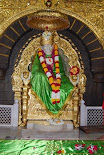
Sairam
Baba Guide us all,
At the feet of my Sathguru Sai Baba
Baba's blessing are every where
Manisha.Rautela.Bisht
Baba Guide us all,
At the feet of my Sathguru Sai Baba
Baba's blessing are every where
Manisha.Rautela.Bisht
~Visit Shirdi Sai Baba Websites~
http://www.shirdisaibabakripa.org
http://www.shirdisaibabatemples.org
http://www.saibababhajans.com
http://shirdisaibabatamilstories.blogspot.com
http://www.shirdisaibabakripa.org
http://www.shirdisaibabatemples.org
http://www.saibababhajans.com
http://shirdisaibabatamilstories.blogspot.com
Sai.Manisha
Jul 25, 2013, 5:37:15 AM7/25/13
to shirdi-sai-baba...@googlegroups.com
Thursday Message:
Really this Jiva (human soul) transcends the three qualities, viz. Sattwa, Rajas and Tamas, but being deluded by Maya, he forgets his nature which is 'Existence-knowledge-bliss', and thinks that he is the doer and enjoyer and thus entangles himself in endless miseries and does not know the way of deliverance. The only way of deliverance is Loving Devotion towards the Guru's feet. The great Player or Actor Lord Sai has delighted His Bhaktas and transformed them into Himself (His nature).
We regard Sai Baba as an incarnation of God for reasons already stated, but He always said that He was an obedient servant of God. Though an incarnation He showed the people the way, how to behave satisfactorily and carry out the duties of their respective stations (Varnas) in this life. He never emulated others in any way, nor asked others to have something done for Him. For Him, Who saw the Lord in all movable and immovable things of this world, humility was the most proper thing. None He disregarded or disrespected; for He saw Narayan (Lord) in all beings, He never said, "I am God," but that He was a humble servant and He always remembered Him and always uttered - "Allah Malik" (God is the sole proprietor or
Owner).
We do not know the various kinds of Saints, how they behave, what they do and eat etc. We only know, that by God's grace they manifest themselves in this world to liberate the ignorant and bound souls. If there be any store of merits on our account, we get a desire in listening to the stories and Leelas of the Saints, otherwise not. Let us now turn to the main stories of this Chapter.
Yoga and Onion
Once it so happened, that a sadhak of Yoga came to Shirdi with Nanasaheb Chandorkar. He had studied all the works on Yoga, including the Yoga-sutras of Patanjali, but had no practical experience. He could not concentrate his mind and attain samadhi even for a short time. He thought that if Sai Baba be pleased with him, He will show him the way to attain samadhi for a long time. With this object in view he came to Shirdi, and when he went to the Masjid he saw Sai Baba eating bread with onion. On seeing this, a thought arose in his mind - `How can this man, eating stale bread with raw onion, solve my difficulties and help me?' Sai Baba read his
mind and said to Nanasaheb - "Oh Nana, he who has the power to digest onion, should eat it and none else". Hearing this remark, the yogi was wonder-struck and then he fell at Baba's Feet with complete surrender. With pure and open mind, he asked his difficulties and got their solution from Baba. Thus being satisfied and happy, he left Shirdi with Baba's Udi and blessings.
Shama Cured of Snake-Bite
Before Hemadpant begins the story, he says about the Jiva that it can be very well compared with a parrot, and that they both are bound, the one in the body and the other in a cage. Both think that their present bound state is good for them. It is only when a Helper, i.e., Guru comes and by God's grace opens their eyes and liberates them from their bondage, that their eyes are opened to a greater and larger life, compared to which their former limited life is nothing.
In the last Chapter, it was shown how Baba anticipated the calamity, that was to befall on Mr. Mirikar and rescued him from it. Now let the readers hear a story grander than that. Once Shama was bitten by a poisonous snake. His little finger of the hand was stung and the poison began to spread into the body. The pain was also severe and Shama thought that he would pass off soon. His friends wanted to take him to the God Viroba, where such cases were often sent, but Shama ran to the Masjid -- to His Viroba (Sai Baba). When Baba saw him, He began to scold and abuse. He got enraged and said - "Oh vile Bhaturdya (Priest) do not climp up. Beware if you do so" and then roared - "Go, Get away, Come down." Seeing Baba thus
red with wrath, Shama was greatly puzzled and disappointed. He thought that the Masjid was his home and Sai Baba his sole Refuge, but if he was driven away like this, where should he go? He lost all hope of life and kept silent. After a time Baba became normal and calm when Shama went up and sat near. Then Baba said to him - "Don't be afraid, don't care a jot, the Merciful Fakir will save you, go and sit quiet at home, don't go out, believe in Me and remain fearless and have no anxeity". Then he was sent home. Immediately afterwards, Baba sent Tatya Patil and Kakasaheb Dixit to him with instructions to the effect, that he should eat what he liked, should move in the home, but should never lie down and sleep. Needless to say that these instructions were acted upon and Shama got all-right in a short time. The only thing to be remembered in this connection is this - the words of Baba (or the five syllabled Mantra, viz, `Go, Get away, Come down') were not
addressed to Shama- as it apparently looked - but they were a direct order to the snake and its poison not to go up and circulate through Shama's body. Like others well-versed in Mantrashastra, He had not to use any incantation, charged rice or water etc. His words only were most efficacious in saving the life of Shama.
Any one, hearing this story and other similar ones, will beget firm faith in the Feet of Sai Baba, and the only way to cross the ocean of Maya is to remember ever the Feet of Baba in the heart.
Cholera Epidemic
Once, Cholera was raging virulently in Shirdi. The residents were much frightened and they stopped all communication with the outside people. The panchas of the village assembled together and decided upon two ordinances as a remedy to check and put down the Epidemic. They were (1) No fuel-cart should be allowed to come in the village, and (2) No goat should be killed there. If anybody disobeyed these ordinances, they were to be fined by the village-authorities and panchas. Baba knew that all this was mere supersition, and therefore, He cared two pence for the Cholera-ordinances. While the ordinances were in force, a fuel-cart came there, and
wanted to enter the village. Everybody knew that there was dearth of fuel in the village, still the people began to drive away the fuel-cart. Baba came to know of this. He came to the spot and asked the cartman to take the fuel-cart to the Masjid. None dared to raise his voice against this action of Baba. He wanted fuel for His Dhuni and so He purchased it. Like an Agnihotri keeping his sacred fire alive throughout his life, Baba kept His Dhuni ever burning all day and night; and for this He always stocked fuel. Baba's home, i.e. the Masjid was free and open to all. It had no lock and key; and some poor people removed some wood from there for their use. Baba did not grumble about this. Baba saw that the whole universe was pervaded by the Almighty, and so He never bore enmity or ill-will to anybody. Though perfectly detached. He behaved like an ordinary house-holder to set an example to the people.
Ordeal of Guru-Bhakti
Let us now see, how the second Cholera-ordinance fared with Baba. While it was in force, somebody brought a goat to the Masjid. It was weak, old and about to die. At this time Fakir Pir Mohamad of Malegaon alias Bade Baba was near. Sai Baba asked him to behead it with one stroke, and offer it as an oblation. This Bade Baba was much respected by Sai Baba. He always sat on the right hand of Sai Baba. After the chilim (pipe) was first smoked by him, it was then offered to Baba and others. After the dishes were served, at the time of taking meals at noon, Baba respectfully called Bade Baba and made him sit on His left side, and then all partook of
food. Baba paid him also daily Rs.50/- out of the amount collected as Dakshina. Baba accompanied him hundred paces whenever he was going away. Such was his position with Baba. But when Baba asked him to behead the goat, he flatly refused, saying "Why it should be killed for nothing?" Then Baba asked Shama to kill it. He went to Radha-Krishna-Mai and brought a knife from her and placed it before Baba. Knowing the purpose for which the knife was taken, she recalled it. Then Shama went to bring another knife, but stayed in the Wada, and did not return soon. Then came the turn of Kakasaheb Dixit. He was 'good gold' no doubt, but had to be tested. Baba asked him to get a knife and kill the goat. He went to Sathe's Wada and returned with a knife. He was ready to kill it at Baba's bidding. He was born in a pure Brahmin family and never in his life knew killing. Though quite averse to do any act of violence, he made himself bold to kill the goat. All the people
wondered to see that Bade Baba, a Mahomedan was unwilling to kill it while this pure Brahmin was making preparations to do so. He tightened his dhotar and with a semicircular motion raised his hand with the knife and looked at Baba for the final signal. Baba said - "What are you thinking of? Go on, strike". Then, when the hand was just about to come down, Baba said - "Stop, how cruel you are! Being a Brahmin, you are killing a goat?" Kakasaheb obeyed and kept the knife down and said to baba - "Your nectarlike word is law unto us, we do not know any other ordinance. We remember You always, meditate on Your Form and obey You day and night, we do not know or consider whether it is right or wrong to kill, we do not want to reason or discuss things, but implicit and prompt compliance with Guru's orders, is our duty and dharma".
Then Baba said to Kakaseheb, that He would Himself do the offering and killing business. It was settled that the goat should be disposed of near a place called Takkya, where fakirs used to sit. When the goat was being removed to that place, it fell dead on the way.
Hemadpant closes the Chapter with a classification of disciples. He says that they are of three kinds : (1) First or best (2) Second or middling and (3) Third or ordinary. The best kind of disciples are those who guess what their Gurus want and immediately carry it out and serve them without waiting for an order from them. The average disciples are those who carry out the orders of their Masters to a letter, without any delay, and the third kind of disciples are those, who go on postponing the carrying out of their orders and making mistakes at every step.
The disciples should have firm faith, backed up by intelligence and if they and patience to these, their spiritual goal will not be distant. Control of breath -- ingoing and outgoing, or Hath-Yoga or other difficult practices are not at all necessary. When the disciples get the above-mentioned qualities, they become ready for further instructions and the Masters then appear and lead them on, in their spiritual path to perfection.
In the next Chapter we will deal with Baba's interesting wit and humour.
Bow to Shri Sai - Peace be to all
Reply all
Reply to author
Forward
0 new messages