|
Nahjul Balagaha An uparalled A book of sermons &
letters by Imam Ali(as) | NahjulBalagha
Details
Sahifa Alavia - A
beautiful collection of some supplications by Imam
Ali(as)
The
Voice of Human Justice-George
Jordache
Life of
Imam Ali-as ( Seerat) More
Books |
More on Imam
Ali
al-islam.org link
Ghadeer - Official
appointment by the Prophet(as) as his
successor
+ A Collection
of traditions from the various schools of Islamic belief ,on the
leadership (Imamate) and mastership (Wilaayat) of , Ali b. Abi
Talib. A
119
page (11 mb Pdf) booklet
.
Imam Ali (as) & Ahlulbayt in
the Quran
| Hadith By the Prophet on Imam ali
(as)
Two Miraculous sermons by
Imam Ali (as)-Sermon without using any alphabets with dots ي ث خ ت ن ظ ف خ ج & A sermon w/o alphabet Alif
ا
Imam Ali (as) Mathematical
brilliance samples | Download 'Selected Judgements of
Imam Ali(as)'- zip file
Evidence of Imam's Miraculous
birth inside the Kaaba
pdf | More Photos of Rukn Yamani
Imam Ali (as) role in each
battle |
Examples of Imam Ali (as) Moral
virtues |
Imam Ali (as)- Western
views
Know about the Family of
Ali (as) :- Father
:-Abu Talib
(Also see book On
Abutalib)
, Wife:-
the daugther of the Prophet(as), Syeda Fatima Zehra
, Sons:- Imam
Hassan(as)
Imam Hussain
(as) &
Hazrat Abbas
(as)
(another book )
,Daughter:
Syeda Zainub
(Another
book)
& Mother Fatima bint Asad , Grandson:- Imam Zainul
Abideen(as)
Ziaraat
(visitation recitation ) of Imam Ali(as)
Download Powerpoint Presentation 'Who is
Ali'
Birth
On the 13th of the month of Rajab, twenty-three years
before the migration of the Prophet (P.B.U.H.) a child was born in
the family of Abu Talib, the light of whom kindled the whole World.
Kunaab Mecci narrates about his birth: "We and Abbas (Ibne Abdul
Mutalib) were sitting together when suddenly we saw Fatima
bint-e-Asad moving towards the Kaabah in the condition having
delivery pain and saying "Oh God I have faith in you and the Prophet
( i.e., Abraham) who by your command laid the foundation of this
house. O God! I swear you by the same Prophet (P.B.U.H.) and swear
you by the child in my womb make this birth comfortable and easy for
me."
This was the time when all of us saw with our own eyes that
the wall of Kaabah broke apart and Fatima bint-e-Asad entered into
the Kaabah. Then the wall again united.
We ran terrified and
trembling to our houses to send our women into the Kaabah for the
help and assistance of Fatima. We did our best but the door did not
open. This event surprised all the people of Mecca.
The women of
Mecca were anxiously counting moments to meet Fatima till the time
she came out of the Kaabah along with a beautiful baby, saying, "God
has chosen me from among the ladies of Mecca and He made me His
guest in His house and gave me meals and fruits of the heaven to
eat.
The ladies who were surrounding her in the form of a circle
and escorting her to her home asked her, "What name have you given
to this child?"
She said: "When I was in the Kaabah, I heard a
hidden voice call," Name this child "ALI".
Yes! We are talking
about Ali (A.S.) the pious man whose childhood and infancy period
lasted in such a pure and chaste way that he himself stated in
Nahjul Balaghah, "The Prophet (P.B.U.H.) used to pick me in his lap
and embrace me and chew the food and put it into my
mouth.
Early Youth
Ali Ibne
Abi Talib describes this enlightening period of his age as under:
The Prophet (P.B.U.H.) used to go the Cave of Hira but nobody except
he (P.B.U.H.) and I did know about it. At the time when the religion
of Islam had not yet reached the homes, he (P.B.U.H.) and his wife
Khatija were the only Muslims. I was the next person to them who saw
the light of revelation and prophet hood and smelled the fragrance
of the Prophet hood.
When the Prophet (P.B.U.H.) of Islam was
ordered by God to invite his family members to embrace Islam Ali (
A.S.) according to the advice of the Prophet (P.B.U.H.) invited
forty persons of the Prophet's family at his home. Although the food
was quite little but all of them ate fully well. After the meal was
over the Prophet (P.B.U.H .) spoke to those present saying, "Oh the
sons of Abdul Mutalib, God has ordered me to invite you to embrace
Islam and get you introduced to it."
Whosoever, having believed
in my Prophet hood, promises to help and assist me shall be my
brother, deputy and successor and my caliph.
He repeated this
sentence thrice but no one except "Ali (A.S.)" gave a positive
response. As many time as the Prophet ( P.B.U.H.) addressed the
persons present, nobody except Ali (A.S.) answered. Ali (A.S.) was
rising again and again to his feet and promising help to him and
announcing his faith.
Evidence present at the Kaaba of his birth is
at here
Youth
This is the
very reason why the Prophet ( P.B.U.H.) said: "This Ali, is my
brother and successor listen and lend ears to what he says and obey
his orders." When Ali (A.S.) entered from his early youth into the
phase of puberty, the part of age when all the human energies and
powers are strong and firm, even in this part of the life he
remained closely associated to the Prophet ( P.B.U.H.) like a flying
moth which moves around the Candle. He defended Islam and the
Prophet (P.B.U.H.) with his strong, energetic arms.
When the
enemy besieged and surrounded the Muslims in the battle of Hunain
and they abandoned and left behind the Prophet (P.B.U.H.) running
away for their lives, it was only and only Ali (A.S.) who defended
and saved the Prophet (P.B.U.H .) and made the enemies retreat and
take to their heals.
Ali (A.S.) killed Marhab the chief of army
of Jews in the Khyber battle, whose power and bravery was making
everybody tremble but Ali (A.S.) cut him into two and pulled apart
the gate of the Khyber fort which used to be opened and closed by
twenty men together. Ali ( A.S.) used it as a bridge over the trench
for the Islamic army to cross over to the Khyber fort. Many such
events are the specimens and evidences about the faith, and spirit
of self-sacrifice and devotion of Ali (A.S.).
Self-Sacrifice and
Devotion
There is no doubt to it that every body loves his soul
and very rarely gets ready to sacrifice it for another person but
because of the fact that Ali (A.S.) loved the soul of the Prophet
(P.B.U.H.) even more than his own one, he got prepared to lay his
life for him.
The event takes shape like this. When the
polytheists saw that they are in danger, they jointly made a firm
determination to take the Prophet ( P.B.U.H.) by surprise and martyr
him. So all of them gathered in "Dar un Nadva" and choose one person
from each family so that every tribe gets involved in getting
Mohammad (P.B.U.H.) killed and then no one could take the revenge of
him.
The Prophet (P.B.U.H.) had come to know about this
conspiracy through revelation. God ordered him (P.B.U.H.) to migrate
from Mecca in the darkness of the night. The Prophet (P.B.U.H.)
needed someone, prepared to sacrifice his life and must be a
trustworthy secret holder.
Hence, there was no one else except
Ali (A.S.) in whom he confided, and told him "God has informed me
that the infidels will break through the house to kill me so today
you sleep on my bed." Ali (A.S.) smilingly accepted it.
Then the
time came when the darkness of the night covered everything and Ali
(A.S.) was sleeping on the Prophet's (P.B.U.H.) bed calmly and
peacefully and the Prophet ( P.B.U.H.) came out of his house and
started proceeding towards the Cave of Saur. The infidels besieged
the house and got prepared with their swords and spears to attack
it. The sooner they were instructed to make it, they break through
the house rushing with naked swords. But when they found Ali ( A.S.)
laying on the bed of the Prophet (P.B.U.H.) they immediately moved
out of the house desperate and astonished, and sent a few horsemen
to search the Prophet (P.B.U.H.). But not very long afterwards they
too returned defeated and hopeless.
Ali (A.S.) and Holy
War
Islam is the religion of peace and tranquility
and does not like killing, plundering, and bloodshed. But if some
one kills another without any reason then Islam has strong
punishment to deal with him.
Of course, if an enemy attacks the
Muslims then by the standards of wits, common sense, and religious
law, self defense which as a form of Jehad becomes essential and
indispensable.
All the battles of the Prophet (P.B.U.H.) in which
Ali (A.S.) fought armed and truthfully were defensive
battles.
Ali (A.S.) was such a brave, faithful, holy warrior who
never got frustrated and upset and tired of the fighting and
battles. He was afraid of no one except God. He used to say "By God
if I see that on one side is the truth and on the other side all the
rest of the people I, without caring and paying heed to those
reproaching me, will fight all alone with my sword, on the way and
path of the right, against them.
Ali's (A.S.) way or
Training
The city of Kufa was the capital of
the Islamic Government. People from all over the World used to
gather at that point to get the benefit of knowledge and learning
from that great Islamic University.
One of those days two men
came across each other in the vicinity of the city one of them was
Ali (A.S.) and the other was a Christian who did not recognize him.
The Christian man was moving towards the suburban area of Kufa,
where as, Ali ( A.S.) was on his way to kufa.
They mutually
agreed to accompany each other for a while, talking to each other,
so that they do not get tired.
They reached a point where two
ways split out, so that each one wanted to move on one of those two
different roads. The Christian bade Farwell and went on his way but
he observed that his Muslim companion, whose way was on the opposite
side, was moving towards him. So he stopped and questioned him,
"Don't you want to go to kufa?"
Ali (A.S.) said, "Yes". The
Christian man said, "Then why are you coming towards this
direction?"
Ali (A.S.) replied, "I wish to accompany you to a
certain length of distance because the Prophet (P.B.U.H.) said,
"when two persons are together on a way (journey companions) they
get a right over each other."
"Now that you have got a right upon
me, I go along with you up to a certain distance so that I must pay
you (discharge) that light of yours in this world. Then I will part
off on my own way." The Christian man was much pleased and moved by
this humanly attitude and conduct and he liked his talk and said,
"It is befitting that I should also embrace Islam which has such a
culture and students."
His amazement and astonishment was only
too enhanced when he discovered that his travel companion is Ali
(A.S.), the ruler of Islam. So he immediately accepted and embraced
Islam at his hand.
Self-preservation of Ali (
A.S.)
When human being is in the normal and
natural condition, he can better be the master of his wits and
control himself and take distance and move away from the sins and
bad acts and get himself aside from them. But when the flames of
anger, rage or jealousy are lit, then it is only with difficulty
that man could think and keep in view fact and God. Therefore, most
of the crimes are committed at times when man looses his normal
natural condition.
But, Ali (A.S.) who was a self made and
sublime person his approach and behavior was different than that of
the others. He, in all the conditions, kept his attention focused
and concentrated on God and took distance from anything which did
not have the approval of God, whether he was at home or in the
battle field, both in joy or anger.
We would better have a glance
upon his behavior and conduct in the battlefield to prove our point.
In the battle of "the trench" all the people of Medinah dug up a
great trench on the sides of the city and filled it up with water to
block the enemy's way. Amer bin Abduwad, the famous and gallant Arab
warrior among the enemy army, was challenged the Muslims to send him
a match for the fight. Nobody among the Muslims plucked the courage
to give him a response and came out to face him. On this occasion
Ali (A.S.) came out taking stable and strong steps to face him with
a heart full of faith. He said, "Oh Amro do not boast off too much
about your bravery and man-hood. The one who has the power and
energy to fight you is standing before you".
Amro viewed him and
said: "You would better turn back I do not like to kill you because
I was a friend of your father."
Ali (A.S.) replied: "By God, I
like killing you."
Amro got angry and climbed down from the horse
and quickly attacked Ali (A.S.) with his sword but the sword did
strongly strike Ali's (A.S.) shield and so it was not effective.
Then Ali (A.S.) by blowing a strike of his sword made him fall to
the earth and climbed upon his chest to kill him. But Amro, out of
his rage and anger spitted at Ali's ( A.S.) face. Suddenly Ali
(A.S.) came down from his chest and started walking on the ground.
Then he came again towards him. Amro enquired him, "what is the
meaning of it that firstly you struck me an effective blow and then
let me go free?"
Ali (A.S.) said, "Oh Amro I use my sword for God
and not myself? At the time when I saw you fall to the ground and
climbed your chest, you spit at my face and made me angry. Had I
killed you in such condition I would had no reward to my credit
because I was angry. Therefore, I got up from your chest and started
walking so that my anger and hot temper is cooled down and subsided
and I may do my job purely for God."
The bravery, ferocity,
self-preservation and control of Ali had a very deep effect over the
Arab champion. And attracted the attention and eyes of both the
friends and foes to such an extent that the friends raised the
slogan of Takbeer (Allaho Akbar) from the depth of their heart and
the enemies hearts were filled up with tenor and harassment, so far
so, that it ended upon the defeat of the enemy. This is the sole
reason why his deed was decisive and fate making such as the Prophet
said about it. "The job that Ali (A.S.) did on the day of the
Khandak (battle of trench) and the sword strike by him (against the
enemy) is more precious to God then the collective prayers of the
mankind and jins together.
Ali's (A.S.) Mercy and
Compassion
We learnt about the bravery and
dauntlessness of Ali (A.S.) in the battlefield but we should not
omit this point that if a man is brave, ferocious, and dauntless but
he does not possess the qualities of mercy and generosity then that
bravery and gallantry has no value. The bravery of Ali ( A.S.), when
he stepped into the battlefield, was such that he did care and was
attentive to the injured, thirsty and hungry ones. He would attack
an aggressive enemy and kill him but when he came across an injured
thirsty and hungry enemy he would save him from thirst and hunger
and if he was injured then he would extend his treatment.
He did
fiercely fight the enemy but never killed him while he was in a
thirsty or hungry condition and he never destroyed and dismantled
the houses of the enemy. Because he considered all these acts as
against the norms of nobility and generosity. This is the reason,
why having taken the river water from the control of the Muawiyah's
forces in the sifeen battle he ordered his warriors to let the water
free for all and sundry and do not resist against the army men of
Muawiyah if they wanted to use the water.
The army men of Ali
(A.S.) objected and said "the enemy having taken the water's control
in their hand had stopped us from using it. So that they wanted us
to submit to them through this way. We would better do the same to
them."
Ali (A.S.) replied, "No we will fight the enemy manly and
we consider this act against the human nobility and generosity. If
we do the same what they did then what would be the difference
between them and us? Beware, works are for God and we should not
take steps against His wish and will."
Ali (A.S.) Conduct during his ruler
ship
1. Siding with
the masses
Ali (A.S.), with all the difficulties
that he had to face, used to personally attend the affairs and
works. He would get himself informed about the problems of the
people. He did not drive away his enemies due to personal enmities.
So far so that he used to give them their rights from the
bait-ul-mal (Islamic treasury). Moreover, he did not give any
privileges to his friends due to their friendship. He continuously
used to order his officials and workers to have a conduct of justice
with the people and if he observed any misdeed or misconduct of his
subordinates and workers he did not spare them. So when one of the
ladies known as Sooda approached him for justice, he was then
offering his prayers. He shortened his prayer and smilingly greeted
her and asked, "What is it that you want?"
With tears rolling on
her face, Sooda complained about the tax officer and his
excesses.
He, in the same standing condition of his prayers, wept
and said: "Oh God be a witness that I have not ordered them to
commit excesses and aggressions against your slaves."
He at once
picked up a skin piece and jotted down the dismissal order of his
official and gave it to Sooda to take it to him as soon as
possible.
Another day he received the information that son of
Hunaif (the Governor of Basra) made himself present on a very
colorful, richly provisioned dinner table of one of the nobles and
notables and possibly the blood thirsty and cruel chance seekers and
opportunists may make the most of his political station and
position.
He got seriously annoyed and reprimanded him for this
act of his and wrote him a letter saying. "I have heard that you
joined a richly provisioned (colorful) dinner table which the poor
were not allowed to join. Be aware! That I am your Imam, leader and
chief if I wish and am inclined to it I can lay hand and provide
myself with the best food but I will not do such a thing because it
is possible that there might be some hungry people in the nooks and corners of my country who
go to sleep with empty stomachs. I have contented myself with a
simple dress and small quantity of food, which is bread and dates,
from this world of yours. Although you can not do this, which I
practice but try it that your way and path is not segregated from
that of mine."
He, through this letter, gave him a good advice
and exhortation and reminded him about his duty. Imam Ali (A.S.)
lived his life with such a justice and equity that when Muawiyah a
staunch and extreme enemy of Ali ( A.S.) met one of his companions
"Addi-bin-Hatim" and asked him, "How did you find Ali (A.S.) during
his reign and rule?"
He replied, "The oppressive and coercive
ones did not have the courage of oppression during his reign and the
weak ones always took benefit from his justice and never allowed
disappointment find its way towards them. So that he repeatedly used
to say, "Is it right and just that people consider and think I am
their leader and Imam but I do not share their difficulties and
hardships?"
Still again, we read in the history that one day the
governors accompanied by his old friend Ibn-e-Abbas came to see
him.
They saw their leader repairing and mending his shoes. Ali
(A.S.) turned his face towards them and said, "What do you think is
the price of this shoe?" They replied, "It value is not much. It
cann't be more than a few Dirhams."
He said, "By Lord this post
that I have got, if I could not make use of it in connection with
the salvation and safety of the poor, have not and arresting and
stopping the cruelties or restoration of the right and truth, then
for me it's value would be lesser than this
shoe."
2. Canceling the distinctions and
Privileges
The moment people took oath of an
allegiance at his hand and accepted his caliphate he climbed the
pulpit and tribune and addressed them, "By God till the time I
possess even one single palm date tree in Medinah. I will not take
anything from the bait-ul-mal (Islamic treasury).
His brother
Aqeel stood up and said, "Do you take me equal to a black skinned
living in Medinah?"
He said, "Oh brother sit down, you do not
have any superiority over that black man except through faith and
piety."
One summer night his brother Aqeel invited him to dinner
at his house so that he may attract the attention of his brother
towards himself and he increases his monthly stipend.
He said,
"Oh brother from where did you procure and provide this
dinner."
He replied "For a few days, I and my wife spent lesser
amount of money thus saved the surplus money to invite you to
dinner."
He said, "From tomorrow onwards I would issue an order
that your monthly salary may be curtailed and decreased to the equal
of the amount that you saved because, you can, as per your own
confession, spend lesser than that."
Aqeel was very much
perturbed and annoyed and he started shouting appealingly. Ali
(A.S.) picked up a piece of iron lying near him heated it up (on a
nearby lamp) and took it near his hand.
Aqeel cried, "Oh I am
burnt."
Ali (A.S.) said, "What a surprise that you are so much
afraid and cry of a fire which is provided by me alone. How are you
prepared to get me burnt in the fire of God's anger? These are the
money and property of the people and I am the trustee and custodian
of them."
Again, we observe that a group of the officials
objected up on him and said, "Had you given a larger contribution
and portion to the rebellious and the governors, you could run and
manage the newly established Islamic government in a better way.
Then, you might have ruled with authority and justice.
Imam Ali
(A.S.) replied, "What a surprise you want me to lay the foundations
of my government, which is formed in the name of Islam, upon the
pillars of excess and injustice? By God, I will definitely never do
such a work."
Moreover, had the Muslim's money and property been
my own property I would not have done this thing still less all of
it belongs to the people and I am not more than a trustee.
3. Attending the
Complaints
Ali (A.S.) during his ruler ship
personally attented to the complaints. During the hot days of
summer, when all the people rested at their homes, he sat by the
shadow of a wall, so that if someone had a complaint he might reach
him and tell him about it.
One of the hot scorching summer days,
when he was perspiring sitting besides and leaning at the wall. A
woman who was depressed and disturbed came and said, "My husband has
committed excess and ousted me from the house in this hot weather. I
wish you to attend to my problem."
Ali (A.S.) hung his head down
and said, "Oh lady the weather is hot, and can you possibly wait
till it becomes better. Then I will accompany you and attend to your
matter. The woman said, "I am afraid that the temper and anger of my
husband may shoot up even higher. It is better that you do the
needful right away.
Ali (A.S.) said, "very well, you walk on and
I follow you." Ali (A.S.), along with the lady, came to the door of
the young man and called him out of the house. He did not recognize
Ali (A.S.) and knew that his wife has called this man to her
help.
Ali (A.S.) said, "This woman says you turned her out of the
house. I have come to advise you that you should have the fear of
God and be kind, nice and do good to your wife. The self-loving,
egotist giving an insulting reply to Ali (A.S.) said, "This matter
is not your concern. I would do whatever I please. Now, when she has
brought you along with her I shall burn her with fire."
Ali
(A.S.) was angry and annoyed at this response of the man and shouted
objecting. Thereafter, he laid his hand on his sword to punish the
youth. When people heard the loud voice of the Imam, they rushed out
of their houses. As their eyes met Ali ( A.S.), they respectfully
came close to him and saluted and greeted him. The rude and impolite
youth knew that he was facing Ali (A.S.). So he got embarrassed,
loosing his wits fell down to the ground and started making excuses
and apologizes and said, "I will accept whatever you say and
hereafter I shall respect my wife and not annoy her."
Ali (A.S.)
said, "I hope you will do the same." Then he addressed the woman
saying, "return to your home, I hope that you would also he a good
wife to your husband."
The Ghadeer Affair
The Prophet (P.B.U.H.) set out for the pilgrimage of God's
house with a large Caravan in the 10th Hijra, so that the people may
perform their Hajj rituals with great fervor, in dignified and
magnificent way, because that was the last Hajj of the Prophet (
P.B.U.H.). The rituals were performed very well and the Prophet
(P.B.U.H.) returned to Medinah along with his companions. On his way
back, the Prophet (P.B.U.H.) was very anxious. His anxiety was about
his followers and the ummah. He was uneasy and anxious about the
events, which were to take place after his death. The actors and
jugglers among the ummah, were waiting for his death and had
preplanned to deviate and de-track the Imamate and leadership from
its course. He sees all the hypocrites who disguised as his friends;
beat their heads and chests for him. But they have not committed any
blunder, folly and wrong yet, so that he may publicly disgrace and
dishonor them and prevent them (from doing what they intend). He on
one side, views all the incidents of the history and on the other,
he must perform the mission that God has handed him in connection
with Ali ( A.S.), that duty and mission is the caliphate of Ali
(A.S.) that he must choose and select him as his successor and heir,
and put an end to the ambitions of the chance seekers. Those who had
nominated each one of themselves for the post of caliphate and had
made propaganda among the people that the Prophet ( P.B.U.H.) will
choose us as his heirs and successors.
The call of the angel of
revelation is reflecting in the heart and soul of the Prophet
(P.B.U.H.) as if still he is listening to what he said, "you have a
great mission ahead, if you did not perform this job then you have
not done the Prophetic duty and mission at all." You must know, that
God will save you from the deceitfulness and tricks of the
enemy.
Yes, the successor of the sun of Prophet hood should be
the sun of Willayat (guardianship), possessing all the perfections,
completeness and values of the Prophet (P.B.U.H.). Who else could
that be except Ali Ibne Abi Talib ( A.S.)? Ali (A.S.), who was many
times introduced by the Prophet (P.B.U.H.) with the words such as:
"'Ali (A.S.) is the wisest of all my ummah (followers).' 'I am the
city of knowledge and wisdom and Ali is (like) its gate.' 'Whosoever
desires to have access to my wisdom should learn it from Ali.'" This
is the very reason that only Ali ( A.S.) can go up the cathedra
(tribune) and say amid the people. "Oh people, ask me whatsoever you
desire, before a time comes that you loose me."
The Prophet
(P.B.U.H.) made up his mind and decided it to choose Ali ( A.S.) as
his successor on the command and at behest of God, so that, he may
complete and make the Islam perfect, as God had ordered him to do.
The day of Ghadeer, became a day in the history when God gave the
good news to the Prophet (P.B.U.H.) and said, "Today is the day when
I have made Islam to be a perfect (religion) and completed and
finalized my blessings upon you (Muslims)." What a fruitful Hajj and
a holy return. There were approximately one hundred and twenty
thousand men accompanying the Prophet ( P.B.U.H.).
All of them
reached a place known as "Ghadeer-e-Khum" on the land of "Juhfa".
The Prophet (P.B.U.H.) ordered them to stop. All of them did stop at
the behest of the Prophet (P.B.U.H .). They were saying to
themselves, "It appears that some vitally important problem has
confronted us." It was just the same that they were thinking
of.
They built a tribune with the camel saddles for the Prophet (
P.B.U.H), heralds were appointed amid the gathering to repeat and
call out the words of the Prophet (P.B.U.H.), so that, all the
people may hear. He (P.B.U.H) went atop the tribune while he was
surrounded by his friends and said: "Oh people! I performed my
Prophetic mission and did put in endeavor to the maximum of my
energy that I possess. You should know that I leave two valuable
(weighty) things among you after myself (after my death) so that
these two will never at all get separated from each other.
1. The
Holy Quran, the Book of God.
2. My Ahle Baith [People of the
house, the Imam Ali (A.S.) Fatima (A.S.), Hassan (A.S.), Hussain
(A.S.) and nine Imams from the descendents of Hussain
(A.S.)].
Then, he took the hand of Ali (A.S.) and hoisted it like
a flag, so that all of the people might see. Thereafter, he said, "I
am the guardian (wali) of whosoever, (he should know that) Ali is
also his guardian. Oh God! Be the friend of the friends of Ali and
be the enemy of his enemies. Help those who help him and be the
enemy of anyone who fights him. Yes, those who are present convey my
words to those who are not present here. I hope they will lend ears
and accept it."
Full
details about Ghadir event with scanned book evidences click
HERE
How did Ali (A.S.) get the
Government?
The opportunists, who had embraced
Islam for the sake of seeking power and made themselves, move along
on the path of Prophet (P.B.U.H.), held confidential and secret
meetings to oust the caliphate from the family of Bani Hashim. They
were counting days to achieve their ends and to put into practical
shape what they had planned to do, because they were aware that they
are face to face with a person whose past services for Islam are not
hidden and are clear to everybody. The Prophet ( P.B.U.H.) had made
a plenty of recommendations about him and particularly invited all
to swear in an oath of allegiance for him. After the death of the
Prophet (P.B.U.H.), all the plans were put into practice and
materialized one after the other. So that Ali ( A.S.) became all
alone, and did not have any alternative except remaining silent.
For, he only thought of Islam and did not pay any attention towards
his post and station. And had he drawn the sword then the only
desire of his enemies would have taken practical shape, that is to
say, no sign of Islam would have been left back.
The silence of
Ali (A.S.) and Fatima Zahra (A.S.) and the immoralities and
irregularities of the previous power seekers, particularly the
cruelties and excesses of the officials and agents of the Bani
Ommayides dynasty, whose influence had gone up during the regime of
third Caliph Usman, had made the people aware and all of them knew
that the Islamic Caliphate had turned into the stage of political
actors and stooges and what God and the Prophet ( P.B.U.H.) had
meant was quite different from those things.
Resultantly the
displeasure and dissatisfaction of people reached it's climax and
the spark of revolution was kindled in the hearts of the people,
which erupted like a volcano, so that, no one had the means and
power to resist and stand up to it. People attacked the house of
Usman in the shape of a flood, showing camel like anger and grudge,
a camel who throws foam out of its mouth due to anger. These out
numbered and countless people, who made the attack, killed
him.
People were so enraged and furious that they even did not
pay any attention and notice to Imam Hasan ( A.S.) and Imam Hussain
(A.S.) who were sent by Imam Ali (A.S.) to prevent Usman from being
slain. Imam Hassan (A.S.) was injured in this disturbance.
People
rushed towards Ali's (A.S.) house with blood dripping out of their
swords and they were burning with fever and fervor of excitement and
commotion. They insistently and requesting dragged him out and took
the oath of allegiance and chose him as their leader and
ruler.
Why Ali's (A.S.) Government faced
defeat?
Although Ali (A.S.) had told the people,
while they were taking the oath of allegiance, that, "I will act
upon the right and will not sell my religion for anybody's world
(wishing to gain material), and will not hand over the power to this
person or that person without seeing reason. I will take into
consideration their past activities and if I observe any violation
and breach of law by my officials I will not spare them, I will
dismiss them immediately. I will act decisively and peremptorinessly
and will not have any fear of any reproaching and blaming. I will
not give Baith-ul-mal's wealth to this and that person without
reason though he may be my son.
But alas, the materialist and
ease and comfort seekers did not welcome the right government of Ali
(A.S.). They abandoned and quit Ali (A.S.) at the initial stage and
created chaos, disorder and mutiny for him. Talha and Zubair, who
were experienced men, went to Mecca and provoked Ayesha ( R.A.) to
rise up for the sake of taking vengeance of Usman's blood. They by
taking benefit of the station of Ayesha (R.A.), who was the wife of
Prophet, gathered a large group around her. And, with a big army,
they moved hastily towards Ali (A.S.). They had told the illiterate
people that Ali (A.S.) was the murderer of Usman. As a result, they
shed the blood of a group of Muslims and shifted its responsibility
towards Ali (A.S .). After this incident Muawiyah, that cunning fox,
who was discharged by Ali (A.S.) perceived a very good chance for
his obstinacy and resistance. He rose against Ali (A.S.) from Syria
and declared war against him.
These battles were continuing, when
a group named Khwarij came into existence among the army men of Ali
(A.S.). This was a group, which considered neither of Ali (A.S.),
nor Muawiyah, and Amro Aas suitable for ruler ship. They, under the
slogan of "Rule is only for God," started a mutiny and
adventure.
Finally, they martyred Ali (A.S.) but they did not
succeed in killing Muawiyah and Amro Aas. This is how Ali's (A.S.)
Government was defeated and sacrificed upon its own Justice
(righteousness) meaning thereby, if Ali (A.S.) had ruled cunningly
treacherously like Muawiyah he would had never been killed.
Martyrdom of Ali
(A.S.)
After the battle of Neherwan was over,
group of Khwarij daily held a meeting in Mecca and wept over their
dead, those killed in Neherwan. One day, they told each other,
"Sitting here and weeping is of no use. We should kill these three
persons Ali ( A.S.), Muawiyah and Amro Aas, who destroyed the
Islamic State and killed our brothers."
They invited three
volunteers to perform these errands. Ibn-e-Muljim stood and said, "I
will kill Ali (A.S.)." Hajjaj bin Abdullah, under took killing
Muawiyah and Amro bin Bakr Taimeemi said, "I will kill Amro Aas."
The three of them made a commitment together that they would
materialize their plan on the 19th of Ramadan. Then, each one of
them moved towards the place of his mission, so that they reach
there and wait for the date, which was fixed.
But alas, the other
two did not succeed in achieving there end, whereas, Ibn-e-Muljim
did succeed. Ibn-e-Muljim came to Kufa and contacted the enemies of
Ali (A.S.) and lived in their house till the 19th of Ramadan
approached. One day Ali (A.S.) came across him in the streets of
Kufa. He wanted to hide himself. But Ali ( A.S.) said, "I know for
what purpose you have come to Kufa."
As soon as Ibn-e-Muljim
heard these words, he trembled and his legs could no more carry him.
He said to Ali (A.S.), "Oh Ali (A.S.) when it is so (that you know)
release the orders of my being killed or put me in the prison or
banish me off. Ali ( A.S.) had a look upon him and said, "Although I
can put into practice each one of your suggestions, but Islam does
not deem pre-crime punishment, fair. So I am obliged to let you go
free. Perhaps you may repent upon your decision.
At last, on the
19th of Ramadan of the 40th Hijra the son of Muradi opened apart
Ali's (A.S.) head and the mountain of faith and piety tumbled and
crumbled down making the world of Islam mournful.
After Ali
(A.S.) cried on the prayer place (when injured), "By the God of
Kaabah I have succeeded." The haven's angel Jabriel shouted, "By
God, the pillars of guidance are demolished. Ali ( A.S.) has been
martyred."
People rushed out of their houses and arrested the
killer of Ali (A.S.) and handed him over to Imam Hassan (A.S.), and
carried Ali (A.S.) with a blood stained face to his house.
Imam
Hassan (A.S.) imprisoned the killer and informed his father about
it.
Imam Ali (A.S.) told his son, "Oh Son! This man who is my
killer and he is your prisoner, look after his food and water and do
not molest him. If I survive I know what to do with him and if I die
then do not strike him but one blow."
Alas, Ali (A.S.) did not
survive for this ummah. He passed away on the 21st of Ramadan at the
age of 63 years. His pure body was burried secretly at Najaf
(Iraq)
Imam Ali Ibn e Abi Talib (as) according to Hadith's
of Prophet Muhammad (saww) :
The Prophet (s) said, "Ali (a) is the door of
servitude, and whoever passes through that door is a true believer."
Mustadrak Al-Sahihain of Al-Hakim Al-Nisabori; Kenz Al-Omal, 6/156;
Al-Dilmi.
The Prophet (s) said, "Ali (a) is the Imam of goodness,
the fighter against iniquity, the helper of those who come to his
aid, and the deserter of those who desert him." Kenz Al-Omal, 6/153;
Al-Darqatani.
The Prophet (s) said, "Ali (a) is the Imam of the
pious, the prince of believers, and the leader of the resplendent."
Mustadrak Al-Sahihain of Al-Hakim Al-Nisabori, 3/129; Kenz Al-Omal,
6/153.
The Prophet (s) said, "Ali (a) is to me what Haroun was to
Musa." Mustadrak Al-Sahihain of Al-Hakim Al-Nisabori, 3/137; Ibn
Al-Maghazeli, 65, 104; Al-Tabarani; HAliyat Al-Awliya', 1/63; Akhtab
Khawarizm, 229.
The Prophet (s) said, "Ali (a) holds a right over
this nation like the right of a father over his son." Muslim, 2/361;
Al-Tirmidhi, 2/299; Al-Hakim, 3/130; Musnad Ahmad, 3/198; Al-Nisa'i,
7; Asad Al-Ghaba, 3/40.
The Prophet (s) said, "Ali (a) is with
the Qur'an, and the Qur'an is with Ali." Al-Bukhari, 5/19; Muslim,
2/360; Al-Tirmidhi, 5/304; Mustadrak Al-Sahihain of Al-Hakim
Al-Nisabori, 3/109; Ibn Majah, 1/28; Musnad Ahmad, 3/328.
The
Prophet (s) said, "Ali (a) and his shi^a are the successful ones."
Ibn Al-Maghazeli, 47; Mizan Al-^Itidal, 2/313.
The Prophet (s)
said, "Ali (a) is the door of my knowledge, and the one who will
clarifies for my nation that which I was sent with." Tafsir
Al-Tabari, 3/171; Shawahid Al-Tanzil, 2/356; Al-Darr Al-Manthour,
6/379; Yanabi^ Al-Mawda, 61.
The Prophet (s) said, "Love for Ali
(a) is faith, and hatred for Ali is hypocrisy." Ibn Al-Maghazeli,
67; Al-Khawarizmi, 236; Fara'id Al-Samateen; Yanabi^
Al-Mawda.
The Prophet (s) said, "Ali (a) is the partition between
Heaven and Hell." Mustadrak Al-Sahihain of Al-Hakim Al-Nisabori,
3/127; Kenz Al-Omal, 5/30; Al-Jami^ of Al-Suyuti, 1/374;
Al-Tirmidhi; Ibn Maghazeli, 80.
The Prophet (s) said, "The
position of Ali (a) amongst the people is like Surat Qul Hu Allahu
Ahad in the Qur'an." Muslim, 1/48; Al-Tirmidhi, 2/299; Al-Nisa'i,
27; Musnad Ahmad, 6/299; Ibn Al-Maghazeli, 191.
The Prophet (s)
said, "Ali (a) is the beloved between two friends, myself and
Ibrahim." Yanabi^ Al-Mawda, 88; Fara'id Al-Samateen; Bea^ Al-Abrar;
Moniq Ibn Ahmad Al-Khawarizmi.
The Prophet (s) said, "Whoever
splits with Ali (a) has split with me, and whoever splits with me
has split with God." Ibn Al-Maghazeli, 45; Yanabi^ Al-Mawda,
181.
The Prophet (s) said, "Ali (a) is from me and I am from him,
and he is the protector of every true believer after me." Ibn
Al-Maghazeli, 69; Yanabi^ Al-Mawda, 125.
The Prophet (s) said,
"Ali (a) is the most beloved of God and His Prophet in all of
creation." Kenz Al-Omal, 5/33; Al-Riyadh Al-Nudhra, 2/211; Ibn
Al-Maghazeli, 219.
The Prophet (s) said, "Mentioning Ali (a) is a
form of worship, and looking upon him is a form of worship."
Mustadrak Al-Sahihain of Al-Hakim Al-Nisabori, 3/123; Kenz Al-Omal,
6/156; Al-Tabarani; Ibn Al-Maghazeli, 240, 278; Al-Khawarizmi,
62.
The Prophet (s) said, "Love for Ali (a) is a good deed, so
don't ruin it with bad deeds." Al-Tabarani; Yanabi^ Al-Mawda,
2/3.
The Prophet (s) said, "Ali (a) holds the position of the
Ka^aba." Mustadrak Al-Sahihain of Al-Hakim Al-Nisabori, 3/122;
Musnad Ahmad, 3/82; Al-Tabarani, 6/155; Kenz Al-Omal.
The Prophet
(s) said, "Ali (a) stands in relation to me as my head to my body."
Mustadrak Al-Sahihain of Al-Hakim Al-Nisabori, 3/141; Al-Jami^ of
Al-Suyuti, 1/583; Tarikh Baghdad of Al-Khateeb Al-Baghdadi, 1/51;
HAliyat Al-Awliya', 1/182; Al-Riyadh Al-Nudhra, 2/219.
The
Prophet (s) said, "Oh, Ali, Jibreel has informed me that God has
married you to Fatima." Manaqib Al-Imam Ali from Al-Riyadh
Al-Nudhra, p. 141.
The Prophet (s) said, "Oh, Ali, God has
commanded me to marry you to Fatima."Al-Sawaiq Al-Muhariqa,. ch. 4,
p. 142; Dakha'ir Al-Uqubi, p. 30 & 31; Tadhkirat Al-Khawas, p.
276; Manaqib Al-Imam Ali from Al-Riyadh Al-Nudhra, p. 141; Nur
Al-Absar, p. 53.
The Prophet (s) said, "Verily, God married Ali
to Fatima."Al-Sawaiq Al-Muhariqa, p. 173.
The Prophet (s) said,
"The first people to enter Paradise will be Ali and Fatima."Nur
Al-Absar, p. 52; related by similar wording in Kenz Al-Omal, v. 13,
p. 95.
The Prophet (s) said, "The verse of purification was
revealed concerning five people: myself, Ali, Hassan, Hussein, and
Fatima."Is^af Al-Raghibeen, p. 116; Sahih Muslim, Kitab Fadha'il
Al-Sahaba.
The Prophet (s) said, "Fatima is more beloved to me
than you, oh Ali, and you are dearer to me than her."Majma^
Al-Zawa'id, v. 9, p. 202; Al-Jami^ Al-Sagheer, v. 2, p. 654, n.
5761; Muntakhab Kenz Al-Omal, v. 5, 97; Asad Al-Ghaba, v. 5, p. 522;
Yanabi^ Al-Mawadda, v. 2, ch. 56, p. 79; Al-Sawaiq Al-Muhariqa, ch.
3, p. 191
Two Miraculous sermons by Imam Ali
(as)
1.
A Sermon without Dots (nuqta)
The knowledge, wisdom
and eloquence of Imam ‘Ali b. Abi Talib (a) is well known among
Muslims of all schools of thought. One such example of his
mastery over the Arabic language manifested itself in this extempore
sermon which, in its written form, is devoid of any dots
!!
All praise be to Allah: the
praised King, the affectionate Owner, the Fashioner of all who are
born, the Recourse for every downtrodden, the Outstretcher of lands,
the Establisher of firm mountains, the Sender of rain, the
Alleviator of difficulties, the Knower and Perceiver of secrets, the
Destroyer of kingdoms and Perisher of possessions, the Renewer of
eras and their Repetitor, the Source of all things and their
Destination. Widespread
is His generosity and sufficient are the layered clouds and the
supply of rain. He
responds to the one who asks or hopes, giving wide and with
abundance.
I praise Him endlessly. I
consider Him one as He is considered one by those who turn to Him.
Lo ! He is Allah, there is no god for the nations except Him. No one can distort what He
set upright and established. He sent Muhammad as the standard-bearer
of submission (Islam),
the leader for the rulers and preventer of their oppression, The
crippler of the authorities of Wudd and Sawa` (two idols). He informed and educated,
appointed and perfected.
He founded the fundamentals and eased them in. He emphasized
the appointed promise (Day of Judgment) and forewarned. Allah has
linked him with honor and granted his soul the peace, and may Allah
have mercy on his progeny and his venerated family; as long as the
guiding stars shine, the crescent continues to rise, and the chant
of the oneness (La ilaha illa
Allah) is made to be heard around.
May God protect ye! Work towards the best of
deeds. So tread the path seeking the lawful, and give up the
forbidden and abandon it.
Listen to the command of Allah and be aware of it. Maintain
the ties with relations and nurture them. Disobey desires and repel
them. Bond as kins with the righteous and pious, and discontinue the
company of amusement and greed.
Your groom is the most
impeccable of free men by birth, most generous and honorable with
glories, and of the sweetest of descent. Here he came to you, took
your kin with permission, in marriage, the gracious bride. Offered a dowry, just as the
Messenger of Allah did to Umm Salamah. Certainly, he [s] was the
most gracious son-in-law. Kind to his progeny. He gave them in
marriage to whom he wanted.
He was neither confused in his choice of wife nor had an
oversight.
I ask Allah, on your behalf, for the lasting graciousness of
His connection. And the continuation of His pleasures, and that He
may inspire all: the reform of their own condition, and the
preparation for their individual destiny and the hereafter. Gratitude is for Him forever
and the praise for His Messenger Ahmad [s].
This sermon appears to have been
delivered by Imam ‘Ali (a) on the occasion of someone’s marriage (nikah), and may well have
been his own marriage.
It has been quoted by several scholars such as :
-
Muhammad Rida al-Hakimi, Saluni
qabl an tafqiduni, vol. 2, pp.
442-3.
-
Sayyid al-Musawi, al-Qatarah
min bihar manaqib Aal-Nabi wa al-`Itrah, vol. 2, p. 179
-
Hasun al-Dulafi, Fada’il
Aal al-Rasul, p.
6

What is so special about
this sermon?
Those who know Arabic or can at least read the
Qur’anic script will appreciate that certain letters of the Arabic
alphabet have dots associated with them. These letters are listed
below and are used all the time in Arabic speech and written
texts.
It may need to use the karbala font attached to
see the arabic letters
Õ
l © p ^ f ± µ ¹ Z ¡ É V P v
To create any written script of any
meaningful nature, without using any of these letters, is a
difficult task. To
deliver such a sermon without prior preparation, as Imam ‘Ali (a) is
known to have done with all his sermons, is truly amazing!
[Note:
The letter representing taa marbutah used to be written
without dots in early Arabic script]
Are
there any other such sermons?
Imam ‘Ali (a) once delivered
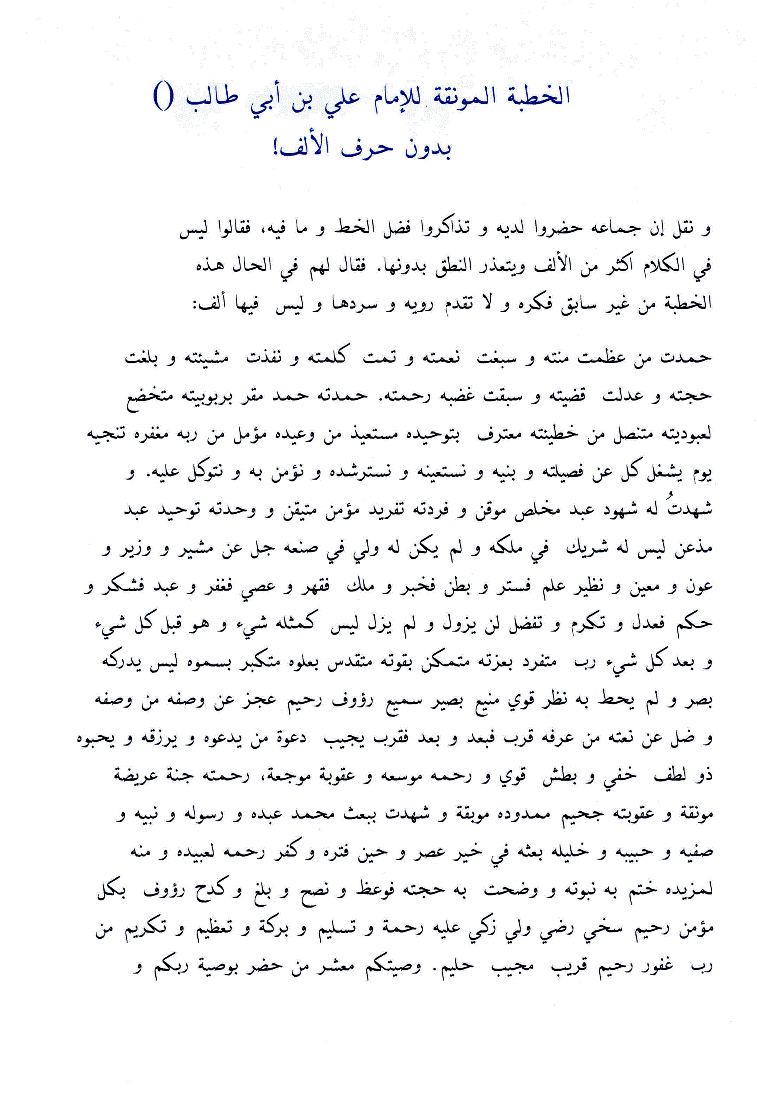
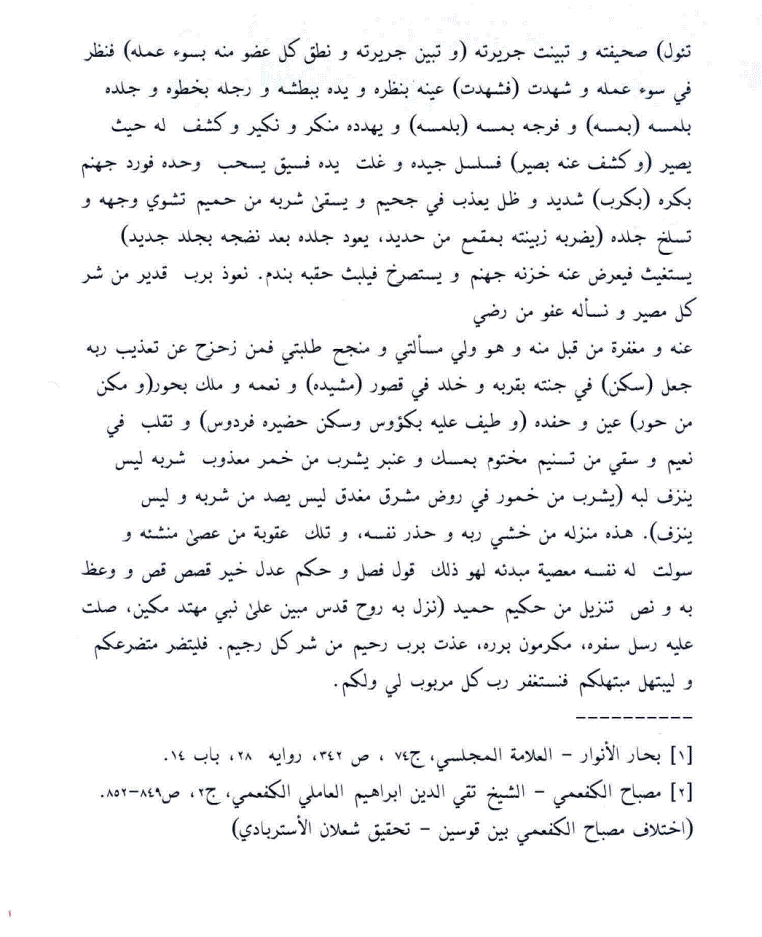
another beautiful sermon which was without the letter alif !! http://www.al-islam.org/arabic/short/noalef.htm
This letter of the Arabic alphabet is undoubtedly
the most commonly occurring character in the language. If composing a few
meaningful sentences without dots is hard enough, how about
delivering a sermon, one which is full of wisdom and which is many
times the size of the one you have just seen, but without ever using
a single alif !!
This sermon is usually called al-Khutbah
al-Muniqah and is recorded by many Muslim scholars. Amongst the Sunni scholars
who quote it can be mentioned:
Muhammad b. Muslim al-Shafi’i, Kifayat
al-Talib,
p. 248
Ibn Abi’l Hadid al-Mu’tazili, Sharh Nahj
al-Balaghah, vol. 19, p.
140
How could Imam ‘Ali (a) accomplish such a
feat?
Imam ‘Ali (a) derived his vast knowledge and striking
eloquence by virtue of his long and close association with the
Prophet Muhammad (s).
The Prophet (s), with Divine inspiration, was the source of
all such knowledge and wisdom and a teacher par excellence for Imam
‘Ali (a).
A
Sermon without Alif : There is another sermon without alif from http://www.al-islam.org/arabic/short/noalef.htm It may need to use the karbala font see the arabic
letters

|


