
gear question.

namibia

Joergen Geerds
Good day, I was referred here byJoost Nieuwenhuijse from PTGui.I currently shoot landscape panos, genreally 180 to 200 degrees.I use a Nikon D3Nikkor 28, 50 and 60mm glassmirror upcable release f8 to f11ISO 200I print on a Epson 7900
Chris Johnston
Sent from my iPad
--
--
You received this message because you are subscribed to the Google Groups "PTGui" group.
To post to this group, send email to pt...@googlegroups.com
To unsubscribe from this group, send email to ptgui+un...@googlegroups.com
Please do not add attachments to your posts; instead upload your files at a file sharing site (for example http://ge.tt/ ) and include a link in your message.
For more options, visit this group at http://groups.google.com/group/ptgui
---
You received this message because you are subscribed to a topic in the Google Groups "PTGui Support" group.
To unsubscribe from this topic, visit https://groups.google.com/d/topic/ptgui/UuBP1Pq4KRc/unsubscribe?hl=en.
To unsubscribe from this group and all its topics, send an email to ptgui+un...@googlegroups.com.
For more options, visit https://groups.google.com/groups/opt_out.

Erik Krause
> I looking for far bigger far sharper images
> then my current system
images with standard point and shoot cameras.
--
Erik Krause
http://www.erik-krause.de
Chris Johnston
I want to get huge files with extreme razor sharp detail of faraway
landscape objects in order to print massive panoramas on my soon to be
delivered Epson 9900. Point and shoot aint going to cut it. Do you have
any suggestions about what the ultimate landscape camera/lens/back
combination might be?
Kind regards,
Chris
Erik Krause
> I want to get huge files with extreme razor sharp detail of faraway
> landscape objects in order to print massive panoramas on my soon to be
> delivered Epson 9900. Point and shoot aint going to cut it. Do you have
> any suggestions about what the ultimate landscape camera/lens/back
> combination might be?
- where shot with standard DSLRs, most of the time not even full frame
ones.
The Epson 9900 prints 44 inch wide. For a very good print quality you
need 300 ppi images, this is 13200 pixels. Your Nikon D3 gives images
4256 pixels wide. You would need 4 rows in portrait orientation to cover
your printer resolution.
A 100mm lens on such a camera covers 14� which is 305 pixel per degree.
Your 4 row panorama would cover a vertical angle of 43�, a bit wider
than a 50mm lens on a 35mm camera. If you use longer lenses you get
narrower angles or higher resolution of course. The mentioned gigapixel
world records where shot with 400mm to 800mm lenses. One of the
currently largest ones (Shanghai Ckyline) would print 75x32 meters at
300 ppi.
If you want to shoot such images you probably need a motorized panoramic
tripod head and a fast computer.

Henrik Tived
great when it works and you have no errors in the process.
But the more images you shoot the greater the likelihood of errors. It takes
a long time to shoot, the environment changes while shooting, the risk of
vibration increases with each movements, regardless of you using the best
techniques, the best gear.
However, when it does work it's amazing - which is why we keep doing/trying
:-)
If what you want to do is to maximise what your current printer can output,
then it's a pure math exercise, as Erik has worked out for you. Now you just
need to work out the best gear for that condition.
Best of luck and remember to have fun doing it :-)
Henrik
"PTGui Support" group.
To unsubscribe from this group and stop receiving emails from it, send an
Henrik
is great when it works and you have no errors in the process.
But the more images you shoot the greater the likelihood of errors. It
takes a long time to shoot, the environment changes while shooting
From: pt...@googlegroups.com [mailto:pt...@googlegroups.com] On Behalf Of
Sent: Monday, 29 April 2013 10:36 PM
To: pt...@googlegroups.com
Subject: RE: [PTGui] Re: gear question.
"PTGui Support" group.
To unsubscribe from this group and stop receiving emails from it, send an
Chris Johnston
Thanks for the follow-up, I think what I am really after is the highest degree of critical sharpness at the small detail level at distance.
Cheers.

Keith Martin
Thanks for the follow-up, I think what I am really after is the highest degree of critical sharpness at the small detail level at distance.
Chris Johnston
Hello Keith.
My panorama work is limited to landscapes, with the exception of clouds or moving shadow or sunrise, they are static.
I use a Manfrotto deluxe head generally shoot 5 or 12 degree shots with one of three lenses, 28mm f2.8, 50mm f1.4 or 60mm micro Nikkor and my D3
I am using a Epson 7900 but want to step up to a 9900 to print high end commercial and residential decor landscapes
I am typically stitching 6 t 20 images in a final pano, generally less than 250 degrees, more often 180 or less. Normally my exposures are 30 seconds or less.
Where I feel the D3 and my lenses let me down is in deep background edge detail.
The thing I have been hoping to get from someone on this forum is a concrete suggestion, e.g., get a Phase One Mamiya P45+ and the 80mm lens or a Mamiya RZ Pro 2 with the 110mm lens or a Hasselblad H3D 39mp and their version of the fast 80mm. Something specific that address my specific question.
I am also obviously interested in using the same camera system for other purposes, product, fashion, portraiture, and yes even occasionally animals I do after all live in Africa. But the prime purpose of this is to shoot the majestic desert landscapes of Namibia.
All the best.
Chris
--
Erik Krause
> The thing I have been hoping to get from someone on this forum is a
> concrete suggestion, e.g., get a Phase One Mamiya P45+ and the 80mm lens or
> a Mamiya RZ Pro 2 with the 110mm lens or a Hasselblad H3D 39mp and their
> version of the fast 80mm. Something specific that address my specific
> question.
want to achieve. You not only don't need them, you will eventually get
better results from your current camera, because it has a wider depth of
field. You need a longer lens and eventually a motorized pano head if
you want to get higher resolution.
F.e. the Mamiya digital has 22 megapixels on a 48x36mm Sensor. This is a
pixel density of 113px/mm. Your D3 has a pixel density of 118px/mm,
which is slightly better. Any prime lens should resolve this pixel
density. Using the same focal length on both cameras you need to shoot
two images with your D3 to get the same size as one image from the
Mamiya. Plus you have less edge light fall off and less chromatic
aberration wi8th your Nikon, since it uses only the inner part of the
image circle.
If you want to buy a new camera in any case, get a D800. You can re-use
your lenses and you get the best sensor currently available.
Joergen Geerds
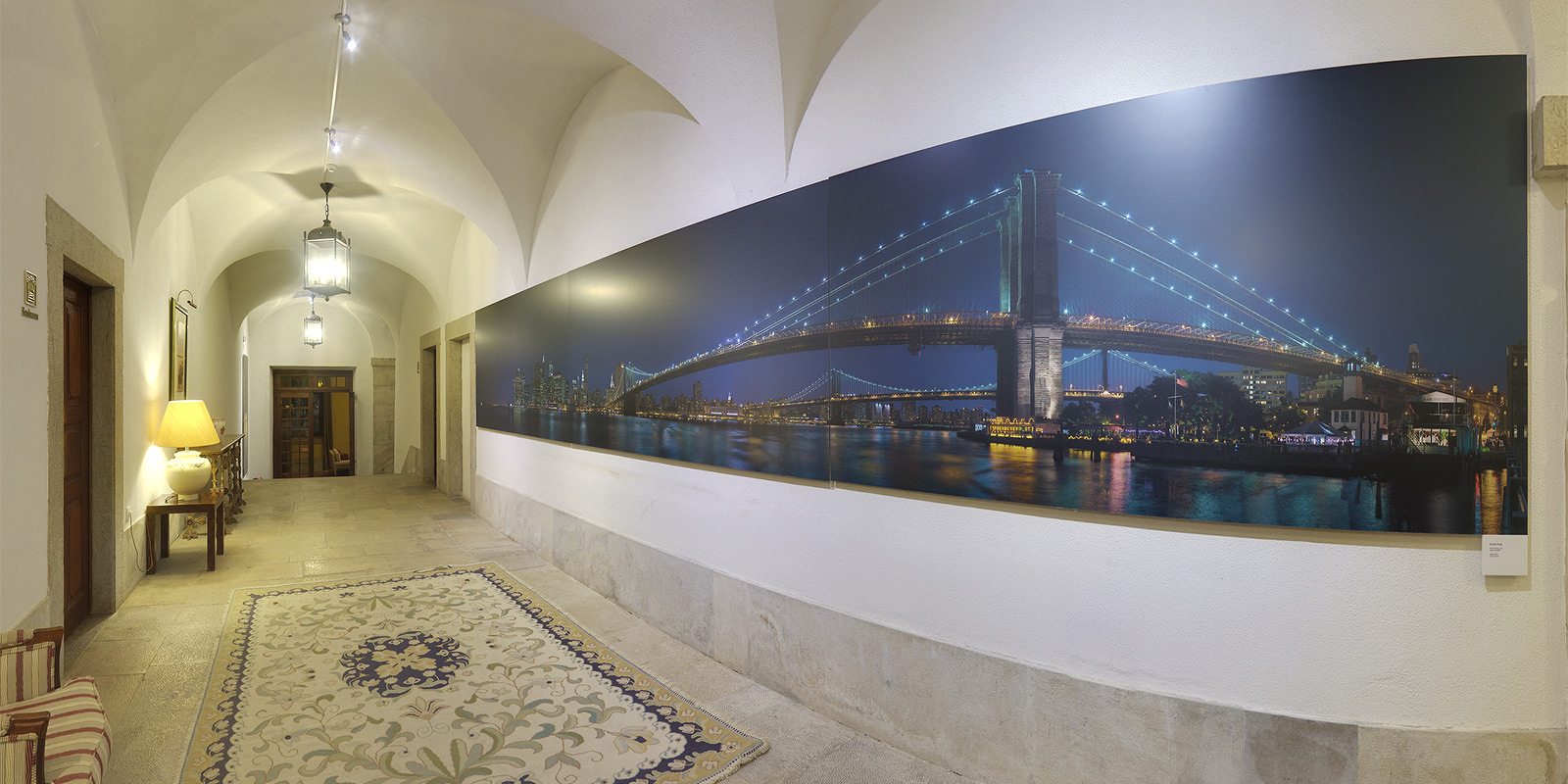
from http://newyorkpanorama.com/2011/06/01/lumin-o-city-solo-exhibition-in-portugal/
and all the others that have given you advise so far are extremely knowledgable photographers as well, they all have done projects like this.
but in the end, you really have to decide yourself what you want and need. if you feel like going MF, go for it.
I personally think you are affected by "lens fever", where you have your mind set already onto an imaginary target, and it doesn't really matter anymore what we suggest.
The only thing I want to add is that the lens & camera body only make about 60% of your image. mount, pano head, stabilization, and most of all, proper focus all affect the quality of your product way more than you make me believe you know. I hope you have put some budget aside to upgrade your computer infrastructure (if not done already), since working on 500-6000 mpx files needs quite a bit of computer resources.
Joergen Geerds

Hambagahle
The repeat: Based on the equipment list at the start of this thread, you do not need to change camera body... I agree with Erik: I believe you need a longer lens.
The New Can of Worms: I would like to know how you approach focusing, and the scale of the scenes you're trying to capture... I know Namibia a little, and I suspect you are dealing with distances in a range from perhaps 200 metre to perhaps 2,000 metre.
I am using a Nikon D300 (12mp) and for a slightly smaller range of distances my favorite lens is the Nikkor 105mm F2.8 VR. I have to keep my output .jpg below 30,000px because I am still using PhotoShop CS4. If you're shooting at Dune 7, Rooikop, the Kuiseb etc, a wide angle lense is not going to help you achieve the goal I understand you to be interested in.....
Namibia is a big country; where are you based?
Regards

Chris Erskine
You received this message because you are subscribed to the Google Groups "PTGui Support" group.
To unsubscribe from this group and stop receiving emails from it, send an email to ptgui+un...@googlegroups.com.

Matthew Ward
Chris Johnston
Hello Mathew,
In my early field geologist days, my duties included surveying in mining claims with a Bruton pocket transit and a plane table/stadia. The inherent issues with heat distortion was pounded into our heads at university and actual field tests proved heat distortion is a bad thing. Fortunately here for me in Namibia I shoot early and late when heat influences are minimal at worst.
I use a heavy tri-pod with weights.
Mirror lock up and remote trigger are a given.
It is interesting that I have now heard back from both Phase One and Pentax about loaners to test. It seems clear that at least with certain manufacturers, the public forums are something that they pay very close attention too. Nikon has still not replied, I guess they have too much money to care. For me it’s telling, given how much money I have invested in their kit and my loyalty through the dark days when Canon was king.
I enjoyed the unfair fight review, thanks for that.
And I am well familiar with Mr. White in the UK.
Kind regards,
Chris
From: pt...@googlegroups.com [mailto:pt...@googlegroups.com] On Behalf Of Matthew Ward
Sent: Thursday, May 02, 2013 8:27 AM
To: pt...@googlegroups.com
Subject: Re: [PTGui] Re: gear question.
Hi
Ellis Vener
A) both Phase One and Pentax have gear they are trouble moving
B) Nikon actually does not have piles of money or gear sitting around (I know both of these as facts)
C) Who did you contact at Nikon? Nikon Japan, is well, Japanese and and in their culture saying a direct "no" is considered rude. It may also be that your request landed on the wrong guys desk.
the D800 is terrific but as others have pointed out, your best bet is long lenses and multi-row stitching no matter which system you choose to go with.
best luck,
On Saturday, April 27, 2013 6:07:17 AM UTC-4, namibia wrote: