
[Sleepless in Baghdad] In the Graveyard of Empires
4 views
Skip to first unread message

Sleepless in Baghdad
Dec 16, 2009, 2:11:50 PM12/16/09
to jr...@googlegroups.com
In the Graveyard of Empires
Seth Jones, 2009 - Political Scientist at Rand Institute and professor at Georgetown University
"In the Graveyard of Empires" by Seth Jones reviews the failed attempts through history to successfully occupy Afghanistan. The most memorable quote from the book provides the backdrop for a discussion on current US efforts there -- "... though the landscape is barren and parched, and though the people appear unobtrusive and primitive, this region has nurtured a proud warrior class that has repelled invading armies for more than 2,000 years." Jones basically states that the region that makes up modern Afghanistan has, since the earliest times, be a land of clans and tribes governed more by war lords than emperors. This same theme was sounded by Roman historian Quintus Curtius Rufus in his history of Alexander the Great's conquest of the region. It has been variously occupied by the Medes, Persians, Greeks, Indo-Europeans, Arabs, Mongols, Pashtuns, Russians and now the Americans.
First inhabited 50,000 years ago, early agricultural settlements appeared in 1,000 BC and not long after that the first invaders came -- the Medes established the Median Empire in 600 BC. Next was Alexander the Great, followed by Kushan Empire, then came the Muslim occupations by Arabs, Persians and Mongols. Finally, the Pashtuns rose in revolt to establish modern Afghanistan. In the 19th century, Great Britain sought to protect India from Russian advances by occupying Afghanistan. The British fought three wars: First Anglo-Afghan War (1839 - 1842) - which ended badly for the retreating British with only one survivor (William Brydon), out of 16,000 soldiers and camp followers, reaching the nearest British garrison in Jalalabad -- British India; Second Anglo-Afghan War (1878 - 1880) - the British won the battle of Kandahar and occupied the country and 1893 drew the "Durand Line" separating the Pashtun tribes between Afghanistan and British India; and Third Anglo-Afghan War (1919). The Pashtuns took power after Afghanistan became independent from British in 1921. From 1919 to 1929, King Amanullah Khan ruled Afghanistan. The Pushtun Musahiban family dynasty was formed in 1929 and led the country until 1978
The next country to invade Afghanistan was the Soviet Union in 1979. The Soviets never controlled more than 15 percent of the country during their nine year occupation (December 1979 to February 1989) and they suffered relatively heavy causalities with 15,000 dead and 35,000 wounded. The Soviets had an average of 85,000 soldiers in the country but reached a high of 115,000 in 1986. The Soviet Deputy Minister of Defense stated, "At the center there is authority .. but on occupied territory we can not establish authority. We have lost the battle for the Afghan people."
After the Soviets left, Afghanistan experienced Bruit style fighting from 1989 through 1994. In 1994, the Taliban took Kandahar. The Taliban movement started in 1994. A "talib" is a student, one who seeks knowledge. The Taliban goal was to restore peace, enforce Sharia law, and defend Islam. "The Taliban were deeply disillusioned with the factionalism" wrote Jones. The Taliban's leader, Mullah Muhammed Omar, cited their role as "khirka sharif" (cloak of the Prophet). The Taliban's roots go back to Deobandism which came from the e Dar ul Ulum madrassa (school) in 1867 in Deoband, India is similar to Wahhabism in seeking to emulate the time and life of the Prophet Mohammed. Muslim schools (madrassas) built with the support Pakisan President General Muhammad Zia-ul-Haq (president of Pakistan from 1978 to 1988) created the education system in Afghanistan from which the Taliban emerged. Zia generally supported Deobandism. Taliban also followed teachings of Sayyid Abdul Ala Maududi who wrote "Jihad in Islam" in the 1920s that emphasized that sovereignty should be exercised in the name of Allah and that "Sharia" law governs all. He also emphasized the need to focus on the five pillars of Islam: Shahadad (faith), Salat (prayer), Sawm (fasting), Haji (pilgrimage) and Zakat (alms).
The Taliban strategy was "bottom up" focused on rural areas. They offered order and religious clarity, conducted terror against local opponents, and offered to restore Pashtun control of Afghanistan. The Taliban are made up of members from different Pashtun tribes and only two times in modern Afghan history have Pashtuns not ruled the country (1929 - Habibullah Kalakani - a Tajik, and 1992 Burhanuddin Rabbani - Tajik). Pakistan officials sided with the Taliban not looking to the future of radical Islam rising in Pakistan's tribal regions. The Pakistan's Inter-Services Intelligence Directorate and Frontier Corps (ISI) supported insurgency and radical Islam against Soviets. Osama bin Laden also came to support the insurgents and later theTaliban and installed his operation at "Tarnak Farms" a facility originally built by USAID. Kandahar fell to the Taliban in 1994 followed by Helman, Niroz, Farah, Herat in 1995. Mazar al Shari, Kabul in 1996 and Taloqan in 2000.
The US led Operation Enduring Freedom in Afghanistan began in October 2001 and the Taliban were driven from the country and despite some early criticism that early reconstruction efforts empowered local war lords (Ali Jalali - 2002) -- there were early successes. An Asia Foundation survey in 2004 found that 84 percent of Afghans believed their security situation had improved. The overall "foot print" of the US was light with only 10,000 soldiers in the country (three divisions) but again this allowed war lords to fill the vacuum. The author states that the primary causes of the insurgency was weak governance and religion. The inability to establish law and order in rural areas of Afghanistan pushed local communities into the hands of the Taliban. The lack of essential services in these areas further diminished the legitimacy of the Afghan government. Coalition forces were not very effective -- the NATO International Security Assistance Force (ISAF) was ridiculed by US soldiers, according to the author, as (1) "I suck at fighting," (2) "I saw Americans fight," and (3) "I sunbath at FOBs." Jones's writes, "Bottom line, the Afghan government was unable to provide key services or protect the local population, especially in the rural areas, and the government was widely viewed as corrupt, to make matters worse, the US and its allies focused almost entirely on a top down strategy based on a strong central government." An indicator of the diminished security situation was the increase in suicide bombings: 2002 - 1 bombing, 2003 - 2, 2004 - 6, 2007 - 21, 2006 - 139, 207 - 140. The drug trade provides vital support to the insurgency by eroding efforts to improve governance, fosters systemic corruption, and hampers develop of a licit economy. Current opium poppy production area is 150,000 to 180,000 hectares -- up from 60,000 in 2000. Further complicating this situation is Pakistan unreliability as a partner given the ISI support, especially among middle to lower ranks. Indications are that effective development (roads and bridges) and strengthen local governance and increased economic growth are the key to countering the insurgency. Actions that strengthen support among local populations is critical -- " ... the sine qua non of victory is modern warfare is unconditional support by local populations." We have to break the key formula of the insurgency -- Surplus of Poor Rural People Suffering under Bad Governance PLUS Demand for Recruits by Religious Movement.
History is on the side of the Afghans remaining in control of their own destiny. Empires have ruled from a distance and in capital and provincial cities but rarely has that control been extended to the countryside. The US may have to find a balance that allows local control to revert back to the traditional power brokers with an agreement that radical Islam be controlled.
Background --
Afghanistan is comprised of four major ethnic groups (1) Pashtun, (2) Uzbek, (3) Tajik, and (4) Hazara. See map.

History of occupation.
First came the Medes and established the Median Empire. See map below.

The Achaemenid Empire or Persian Empire was the successor to the Median Empire and ruled the area that became Afghanistan between 550 to 330 BC. See map below.

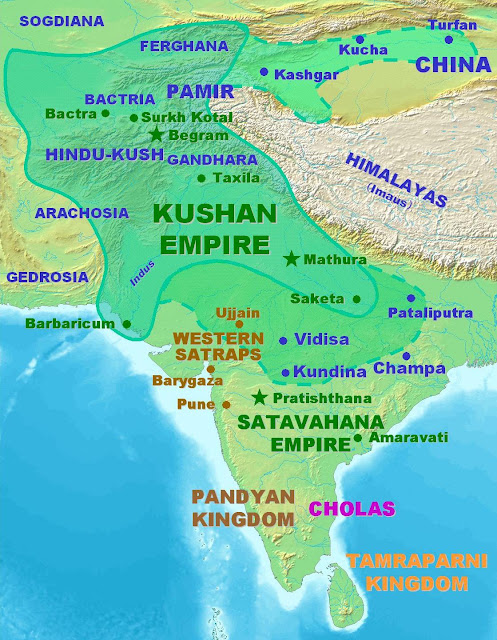
The Kushan Empire (Indo Europeans) from 100 to 300 AD was formed in the territories of ancient Bactria on either side of the middle course of the Oxus River or Amu Darya in what is now northern Afghanistan, and southern Tajikistan and Uzbekistan. See map below.
The Islamic conquest followed from 642 to 1215 AD --Arab Muslims and Persian Muslims (Saffarids, Ghaznvids, Ghurids). This was followed by the Mongols (Timurid 1370 - 1526, and Mughal Empires 1526 - 1707). By the early 1700s, Afghanistan was controlled by several ruling groups: Uzbeks to the north, Safavids (Perisians) to the west and the remaining larger area by the Mughals or self-ruled by local tribes. In 1709, the Hotaki dynasty was formed by a Pashto chief, Mirwais Khan Hotak, the chief of the Ghilzai Pashtuns of Kandahar. Mirwais Khan and his Afghan followers rose against the Persian Safavids in Kandahar City. The Afghans then defeated twice a large Persian army that was dispatched from Isfahan (capital of the Safavid Empire). Next came the Durrani Empire (1747 - 1823), The Hotaki Dynasty was defeated, in October 1729, by Nader Shah, head of the Afsharids, in the Battle of Damghan. In 1747, Nadir Shah was assassinated and Ahmad Shah Abdali, a Pashtun from the Abdali clan, was chosen as their new leader. Ahmad Shah is often regarded as the founder of modern Afghanistan. Ahmad Shah changed his title or clans' name to “Durrani”, and by 1751 his Afghan army conquered present-day Afghanistan, Pakistan, Khorasan and Kohistan provinces of Iran, along with Delhi in India. In October 1772, Ahmad Shah died and his son, Timur Shah Durrani, transferred the capital from Kandahar to Kabul. During the nineteenth century, following the Anglo-Afghan wars (fought 1839–42, 1878–80, and lastly in 1919) and the ascension of the Barakzai dynasty, Afghanistan saw much of its territory and autonomy ceded to the United Kingdom. The UK exercised a great deal of influence, and it was not until King Amanullah Khan acceded to the throne in 1919 that Afghanistan re-gained complete independence over its foreign affairs. During the period of British intervention in Afghanistan, ethnic Pashtun territories were divided by the Durand Line. This would lead to strained relations between Afghanistan and British India – and later the new state of Pakistan – over what came to be known as the Pashtunistan debate. King Amanullah on a royal trip to Berlin. This trip initiated a great alliance between Afghanistan and Germany that continues to this day.King Amanullah (1919–1929) moved to end his country's traditional isolation in the years following the Third Anglo-Afghan war. He established diplomatic relations with most major countries and, following a 1927 tour of Europe and Turkey (during which he noted the modernization and secularization advanced by Atatürk), introduced several reforms intended to modernize Afghanistan.
A key force behind these reforms was Mahmud Tarzi, Amanullah Khan's Foreign Minister and father-in-law – and an ardent supporter of the education of women. He fought for Article 68 of Afghanistan's first constitution (declared through a Loya Jirga), which made elementary education compulsory. Some of the reforms that were actually put in place, such as the abolition of the traditional Muslim veil for women and the opening of a number of co-educational schools, quickly alienated many tribal and religious leaders. Faced with overwhelming armed opposition, Amanullah was forced to abdicate in January 1929 after Kabul fell to forces led by Habibullah Kalakani. Prince Mohammed Nadir Khan, a cousin of Amanullah's, in turn defeated and killed Habibullah Kalakani in October of the same year, and with considerable Pashtun tribal support he was declared King Nadir Shah. He began consolidating power and regenerating the country. He abandoned the reforms of Amanullah Khan in favour of a more gradual approach to modernisation. In 1933, however, he was assassinated in a revenge killing by a Kabul student. Afghan King Zahir Shah and his wife with US President John F. Kennedy and his wife Jacqueline in New York.Mohammad Zahir Shah, Nadir Khan's 19-year-old son, succeeded to the throne and reigned from 1933 to 1973. The longest period of stability in Afghanistan was when the country was under the rule of King Zahir Shah. Until 1946 Zahir Shah ruled with the assistance of his uncle, who held the post of Prime Minister and continued the policies of Nadir Shah. In 1946, another of Zahir Shah's uncles, Sardar Shah Mahmud Khan, became Prime Minister and began an experiment allowing greater political freedom, but reversed the policy when it went further than he expected. In 1953, he was replaced as Prime Minister by Mohammed Daoud Khan, the king's cousin and brother-in-law. Daoud sought a closer relationship with the Soviet Union and a more distant one towards Pakistan. During this period Afghanistan remained neutral. It was not a participant in World War II, nor aligned with either power bloc in the Cold War. However, it was a beneficiary of the latter rivalry as both the Soviet Union and the U.S. vied for influence by building such works as hotels and sewer systems. A good two lane road was constructed from Iran. Running through Herat, Kandahar, and Kabul, it ended at the Pakistani border. By the late 1960s large numbers of travelers were using it as part of the Hippie trail.
--
Posted By Sleepless in Baghdad to Sleepless in Baghdad at 12/16/2009 11:11:00 AM
Seth Jones, 2009 - Political Scientist at Rand Institute and professor at Georgetown University
"In the Graveyard of Empires" by Seth Jones reviews the failed attempts through history to successfully occupy Afghanistan. The most memorable quote from the book provides the backdrop for a discussion on current US efforts there -- "... though the landscape is barren and parched, and though the people appear unobtrusive and primitive, this region has nurtured a proud warrior class that has repelled invading armies for more than 2,000 years." Jones basically states that the region that makes up modern Afghanistan has, since the earliest times, be a land of clans and tribes governed more by war lords than emperors. This same theme was sounded by Roman historian Quintus Curtius Rufus in his history of Alexander the Great's conquest of the region. It has been variously occupied by the Medes, Persians, Greeks, Indo-Europeans, Arabs, Mongols, Pashtuns, Russians and now the Americans.
First inhabited 50,000 years ago, early agricultural settlements appeared in 1,000 BC and not long after that the first invaders came -- the Medes established the Median Empire in 600 BC. Next was Alexander the Great, followed by Kushan Empire, then came the Muslim occupations by Arabs, Persians and Mongols. Finally, the Pashtuns rose in revolt to establish modern Afghanistan. In the 19th century, Great Britain sought to protect India from Russian advances by occupying Afghanistan. The British fought three wars: First Anglo-Afghan War (1839 - 1842) - which ended badly for the retreating British with only one survivor (William Brydon), out of 16,000 soldiers and camp followers, reaching the nearest British garrison in Jalalabad -- British India; Second Anglo-Afghan War (1878 - 1880) - the British won the battle of Kandahar and occupied the country and 1893 drew the "Durand Line" separating the Pashtun tribes between Afghanistan and British India; and Third Anglo-Afghan War (1919). The Pashtuns took power after Afghanistan became independent from British in 1921. From 1919 to 1929, King Amanullah Khan ruled Afghanistan. The Pushtun Musahiban family dynasty was formed in 1929 and led the country until 1978
The next country to invade Afghanistan was the Soviet Union in 1979. The Soviets never controlled more than 15 percent of the country during their nine year occupation (December 1979 to February 1989) and they suffered relatively heavy causalities with 15,000 dead and 35,000 wounded. The Soviets had an average of 85,000 soldiers in the country but reached a high of 115,000 in 1986. The Soviet Deputy Minister of Defense stated, "At the center there is authority .. but on occupied territory we can not establish authority. We have lost the battle for the Afghan people."
After the Soviets left, Afghanistan experienced Bruit style fighting from 1989 through 1994. In 1994, the Taliban took Kandahar. The Taliban movement started in 1994. A "talib" is a student, one who seeks knowledge. The Taliban goal was to restore peace, enforce Sharia law, and defend Islam. "The Taliban were deeply disillusioned with the factionalism" wrote Jones. The Taliban's leader, Mullah Muhammed Omar, cited their role as "khirka sharif" (cloak of the Prophet). The Taliban's roots go back to Deobandism which came from the e Dar ul Ulum madrassa (school) in 1867 in Deoband, India is similar to Wahhabism in seeking to emulate the time and life of the Prophet Mohammed. Muslim schools (madrassas) built with the support Pakisan President General Muhammad Zia-ul-Haq (president of Pakistan from 1978 to 1988) created the education system in Afghanistan from which the Taliban emerged. Zia generally supported Deobandism. Taliban also followed teachings of Sayyid Abdul Ala Maududi who wrote "Jihad in Islam" in the 1920s that emphasized that sovereignty should be exercised in the name of Allah and that "Sharia" law governs all. He also emphasized the need to focus on the five pillars of Islam: Shahadad (faith), Salat (prayer), Sawm (fasting), Haji (pilgrimage) and Zakat (alms).
The Taliban strategy was "bottom up" focused on rural areas. They offered order and religious clarity, conducted terror against local opponents, and offered to restore Pashtun control of Afghanistan. The Taliban are made up of members from different Pashtun tribes and only two times in modern Afghan history have Pashtuns not ruled the country (1929 - Habibullah Kalakani - a Tajik, and 1992 Burhanuddin Rabbani - Tajik). Pakistan officials sided with the Taliban not looking to the future of radical Islam rising in Pakistan's tribal regions. The Pakistan's Inter-Services Intelligence Directorate and Frontier Corps (ISI) supported insurgency and radical Islam against Soviets. Osama bin Laden also came to support the insurgents and later theTaliban and installed his operation at "Tarnak Farms" a facility originally built by USAID. Kandahar fell to the Taliban in 1994 followed by Helman, Niroz, Farah, Herat in 1995. Mazar al Shari, Kabul in 1996 and Taloqan in 2000.
The US led Operation Enduring Freedom in Afghanistan began in October 2001 and the Taliban were driven from the country and despite some early criticism that early reconstruction efforts empowered local war lords (Ali Jalali - 2002) -- there were early successes. An Asia Foundation survey in 2004 found that 84 percent of Afghans believed their security situation had improved. The overall "foot print" of the US was light with only 10,000 soldiers in the country (three divisions) but again this allowed war lords to fill the vacuum. The author states that the primary causes of the insurgency was weak governance and religion. The inability to establish law and order in rural areas of Afghanistan pushed local communities into the hands of the Taliban. The lack of essential services in these areas further diminished the legitimacy of the Afghan government. Coalition forces were not very effective -- the NATO International Security Assistance Force (ISAF) was ridiculed by US soldiers, according to the author, as (1) "I suck at fighting," (2) "I saw Americans fight," and (3) "I sunbath at FOBs." Jones's writes, "Bottom line, the Afghan government was unable to provide key services or protect the local population, especially in the rural areas, and the government was widely viewed as corrupt, to make matters worse, the US and its allies focused almost entirely on a top down strategy based on a strong central government." An indicator of the diminished security situation was the increase in suicide bombings: 2002 - 1 bombing, 2003 - 2, 2004 - 6, 2007 - 21, 2006 - 139, 207 - 140. The drug trade provides vital support to the insurgency by eroding efforts to improve governance, fosters systemic corruption, and hampers develop of a licit economy. Current opium poppy production area is 150,000 to 180,000 hectares -- up from 60,000 in 2000. Further complicating this situation is Pakistan unreliability as a partner given the ISI support, especially among middle to lower ranks. Indications are that effective development (roads and bridges) and strengthen local governance and increased economic growth are the key to countering the insurgency. Actions that strengthen support among local populations is critical -- " ... the sine qua non of victory is modern warfare is unconditional support by local populations." We have to break the key formula of the insurgency -- Surplus of Poor Rural People Suffering under Bad Governance PLUS Demand for Recruits by Religious Movement.
History is on the side of the Afghans remaining in control of their own destiny. Empires have ruled from a distance and in capital and provincial cities but rarely has that control been extended to the countryside. The US may have to find a balance that allows local control to revert back to the traditional power brokers with an agreement that radical Islam be controlled.
Background --
Afghanistan is comprised of four major ethnic groups (1) Pashtun, (2) Uzbek, (3) Tajik, and (4) Hazara. See map.

History of occupation.
First came the Medes and established the Median Empire. See map below.

The Achaemenid Empire or Persian Empire was the successor to the Median Empire and ruled the area that became Afghanistan between 550 to 330 BC. See map below.

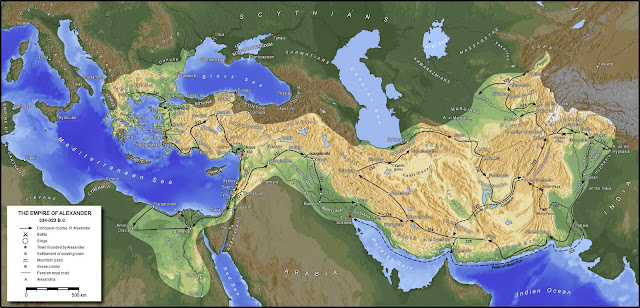
Then came Alexander the Great in 330 BC he conquered the Persians and entered Afghanistan in pursuit of the Perisian ruler, Darius. During this conquest Alexander founded a series of new cities including modern Kandahar See map below.

The Kushan Empire (Indo Europeans) from 100 to 300 AD was formed in the territories of ancient Bactria on either side of the middle course of the Oxus River or Amu Darya in what is now northern Afghanistan, and southern Tajikistan and Uzbekistan. See map below.

The Islamic conquest followed from 642 to 1215 AD --Arab Muslims and Persian Muslims (Saffarids, Ghaznvids, Ghurids). This was followed by the Mongols (Timurid 1370 - 1526, and Mughal Empires 1526 - 1707). By the early 1700s, Afghanistan was controlled by several ruling groups: Uzbeks to the north, Safavids (Perisians) to the west and the remaining larger area by the Mughals or self-ruled by local tribes. In 1709, the Hotaki dynasty was formed by a Pashto chief, Mirwais Khan Hotak, the chief of the Ghilzai Pashtuns of Kandahar. Mirwais Khan and his Afghan followers rose against the Persian Safavids in Kandahar City. The Afghans then defeated twice a large Persian army that was dispatched from Isfahan (capital of the Safavid Empire). Next came the Durrani Empire (1747 - 1823), The Hotaki Dynasty was defeated, in October 1729, by Nader Shah, head of the Afsharids, in the Battle of Damghan. In 1747, Nadir Shah was assassinated and Ahmad Shah Abdali, a Pashtun from the Abdali clan, was chosen as their new leader. Ahmad Shah is often regarded as the founder of modern Afghanistan. Ahmad Shah changed his title or clans' name to “Durrani”, and by 1751 his Afghan army conquered present-day Afghanistan, Pakistan, Khorasan and Kohistan provinces of Iran, along with Delhi in India. In October 1772, Ahmad Shah died and his son, Timur Shah Durrani, transferred the capital from Kandahar to Kabul. During the nineteenth century, following the Anglo-Afghan wars (fought 1839–42, 1878–80, and lastly in 1919) and the ascension of the Barakzai dynasty, Afghanistan saw much of its territory and autonomy ceded to the United Kingdom. The UK exercised a great deal of influence, and it was not until King Amanullah Khan acceded to the throne in 1919 that Afghanistan re-gained complete independence over its foreign affairs. During the period of British intervention in Afghanistan, ethnic Pashtun territories were divided by the Durand Line. This would lead to strained relations between Afghanistan and British India – and later the new state of Pakistan – over what came to be known as the Pashtunistan debate. King Amanullah on a royal trip to Berlin. This trip initiated a great alliance between Afghanistan and Germany that continues to this day.King Amanullah (1919–1929) moved to end his country's traditional isolation in the years following the Third Anglo-Afghan war. He established diplomatic relations with most major countries and, following a 1927 tour of Europe and Turkey (during which he noted the modernization and secularization advanced by Atatürk), introduced several reforms intended to modernize Afghanistan.
A key force behind these reforms was Mahmud Tarzi, Amanullah Khan's Foreign Minister and father-in-law – and an ardent supporter of the education of women. He fought for Article 68 of Afghanistan's first constitution (declared through a Loya Jirga), which made elementary education compulsory. Some of the reforms that were actually put in place, such as the abolition of the traditional Muslim veil for women and the opening of a number of co-educational schools, quickly alienated many tribal and religious leaders. Faced with overwhelming armed opposition, Amanullah was forced to abdicate in January 1929 after Kabul fell to forces led by Habibullah Kalakani. Prince Mohammed Nadir Khan, a cousin of Amanullah's, in turn defeated and killed Habibullah Kalakani in October of the same year, and with considerable Pashtun tribal support he was declared King Nadir Shah. He began consolidating power and regenerating the country. He abandoned the reforms of Amanullah Khan in favour of a more gradual approach to modernisation. In 1933, however, he was assassinated in a revenge killing by a Kabul student. Afghan King Zahir Shah and his wife with US President John F. Kennedy and his wife Jacqueline in New York.Mohammad Zahir Shah, Nadir Khan's 19-year-old son, succeeded to the throne and reigned from 1933 to 1973. The longest period of stability in Afghanistan was when the country was under the rule of King Zahir Shah. Until 1946 Zahir Shah ruled with the assistance of his uncle, who held the post of Prime Minister and continued the policies of Nadir Shah. In 1946, another of Zahir Shah's uncles, Sardar Shah Mahmud Khan, became Prime Minister and began an experiment allowing greater political freedom, but reversed the policy when it went further than he expected. In 1953, he was replaced as Prime Minister by Mohammed Daoud Khan, the king's cousin and brother-in-law. Daoud sought a closer relationship with the Soviet Union and a more distant one towards Pakistan. During this period Afghanistan remained neutral. It was not a participant in World War II, nor aligned with either power bloc in the Cold War. However, it was a beneficiary of the latter rivalry as both the Soviet Union and the U.S. vied for influence by building such works as hotels and sewer systems. A good two lane road was constructed from Iran. Running through Herat, Kandahar, and Kabul, it ended at the Pakistani border. By the late 1960s large numbers of travelers were using it as part of the Hippie trail.
--
Posted By Sleepless in Baghdad to Sleepless in Baghdad at 12/16/2009 11:11:00 AM
Michael Maxey
Dec 16, 2009, 3:17:30 PM12/16/09
to jr...@googlegroups.com
This is a book summary of a history of Afghanistan.
Michael Maxey
JRHS 1970
--
To unsubscribe -- please send me an email -- maxey...@gmail.com.
Reply all
Reply to author
Forward
0 new messages