
[The IPKat - for IP in a changing world] Why are CTM applications through the...

Mark Schweizer
 IPKat reader Alfred Strahlberg of Strahlberg & Partners, Switzerland, points to an interesting statistic: roughly 17% of all CTMs filed directly with the OHIM are opposed (see table above, click on it to enlarge - I know it's impossible to read). However, CTMs filed using the Madrid System - i.e. international marks seeking extension to the EU - are only opposed in about 8% of all cases (see table below).
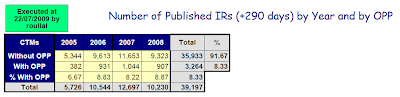 The difference is quite large and definitely not due to chance. The IPKat thinks that one reason why "IR CTMs" are opposed less often is that the opponent may oppose the base registration instead and kill the IR mark once and for all ("central attack"). Only when that was not possible or seems unadvisable (home turf advantage for the registrant?) would he or she chose to oppose before the OHIM. This would mean that the combined rate of opposition - base registration and before OHIM - should be about the same for international marks as for directly filed CTMs; the IPKat lacks the empirical data to back this up, though (in Switzerland, roughly 5% of all national registrations were opposed in 2008; adding this figure to the 8% opposition rate for "IR CTMs" one arrives at a combined opposition rate of about 13% - still not quite 18%, but getting closer).
Do the IPKat readers have other explanations for the difference in opposition rates?
--
Posted By Mark Schweizer to The IPKat - for IP in a changing world on 11/03/2009 11:26:00 AM