
Saving & Empowering Lives through Clean Cooking Innovation | Implications of Charcoal Briquettes | Behaviour change for better health: nutrition, hygiene and sustainability

Dan Campbell
Saving & Empowering Lives through Clean Cooking Innovation | Source: Radha Muthiah, USAID Impact blog, May 11th 2013 |
A major study published in December cited high blood pressure, alcohol, and tobacco as the top three health risks in the world. Could you guess the fourth? You probably did it last night.
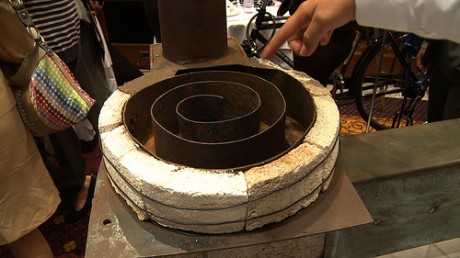
Example of a pine needle powered cook stove. Photo credit: USAID
The seemingly simple act of cooking a meal is responsible for 4 million deaths each year.
That’s because nearly 3 billion people burn solid fuels such as wood, charcoal, coal, and other fuels to cook every day. When burned in open fires and basic stoves, solid fuels emit a harmful smoke that causes a range of cancers, heart and lung diseases, developmental and neurological impacts, cataracts, and more.
Inefficient and dangerous cooking practices are also a major cause of burns, and the acts of collecting and burning fuelwood lead to deforestation and the release of climate-changing gases, respectively.
Women and children have the primary responsibility for cooking and fuel collection in developing countries, and are therefore most at risk from the side effects: smoke inhalation, crippling burns, time lost for schooling or work, human or animal attacks during fuel collection, and myriad others.
Intrauterine exposure to fine particulate matter as a risk factor for increased susceptibility to acute broncho-pulmonary infections in early childhood.International Journal of Hygiene and Environmental Health, 2013.
Over the last decades many epidemiologic studies considered the morbidity patterns for respiratory diseases and lung function of children in the context of ambient air pollution usually measured in the postnatal period. The main purpose of this study is to assess the impact of prenatal exposure to fine particulate matter (PM2.5) on the recurrent broncho-pulmonary infections in early childhood.
In conclusion,the study suggests that prenatal exposure to PM2.5 increases susceptibility to respiratory infections and may program respiratory morbidity in early childhood. The study also provides evidence that the target value of 20?g/m3 for the 24-h mean level of PM2.5 protects unborn babies better than earlier established EPA guidelines.
The state of scientific evidence on air pollution and human health in Nepal.
MAY 15, 2013 · 0 COMMENTS
Environ Res. 2013 May 7. pii: S0013-9351(13)00067-4. doi: 10.1016/j.envres.2013.03.007.
The state of scientific evidence on air pollution and human health in Nepal.
Gurung A, Bell ML. School of Forestry and Environmental Studies, Yale University, New Haven, CT 06511, USA.
Abstract
Air pollution has been linked to acute and chronic health effects. However, the majority of evidence is based in North America and Europe, with a growing number of studies in Asia and Latin America. Nepal is one of the many South Asian countries where little
such research has been conducted. We summarized the state of scientific evidence and identify research gaps based on the existing literature on air pollution and human health in Nepal. We performed a systematic literature search to identify relevant studies.
Studies were categorized as those that estimate: (1) health impacts of indoor air pollution, (2) health impacts of outdoor air pollution, (3) health burdens from outdoor air pollution in Nepal based on existing concentration-response relationships from elsewhere,
or (4) exposure and air quality but do not link to health.
We identified 89 studies, of which 23 linked air pollution to health impacts. The remainder focused on exposure and air quality, demonstrating high pollution levels. The few health studies focused mainly on indoor air (n=15), especially in rural areas and during cooking. Direct exposure measurements were for short time periods; most studies used indirect exposure methods (e.g., questionnaire). Most health studies had small sample sizes with almost all focusing on respiratory health. Although few studies have examined air pollution and health in Nepal, the existing studies indicate high pollution levels and suggest large health impacts. Nepal’s dearth of scientific research on air pollution and health is not unique and likely is similar to that of many other developing regions. Future research with larger studies and more health outcomes is needed. Key challenges include data availability.
Implications of Charcoal Briquette Produced by Local Communities on Livelihoods and Environment in Nairobi Kenya
MAY 15, 2013 · 0 COMMENTS
Implications of Charcoal Briquette Produced by Local Communities on Livelihoods and Environment in Nairobi Kenya
Mary Njenga, et al.
Abstract
The residents of Nairobi, Kenya, use 700 tonnes of charcoal per day, producing about 88 tonnes of charcoal dust that is found in most of the charcoal retailing stalls that is disposed of in water drainage systems or in black garbage heaps. The high costs of cooking fuel results in poor households using unhealthy materials such as plastic waste. Further, poor households are opting to cook foods that take a short time to prepare irrespective of their nutritional value.
This article presents experiences with community self-help groups producing charcoal fuel briquettes from charcoal dust in poorer nieghbourhoods of Nairobi for home use and sale. Households that produced charcoal fuel briquettes for own use and those that bought them saved 70% and 30% of money spent on cooking energy respectively. The charcoal fuel briquettes have been found to be environmentally beneficial since they produce less smoke and increase total cooking energy by more than 15%, thereby saving an equivalent volume of trees that would be cut down for charcoal.
Charcoal briquette production is a viable opportunity for good quality and affordable cooking fuel. Bioenergy and waste management initiatives should promote recovery of organic by-products for charcoal briquette production.
Behaviour change for better health: nutrition, hygiene and sustainability. BMC Public Health 2013, 13(Suppl 1):S1
Rachel S Newson, et al.
As the global population grows there is a clear challenge to address the needs of consumers, without depleting natural resources and whilst helping to improve nutrition and hygiene to reduce the growth of noncommunicable diseases. For fast-moving consumer goods companies, like Unilever, this challenge provides a clear opportunity to reshape its business to a model that decouples growth from a negative impact on natural resources and health. However, this change in the business model also requires a change in consumer behaviour. In acknowledgement of this challenge Unilever organised a symposium entitled ‘Behaviour Change for Better Health: Nutrition, Hygiene and Sustainability’.
The intention was to discuss how consumers can be motivated to live a more healthy and sustainable lifestlye in today’s environment. This article summarises the main conclusions of the presentations given at the symposium. Three main topics were discussed. In the first session, key experts discussed how demographic changes – particularly in developing and emerging countries – imply the need for consumer behaviour change. The second session focused on the use of behaviour change theory to design, implement and evaluate interventions, and the potential role of (new or reformulated) products as agents of change.
In the final session, key issues were discussed regarding the use of collaborations to increase the impact and reach, and to decrease the costs, of interventions. The symposium highlighted a number of key scientific challenges for Unilever and other parties that have set nutrition, hygiene and sustainability as key priorities. The key challenges include: adapting behaviour change approaches to cultures in developing and emerging economies; designing evidence-based behaviour change interventions, in which products can play a key role as agents of change; and scaling up behaviour change activities in cost-effective ways, which requires a new mindset involving public–private partnerships.