
[Houston Strategies] Why Mayor Parker needs to audit Metro's plans
0 views
Skip to first unread message

Tory Gattis
Dec 23, 2009, 10:11:18 PM12/23/09
to HoustonS...@googlegroups.com
The Houston Chronicle editorial board recently called on Mayor-elect Parker to essentially 'tread lightly' when it comes to Metro, so as not to potentially jeopardize federal funding for the new rail lines. While I think everybody would agree we don't want to put federal funding at risk with any clumsy moves, an immediate deep-dive audit and analysis of Metro's cloudy future plans and financials is absolutely called for. There are big money bets being made here that require fiscal due diligence and a fiduciary duty by the mayor, who appoints the majority of Metro board members.
First, some of the troubling Metro numbers I've seen recently:
Houston has a real chance to make sure we don't make the same mistakes.
As far as federal funding, it is important, but it's not everything. An analogy: if a salesman offers a $200K Ferrari at half-price with a $100K government subsidy to a middle-class family (and, to make this analogy match rail, they can't resell it), it's still a financially imprudent and disastrous move - subsidy or not. The goal is not maximizing federal subsidies - it's building a sustainable, affordable, functional, high-ridership transit system.
--
Posted By Tory Gattis to Houston Strategies at 12/23/2009 09:10:00 PM
First, some of the troubling Metro numbers I've seen recently:
- Randal O'Toole examines the evidence of the 'successful' Main St. line and takes issue with it, concluding:
"In short, for a $300 million capital cost, light rail significantly increased the costs of operating Houston transit while it killed the growth in transit ridership and significantly reduced passenger miles."
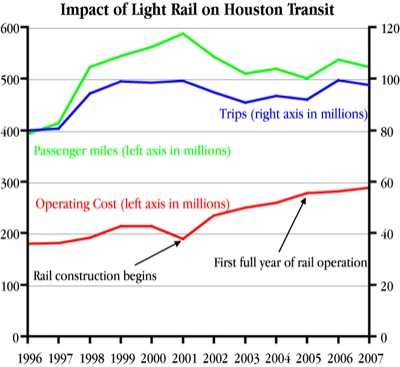
I myself worry that much of the line's ridership is simply as a parking shuttle for the Texas Medical Center - something future lines won't benefit from.
- Those of you who know Tom Bazan know that he is a strident Metro critic - and not one I always agree with - but he does make some fair points:
"METRO has failed to honor the main promises made to voters in the 2003 “Solutions” referendum; that of a 50% INCREASE of bus service. Further when voters approved the “Solutions” plan in 2003, the urban rail portion was to be 22 miles, costing $1.2 billion ($54.5 million/mile). Today, it is a 30 mile rail plan, and the cost is in the range of $4 billion ($133.3 million/mile)!"
BEFORE METRO BUILT URBAN RAIL, FY 2001
Population: 4,262,000
Transit Boardings: 101,914,157
SIX YEARS AFTER URBAN RAIL COMPLETED, FY 2009
Population: 5,090,600 (2008)
Transit Boardings: 73,080,702 + 11,561,633(rail) = 84,642,335 total (12 months ending September 2009) - a 17% drop in ridership
- Several reports say Metro's announced costs for the new light rail lines are low by more than half (KHOU Channel 11 and followup, Examiner, blogHouston, Neal analysis). From The Examiner:
Using the $1.46 billion contract as the basis for calculations, the average cost of the four corridors will be $68 million per mile. The average based on the (FTA) letters of no prejudice amounts for the North and Southeast corridors would increase the cost to $159.4 million per mile.
$4.7 billion is a truly staggering amount of money if that turns out to be the true cost - way, way beyond the $640 million bond issue voters approved in 2003.
It would also increase the cost of the East End Corridor to $527.7 million and more than double the price of the Uptown Corridor to $688.8 million.
That would bring the estimated cost of the four lines to more than $3 billion.
Separately, the 11 miles of the University Corridor not included in the contract would be more than than $1.7 billion.
- Finally, a statistic that sort of jumps out at you: Is Metro spending $150,000 for each new transit rider on the new rail lines? (about what it would cost to give each rider a lifetime supply of cars) Ouch.
- An op-ed on the slow-motion fiscal disaster of Austin rail. A lot people think Houston Metro is a similar financial bind, but just doing a better job of hiding it.
- A similar story from Denver's multi-billion dollar FasTracks program, with details of huge cost underestimates, over-hyped congestion and environmental benefits, and traffic snarls from at-grade crossings (sound familiar? Are we about to make the same mistake?). Their proposed answer? Better bus service.
- The NY Times has more on Denver's rail problems: Grand Plans for Rail in Denver Hit a Wall of Fiscal Realities
- More NY Times on 'Why Is the M.T.A. Always in Trouble?'
- The disaster of San Jose transit.
Houston has a real chance to make sure we don't make the same mistakes.
As far as federal funding, it is important, but it's not everything. An analogy: if a salesman offers a $200K Ferrari at half-price with a $100K government subsidy to a middle-class family (and, to make this analogy match rail, they can't resell it), it's still a financially imprudent and disastrous move - subsidy or not. The goal is not maximizing federal subsidies - it's building a sustainable, affordable, functional, high-ridership transit system.
--
Posted By Tory Gattis to Houston Strategies at 12/23/2009 09:10:00 PM
Reply all
Reply to author
Forward
0 new messages