Maybe my idea sounds somewhat strange, so please tell me if I have some big failures anywhere: Many here might now the nice graph with "Arrival rate" (*R*) on the x-axis and "Response time" (*λ*) on y-axis. It's also some fun to change the number of "servers" in the underlying excels/R/whatever to show slightly different graphs. My question is now if someone ever tried to calculate an artificial value for the servers (*M*) for a given set of measurements (R,λ) on a totally unknown system? Is this value of any usage, to describe the system? (The Service time would be also an outcome of this calculation, I guess).
Any comments on this approach?
I did a lot of multidimensional exploratory plots around Little's Law a while back (2008 CMG conference, to be exact) from "iostat" data on Linux during a disk benchmark. Something like a scatterplot matrix would work for what you're trying to do, I think.
2012/3/15 Martin Berger <martin.a.ber...@gmail.com>:
> Maybe my idea sounds somewhat strange, so please tell me if I have some big > failures anywhere: > Many here might now the nice graph with "Arrival rate" (R) on the x-axis and > "Response time" (λ) on y-axis. > It's also some fun to change the number of "servers" in the underlying > excels/R/whatever to show slightly different graphs. > My question is now if someone ever tried to calculate an artificial value > for the servers (M) for a given set of measurements (R,λ) on a totally > unknown system? > Is this value of any usage, to describe the system? (The Service time would > be also an outcome of this calculation, I guess). > Any comments on this approach?
First, let me see if I can more accurately rephrase your question (with corrected notation) to check my understanding.
Suppose you have measurements for the following metrics:
- Response time or, more accurately, residence time: R
- Arrival rate of requests: λ
- Service times at each service process or facility: S
If you plot those data as follows:
- (R/S) on the y-axis
- (λ/S) on the x-axis
we would expect them to fall in a more or less *convex* arrangement, i.e., tending to bend *upward* with increasing traffic. See Figure 1 of this blog post<http://perfdynamics.blogspot.com/2009/07/remembering-mr-erlang-as-uni...>. With these assumptions, and denoting the number of *active service processes
* by *m*, your question then becomes: Can we determine which m value best matches those data?
In principle, you can, but *not* if you don't know the mean service time S.
Assuming you do know S, it's easiest to apply the power law *approximation*to the exact Erlang residence-time formula:
> I did a lot of multidimensional exploratory plots around Little's Law
> a while back (2008 CMG conference, to be exact) from "iostat" data on
> Linux during a disk benchmark. Something like a scatterplot matrix
> would work for what you're trying to do, I think.
> 2012/3/15 Martin Berger:
> > Maybe my idea sounds somewhat strange, so please tell me if I have some > big
> > failures anywhere:
> > Many here might now the nice graph with "Arrival rate" (R) on the x-axis > and
> > "Response time" (λ) on y-axis.
> > It's also some fun to change the number of "servers" in the underlying
> > excels/R/whatever to show slightly different graphs.
> > My question is now if someone ever tried to calculate an artificial value
> > for the servers (M) for a given set of measurements (R,λ) on a totally
> > unknown system?
> > Is this value of any usage, to describe the system? (The Service time > would
> > be also an outcome of this calculation, I guess).
> > Any comments on this approach?
> > thank you,
> > Martin
> > --
> > You received this message because you are subscribed to the Google Groups
> > "Guerrilla Capacity Planning" group.
> > To view this discussion on the web visit
On Thursday, March 15, 2012 10:04:42 AM UTC-7, DrQ wrote:
> Hi Martin,
> First, let me see if I can more accurately rephrase your question (with > corrected notation) to check my understanding.
> Suppose you have measurements for the following metrics:
> - Response time or, more accurately, residence time: R
> - Arrival rate of requests: λ
> - Service times at each service process or facility: S
> If you plot those data as follows:
> - (R/S) on the y-axis
> - (λ/S) on the x-axis
> we would expect them to fall in a more or less *convex* arrangement, > i.e., tending to bend *upward* with increasing traffic. See Figure 1 of > this blog post<http://perfdynamics.blogspot.com/2009/07/remembering-mr-erlang-as-uni...>. > With these assumptions, and denoting the number of *active service > processes* by *m*, your question then becomes: Can we determine which m > value best matches those data?
> In principle, you can, but *not* if you don't know the mean service time > S.
> Assuming you do know S, it's easiest to apply the power law *approximation
> * to the exact Erlang residence-time formula:
> You can solve for (or fit) m, but not both m and S simultaneously.
> On Thursday, March 15, 2012 9:00:56 AM UTC-7, M. Edward (Ed) Borasky wrote:
>> I did a lot of multidimensional exploratory plots around Little's Law
>> a while back (2008 CMG conference, to be exact) from "iostat" data on
>> Linux during a disk benchmark. Something like a scatterplot matrix
>> would work for what you're trying to do, I think.
>> 2012/3/15 Martin Berger:
>> > Maybe my idea sounds somewhat strange, so please tell me if I have some >> big
>> > failures anywhere:
>> > Many here might now the nice graph with "Arrival rate" (R) on the >> x-axis and
>> > "Response time" (λ) on y-axis.
>> > It's also some fun to change the number of "servers" in the underlying
>> > excels/R/whatever to show slightly different graphs.
>> > My question is now if someone ever tried to calculate an artificial >> value
>> > for the servers (M) for a given set of measurements (R,λ) on a totally
>> > unknown system?
>> > Is this value of any usage, to describe the system? (The Service time >> would
>> > be also an outcome of this calculation, I guess).
>> > Any comments on this approach?
>> > thank you,
>> > Martin
>> > --
>> > You received this message because you are subscribed to the Google >> Groups
>> > "Guerrilla Capacity Planning" group.
>> > To view this discussion on the web visit
On Thu, Mar 15, 2012 at 1:04 PM, DrQ <redr...@yahoo.com> wrote: > Hi Martin,
> First, let me see if I can more accurately rephrase your question (with > corrected notation) to check my understanding.
> Suppose you have measurements for the following metrics:
> - Response time or, more accurately, residence time: R > - Arrival rate of requests: λ > - Service times at each service process or facility: S
> If you plot those data as follows:
> - (R/S) on the y-axis > - (λ/S) on the x-axis
> we would expect them to fall in a more or less *convex* arrangement, > i.e., tending to bend *upward* with increasing traffic. See Figure 1 of > this blog post<http://perfdynamics.blogspot.com/2009/07/remembering-mr-erlang-as-uni...>. > With these assumptions, and denoting the number of *active service > processes* by *m*, your question then becomes: Can we determine which m > value best matches those data?
> In principle, you can, but *not* if you don't know the mean service time > S.
> Assuming you do know S, it's easiest to apply the power law *approximation > * to the exact Erlang residence-time formula:
> You can solve for (or fit) m, but not both m and S simultaneously.
> On Thursday, March 15, 2012 9:00:56 AM UTC-7, M. Edward (Ed) Borasky wrote:
>> I did a lot of multidimensional exploratory plots around Little's Law >> a while back (2008 CMG conference, to be exact) from "iostat" data on >> Linux during a disk benchmark. Something like a scatterplot matrix >> would work for what you're trying to do, I think.
>> 2012/3/15 Martin Berger: >> > Maybe my idea sounds somewhat strange, so please tell me if I have some >> big >> > failures anywhere: >> > Many here might now the nice graph with "Arrival rate" (R) on the >> x-axis and >> > "Response time" (λ) on y-axis. >> > It's also some fun to change the number of "servers" in the underlying >> > excels/R/whatever to show slightly different graphs. >> > My question is now if someone ever tried to calculate an artificial >> value >> > for the servers (M) for a given set of measurements (R,λ) on a totally >> > unknown system? >> > Is this value of any usage, to describe the system? (The Service time >> would >> > be also an outcome of this calculation, I guess). >> > Any comments on this approach?
>> "A mathematician is a device for turning coffee into theorems." -- Paul >> Erdős
> -- > You received this message because you are subscribed to the Google Groups > "Guerrilla Capacity Planning" group. > To view this discussion on the web visit > https://groups.google.com/d/msg/guerrilla-capacity-planning/-/oL2q-US... > . > To post to this group, send email to > guerrilla-capacity-planning@googlegroups.com. > To unsubscribe from this group, send email to > guerrilla-capacity-planning+unsubscribe@googlegroups.com. > For more options, visit this group at > http://groups.google.com/group/guerrilla-capacity-planning?hl=en.
Bloody hell, I just realized I made another notational error. I should have just used the correct notation in the first place, instead of trying to be cleverly accommodating.
The per-server utilization is: ρ = λ / (mS), where you have to divide by the number of servers (m) to ensure that ρ < 1. You can't have any server busier than 100% of the time.
Then, the normalized residence time is given by:
(R/S) = 1 / [ 1 - ρ^m ]
Once again, you see how much m and S get mixed together.
Sorry about that. Please consider that I have now been slapped by a recursive Socrates. :)
On Thursday, March 15, 2012 10:22:02 AM UTC-7, DrQ wrote:
> Now let me correct myself. :/
> You cannot analytically *solve* for m without knowing S, but you could do > a regression fit for both m and S simultaneously.
> To clarify what I mean by solving for m, that corresponds to determining > which of the possible m-curves (in Figure 1) your data lies on.
> Another way to look at it is, the "flatter" the data under heavy traffic, > the greater the value of m servers.
> On Thursday, March 15, 2012 10:04:42 AM UTC-7, DrQ wrote:
>> Hi Martin,
>> First, let me see if I can more accurately rephrase your question (with >> corrected notation) to check my understanding.
>> Suppose you have measurements for the following metrics:
>> - Response time or, more accurately, residence time: R
>> - Arrival rate of requests: λ
>> - Service times at each service process or facility: S
>> If you plot those data as follows:
>> - (R/S) on the y-axis
>> - (λ/S) on the x-axis
>> we would expect them to fall in a more or less *convex* arrangement, >> i.e., tending to bend *upward* with increasing traffic. See Figure 1 of >> this blog post<http://perfdynamics.blogspot.com/2009/07/remembering-mr-erlang-as-uni...>. >> With these assumptions, and denoting the number of *active service >> processes* by *m*, your question then becomes: Can we determine which m >> value best matches those data?
>> In principle, you can, but *not* if you don't know the mean service time >> S.
>> Assuming you do know S, it's easiest to apply the power law *
>> approximation* to the exact Erlang residence-time formula:
>> You can solve for (or fit) m, but not both m and S simultaneously.
>> On Thursday, March 15, 2012 9:00:56 AM UTC-7, M. Edward (Ed) Borasky >> wrote:
>>> I did a lot of multidimensional exploratory plots around Little's Law
>>> a while back (2008 CMG conference, to be exact) from "iostat" data on
>>> Linux during a disk benchmark. Something like a scatterplot matrix
>>> would work for what you're trying to do, I think.
>>> 2012/3/15 Martin Berger:
>>> > Maybe my idea sounds somewhat strange, so please tell me if I have >>> some big
>>> > failures anywhere:
>>> > Many here might now the nice graph with "Arrival rate" (R) on the >>> x-axis and
>>> > "Response time" (λ) on y-axis.
>>> > It's also some fun to change the number of "servers" in the underlying
>>> > excels/R/whatever to show slightly different graphs.
>>> > My question is now if someone ever tried to calculate an artificial >>> value
>>> > for the servers (M) for a given set of measurements (R,λ) on a totally
>>> > unknown system?
>>> > Is this value of any usage, to describe the system? (The Service time >>> would
>>> > be also an outcome of this calculation, I guess).
>>> > Any comments on this approach?
>>> > thank you,
>>> > Martin
>>> > --
>>> > You received this message because you are subscribed to the Google >>> Groups
>>> > "Guerrilla Capacity Planning" group.
>>> > To view this discussion on the web visit
I did the formal transformations before and my equitation was
R = S / [ 1 - ( λ/(mS) )^m ]
that was the point where I decided to ask the group.
Your assumption regarding my question is correct. I still try to do my best to make it somehow useable for me:
Can I say "If I have a measurement with a very small λ (max. only one request is in the whole system at the same time) I can say S ≈ R" ? This would make the whole problem slightly easier :-)
I will have to force R (the program, not the residence time) to solve my problem.
On Thu, Mar 15, 2012 at 19:05, DrQ <redr...@yahoo.com> wrote: > Bloody hell, I just realized I made another notational error. I should have > just used the correct notation in the first place, instead of trying to be > cleverly accommodating.
> The per-server utilization is: ρ = λ / (mS), where you have to divide by the > number of servers (m) to ensure that ρ < 1. You can't have any server busier > than 100% of the time.
> Then, the normalized residence time is given by:
> (R/S) = 1 / [ 1 - ρ^m ]
> Once again, you see how much m and S get mixed together.
> Sorry about that. Please consider that I have now been slapped by a > recursive Socrates. :)
> On Thursday, March 15, 2012 10:22:02 AM UTC-7, DrQ wrote:
>> Now let me correct myself. :/
>> You cannot analytically solve for m without knowing S, but you could do a >> regression fit for both m and S simultaneously.
>> To clarify what I mean by solving for m, that corresponds to determining >> which of the possible m-curves (in Figure 1) your data lies on.
>> Another way to look at it is, the "flatter" the data under heavy traffic, >> the greater the value of m servers.
>> On Thursday, March 15, 2012 10:04:42 AM UTC-7, DrQ wrote:
>>> Hi Martin,
>>> First, let me see if I can more accurately rephrase your question (with >>> corrected notation) to check my understanding.
>>> Suppose you have measurements for the following metrics:
>>> Response time or, more accurately, residence time: R >>> Arrival rate of requests: λ >>> Service times at each service process or facility: S
>>> If you plot those data as follows:
>>> (R/S) on the y-axis >>> (λ/S) on the x-axis
>>> we would expect them to fall in a more or less convex arrangement, i.e., >>> tending to bend upward with increasing traffic. See Figure 1 of this blog >>> post. With these assumptions, and denoting the number of active service >>> processes by m, your question then becomes: Can we determine which m value >>> best matches those data?
>>> In principle, you can, but not if you don't know the mean service time S.
>>> Assuming you do know S, it's easiest to apply the power law approximation >>> to the exact Erlang residence-time formula:
>>> (R/S) = 1 / [ 1 - (λ/S))^m ] .... See eqn. (4.68) in my Perl::PDQ book.
>>> You can solve for (or fit) m, but not both m and S simultaneously.
>>> On Thursday, March 15, 2012 9:00:56 AM UTC-7, M. Edward (Ed) Borasky >>> wrote:
>>>> I did a lot of multidimensional exploratory plots around Little's Law >>>> a while back (2008 CMG conference, to be exact) from "iostat" data on >>>> Linux during a disk benchmark. Something like a scatterplot matrix >>>> would work for what you're trying to do, I think.
>>>> 2012/3/15 Martin Berger: >>>> > Maybe my idea sounds somewhat strange, so please tell me if I have >>>> > some big >>>> > failures anywhere: >>>> > Many here might now the nice graph with "Arrival rate" (R) on the >>>> > x-axis and >>>> > "Response time" (λ) on y-axis. >>>> > It's also some fun to change the number of "servers" in the underlying >>>> > excels/R/whatever to show slightly different graphs. >>>> > My question is now if someone ever tried to calculate an artificial >>>> > value >>>> > for the servers (M) for a given set of measurements (R,λ) on a totally >>>> > unknown system? >>>> > Is this value of any usage, to describe the system? (The Service time >>>> > would >>>> > be also an outcome of this calculation, I guess). >>>> > Any comments on this approach?
>>>> > thank you, >>>> > Martin
>>>> > -- >>>> > You received this message because you are subscribed to the Google >>>> > Groups >>>> > "Guerrilla Capacity Planning" group. >>>> > To view this discussion on the web visit
> To post to this group, send email to > guerrilla-capacity-planning@googlegroups.com. > To unsubscribe from this group, send email to > guerrilla-capacity-planning+unsubscribe@googlegroups.com. > For more options, visit this group at > http://groups.google.com/group/guerrilla-capacity-planning?hl=en.
-- Martin Berger martin.a.ber...@gmail.com Lederergasse 27/2/14 +43 660 660 83306 1080 Wien http://berx.at/
min(R) = S for all standard queueing systems, because the shortest residence time is just the service time (i.e., no waiting time) and occurs only when ρ ≈ 0 or λ ≈ 0.
Equivalently for the normalized residence time, R/S → 1 as ρ → 0.
On Thursday, March 15, 2012 12:39:33 PM UTC-7, Martin Berger wrote:
> Neil,
> thank you for your 2 replies.
> I did the formal transformations before and my equitation was
> R = S / [ 1 - ( λ/(mS) )^m ]
> that was the point where I decided to ask the group.
> Your assumption regarding my question is correct. I still try to do my
> best to make it somehow useable for me:
> Can I say "If I have a measurement with a very small λ (max. only one
> request is in the whole system at the same time) I can say S ≈ R" ?
> This would make the whole problem slightly easier :-)
> I will have to force R (the program, not the residence time) to solve
> my problem.
> On Thu, Mar 15, 2012 at 19:05, DrQ wrote:
> > Bloody hell, I just realized I made another notational error. I should > have
> > just used the correct notation in the first place, instead of trying to > be
> > cleverly accommodating.
> > The per-server utilization is: ρ = λ / (mS), where you have to divide by > the
> > number of servers (m) to ensure that ρ < 1. You can't have any server > busier
> > than 100% of the time.
> > Then, the normalized residence time is given by:
> > (R/S) = 1 / [ 1 - ρ^m ]
> > Once again, you see how much m and S get mixed together.
> > Sorry about that. Please consider that I have now been slapped by a
> > recursive Socrates. :)
> > On Thursday, March 15, 2012 10:22:02 AM UTC-7, DrQ wrote:
> >> Now let me correct myself. :/
> >> You cannot analytically solve for m without knowing S, but you could do > a
> >> regression fit for both m and S simultaneously.
> >> To clarify what I mean by solving for m, that corresponds to determining
> >> which of the possible m-curves (in Figure 1) your data lies on.
> >> Another way to look at it is, the "flatter" the data under heavy > traffic,
> >> the greater the value of m servers.
> >> On Thursday, March 15, 2012 10:04:42 AM UTC-7, DrQ wrote:
> >>> Hi Martin,
> >>> First, let me see if I can more accurately rephrase your question (with
> >>> corrected notation) to check my understanding.
> >>> Suppose you have measurements for the following metrics:
> >>> Response time or, more accurately, residence time: R
> >>> Arrival rate of requests: λ
> >>> Service times at each service process or facility: S
> >>> If you plot those data as follows:
> >>> (R/S) on the y-axis
> >>> (λ/S) on the x-axis
> >>> we would expect them to fall in a more or less convex arrangement, > i.e.,
> >>> tending to bend upward with increasing traffic. See Figure 1 of this > blog
> >>> post. With these assumptions, and denoting the number of active service
> >>> processes by m, your question then becomes: Can we determine which m > value
> >>> best matches those data?
> >>> In principle, you can, but not if you don't know the mean service time > S.
> >>> Assuming you do know S, it's easiest to apply the power law > approximation
> >>> to the exact Erlang residence-time formula:
> >>> (R/S) = 1 / [ 1 - (λ/S))^m ] .... See eqn. (4.68) in my Perl::PDQ book.
> >>> You can solve for (or fit) m, but not both m and S simultaneously.
> >>> On Thursday, March 15, 2012 9:00:56 AM UTC-7, M. Edward (Ed) Borasky
> >>> wrote:
> >>>> I did a lot of multidimensional exploratory plots around Little's Law
> >>>> a while back (2008 CMG conference, to be exact) from "iostat" data on
> >>>> Linux during a disk benchmark. Something like a scatterplot matrix
> >>>> would work for what you're trying to do, I think.
> >>>> 2012/3/15 Martin Berger:
> >>>> > Maybe my idea sounds somewhat strange, so please tell me if I have
> >>>> > some big
> >>>> > failures anywhere:
> >>>> > Many here might now the nice graph with "Arrival rate" (R) on the
> >>>> > x-axis and
> >>>> > "Response time" (λ) on y-axis.
> >>>> > It's also some fun to change the number of "servers" in the > underlying
> >>>> > excels/R/whatever to show slightly different graphs.
> >>>> > My question is now if someone ever tried to calculate an artificial
> >>>> > value
> >>>> > for the servers (M) for a given set of measurements (R,λ) on a > totally
> >>>> > unknown system?
> >>>> > Is this value of any usage, to describe the system? (The Service > time
> >>>> > would
> >>>> > be also an outcome of this calculation, I guess).
> >>>> > Any comments on this approach?
> >>>> > thank you,
> >>>> > Martin
> >>>> > --
> >>>> > You received this message because you are subscribed to the Google
> >>>> > Groups
> >>>> > "Guerrilla Capacity Planning" group.
> >>>> > To view this discussion on the web visit
> > --
> > You received this message because you are subscribed to the Google Groups
> > "Guerrilla Capacity Planning" group.
> > To view this discussion on the web visit
> > To post to this group, send email to
> > guerrilla-capacity-planning@googlegroups.com.
> > To unsubscribe from this group, send email to
> > guerrilla-capacity-planning+unsubscribe@googlegroups.com.
> > For more options, visit this group at
> > http://groups.google.com/group/guerrilla-capacity-planning?hl=en.
> -- > Martin Berger martin.a.ber...@gmail.com
> Lederergasse 27/2/14 +43 660 660 83306
> 1080 Wien http://berx.at/
Everything we've discussed so far is based on the assumption that a single M/M/m queueing model is appropriate. At some point you will need to validate that assumption independently. Why do I say that?
Your starting point (as I understand it) is *measured* performance metrics. And suppose further that you are able to determine the minimum residence time or minimum response time from those data. That minimum time, however, might *not* correspond to the service time, as previously discussed.
Consider the case where there is another queue (say, M/M/1 for the sake of argument) preceding the M/M/m queue or succeeding it or both. In other words, there was a tandem arrangement of queued service stages (buffers) in the production system or the test rig. Remember, all you have is your data.
If, for example, there were 3 such stages in tandem and only a single request in the system (as you mentioned earlier), the minimum time to get through that chain of queues would be the sum of the 3 service times at each buffer. In other words, we would now have min(R) = S1 + S2 + S, in which case the minimum *response* time min(R) != S minimum *residence* time for the M/M/m stage.
This is one reason why I stress the distinction b/w *response* time and *
residence* time in my classes<http://www.perfdynamics.com/Classes/schedule.html>. It's one thing to read it in my books; quite another to have me ramming it down your throat in real time. ;-)
On Thursday, March 15, 2012 1:07:32 PM UTC-7, DrQ wrote:
> Yes, quite so.
> min(R) = S for all standard queueing systems, because the shortest > residence time is just the service time (i.e., no waiting time) and occurs > only when ρ ≈ 0 or λ ≈ 0.
> Equivalently for the normalized residence time, R/S → 1 as ρ → 0.
> On Thursday, March 15, 2012 12:39:33 PM UTC-7, Martin Berger wrote:
>> Neil,
>> thank you for your 2 replies.
>> I did the formal transformations before and my equitation was
>> R = S / [ 1 - ( λ/(mS) )^m ]
>> that was the point where I decided to ask the group.
>> Your assumption regarding my question is correct. I still try to do my
>> best to make it somehow useable for me:
>> Can I say "If I have a measurement with a very small λ (max. only one
>> request is in the whole system at the same time) I can say S ≈ R" ?
>> This would make the whole problem slightly easier :-)
>> I will have to force R (the program, not the residence time) to solve
>> my problem.
>> On Thu, Mar 15, 2012 at 19:05, DrQ wrote:
>> > Bloody hell, I just realized I made another notational error. I should >> have
>> > just used the correct notation in the first place, instead of trying to >> be
>> > cleverly accommodating.
>> > The per-server utilization is: ρ = λ / (mS), where you have to divide >> by the
>> > number of servers (m) to ensure that ρ < 1. You can't have any server >> busier
>> > than 100% of the time.
>> > Then, the normalized residence time is given by:
>> > (R/S) = 1 / [ 1 - ρ^m ]
>> > Once again, you see how much m and S get mixed together.
>> > Sorry about that. Please consider that I have now been slapped by a
>> > recursive Socrates. :)
>> > On Thursday, March 15, 2012 10:22:02 AM UTC-7, DrQ wrote:
>> >> Now let me correct myself. :/
>> >> You cannot analytically solve for m without knowing S, but you could >> do a
>> >> regression fit for both m and S simultaneously.
>> >> To clarify what I mean by solving for m, that corresponds to >> determining
>> >> which of the possible m-curves (in Figure 1) your data lies on.
>> >> Another way to look at it is, the "flatter" the data under heavy >> traffic,
>> >> the greater the value of m servers.
>> >> On Thursday, March 15, 2012 10:04:42 AM UTC-7, DrQ wrote:
>> >>> Hi Martin,
>> >>> First, let me see if I can more accurately rephrase your question >> (with
>> >>> corrected notation) to check my understanding.
>> >>> Suppose you have measurements for the following metrics:
>> >>> Response time or, more accurately, residence time: R
>> >>> Arrival rate of requests: λ
>> >>> Service times at each service process or facility: S
>> >>> If you plot those data as follows:
>> >>> (R/S) on the y-axis
>> >>> (λ/S) on the x-axis
>> >>> we would expect them to fall in a more or less convex arrangement, >> i.e.,
>> >>> tending to bend upward with increasing traffic. See Figure 1 of this >> blog
>> >>> post. With these assumptions, and denoting the number of active >> service
>> >>> processes by m, your question then becomes: Can we determine which m >> value
>> >>> best matches those data?
>> >>> In principle, you can, but not if you don't know the mean service >> time S.
>> >>> Assuming you do know S, it's easiest to apply the power law >> approximation
>> >>> to the exact Erlang residence-time formula:
>> >>> (R/S) = 1 / [ 1 - (λ/S))^m ] .... See eqn. (4.68) in my Perl::PDQ >> book.
>> >>> You can solve for (or fit) m, but not both m and S simultaneously.
>> >>> On Thursday, March 15, 2012 9:00:56 AM UTC-7, M. Edward (Ed) Borasky
>> >>> wrote:
>> >>>> I did a lot of multidimensional exploratory plots around Little's Law
>> >>>> a while back (2008 CMG conference, to be exact) from "iostat" data on
>> >>>> Linux during a disk benchmark. Something like a scatterplot matrix
>> >>>> would work for what you're trying to do, I think.
>> >>>> 2012/3/15 Martin Berger:
>> >>>> > Maybe my idea sounds somewhat strange, so please tell me if I have
>> >>>> > some big
>> >>>> > failures anywhere:
>> >>>> > Many here might now the nice graph with "Arrival rate" (R) on the
>> >>>> > x-axis and
>> >>>> > "Response time" (λ) on y-axis.
>> >>>> > It's also some fun to change the number of "servers" in the >> underlying
>> >>>> > excels/R/whatever to show slightly different graphs.
>> >>>> > My question is now if someone ever tried to calculate an artificial
>> >>>> > value
>> >>>> > for the servers (M) for a given set of measurements (R,λ) on a >> totally
>> >>>> > unknown system?
>> >>>> > Is this value of any usage, to describe the system? (The Service >> time
>> >>>> > would
>> >>>> > be also an outcome of this calculation, I guess).
>> >>>> > Any comments on this approach?
>> >>>> > thank you,
>> >>>> > Martin
>> >>>> > --
>> >>>> > You received this message because you are subscribed to the Google
>> >>>> > Groups
>> >>>> > "Guerrilla Capacity Planning" group.
>> >>>> > To view this discussion on the web visit
>> > --
>> > You received this message because you are subscribed to the Google >> Groups
>> > "Guerrilla Capacity Planning" group.
>> > To view this discussion on the web visit
>> > To post to this group, send email to
>> > guerrilla-capacity-planning@googlegroups.com.
>> > To unsubscribe from this group, send email to
>> > guerrilla-capacity-planning+unsubscribe@googlegroups.com.
>> > For more options, visit this group at
>> > http://groups.google.com/group/guerrilla-capacity-planning?hl=en.
>> -- >> Martin Berger martin.a.ber...@gmail.com
>> Lederergasse 27/2/14 +43 660 660 83306
>> 1080 Wien http://berx.at/
A good example of an M/M/m model that adheres to the aforementioned validation assumptions can be found in Example 1.2 (p.16) of my Perl::PDQ book <http://www.perfdynamics.com/iBook/ppa_new.html>. It's a performance model of an email span-scan farm taken from a very well known, large-scale, website.
The farm comprises hundreds of 4-way servers. These were modeled as M/M/4 queueing nodes in PDQ. The reason this model works so well is because the workload is essentially a cpu-intensive batch processing type with no significant inter-processor communication (i.e., no SMP overhead). In addition, the website collected many other performance metrics to provide full validation of this simple model.
In all honesty, the person who was most surprised that this simple model came together so quickly and worked so well, was me.
On Thursday, March 15, 2012 1:38:51 PM UTC-7, DrQ wrote:
> A word of caution here, as I think more about it.
> Everything we've discussed so far is based on the assumption that a single > M/M/m queueing model is appropriate. At some point you will need to > validate that assumption independently. Why do I say that?
> Your starting point (as I understand it) is *measured* performance > metrics. And suppose further that you are able to determine the minimum > residence time or minimum response time from those data. That minimum time, > however, might *not* correspond to the service time, as previously > discussed.
> Consider the case where there is another queue (say, M/M/1 for the sake of > argument) preceding the M/M/m queue or succeeding it or both. In other > words, there was a tandem arrangement of queued service stages (buffers) in > the production system or the test rig. Remember, all you have is your data.
> If, for example, there were 3 such stages in tandem and only a single > request in the system (as you mentioned earlier), the minimum time to get > through that chain of queues would be the sum of the 3 service times at > each buffer. In other words, we would now have min(R) = S1 + S2 + S, in > which case the minimum *response* time min(R) != S minimum *residence*time for the M/M/m stage.
> This is one reason why I stress the distinction b/w *response* time and *
> residence* time in my classes<http://www.perfdynamics.com/Classes/schedule.html>. > It's one thing to read it in my books; quite another to have me ramming it > down your throat in real time. ;-)
> On Thursday, March 15, 2012 1:07:32 PM UTC-7, DrQ wrote:
>> Yes, quite so.
>> min(R) = S for all standard queueing systems, because the shortest >> residence time is just the service time (i.e., no waiting time) and occurs >> only when ρ ≈ 0 or λ ≈ 0.
>> Equivalently for the normalized residence time, R/S → 1 as ρ → 0.
>> On Thursday, March 15, 2012 12:39:33 PM UTC-7, Martin Berger wrote:
>>> Neil,
>>> thank you for your 2 replies.
>>> I did the formal transformations before and my equitation was
>>> R = S / [ 1 - ( λ/(mS) )^m ]
>>> that was the point where I decided to ask the group.
>>> Your assumption regarding my question is correct. I still try to do my
>>> best to make it somehow useable for me:
>>> Can I say "If I have a measurement with a very small λ (max. only one
>>> request is in the whole system at the same time) I can say S ≈ R" ?
>>> This would make the whole problem slightly easier :-)
>>> I will have to force R (the program, not the residence time) to solve
>>> my problem.
>>> On Thu, Mar 15, 2012 at 19:05, DrQ wrote:
>>> > Bloody hell, I just realized I made another notational error. I should >>> have
>>> > just used the correct notation in the first place, instead of trying >>> to be
>>> > cleverly accommodating.
>>> > The per-server utilization is: ρ = λ / (mS), where you have to divide >>> by the
>>> > number of servers (m) to ensure that ρ < 1. You can't have any server >>> busier
>>> > than 100% of the time.
>>> > Then, the normalized residence time is given by:
>>> > (R/S) = 1 / [ 1 - ρ^m ]
>>> > Once again, you see how much m and S get mixed together.
>>> > Sorry about that. Please consider that I have now been slapped by a
>>> > recursive Socrates. :)
>>> > On Thursday, March 15, 2012 10:22:02 AM UTC-7, DrQ wrote:
>>> >> Now let me correct myself. :/
>>> >> You cannot analytically solve for m without knowing S, but you could >>> do a
>>> >> regression fit for both m and S simultaneously.
>>> >> To clarify what I mean by solving for m, that corresponds to >>> determining
>>> >> which of the possible m-curves (in Figure 1) your data lies on.
>>> >> Another way to look at it is, the "flatter" the data under heavy >>> traffic,
>>> >> the greater the value of m servers.
>>> >> On Thursday, March 15, 2012 10:04:42 AM UTC-7, DrQ wrote:
>>> >>> Hi Martin,
>>> >>> First, let me see if I can more accurately rephrase your question >>> (with
>>> >>> corrected notation) to check my understanding.
>>> >>> Suppose you have measurements for the following metrics:
>>> >>> Response time or, more accurately, residence time: R
>>> >>> Arrival rate of requests: λ
>>> >>> Service times at each service process or facility: S
>>> >>> If you plot those data as follows:
>>> >>> (R/S) on the y-axis
>>> >>> (λ/S) on the x-axis
>>> >>> we would expect them to fall in a more or less convex arrangement, >>> i.e.,
>>> >>> tending to bend upward with increasing traffic. See Figure 1 of this >>> blog
>>> >>> post. With these assumptions, and denoting the number of active >>> service
>>> >>> processes by m, your question then becomes: Can we determine which >>> m value
>>> >>> best matches those data?
>>> >>> In principle, you can, but not if you don't know the mean service >>> time S.
>>> >>> Assuming you do know S, it's easiest to apply the power law >>> approximation
>>> >>> to the exact Erlang residence-time formula:
>>> >>> (R/S) = 1 / [ 1 - (λ/S))^m ] .... See eqn. (4.68) in my Perl::PDQ >>> book.
>>> >>> You can solve for (or fit) m, but not both m and S simultaneously.
>>> >>> On Thursday, March 15, 2012 9:00:56 AM UTC-7, M. Edward (Ed) Borasky
>>> >>> wrote:
>>> >>>> I did a lot of multidimensional exploratory plots around Little's >>> Law
>>> >>>> a while back (2008 CMG conference, to be exact) from "iostat" data >>> on
>>> >>>> Linux during a disk benchmark. Something like a scatterplot matrix
>>> >>>> would work for what you're trying to do, I think.
>>> >>>> 2012/3/15 Martin Berger:
>>> >>>> > Maybe my idea sounds somewhat strange, so please tell me if I have
>>> >>>> > some big
>>> >>>> > failures anywhere:
>>> >>>> > Many here might now the nice graph with "Arrival rate" (R) on the
>>> >>>> > x-axis and
>>> >>>> > "Response time" (λ) on y-axis.
>>> >>>> > It's also some fun to change the number of "servers" in the >>> underlying
>>> >>>> > excels/R/whatever to show slightly different graphs.
>>> >>>> > My question is now if someone ever tried to calculate an >>> artificial
>>> >>>> > value
>>> >>>> > for the servers (M) for a given set of measurements (R,λ) on a >>> totally
>>> >>>> > unknown system?
>>> >>>> > Is this value of any usage, to describe the system? (The Service >>> time
>>> >>>> > would
>>> >>>> > be also an outcome of this calculation, I guess).
>>> >>>> > Any comments on this approach?
>>> >>>> > thank you,
>>> >>>> > Martin
>>> >>>> > --
>>> >>>> > You received this message because you are subscribed to the Google
>>> >>>> > Groups
>>> >>>> > "Guerrilla Capacity Planning" group.
>>> >>>> > To view this discussion on the web visit
>>> > --
>>> > You received this message because you are subscribed to the Google >>> Groups
>>> > "Guerrilla Capacity Planning" group.
>>> > To view this discussion on the web visit
>>> > To post to this group, send email to
>>> > guerrilla-capacity-planning@googlegroups.com.
>>> > To unsubscribe from this group, send email to
>>> > guerrilla-capacity-planning+unsubscribe@googlegroups.com.
>>> > For more options, visit this group at
>>> > http://groups.google.com/group/guerrilla-capacity-planning?hl=en.
>>> -- >>> Martin Berger martin.a.ber...@gmail.com
>>> Lederergasse 27/2/14 +43 660 660 83306
>>> 1080 Wien http://berx.at/
again you are correct in your assumption, as well as your warnings.
Personally I am aware it is risky to simplify any system down to the level where I am right now. In fact the whole system is quite complex: An Oracle cluster with shared storage network and disk arrays below - It is nothing I would ever volunteer to model in any detail in PDQ. But in this exercise my audience (internal application team which uses the DB) are facing 'their' database as a black box. Currently they are only focused on 'response time' - so they claim, if they change their code to get a better 'response time', they scale better. I just observed sometimes they use much more resources *per request* to get this better response time. So based on my simple math, they will saturate anything earlier and scale worse. That's where I started to dream of an easy way to calculate my "artificial" servers for any of their testcases. If I can compare implementations with not only S, but a tupel (S,m), I hope the comparison is more correct.
On Thu, Mar 15, 2012 at 21:38, DrQ <redr...@yahoo.com> wrote: > A word of caution here, as I think more about it.
> Everything we've discussed so far is based on the assumption that a single > M/M/m queueing model is appropriate. At some point you will need to validate > that assumption independently. Why do I say that?
> Your starting point (as I understand it) is measured performance metrics. > And suppose further that you are able to determine the minimum residence > time or minimum response time from those data. That minimum time, however, > might not correspond to the service time, as previously discussed.
> Consider the case where there is another queue (say, M/M/1 for the sake of > argument) preceding the M/M/m queue or succeeding it or both. In other > words, there was a tandem arrangement of queued service stages (buffers) in > the production system or the test rig. Remember, all you have is your data.
> If, for example, there were 3 such stages in tandem and only a single > request in the system (as you mentioned earlier), the minimum time to get > through that chain of queues would be the sum of the 3 service times at each > buffer. In other words, we would now have min(R) = S1 + S2 + S, in which > case the minimum response time min(R) != S minimum residence time for the > M/M/m stage.
> This is one reason why I stress the distinction b/w response time and > residence time in my classes. It's one thing to read it in my books; quite > another to have me ramming it down your throat in real time. ;-)
> On Thursday, March 15, 2012 1:07:32 PM UTC-7, DrQ wrote:
>> Yes, quite so.
>> min(R) = S for all standard queueing systems, because the shortest >> residence time is just the service time (i.e., no waiting time) and occurs >> only when ρ ≈ 0 or λ ≈ 0.
>> Equivalently for the normalized residence time, R/S → 1 as ρ → 0.
Hi Martin
Two queries here out of curiosity: For the storage subsystem do you
use Oracle orion or any other kit to test the storage scalability
metrics separately and then fit it into a model separately for your
Oracle workload ( OLTP or any other as you need) ?
Dr Q/Neil , For such cases like a typical Oracle Cluster/RAC workload
with a shared storage( NAS/SAN or any other) do you suggest modelling/
testing the storage separately and then do the CPU subsystem
separately (SMP, NUMA)
Pls excuse me if this goes off topic or unrelated.
thx
Laks
On Mar 16, 3:42 pm, Martin Berger <martin.a.ber...@gmail.com> wrote:
> again you are correct in your assumption, as well as your warnings.
> Personally I am aware it is risky to simplify any system down to the level
> where I am right now.
> In fact the whole system is quite complex: An Oracle cluster with shared
> storage network and disk arrays below - It is nothing I would ever
> volunteer to model in any detail in PDQ. But in this exercise my audience
> (internal application team which uses the DB) are facing 'their' database
> as a black box.
> Currently they are only focused on 'response time' - so they claim, if they
> change their code to get a better 'response time', they scale better. I
> just observed sometimes they use much more resources *per request* to get
> this better response time. So based on my simple math, they will saturate
> anything earlier and scale worse.
> That's where I started to dream of an easy way to calculate my "artificial"
> servers for any of their testcases.
> If I can compare implementations with not only S, but a tupel (S,m), I hope
> the comparison is more correct.
> Martin
> On Thu, Mar 15, 2012 at 21:38, DrQ <redr...@yahoo.com> wrote:
> > A word of caution here, as I think more about it.
> > Everything we've discussed so far is based on the assumption that a single
> > M/M/m queueing model is appropriate. At some point you will need to
> validate
> > that assumption independently. Why do I say that?
> > Your starting point (as I understand it) is measured performance metrics.
> > And suppose further that you are able to determine the minimum residence
> > time or minimum response time from those data. That minimum time, however,
> > might not correspond to the service time, as previously discussed.
> > Consider the case where there is another queue (say, M/M/1 for the sake of
> > argument) preceding the M/M/m queue or succeeding it or both. In other
> > words, there was a tandem arrangement of queued service stages (buffers)
> in
> > the production system or the test rig. Remember, all you have is your
> data.
> > If, for example, there were 3 such stages in tandem and only a single
> > request in the system (as you mentioned earlier), the minimum time to get
> > through that chain of queues would be the sum of the 3 service times at
> each
> > buffer. In other words, we would now have min(R) = S1 + S2 + S, in which
> > case the minimum response time min(R) != S minimum residence time for the
> > M/M/m stage.
> > This is one reason why I stress the distinction b/w response time and
> > residence time in my classes. It's one thing to read it in my books; quite
> > another to have me ramming it down your throat in real time. ;-)
> > On Thursday, March 15, 2012 1:07:32 PM UTC-7, DrQ wrote:
> >> Yes, quite so.
> >> min(R) = S for all standard queueing systems, because the shortest
> >> residence time is just the service time (i.e., no waiting time) and
> occurs
> >> only when ρ ≈ 0 or λ ≈ 0.
> >> Equivalently for the normalized residence time, R/S → 1 as ρ → 0.
1) The sequence of PDQ queueing nodes in your CaP model does not have to match every possible component that exists in the real system. It just has to be sufficient to resolve where the major bottlenecks are occurring or will occur in the future.
2) If at all possible it is good to measure the latency of the network storage subsystem separately. The point being that the response time part of the PDQ model should be a lot simpler than you might imagine or that you would read about in a book like Simitci's "Storage Network Performance Analysis," (2003); a good book, btw and I know of no other equivalent book.
On Thursday, April 5, 2012 10:47:06 AM UTC-7, laks wrote:
> Hi Martin > Two queries here out of curiosity: For the storage subsystem do you > use Oracle orion or any other kit to test the storage scalability > metrics separately and then fit it into a model separately for your > Oracle workload ( OLTP or any other as you need) ?
> Dr Q/Neil , For such cases like a typical Oracle Cluster/RAC workload > with a shared storage( NAS/SAN or any other) do you suggest modelling/ > testing the storage separately and then do the CPU subsystem > separately (SMP, NUMA)
> Pls excuse me if this goes off topic or unrelated.
> thx > Laks
> On Mar 16, 3:42 pm, Martin Berger <martin.a.ber...@gmail.com> wrote: > > Neil,
> > again you are correct in your assumption, as well as your warnings.
> > Personally I am aware it is risky to simplify any system down to the > level > > where I am right now. > > In fact the whole system is quite complex: An Oracle cluster with shared > > storage network and disk arrays below - It is nothing I would ever > > volunteer to model in any detail in PDQ. But in this exercise my > audience > > (internal application team which uses the DB) are facing 'their' > database > > as a black box. > > Currently they are only focused on 'response time' - so they claim, if > they > > change their code to get a better 'response time', they scale better. I > > just observed sometimes they use much more resources *per request* to > get > > this better response time. So based on my simple math, they will > saturate > > anything earlier and scale worse. > > That's where I started to dream of an easy way to calculate my > "artificial" > > servers for any of their testcases. > > If I can compare implementations with not only S, but a tupel (S,m), I > hope > > the comparison is more correct.
> > Martin
> > On Thu, Mar 15, 2012 at 21:38, DrQ <redr...@yahoo.com> wrote: > > > A word of caution here, as I think more about it.
> > > Everything we've discussed so far is based on the assumption that a > single > > > M/M/m queueing model is appropriate. At some point you will need to > > validate > > > that assumption independently. Why do I say that?
> > > Your starting point (as I understand it) is measured performance > metrics. > > > And suppose further that you are able to determine the minimum > residence > > > time or minimum response time from those data. That minimum time, > however, > > > might not correspond to the service time, as previously discussed.
> > > Consider the case where there is another queue (say, M/M/1 for the > sake of > > > argument) preceding the M/M/m queue or succeeding it or both. In > other > > > words, there was a tandem arrangement of queued service stages > (buffers) > > in > > > the production system or the test rig. Remember, all you have is your > > data.
> > > If, for example, there were 3 such stages in tandem and only a single > > > request in the system (as you mentioned earlier), the minimum time to > get > > > through that chain of queues would be the sum of the 3 service times > at > > each > > > buffer. In other words, we would now have min(R) = S1 + S2 + S, in > which > > > case the minimum response time min(R) != S minimum residence time for > the > > > M/M/m stage.
> > > This is one reason why I stress the distinction b/w response time and > > > residence time in my classes. It's one thing to read it in my books; > quite > > > another to have me ramming it down your throat in real time. ;-)
> > > On Thursday, March 15, 2012 1:07:32 PM UTC-7, DrQ wrote:
> > >> Yes, quite so.
> > >> min(R) = S for all standard queueing systems, because the shortest > > >> residence time is just the service time (i.e., no waiting time) and > > occurs > > >> only when ρ ≈ 0 or λ ≈ 0.
> > >> Equivalently for the normalized residence time, R/S → 1 as ρ → 0.
> 1) The sequence of PDQ queueing nodes in your CaP model does not have to
> match every possible component that exists in the real system. It just has
> to be sufficient to resolve where the major bottlenecks are occurring or
> will occur in the future.
> 2) If at all possible it is good to measure the latency of the network
> storage subsystem separately. The point being that the response time part
> of the PDQ model should be a lot simpler than you might imagine or that you
> would read about in a book like Simitci's "Storage Network Performance
> Analysis," (2003); a good book, btw and I know of no other equivalent book.
> On Thursday, April 5, 2012 10:47:06 AM UTC-7, laks wrote:
> > Hi Martin
> > Two queries here out of curiosity: For the storage subsystem do you
> > use Oracle orion or any other kit to test the storage scalability
> > metrics separately and then fit it into a model separately for your
> > Oracle workload ( OLTP or any other as you need) ?
> > Dr Q/Neil , For such cases like a typical Oracle Cluster/RAC workload
> > with a shared storage( NAS/SAN or any other) do you suggest modelling/
> > testing the storage separately and then do the CPU subsystem
> > separately (SMP, NUMA)
> > Pls excuse me if this goes off topic or unrelated.
> > thx
> > Laks
> > On Mar 16, 3:42 pm, Martin Berger <martin.a.ber...@gmail.com> wrote:
> > > Neil,
> > > again you are correct in your assumption, as well as your warnings.
> > > Personally I am aware it is risky to simplify any system down to the
> > level
> > > where I am right now.
> > > In fact the whole system is quite complex: An Oracle cluster with shared
> > > storage network and disk arrays below - It is nothing I would ever
> > > volunteer to model in any detail in PDQ. But in this exercise my
> > audience
> > > (internal application team which uses the DB) are facing 'their'
> > database
> > > as a black box.
> > > Currently they are only focused on 'response time' - so they claim, if
> > they
> > > change their code to get a better 'response time', they scale better. I
> > > just observed sometimes they use much more resources *per request* to
> > get
> > > this better response time. So based on my simple math, they will
> > saturate
> > > anything earlier and scale worse.
> > > That's where I started to dream of an easy way to calculate my
> > "artificial"
> > > servers for any of their testcases.
> > > If I can compare implementations with not only S, but a tupel (S,m), I
> > hope
> > > the comparison is more correct.
> > > Martin
> > > On Thu, Mar 15, 2012 at 21:38, DrQ <redr...@yahoo.com> wrote:
> > > > A word of caution here, as I think more about it.
> > > > Everything we've discussed so far is based on the assumption that a
> > single
> > > > M/M/m queueing model is appropriate. At some point you will need to
> > > validate
> > > > that assumption independently. Why do I say that?
> > > > Your starting point (as I understand it) is measured performance
> > metrics.
> > > > And suppose further that you are able to determine the minimum
> > residence
> > > > time or minimum response time from those data. That minimum time,
> > however,
> > > > might not correspond to the service time, as previously discussed.
> > > > Consider the case where there is another queue (say, M/M/1 for the
> > sake of
> > > > argument) preceding the M/M/m queue or succeeding it or both. In
> > other
> > > > words, there was a tandem arrangement of queued service stages
> > (buffers)
> > > in
> > > > the production system or the test rig. Remember, all you have is your
> > > data.
> > > > If, for example, there were 3 such stages in tandem and only a single
> > > > request in the system (as you mentioned earlier), the minimum time to
> > get
> > > > through that chain of queues would be the sum of the 3 service times
> > at
> > > each
> > > > buffer. In other words, we would now have min(R) = S1 + S2 + S, in
> > which
> > > > case the minimum response time min(R) != S minimum residence time for
> > the
> > > > M/M/m stage.
> > > > This is one reason why I stress the distinction b/w response time and
> > > > residence time in my classes. It's one thing to read it in my books;
> > quite
> > > > another to have me ramming it down your throat in real time. ;-)
> > > > On Thursday, March 15, 2012 1:07:32 PM UTC-7, DrQ wrote:
> > > >> Yes, quite so.
> > > >> min(R) = S for all standard queueing systems, because the shortest
> > > >> residence time is just the service time (i.e., no waiting time) and
> > > occurs
> > > >> only when ρ ≈ 0 or λ ≈ 0.
> > > >> Equivalently for the normalized residence time, R/S → 1 as ρ → 0.
in general I try at least to get a 'good knowledge' about the storage subsystem. That means a study of the documentation as well as a test with orion or some other tools. (If you want to test physical and logical IOs of an oracle instance, maybe you are interested in [1] ) As we have in general full storage networks, there sometimes are effects our storage admins does not want to accept at first sign. As an example: we tested one big virtual 'disk' attached to a linux host versus 10 smaller 'disks (which where based on the same underlying structures - so they where 'the same thing' - but we got much better results by these 10 disks. - I was never allowed to investigate this to find the real reason, but my curent working theory is the multipoe IO-queues on OS are the key for the better results.
In this particular question I do NOT want to model any sub-system - in fact I try to do it the other way: step 'back' until I can see the whole system as a single black box, where all the details can not e seen anymore.
On Thu, Apr 5, 2012 at 19:47, laks <lnarayanan.sesha...@gmail.com> wrote: > Hi Martin > Two queries here out of curiosity: For the storage subsystem do you > use Oracle orion or any other kit to test the storage scalability > metrics separately and then fit it into a model separately for your > Oracle workload ( OLTP or any other as you need) ?
> Dr Q/Neil , For such cases like a typical Oracle Cluster/RAC workload > with a shared storage( NAS/SAN or any other) do you suggest modelling/ > testing the storage separately and then do the CPU subsystem > separately (SMP, NUMA)
> Pls excuse me if this goes off topic or unrelated.
> thx > Laks
> On Mar 16, 3:42 pm, Martin Berger <martin.a.ber...@gmail.com> wrote: >> Neil,
>> again you are correct in your assumption, as well as your warnings.
>> Personally I am aware it is risky to simplify any system down to the level >> where I am right now. >> In fact the whole system is quite complex: An Oracle cluster with shared >> storage network and disk arrays below - It is nothing I would ever >> volunteer to model in any detail in PDQ. But in this exercise my audience >> (internal application team which uses the DB) are facing 'their' database >> as a black box. >> Currently they are only focused on 'response time' - so they claim, if they >> change their code to get a better 'response time', they scale better. I >> just observed sometimes they use much more resources *per request* to get >> this better response time. So based on my simple math, they will saturate >> anything earlier and scale worse. >> That's where I started to dream of an easy way to calculate my "artificial" >> servers for any of their testcases. >> If I can compare implementations with not only S, but a tupel (S,m), I hope >> the comparison is more correct.
>> Martin
>> On Thu, Mar 15, 2012 at 21:38, DrQ <redr...@yahoo.com> wrote: >> > A word of caution here, as I think more about it.
>> > Everything we've discussed so far is based on the assumption that a single >> > M/M/m queueing model is appropriate. At some point you will need to >> validate >> > that assumption independently. Why do I say that?
>> > Your starting point (as I understand it) is measured performance metrics. >> > And suppose further that you are able to determine the minimum residence >> > time or minimum response time from those data. That minimum time, however, >> > might not correspond to the service time, as previously discussed.
>> > Consider the case where there is another queue (say, M/M/1 for the sake of >> > argument) preceding the M/M/m queue or succeeding it or both. In other >> > words, there was a tandem arrangement of queued service stages (buffers) >> in >> > the production system or the test rig. Remember, all you have is your >> data.
>> > If, for example, there were 3 such stages in tandem and only a single >> > request in the system (as you mentioned earlier), the minimum time to get >> > through that chain of queues would be the sum of the 3 service times at >> each >> > buffer. In other words, we would now have min(R) = S1 + S2 + S, in which >> > case the minimum response time min(R) != S minimum residence time for the >> > M/M/m stage.
>> > This is one reason why I stress the distinction b/w response time and >> > residence time in my classes. It's one thing to read it in my books; quite >> > another to have me ramming it down your throat in real time. ;-)
>> > On Thursday, March 15, 2012 1:07:32 PM UTC-7, DrQ wrote:
>> >> Yes, quite so.
>> >> min(R) = S for all standard queueing systems, because the shortest >> >> residence time is just the service time (i.e., no waiting time) and >> occurs >> >> only when ρ ≈ 0 or λ ≈ 0.
>> >> Equivalently for the normalized residence time, R/S → 1 as ρ → 0.
> -- > You received this message because you are subscribed to the Google Groups "Guerrilla Capacity Planning" group. > To post to this group, send email to guerrilla-capacity-planning@googlegroups.com. > To unsubscribe from this group, send email to guerrilla-capacity-planning+unsubscribe@googlegroups.com. > For more options, visit this group at http://groups.google.com/group/guerrilla-capacity-planning?hl=en.
> in general I try at least to get a 'good knowledge' about the storage
> subsystem.
> That means a study of the documentation as well as a test with orion
> or some other tools. (If you want to test physical and logical IOs of
> an oracle instance, maybe you are interested in [1] )
> As we have in general full storage networks, there sometimes are
> effects our storage admins does not want to accept at first sign. As
> an example: we tested one big virtual 'disk' attached to a linux host
> versus 10 smaller 'disks (which where based on the same underlying
> structures - so they where 'the same thing' - but we got much better
> results by these 10 disks. - I was never allowed to investigate this
> to find the real reason, but my curent working theory is the multipoe
> IO-queues on OS are the key for the better results.
> In this particular question I do NOT want to model any sub-system - in
> fact I try to do it the other way: step 'back' until I can see the
> whole system as a single black box, where all the details can not e
> seen anymore.
> On Thu, Apr 5, 2012 at 19:47, laks <lnarayanan.sesha...@gmail.com> wrote:
> > Hi Martin
> > Two queries here out of curiosity: For the storage subsystem do you
> > use Oracle orion or any other kit to test the storage scalability
> > metrics separately and then fit it into a model separately for your
> > Oracle workload ( OLTP or any other as you need) ?
> > Dr Q/Neil , For such cases like a typical Oracle Cluster/RAC workload
> > with a shared storage( NAS/SAN or any other) do you suggest modelling/
> > testing the storage separately and then do the CPU subsystem
> > separately (SMP, NUMA)
> > Pls excuse me if this goes off topic or unrelated.
> > thx
> > Laks
> > On Mar 16, 3:42 pm, Martin Berger <martin.a.ber...@gmail.com> wrote:
> >> Neil,
> >> again you are correct in your assumption, as well as your warnings.
> >> Personally I am aware it is risky to simplify any system down to the level
> >> where I am right now.
> >> In fact the whole system is quite complex: An Oracle cluster with shared
> >> storage network and disk arrays below - It is nothing I would ever
> >> volunteer to model in any detail in PDQ. But in this exercise my audience
> >> (internal application team which uses the DB) are facing 'their' database
> >> as a black box.
> >> Currently they are only focused on 'response time' - so they claim, if they
> >> change their code to get a better 'response time', they scale better. I
> >> just observed sometimes they use much more resources *per request* to get
> >> this better response time. So based on my simple math, they will saturate
> >> anything earlier and scale worse.
> >> That's where I started to dream of an easy way to calculate my "artificial"
> >> servers for any of their testcases.
> >> If I can compare implementations with not only S, but a tupel (S,m), I hope
> >> the comparison is more correct.
> >> Martin
> >> On Thu, Mar 15, 2012 at 21:38, DrQ <redr...@yahoo.com> wrote:
> >> > A word of caution here, as I think more about it.
> >> > Everything we've discussed so far is based on the assumption that a single
> >> > M/M/m queueing model is appropriate. At some point you will need to
> >> validate
> >> > that assumption independently. Why do I say that?
> >> > Your starting point (as I understand it) is measured performance metrics.
> >> > And suppose further that you are able to determine the minimum residence
> >> > time or minimum response time from those data. That minimum time, however,
> >> > might not correspond to the service time, as previously discussed.
> >> > Consider the case where there is another queue (say, M/M/1 for the sake of
> >> > argument) preceding the M/M/m queue or succeeding it or both. In other
> >> > words, there was a tandem arrangement of queued service stages (buffers)
> >> in
> >> > the production system or the test rig. Remember, all you have is your
> >> data.
> >> > If, for example, there were 3 such stages in tandem and only a single
> >> > request in the system (as you mentioned earlier), the minimum time to get
> >> > through that chain of queues would be the sum of the 3 service times at
> >> each
> >> > buffer. In other words, we would now have min(R) = S1 + S2 + S, in which
> >> > case the minimum response time min(R) != S minimum residence time for the
> >> > M/M/m stage.
> >> > This is one reason why I stress the distinction b/w response time and
> >> > residence time in my classes. It's one thing to read it in my books; quite
> >> > another to have me ramming it down your throat in real time. ;-)
> >> > On Thursday, March 15, 2012 1:07:32 PM UTC-7, DrQ wrote:
> >> >> Yes, quite so.
> >> >> min(R) = S for all standard queueing systems, because the shortest
> >> >> residence time is just the service time (i.e., no waiting time) and
> >> occurs
> >> >> only when ρ ≈ 0 or λ ≈ 0.
> >> >> Equivalently for the normalized residence time, R/S → 1 as ρ → 0.
> > --
> > You received this message because you are subscribed to the Google Groups "Guerrilla Capacity Planning" group.
> > To post to this group, send email to guerrilla-capacity-planning@googlegroups.com.
> > To unsubscribe from this group, send email to guerrilla-capacity-planning+unsubscribe@googlegroups.com.
> > For more options, visit this group athttp://groups.google.com/group/guerrilla-capacity-planning?hl=en.
From everything I've seen (which isn't necessarily that much), I believe correctly tuned and appropriately allocated network storage should respond like a memory reference (i.e., remote cache) such that the response time is possibly even dominated by the network latency, on average. This effect probably degrades under heavy traffic conditions. But even if this is just an approximate truth, it should serve as your *performance goal*, which you may or may not be able to attain, depending on the app and all that. If you can't attain it, you must be able to explain why not. It might not be your fault. :)
The other upshot of this view is that it simplifies any CaP models you may decide to make, e.g., in PDQ. They should be much much simpler than anything you see in Simitci's book.
ASIDE:
1. I think I could almost make the above observation of mine into a theorem.
2. The problem is, I need more data at different workload intensities (request rates). I have only seen data that lies in some specific bands and it seems to be valid there. 3. Many people (including Guerrillas) have promised to provide such, but none have ever delivered.
On Thursday, April 5, 2012 11:54:22 AM UTC-7, laks wrote:
> Thanks Neil for your replies/clarification here.
> Regards > Laks
> On Apr 5, 11:04 pm, DrQ <redr...@yahoo.com> wrote: > > For my part, I would say so for 2 reasons:
> > 1) The sequence of PDQ queueing nodes in your CaP model does not have to > > match every possible component that exists in the real system. It just > has > > to be sufficient to resolve where the major bottlenecks are occurring or > > will occur in the future.
> > 2) If at all possible it is good to measure the latency of the network > > storage subsystem separately. The point being that the response time > part > > of the PDQ model should be a lot simpler than you might imagine or that > you > > would read about in a book like Simitci's "Storage Network Performance > > Analysis," (2003); a good book, btw and I know of no other equivalent > book.
> > On Thursday, April 5, 2012 10:47:06 AM UTC-7, laks wrote:
> > > Hi Martin > > > Two queries here out of curiosity: For the storage subsystem do you > > > use Oracle orion or any other kit to test the storage scalability > > > metrics separately and then fit it into a model separately for your > > > Oracle workload ( OLTP or any other as you need) ?
> > > Dr Q/Neil , For such cases like a typical Oracle Cluster/RAC workload > > > with a shared storage( NAS/SAN or any other) do you suggest modelling/ > > > testing the storage separately and then do the CPU subsystem > > > separately (SMP, NUMA)
> > > Pls excuse me if this goes off topic or unrelated.
> > > thx > > > Laks
> > > On Mar 16, 3:42 pm, Martin Berger <martin.a.ber...@gmail.com> wrote: > > > > Neil,
> > > > again you are correct in your assumption, as well as your warnings.
> > > > Personally I am aware it is risky to simplify any system down to the > > > level > > > > where I am right now. > > > > In fact the whole system is quite complex: An Oracle cluster with > shared > > > > storage network and disk arrays below - It is nothing I would ever > > > > volunteer to model in any detail in PDQ. But in this exercise my > > > audience > > > > (internal application team which uses the DB) are facing 'their' > > > database > > > > as a black box. > > > > Currently they are only focused on 'response time' - so they claim, > if > > > they > > > > change their code to get a better 'response time', they scale > better. I > > > > just observed sometimes they use much more resources *per request* > to > > > get > > > > this better response time. So based on my simple math, they will > > > saturate > > > > anything earlier and scale worse. > > > > That's where I started to dream of an easy way to calculate my > > > "artificial" > > > > servers for any of their testcases. > > > > If I can compare implementations with not only S, but a tupel (S,m), > I > > > hope > > > > the comparison is more correct.
> > > > Martin
> > > > On Thu, Mar 15, 2012 at 21:38, DrQ <redr...@yahoo.com> wrote: > > > > > A word of caution here, as I think more about it.
> > > > > Everything we've discussed so far is based on the assumption that > a > > > single > > > > > M/M/m queueing model is appropriate. At some point you will need > to > > > > validate > > > > > that assumption independently. Why do I say that?
> > > > > Your starting point (as I understand it) is measured performance > > > metrics. > > > > > And suppose further that you are able to determine the minimum > > > residence > > > > > time or minimum response time from those data. That minimum time, > > > however, > > > > > might not correspond to the service time, as previously discussed.
> > > > > Consider the case where there is another queue (say, M/M/1 for the > > > sake of > > > > > argument) preceding the M/M/m queue or succeeding it or both. In > > > other > > > > > words, there was a tandem arrangement of queued service stages > > > (buffers) > > > > in > > > > > the production system or the test rig. Remember, all you have is > your > > > > data.
> > > > > If, for example, there were 3 such stages in tandem and only a > single > > > > > request in the system (as you mentioned earlier), the minimum time > to > > > get > > > > > through that chain of queues would be the sum of the 3 service > times > > > at > > > > each > > > > > buffer. In other words, we would now have min(R) = S1 + S2 + S, in > > > which > > > > > case the minimum response time min(R) != S minimum residence time > for > > > the > > > > > M/M/m stage.
> > > > > This is one reason why I stress the distinction b/w response time > and > > > > > residence time in my classes. It's one thing to read it in my > books; > > > quite > > > > > another to have me ramming it down your throat in real time. ;-)
> > > > > On Thursday, March 15, 2012 1:07:32 PM UTC-7, DrQ wrote:
> > > > >> Yes, quite so.
> > > > >> min(R) = S for all standard queueing systems, because the > shortest > > > > >> residence time is just the service time (i.e., no waiting time) > and > > > > occurs > > > > >> only when ρ ≈ 0 or λ ≈ 0.
> > > > >> Equivalently for the normalized residence time, R/S → 1 as ρ → 0.
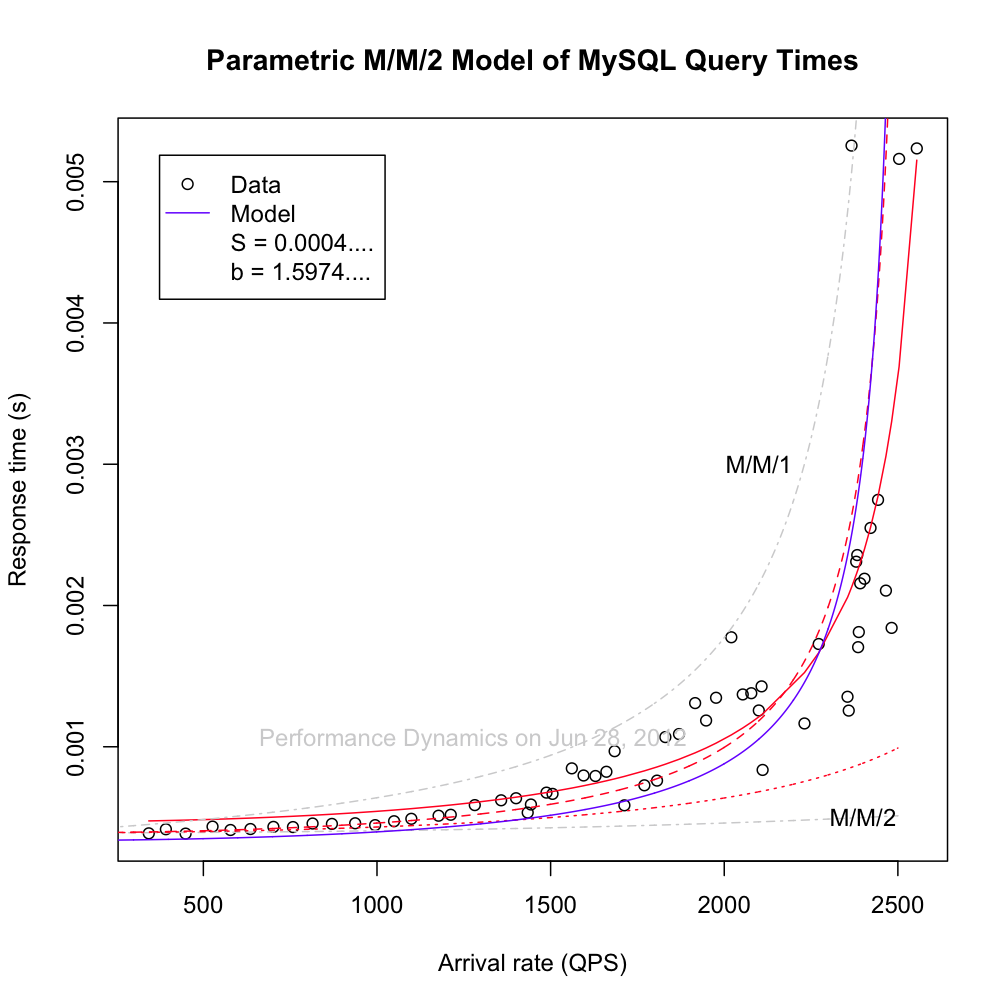
I've been working on this problem for a while. I've built a least squares fitter for queueing stations. (https://github.com/wouterdb/fitlib)
I found out that just a queueing station doesn't really fit my data all that well, I've played around with some of the suggestions from the PDQ book and added a parameter that scales all lambdas (request rate).
This gives me a formula of the form R(L) = S/(1-(b*L*S/n)^n).
On Friday, April 6, 2012 5:45:24 PM UTC+2, DrQ wrote:
> Just to clarify on point (2):
> From everything I've seen (which isn't necessarily that much), I believe > correctly tuned and appropriately allocated network storage should respond > like a memory reference (i.e., remote cache) such that the response time is > possibly even dominated by the network latency, on average. This effect > probably degrades under heavy traffic conditions. But even if this is just > an approximate truth, it should serve as your *performance goal*, which > you may or may not be able to attain, depending on the app and all that. If > you can't attain it, you must be able to explain why not. It might not be > your fault. :)
> The other upshot of this view is that it simplifies any CaP models you may > decide to make, e.g., in PDQ. They should be much much simpler than > anything you see in Simitci's book.
> ASIDE:
> 1. I think I could almost make the above observation of mine into a > theorem.
> 2. The problem is, I need more data at different workload intensities > (request rates). I have only seen data that lies in some specific bands and > it seems to be valid there. > 3. Many people (including Guerrillas) have promised to provide such, > but none have ever delivered.
> So, if you wanna get famous, talk to me.
> On Thursday, April 5, 2012 11:54:22 AM UTC-7, laks wrote:
>> Thanks Neil for your replies/clarification here.
>> Regards >> Laks
>> On Apr 5, 11:04 pm, DrQ <redr...@yahoo.com> wrote: >> > For my part, I would say so for 2 reasons:
>> > 1) The sequence of PDQ queueing nodes in your CaP model does not have >> to >> > match every possible component that exists in the real system. It just >> has >> > to be sufficient to resolve where the major bottlenecks are occurring >> or >> > will occur in the future.
>> > 2) If at all possible it is good to measure the latency of the network >> > storage subsystem separately. The point being that the response time >> part >> > of the PDQ model should be a lot simpler than you might imagine or that >> you >> > would read about in a book like Simitci's "Storage Network Performance >> > Analysis," (2003); a good book, btw and I know of no other equivalent >> book.
>> > On Thursday, April 5, 2012 10:47:06 AM UTC-7, laks wrote:
>> > > Hi Martin >> > > Two queries here out of curiosity: For the storage subsystem do you >> > > use Oracle orion or any other kit to test the storage scalability >> > > metrics separately and then fit it into a model separately for your >> > > Oracle workload ( OLTP or any other as you need) ?
>> > > Dr Q/Neil , For such cases like a typical Oracle Cluster/RAC workload >> > > with a shared storage( NAS/SAN or any other) do you suggest >> modelling/ >> > > testing the storage separately and then do the CPU subsystem >> > > separately (SMP, NUMA)
>> > > Pls excuse me if this goes off topic or unrelated.
>> > > thx >> > > Laks
>> > > On Mar 16, 3:42 pm, Martin Berger <martin.a.ber...@gmail.com> wrote: >> > > > Neil,
>> > > > again you are correct in your assumption, as well as your warnings.
>> > > > Personally I am aware it is risky to simplify any system down to >> the >> > > level >> > > > where I am right now. >> > > > In fact the whole system is quite complex: An Oracle cluster with >> shared >> > > > storage network and disk arrays below - It is nothing I would ever >> > > > volunteer to model in any detail in PDQ. But in this exercise my >> > > audience >> > > > (internal application team which uses the DB) are facing 'their' >> > > database >> > > > as a black box. >> > > > Currently they are only focused on 'response time' - so they claim, >> if >> > > they >> > > > change their code to get a better 'response time', they scale >> better. I >> > > > just observed sometimes they use much more resources *per request* >> to >> > > get >> > > > this better response time. So based on my simple math, they will >> > > saturate >> > > > anything earlier and scale worse. >> > > > That's where I started to dream of an easy way to calculate my >> > > "artificial" >> > > > servers for any of their testcases. >> > > > If I can compare implementations with not only S, but a tupel >> (S,m), I >> > > hope >> > > > the comparison is more correct.
>> > > > Martin
>> > > > On Thu, Mar 15, 2012 at 21:38, DrQ <redr...@yahoo.com> wrote: >> > > > > A word of caution here, as I think more about it.
>> > > > > Everything we've discussed so far is based on the assumption that >> a >> > > single >> > > > > M/M/m queueing model is appropriate. At some point you will need >> to >> > > > validate >> > > > > that assumption independently. Why do I say that?
>> > > > > Your starting point (as I understand it) is measured performance >> > > metrics. >> > > > > And suppose further that you are able to determine the minimum >> > > residence >> > > > > time or minimum response time from those data. That minimum time, >> > > however, >> > > > > might not correspond to the service time, as previously >> discussed.
>> > > > > Consider the case where there is another queue (say, M/M/1 for >> the >> > > sake of >> > > > > argument) preceding the M/M/m queue or succeeding it or both. In >> > > other >> > > > > words, there was a tandem arrangement of queued service stages >> > > (buffers) >> > > > in >> > > > > the production system or the test rig. Remember, all you have is >> your >> > > > data.
>> > > > > If, for example, there were 3 such stages in tandem and only a >> single >> > > > > request in the system (as you mentioned earlier), the minimum >> time to >> > > get >> > > > > through that chain of queues would be the sum of the 3 service >> times >> > > at >> > > > each >> > > > > buffer. In other words, we would now have min(R) = S1 + S2 + S, >> in >> > > which >> > > > > case the minimum response time min(R) != S minimum residence time >> for >> > > the >> > > > > M/M/m stage.
>> > > > > This is one reason why I stress the distinction b/w response time >> and >> > > > > residence time in my classes. It's one thing to read it in my >> books; >> > > quite >> > > > > another to have me ramming it down your throat in real time. ;-)
>> > > > > On Thursday, March 15, 2012 1:07:32 PM UTC-7, DrQ wrote:
>> > > > >> Yes, quite so.
>> > > > >> min(R) = S for all standard queueing systems, because the >> shortest >> > > > >> residence time is just the service time (i.e., no waiting time) >> and >> > > > occurs >> > > > >> only when ρ ≈ 0 or λ ≈ 0.
>> > > > >> Equivalently for the normalized residence time, R/S → 1 as ρ → 0.
I, for one, can't say I follow your math or the overall objective based on a single M/M/m queue (if that's what your formula is supposed to represent), but I can say this. It doesn't do your cause any favors to produce a plot with no labeled axes or legend of any kind. If you are doing science, rather than art, the reader shouldn't be left guessing what you are trying to convey. Otherwise, the response is likely to be a deafening silence.
On Wednesday, May 30, 2012 9:05:48 AM UTC-7, wouterdb wrote:
> Hi all,
> I've been working on this problem for a while. I've built a least squares > fitter for queueing stations. (https://github.com/wouterdb/fitlib)
> I found out that just a queueing station doesn't really fit my data all > that well, I've played around with some of the suggestions from the PDQ > book and added a parameter that scales all lambdas (request rate).
> This gives me a formula of the form R(L) = S/(1-(b*L*S/n)^n).
> PS: feel free to play around with the code, patches and datasets are > welcome.
> On Friday, April 6, 2012 5:45:24 PM UTC+2, DrQ wrote:
>> Just to clarify on point (2):
>> From everything I've seen (which isn't necessarily that much), I believe >> correctly tuned and appropriately allocated network storage should respond >> like a memory reference (i.e., remote cache) such that the response time is >> possibly even dominated by the network latency, on average. This effect >> probably degrades under heavy traffic conditions. But even if this is just >> an approximate truth, it should serve as your *performance goal*, which >> you may or may not be able to attain, depending on the app and all that. If >> you can't attain it, you must be able to explain why not. It might not be >> your fault. :)
>> The other upshot of this view is that it simplifies any CaP models you >> may decide to make, e.g., in PDQ. They should be much much simpler than >> anything you see in Simitci's book.
>> ASIDE:
>> 1. I think I could almost make the above observation of mine into a >> theorem.
>> 2. The problem is, I need more data at different workload intensities >> (request rates). I have only seen data that lies in some specific bands and >> it seems to be valid there. >> 3. Many people (including Guerrillas) have promised to provide such, >> but none have ever delivered.
>> So, if you wanna get famous, talk to me.
>> On Thursday, April 5, 2012 11:54:22 AM UTC-7, laks wrote:
>>> Thanks Neil for your replies/clarification here.
>>> Regards >>> Laks
>>> On Apr 5, 11:04 pm, DrQ <redr...@yahoo.com> wrote: >>> > For my part, I would say so for 2 reasons:
>>> > 1) The sequence of PDQ queueing nodes in your CaP model does not have >>> to >>> > match every possible component that exists in the real system. It just >>> has >>> > to be sufficient to resolve where the major bottlenecks are occurring >>> or >>> > will occur in the future.
>>> > 2) If at all possible it is good to measure the latency of the network >>> > storage subsystem separately. The point being that the response time >>> part >>> > of the PDQ model should be a lot simpler than you might imagine or >>> that you >>> > would read about in a book like Simitci's "Storage Network Performance >>> > Analysis," (2003); a good book, btw and I know of no other equivalent >>> book.
>>> > On Thursday, April 5, 2012 10:47:06 AM UTC-7, laks wrote:
>>> > > Hi Martin >>> > > Two queries here out of curiosity: For the storage subsystem do >>> you >>> > > use Oracle orion or any other kit to test the storage scalability >>> > > metrics separately and then fit it into a model separately for your >>> > > Oracle workload ( OLTP or any other as you need) ?
>>> > > Dr Q/Neil , For such cases like a typical Oracle Cluster/RAC >>> workload >>> > > with a shared storage( NAS/SAN or any other) do you suggest >>> modelling/ >>> > > testing the storage separately and then do the CPU subsystem >>> > > separately (SMP, NUMA)
>>> > > Pls excuse me if this goes off topic or unrelated.
>>> > > thx >>> > > Laks
>>> > > On Mar 16, 3:42 pm, Martin Berger <martin.a.ber...@gmail.com> >>> wrote: >>> > > > Neil,
>>> > > > again you are correct in your assumption, as well as your >>> warnings.
>>> > > > Personally I am aware it is risky to simplify any system down to >>> the >>> > > level >>> > > > where I am right now. >>> > > > In fact the whole system is quite complex: An Oracle cluster with >>> shared >>> > > > storage network and disk arrays below - It is nothing I would ever >>> > > > volunteer to model in any detail in PDQ. But in this exercise my >>> > > audience >>> > > > (internal application team which uses the DB) are facing 'their' >>> > > database >>> > > > as a black box. >>> > > > Currently they are only focused on 'response time' - so they >>> claim, if >>> > > they >>> > > > change their code to get a better 'response time', they scale >>> better. I >>> > > > just observed sometimes they use much more resources *per request* >>> to >>> > > get >>> > > > this better response time. So based on my simple math, they will >>> > > saturate >>> > > > anything earlier and scale worse. >>> > > > That's where I started to dream of an easy way to calculate my >>> > > "artificial" >>> > > > servers for any of their testcases. >>> > > > If I can compare implementations with not only S, but a tupel >>> (S,m), I >>> > > hope >>> > > > the comparison is more correct.
>>> > > > Martin
>>> > > > On Thu, Mar 15, 2012 at 21:38, DrQ <redr...@yahoo.com> wrote: >>> > > > > A word of caution here, as I think more about it.
>>> > > > > Everything we've discussed so far is based on the assumption >>> that a >>> > > single >>> > > > > M/M/m queueing model is appropriate. At some point you will need >>> to >>> > > > validate >>> > > > > that assumption independently. Why do I say that?
>>> > > > > Your starting point (as I understand it) is measured performance >>> > > metrics. >>> > > > > And suppose further that you are able to determine the minimum >>> > > residence >>> > > > > time or minimum response time from those data. That minimum >>> time, >>> > > however, >>> > > > > might not correspond to the service time, as previously >>> discussed.
>>> > > > > Consider the case where there is another queue (say, M/M/1 for >>> the >>> > > sake of >>> > > > > argument) preceding the M/M/m queue or succeeding it or both. >>> In >>> > > other >>> > > > > words, there was a tandem arrangement of queued service stages >>> > > (buffers) >>> > > > in >>> > > > > the production system or the test rig. Remember, all you have is >>> your >>> > > > data.
>>> > > > > If, for example, there were 3 such stages in tandem and only a >>> single >>> > > > > request in the system (as you mentioned earlier), the minimum >>> time to >>> > > get >>> > > > > through that chain of queues would be the sum of the 3 service >>> times >>> > > at >>> > > > each >>> > > > > buffer. In other words, we would now have min(R) = S1 + S2 + S, >>> in >>> > > which >>> > > > > case the minimum response time min(R) != S minimum residence >>> time for >>> > > the >>> > > > > M/M/m stage.
>>> > > > > This is one reason why I stress the distinction b/w response >>> time and >>> > > > > residence time in my classes. It's one thing to read it in my >>> books; >>> > > quite >>> > > > > another to have me ramming it down your throat in real time. ;-)
>>> > > > > On Thursday, March 15, 2012 1:07:32 PM UTC-7, DrQ wrote:
>>> > > > >> Yes, quite so.
>>> > > > >> min(R) = S for all standard queueing systems, because the >>> shortest >>> > > > >> residence time is just the service time (i.e., no waiting time) >>> and >>> > > > occurs >>> > > > >> only when ρ ≈ 0 or λ ≈ 0.
>>> > > > >> Equivalently for the normalized residence time, R/S → 1 as ρ → >>> 0.
What I am trying to do is automatically determine the parameters of
an M/M/m queue, given a set of measurements.
In the example graph, the data is from a mysql database, executing a set of
select queries.
However, it turns out that an M/M/m queue doesn't fit the data all too
well, so I added overdriven throughput (as in 'analyzing computer system
performance with PDQ, 2e ed, p 381').
I have two concrete questions about this:
1. I was wondering if anyone else has ever tried to do automated
parameter estimation before?
2. How can I improve the closeness of fit of the model?
On Fri, Jun 22, 2012 at 9:16 AM, DrQ <redr...@yahoo.com> wrote:
> Not many responses, so far.
> I, for one, can't say I follow your math or the overall objective based on
> a single M/M/m queue (if that's what your formula is supposed to
> represent), but I can say this. It doesn't do your cause any favors to
> produce a plot with no labeled axes or legend of any kind. If you are doing
> science, rather than art, the reader shouldn't be left guessing what you
> are trying to convey. Otherwise, the response is likely to be a deafening
> silence.
> On Wednesday, May 30, 2012 9:05:48 AM UTC-7, wouterdb wrote:
>> I found out that just a queueing station doesn't really fit my data all
>> that well, I've played around with some of the suggestions from the PDQ
>> book and added a parameter that scales all lambdas (request rate).
>> This gives me a formula of the form R(L) = S/(1-(b*L*S/n)^n).
>> PS: feel free to play around with the code, patches and datasets are
>> welcome.
>> On Friday, April 6, 2012 5:45:24 PM UTC+2, DrQ wrote:
>>> Just to clarify on point (2):
>>> From everything I've seen (which isn't necessarily that much), I believe
>>> correctly tuned and appropriately allocated network storage should respond
>>> like a memory reference (i.e., remote cache) such that the response time is
>>> possibly even dominated by the network latency, on average. This effect
>>> probably degrades under heavy traffic conditions. But even if this is just
>>> an approximate truth, it should serve as your *performance goal*, which
>>> you may or may not be able to attain, depending on the app and all that. If
>>> you can't attain it, you must be able to explain why not. It might not be
>>> your fault. :)
>>> The other upshot of this view is that it simplifies any CaP models you
>>> may decide to make, e.g., in PDQ. They should be much much simpler than
>>> anything you see in Simitci's book.
>>> ASIDE:
>>> 1. I think I could almost make the above observation of mine into a
>>> theorem.
>>> 2. The problem is, I need more data at different workload
>>> intensities (request rates). I have only seen data that lies in some
>>> specific bands and it seems to be valid there.
>>> 3. Many people (including Guerrillas) have promised to provide such,
>>> but none have ever delivered.
>>> So, if you wanna get famous, talk to me.
>>> On Thursday, April 5, 2012 11:54:22 AM UTC-7, laks wrote:
>>>> Thanks Neil for your replies/clarification here.
>>>> Regards
>>>> Laks
>>>> On Apr 5, 11:04 pm, DrQ <redr...@yahoo.com> wrote:
>>>> > For my part, I would say so for 2 reasons:
>>>> > 1) The sequence of PDQ queueing nodes in your CaP model does not have
>>>> to
>>>> > match every possible component that exists in the real system. It
>>>> just has
>>>> > to be sufficient to resolve where the major bottlenecks are occurring
>>>> or
>>>> > will occur in the future.
>>>> > 2) If at all possible it is good to measure the latency of the
>>>> network
>>>> > storage subsystem separately. The point being that the response time
>>>> part
>>>> > of the PDQ model should be a lot simpler than you might imagine or
>>>> that you
>>>> > would read about in a book like Simitci's "Storage Network
>>>> Performance
>>>> > Analysis," (2003); a good book, btw and I know of no other equivalent
>>>> book.
>>>> > On Thursday, April 5, 2012 10:47:06 AM UTC-7, laks wrote:
>>>> > > Hi Martin
>>>> > > Two queries here out of curiosity: For the storage subsystem do
>>>> you
>>>> > > use Oracle orion or any other kit to test the storage scalability
>>>> > > metrics separately and then fit it into a model separately for your
>>>> > > Oracle workload ( OLTP or any other as you need) ?
>>>> > > Dr Q/Neil , For such cases like a typical Oracle Cluster/RAC
>>>> workload
>>>> > > with a shared storage( NAS/SAN or any other) do you suggest
>>>> modelling/
>>>> > > testing the storage separately and then do the CPU subsystem
>>>> > > separately (SMP, NUMA)
>>>> > > Pls excuse me if this goes off topic or unrelated.
>>>> > > thx
>>>> > > Laks
>>>> > > On Mar 16, 3:42 pm, Martin Berger <martin.a.ber...@gmail.com>
>>>> wrote:
>>>> > > > Neil,
>>>> > > > again you are correct in your assumption, as well as your
>>>> warnings.
>>>> > > > Personally I am aware it is risky to simplify any system down to
>>>> the
>>>> > > level
>>>> > > > where I am right now.
>>>> > > > In fact the whole system is quite complex: An Oracle cluster with
>>>> shared
>>>> > > > storage network and disk arrays below - It is nothing I would
>>>> ever
>>>> > > > volunteer to model in any detail in PDQ. But in this exercise my
>>>> > > audience
>>>> > > > (internal application team which uses the DB) are facing 'their'
>>>> > > database
>>>> > > > as a black box.
>>>> > > > Currently they are only focused on 'response time' - so they
>>>> claim, if
>>>> > > they
>>>> > > > change their code to get a better 'response time', they scale
>>>> better. I
>>>> > > > just observed sometimes they use much more resources *per
>>>> request* to
>>>> > > get
>>>> > > > this better response time. So based on my simple math, they will
>>>> > > saturate
>>>> > > > anything earlier and scale worse.
>>>> > > > That's where I started to dream of an easy way to calculate my
>>>> > > "artificial"
>>>> > > > servers for any of their testcases.
>>>> > > > If I can compare implementations with not only S, but a tupel
>>>> (S,m), I
>>>> > > hope
>>>> > > > the comparison is more correct.
>>>> > > > Martin
>>>> > > > On Thu, Mar 15, 2012 at 21:38, DrQ <redr...@yahoo.com> wrote:
>>>> > > > > A word of caution here, as I think more about it.
>>>> > > > > Everything we've discussed so far is based on the assumption
>>>> that a
>>>> > > single
>>>> > > > > M/M/m queueing model is appropriate. At some point you will
>>>> need to
>>>> > > > validate
>>>> > > > > that assumption independently. Why do I say that?
>>>> > > > > Your starting point (as I understand it) is measured
>>>> performance
>>>> > > metrics.
>>>> > > > > And suppose further that you are able to determine the minimum
>>>> > > residence
>>>> > > > > time or minimum response time from those data. That minimum
>>>> time,
>>>> > > however,
>>>> > > > > might not correspond to the service time, as previously
>>>> discussed.
>>>> > > > > Consider the case where there is another queue (say, M/M/1 for
>>>> the
>>>> > > sake of
>>>> > > > > argument) preceding the M/M/m queue or succeeding it or both.
>>>> In
>>>> > > other
>>>> > > > > words, there was a tandem arrangement of queued service stages
>>>> > > (buffers)
>>>> > > > in
>>>> > > > > the production system or the test rig. Remember, all you have
>>>> is your
>>>> > > > data.
>>>> > > > > If, for example, there were 3 such stages in tandem and only a
>>>> single
>>>> > > > > request in the system (as you mentioned earlier), the minimum
>>>> time to
>>>> > > get
>>>> > > > > through that chain of queues would be the sum of the 3 service
>>>> times
>>>> > > at
>>>> > > > each
>>>> > > > > buffer. In other words, we would now have min(R) = S1 + S2 + S,
>>>> in
>>>> > > which
>>>> > > > > case the minimum response time min(R) != S minimum residence
>>>> time for
>>>> > > the
>>>> > > > > M/M/m stage.
>>>> > > > > This is one reason why I stress the distinction b/w response
>>>> time and
>>>> > > > > residence time in my classes. It's one thing to read it in my
>>>> books;
>>>> > > quite
>>>> > > > > another to have me ramming it down your throat in real time.
>>>> ;-)
>>>> > > > > On Thursday, March 15, 2012 1:07:32 PM UTC-7, DrQ wrote:
>>>> > > > >> Yes, quite so.
>>>> > > > >> min(R) = S for all standard queueing systems, because the
>>>> shortest
>>>> > > > >> residence time is just the service time (i.e., no waiting
>>>> time) and
>>>> > > > occurs
>>>> > > > >> only when ρ ≈ 0 or λ ≈ 0.
>>>> > > > >> Equivalently for the normalized residence time, R/S → 1 as ρ →
>>>> 0.
re: Plot. Vast improvement. Nice job. One tweak you might add is to note which model you are fitting against.
Anyway, now we can get down to some brass tacks.
Before launching off into various performance modeling exotica (like, nonlinear regression and overdriven demand), you need to convince yourself that the target model (i.e., M/M/m) even makes sense for an RDMBS. For example, I could take the position that any RDMBS can only have a finite number (N) of processes handing DB requests. In which case, the queue length is bounded by N. An open queueing model like M/M/m is not compatible with that assumption b/c there, the number of requests can be unbounded. So which it it?
On the other hand, looking at your nice new plot, it seems to indicate that the RDMBS you're measuring does behave like an unbounded queue, b/c it goes asymptotic at about 2500 RPS. If I assume that indication (fitted curve) is correct and apply Little's law at saturation, I calculate your mean service time to be about 0.0004 s. And that, indeed, seems to jive with your y-intercept. Of course, we could've seen this immediately if you'd plotted against the utilization rather that the request rate on the x-axis. (cf. Fig. 4.17 on p. 121 of PPQ2)
But you say, "an M/M/m queue doesn't fit the data all too well" which I now find puzzling. Your new plot has pretty much convinced me of the thing you were trying to unconvince me of.
On Tuesday, June 26, 2012 5:49:11 AM UTC-7, wouterdb wrote:
> I stand corrected, new graph attached
> What I am trying to do is automatically determine the parameters of > an M/M/m queue, given a set of measurements. > In the example graph, the data is from a mysql database, executing a set > of select queries.
> However, it turns out that an M/M/m queue doesn't fit the data all too > well, so I added overdriven throughput (as in 'analyzing computer system > performance with PDQ, 2e ed, p 381').
> I have two concrete questions about this:
> 1. I was wondering if anyone else has ever tried to do automated > parameter estimation before?
> 2. How can I improve the closeness of fit of the model?
> Wouter
> On Fri, Jun 22, 2012 at 9:16 AM, DrQ <redr...@yahoo.com> wrote:
>> Not many responses, so far.
>> I, for one, can't say I follow your math or the overall objective based >> on a single M/M/m queue (if that's what your formula is supposed to >> represent), but I can say this. It doesn't do your cause any favors to >> produce a plot with no labeled axes or legend of any kind. If you are doing >> science, rather than art, the reader shouldn't be left guessing what you >> are trying to convey. Otherwise, the response is likely to be a deafening >> silence.
>> On Wednesday, May 30, 2012 9:05:48 AM UTC-7, wouterdb wrote:
>>> I found out that just a queueing station doesn't really fit my data all >>> that well, I've played around with some of the suggestions from the PDQ >>> book and added a parameter that scales all lambdas (request rate).
>>> This gives me a formula of the form R(L) = S/(1-(b*L*S/n)^n).
>>> PS: feel free to play around with the code, patches and datasets are >>> welcome.
>>> On Friday, April 6, 2012 5:45:24 PM UTC+2, DrQ wrote:
>>>> Just to clarify on point (2):
>>>> From everything I've seen (which isn't necessarily that much), I >>>> believe correctly tuned and appropriately allocated network storage should >>>> respond like a memory reference (i.e., remote cache) such that the response >>>> time is possibly even dominated by the network latency, on average. This >>>> effect probably degrades under heavy traffic conditions. But even if this >>>> is just an approximate truth, it should serve as your *performance goal
>>>> *, which you may or may not be able to attain, depending on the app >>>> and all that. If you can't attain it, you must be able to explain why not. >>>> It might not be your fault. :)
>>>> The other upshot of this view is that it simplifies any CaP models you >>>> may decide to make, e.g., in PDQ. They should be much much simpler than >>>> anything you see in Simitci's book.
>>>> ASIDE:
>>>> 1. I think I could almost make the above observation of mine into a >>>> theorem. >>>> 2. The problem is, I need more data at different workload >>>> intensities (request rates). I have only seen data that lies in some >>>> specific bands and it seems to be valid there. >>>> 3. Many people (including Guerrillas) have promised to provide >>>> such, but none have ever delivered.
>>>> So, if you wanna get famous, talk to me.
>>>> On Thursday, April 5, 2012 11:54:22 AM UTC-7, laks wrote:
>>>>> Thanks Neil for your replies/clarification here.
>>>>> Regards >>>>> Laks
>>>>> On Apr 5, 11:04 pm, DrQ <redr...@yahoo.com> wrote: >>>>> > For my part, I would say so for 2 reasons:
>>>>> > 1) The sequence of PDQ queueing nodes in your CaP model does not >>>>> have to >>>>> > match every possible component that exists in the real system. It >>>>> just has >>>>> > to be sufficient to resolve where the major bottlenecks are >>>>> occurring or >>>>> > will occur in the future.
>>>>> > 2) If at all possible it is good to measure the latency of the >>>>> network >>>>> > storage subsystem separately. The point being that the response time >>>>> part >>>>> > of the PDQ model should be a lot simpler than you might imagine or >>>>> that you >>>>> > would read about in a book like Simitci's "Storage Network >>>>> Performance >>>>> > Analysis," (2003); a good book, btw and I know of no other >>>>> equivalent book.
>>>>> > On Thursday, April 5, 2012 10:47:06 AM UTC-7, laks wrote:
>>>>> > > Hi Martin >>>>> > > Two queries here out of curiosity: For the storage subsystem do >>>>> you >>>>> > > use Oracle orion or any other kit to test the storage scalability >>>>> > > metrics separately and then fit it into a model separately for >>>>> your >>>>> > > Oracle workload ( OLTP or any other as you need) ?
>>>>> > > Dr Q/Neil , For such cases like a typical Oracle Cluster/RAC >>>>> workload >>>>> > > with a shared storage( NAS/SAN or any other) do you suggest >>>>> modelling/ >>>>> > > testing the storage separately and then do the CPU subsystem >>>>> > > separately (SMP, NUMA)
>>>>> > > Pls excuse me if this goes off topic or unrelated.
>>>>> > > thx >>>>> > > Laks
>>>>> > > On Mar 16, 3:42 pm, Martin Berger <martin.a.ber...@gmail.com> >>>>> wrote: >>>>> > > > Neil,
>>>>> > > > again you are correct in your assumption, as well as your >>>>> warnings.
>>>>> > > > Personally I am aware it is risky to simplify any system down to >>>>> the >>>>> > > level >>>>> > > > where I am right now. >>>>> > > > In fact the whole system is quite complex: An Oracle cluster >>>>> with shared >>>>> > > > storage network and disk arrays below - It is nothing I would >>>>> ever >>>>> > > > volunteer to model in any detail in PDQ. But in this exercise my >>>>> > > audience >>>>> > > > (internal application team which uses the DB) are facing 'their' >>>>> > > database >>>>> > > > as a black box. >>>>> > > > Currently they are only focused on 'response time' - so they >>>>> claim, if >>>>> > > they >>>>> > > > change their code to get a better 'response time', they scale >>>>> better. I >>>>> > > > just observed sometimes they use much more resources *per >>>>> request* to >>>>> > > get >>>>> > > > this better response time. So based on my simple math, they will >>>>> > > saturate >>>>> > > > anything earlier and scale worse. >>>>> > > > That's where I started to dream of an easy way to calculate my >>>>> > > "artificial" >>>>> > > > servers for any of their testcases. >>>>> > > > If I can compare implementations with not only S, but a tupel >>>>> (S,m), I >>>>> > > hope >>>>> > > > the comparison is more correct.
>>>>> > > > Martin
>>>>> > > > On Thu, Mar 15, 2012 at 21:38, DrQ <redr...@yahoo.com> wrote: >>>>> > > > > A word of caution here, as I think more about it.
>>>>> > > > > Everything we've discussed so far is based on the assumption >>>>> that a >>>>> > > single >>>>> > > > > M/M/m queueing model is appropriate. At some point you will >>>>> need to >>>>> > > > validate >>>>> > > > > that assumption independently. Why do I say that?
>>>>> > > > > Your starting point (as I understand it) is measured >>>>> performance >>>>> > > metrics. >>>>> > > > > And suppose further that you are able to determine the minimum >>>>> > > residence >>>>> > > > > time or minimum response time from those data. That minimum >>>>> time, >>>>> > > however, >>>>> > > > > might not correspond to the service time, as previously >>>>> discussed.
>>>>> > > > > Consider the case where there is another queue (say, M/M/1 for >>>>> the >>>>> > > sake of >>>>> > > > > argument) preceding the M/M/m queue or succeeding it or both.
On Tue, Jun 26, 2012 at 5:57 PM, DrQ <redr...@yahoo.com> wrote:
> re: Plot. Vast improvement. Nice job. One tweak you might add is to note
> which model you are fitting against.
> Anyway, now we can get down to some brass tacks.
> Before launching off into various performance modeling exotica (like,
> nonlinear regression and overdriven demand), you need to convince yourself
> that the target model (i.e., M/M/m) even makes sense for an RDMBS. For
> example, I could take the position that any RDMBS can only have a finite
> number (N) of processes handing DB requests. In which case, the queue
> length is bounded by N. An open queueing model like M/M/m is not compatible
> with that assumption b/c there, the number of requests can be unbounded. So
> which it it?
The number of concurrent request is bounded, but the server is configured
so that we never hit that limit.
How can I best model limited queue size?
> On the other hand, looking at your nice new plot, it seems to indicate
> that the RDMBS you're measuring does behave like an unbounded queue, b/c it
> goes asymptotic at about 2500 RPS. If I assume that indication (fitted
> curve) is correct and apply Little's law at saturation, I calculate your
> mean service time to be about 0.0004 s. And that, indeed, seems to jive
> with your y-intercept. Of course, we could've seen this immediately if
> you'd plotted against the utilization rather that the request rate on the
> x-axis. (cf. Fig. 4.17 on p. 121 of PPQ2)
New plot attached
> But you say, "an M/M/m queue doesn't fit the data all too well" which I
> now find puzzling. Your new plot has pretty much convinced me of the thing
> you were trying to unconvince me of.
The plot fits quite well, but only because the request rate has been
multiplied by 2.3. I know it works, but I don't see its real world meaning.
I think a multiplier smaller than one would mean there is a delay station
somewhere inside the server, which adds to the response time, but not
to utilization.
But what does a multiplier larger than one mean?
> On Tuesday, June 26, 2012 5:49:11 AM UTC-7, wouterdb wrote:
>> I stand corrected, new graph attached
>> What I am trying to do is automatically determine the parameters of
>> an M/M/m queue, given a set of measurements.
>> In the example graph, the data is from a mysql database, executing a set
>> of select queries.
>> However, it turns out that an M/M/m queue doesn't fit the data all too
>> well, so I added overdriven throughput (as in 'analyzing computer system
>> performance with PDQ, 2e ed, p 381').
>> I have two concrete questions about this:
>> 1. I was wondering if anyone else has ever tried to do automated
>> parameter estimation before?
>> 2. How can I improve the closeness of fit of the model?
>> Wouter
>> On Fri, Jun 22, 2012 at 9:16 AM, DrQ <redr...@yahoo.com> wrote:
>>> Not many responses, so far.
>>> I, for one, can't say I follow your math or the overall objective based
>>> on a single M/M/m queue (if that's what your formula is supposed to
>>> represent), but I can say this. It doesn't do your cause any favors to
>>> produce a plot with no labeled axes or legend of any kind. If you are doing
>>> science, rather than art, the reader shouldn't be left guessing what you
>>> are trying to convey. Otherwise, the response is likely to be a deafening
>>> silence.
>>> On Wednesday, May 30, 2012 9:05:48 AM UTC-7, wouterdb wrote:
>>>> I found out that just a queueing station doesn't really fit my data all
>>>> that well, I've played around with some of the suggestions from the PDQ
>>>> book and added a parameter that scales all lambdas (request rate).
>>>> This gives me a formula of the form R(L) = S/(1-(b*L*S/n)^n).
>>>> PS: feel free to play around with the code, patches and datasets are
>>>> welcome.
>>>> On Friday, April 6, 2012 5:45:24 PM UTC+2, DrQ wrote:
>>>>> Just to clarify on point (2):
>>>>> From everything I've seen (which isn't necessarily that much), I
>>>>> believe correctly tuned and appropriately allocated network storage should
>>>>> respond like a memory reference (i.e., remote cache) such that the response
>>>>> time is possibly even dominated by the network latency, on average. This
>>>>> effect probably degrades under heavy traffic conditions. But even if this
>>>>> is just an approximate truth, it should serve as your *performance
>>>>> goal*, which you may or may not be able to attain, depending on the
>>>>> app and all that. If you can't attain it, you must be able to explain why
>>>>> not. It might not be your fault. :)
>>>>> The other upshot of this view is that it simplifies any CaP models you
>>>>> may decide to make, e.g., in PDQ. They should be much much simpler than
>>>>> anything you see in Simitci's book.
>>>>> ASIDE:
>>>>> 1. I think I could almost make the above observation of mine into
>>>>> a theorem.
>>>>> 2. The problem is, I need more data at different workload
>>>>> intensities (request rates). I have only seen data that lies in some
>>>>> specific bands and it seems to be valid there.
>>>>> 3. Many people (including Guerrillas) have promised to provide
>>>>> such, but none have ever delivered.
>>>>> So, if you wanna get famous, talk to me.
>>>>> On Thursday, April 5, 2012 11:54:22 AM UTC-7, laks wrote:
>>>>>> Thanks Neil for your replies/clarification here.
>>>>>> Regards
>>>>>> Laks
>>>>>> On Apr 5, 11:04 pm, DrQ <redr...@yahoo.com> wrote:
>>>>>> > For my part, I would say so for 2 reasons:
>>>>>> > 1) The sequence of PDQ queueing nodes in your CaP model does not
>>>>>> have to
>>>>>> > match every possible component that exists in the real system. It
>>>>>> just has
>>>>>> > to be sufficient to resolve where the major bottlenecks are
>>>>>> occurring or
>>>>>> > will occur in the future.
>>>>>> > 2) If at all possible it is good to measure the latency of the
>>>>>> network
>>>>>> > storage subsystem separately. The point being that the response
>>>>>> time part
>>>>>> > of the PDQ model should be a lot simpler than you might imagine or
>>>>>> that you
>>>>>> > would read about in a book like Simitci's "Storage Network
>>>>>> Performance
>>>>>> > Analysis," (2003); a good book, btw and I know of no other
>>>>>> equivalent book.
>>>>>> > On Thursday, April 5, 2012 10:47:06 AM UTC-7, laks wrote:
>>>>>> > > Hi Martin
>>>>>> > > Two queries here out of curiosity: For the storage subsystem do
>>>>>> you
>>>>>> > > use Oracle orion or any other kit to test the storage scalability
>>>>>> > > metrics separately and then fit it into a model separately for
>>>>>> your
>>>>>> > > Oracle workload ( OLTP or any other as you need) ?
>>>>>> > > Dr Q/Neil , For such cases like a typical Oracle Cluster/RAC
>>>>>> workload
>>>>>> > > with a shared storage( NAS/SAN or any other) do you suggest
>>>>>> modelling/
>>>>>> > > testing the storage separately and then do the CPU subsystem
>>>>>> > > separately (SMP, NUMA)
>>>>>> > > Pls excuse me if this goes off topic or unrelated.
>>>>>> > > thx
>>>>>> > > Laks
>>>>>> > > On Mar 16, 3:42 pm, Martin Berger <martin.a.ber...@gmail.com>
>>>>>> wrote:
>>>>>> > > > Neil,
>>>>>> > > > again you are correct in your assumption, as well as your
>>>>>> warnings.
>>>>>> > > > Personally I am aware it is risky to simplify any system down
>>>>>> to the
>>>>>> > > level
>>>>>> > > > where I am right now.
>>>>>> > > > In fact the whole system is quite complex: An Oracle cluster
>>>>>> with shared
>>>>>> > > > storage network and disk arrays below - It is nothing I would
>>>>>> ever
>>>>>> > > > volunteer to model in any detail in PDQ. But in this exercise
>>>>>> my
>>>>>> > > audience
>>>>>> > > > (internal application team which uses the DB) are facing
>>>>>> 'their'
>>>>>> > > database
>>>>>> > > > as a black box.
>>>>>> > > > Currently they are only focused on 'response time' - so they
>>>>>> claim, if
>>>>>> > > they
>>>>>> > > > change their code to get a better 'response time', they scale
>>>>>> better. I
>>>>>> > > > just observed sometimes they use much more resources *per
>>>>>> request* to
>>>>>> > > get
>>>>>> > > > this better response time. So based on my simple math, they
>>>>>> will
>>>>>> > > saturate
>>>>>> > > > anything earlier and scale worse.
>>>>>> > > > That's where I started to dream of an easy way to calculate my
>>>>>> > > "artificial"
>>>>>> > > > servers for any of their testcases.
>>>>>> > > > If I can compare implementations with not only S, but a tupel
>>>>>> (S,m), I
>>>>>> > > hope
>>>>>> > > > the comparison is more correct.
>>>>>> > > > Martin
>>>>>> > > > On Thu, Mar 15, 2012 at 21:38, DrQ <redr...@yahoo.com> wrote:
>>>>>> > > > > A word of caution here, as I think more about it.
>>>>>> > > > > Everything we've discussed so far is based on the assumption
>>>>>> that a
>>>>>> > > single
>>>>>> > > > > M/M/m queueing model is appropriate. At some point you will
On Wednesday, June 27, 2012 2:55:22 AM UTC-7, wouterdb wrote:
> On Tue, Jun 26, 2012 at 5:57 PM, DrQ wrote:
>> re: Plot. Vast improvement. Nice job. One tweak you might add is to note >> which model you are fitting against.
>> Anyway, now we can get down to some brass tacks.
>> Before launching off into various performance modeling exotica (like, >> nonlinear regression and overdriven demand), you need to convince yourself >> that the target model (i.e., M/M/m) even makes sense for an RDMBS. For >> example, I could take the position that any RDMBS can only have a finite >> number (N) of processes handing DB requests. In which case, the queue >> length is bounded by N. An open queueing model like M/M/m is not compatible >> with that assumption b/c there, the number of requests can be unbounded. So >> which it it?
> The number of concurrent request is bounded, but the server is configured > so that we never hit that limit. > How can I best model limited queue size?
Well, you can't with an M/M/m model. But let's come back to that later.
>> On the other hand, looking at your nice new plot, it seems to indicate >> that the RDMBS you're measuring does behave like an unbounded queue, b/c it >> goes asymptotic at about 2500 RPS. If I assume that indication (fitted >> curve) is correct and apply Little's law at saturation, I calculate your >> mean service time to be about 0.0004 s. And that, indeed, seems to jive >> with your y-intercept. Of course, we could've seen this immediately if >> you'd plotted against the utilization rather that the request rate on the >> x-axis. (cf. Fig. 4.17 on p. 121 of PPQ2)
> New plot attached
Me too. See attached PNG (somewhere. I'm really learning to hate GGs).
>> But you say, "an M/M/m queue doesn't fit the data all too well" which I >> now find puzzling. Your new plot has pretty much convinced me of the thing >> you were trying to unconvince me of.
> The plot fits quite well, but only because the request rate has been > multiplied by 2.3. I know it works, but I don't see its real world meaning. > I think a multiplier smaller than one would mean there is a delay station > somewhere inside the server, which adds to the response time, but not > to utilization. > But what does a multiplier larger than one mean?
Dunno. I have to think more about this, now that I can reproduce your plot.
>> On Tuesday, June 26, 2012 5:49:11 AM UTC-7, wouterdb wrote:
>>> I stand corrected, new graph attached
>>> What I am trying to do is automatically determine the parameters of >>> an M/M/m queue, given a set of measurements. >>> In the example graph, the data is from a mysql database, executing a set >>> of select queries.
>>> However, it turns out that an M/M/m queue doesn't fit the data all too >>> well, so I added overdriven throughput (as in 'analyzing computer system >>> performance with PDQ, 2e ed, p 381').
>>> I have two concrete questions about this:
>>> 1. I was wondering if anyone else has ever tried to do automated >>> parameter estimation before?
>>> 2. How can I improve the closeness of fit of the model?
>>> Wouter
>>> On Fri, Jun 22, 2012 at 9:16 AM, DrQ wrote:
>>>> Not many responses, so far.
>>>> I, for one, can't say I follow your math or the overall objective based >>>> on a single M/M/m queue (if that's what your formula is supposed to >>>> represent), but I can say this. It doesn't do your cause any favors to >>>> produce a plot with no labeled axes or legend of any kind. If you are doing >>>> science, rather than art, the reader shouldn't be left guessing what you >>>> are trying to convey. Otherwise, the response is likely to be a deafening >>>> silence.
>>>> On Wednesday, May 30, 2012 9:05:48 AM UTC-7, wouterdb wrote:
>>>>> I found out that just a queueing station doesn't really fit my data >>>>> all that well, I've played around with some of the suggestions from the PDQ >>>>> book and added a parameter that scales all lambdas (request rate).
>>>>> This gives me a formula of the form R(L) = S/(1-(b*L*S/n)^n).
>>>>> PS: feel free to play around with the code, patches and datasets are >>>>> welcome.
>>>>> On Friday, April 6, 2012 5:45:24 PM UTC+2, DrQ wrote:
>>>>>> Just to clarify on point (2):
>>>>>> From everything I've seen (which isn't necessarily that much), I >>>>>> believe correctly tuned and appropriately allocated network storage should >>>>>> respond like a memory reference (i.e., remote cache) such that the response >>>>>> time is possibly even dominated by the network latency, on average. This >>>>>> effect probably degrades under heavy traffic conditions. But even if this >>>>>> is just an approximate truth, it should serve as your *performance >>>>>> goal*, which you may or may not be able to attain, depending on the >>>>>> app and all that. If you can't attain it, you must be able to explain why >>>>>> not. It might not be your fault. :)
>>>>>> The other upshot of this view is that it simplifies any CaP models >>>>>> you may decide to make, e.g., in PDQ. They should be much much simpler than >>>>>> anything you see in Simitci's book.
>>>>>> ASIDE:
>>>>>> 1. I think I could almost make the above observation of mine into >>>>>> a theorem. >>>>>> 2. The problem is, I need more data at different workload >>>>>> intensities (request rates). I have only seen data that lies in some >>>>>> specific bands and it seems to be valid there. >>>>>> 3. Many people (including Guerrillas) have promised to provide >>>>>> such, but none have ever delivered.
>>>>>> So, if you wanna get famous, talk to me.
>>>>>> On Thursday, April 5, 2012 11:54:22 AM UTC-7, laks wrote:
>>>>>>> Thanks Neil for your replies/clarification here.
>>>>>>> Regards >>>>>>> Laks
>>>>>>> On Apr 5, 11:04 pm, DrQ wrote: >>>>>>> > For my part, I would say so for 2 reasons:
>>>>>>> > 1) The sequence of PDQ queueing nodes in your CaP model does not >>>>>>> have to >>>>>>> > match every possible component that exists in the real system. It >>>>>>> just has >>>>>>> > to be sufficient to resolve where the major bottlenecks are >>>>>>> occurring or >>>>>>> > will occur in the future.
>>>>>>> > 2) If at all possible it is good to measure the latency of the >>>>>>> network >>>>>>> > storage subsystem separately. The point being that the response >>>>>>> time part >>>>>>> > of the PDQ model should be a lot simpler than you might imagine or >>>>>>> that you >>>>>>> > would read about in a book like Simitci's "Storage Network >>>>>>> Performance >>>>>>> > Analysis," (2003); a good book, btw and I know of no other >>>>>>> equivalent book.
>>>>>>> > On Thursday, April 5, 2012 10:47:06 AM UTC-7, laks wrote:
>>>>>>> > > Hi Martin >>>>>>> > > Two queries here out of curiosity: For the storage subsystem >>>>>>> do you >>>>>>> > > use Oracle orion or any other kit to test the storage >>>>>>> scalability >>>>>>> > > metrics separately and then fit it into a model separately for >>>>>>> your >>>>>>> > > Oracle workload ( OLTP or any other as you need) ?
>>>>>>> > > Dr Q/Neil , For such cases like a typical Oracle Cluster/RAC >>>>>>> workload >>>>>>> > > with a shared storage( NAS/SAN or any other) do you suggest >>>>>>> modelling/ >>>>>>> > > testing the storage separately and then do the CPU subsystem >>>>>>> > > separately (SMP, NUMA)
>>>>>>> > > Pls excuse me if this goes off topic or unrelated.
>>>>>>> > > thx >>>>>>> > > Laks
>>>>>>> > > On Mar 16, 3:42 pm, Martin Berger <martin.a.ber...@gmail.com> >>>>>>> wrote: >>>>>>> > > > Neil,
>>>>>>> > > > again you are correct in your assumption, as well as your >>>>>>> warnings.
>>>>>>> > > > Personally I am aware it is risky to simplify any system down >>>>>>> to the >>>>>>> > > level >>>>>>> > > > where I am right now. >>>>>>> > > > In fact the whole system is quite complex: An Oracle cluster >>>>>>> with shared >>>>>>> > > > storage network and disk arrays below - It is nothing I would >>>>>>> ever >>>>>>> > > > volunteer to model in any detail in PDQ. But in this exercise >>>>>>> my >>>>>>> > > audience >>>>>>> > > > (internal application team which uses the DB) are facing >>>>>>> 'their'
On Wed, Jun 27, 2012 at 7:40 PM, DrQ <redr...@yahoo.com> wrote:
> On Wednesday, June 27, 2012 2:55:22 AM UTC-7, wouterdb wrote:
>> On Tue, Jun 26, 2012 at 5:57 PM, DrQ wrote:
>> re: Plot. Vast improvement. Nice job. One tweak you might add is to note
>>> which model you are fitting against.
>>> Anyway, now we can get down to some brass tacks.
>>> Before launching off into various performance modeling exotica (like,
>>> nonlinear regression and overdriven demand), you need to convince yourself
>>> that the target model (i.e., M/M/m) even makes sense for an RDMBS. For
>>> example, I could take the position that any RDMBS can only have a finite
>>> number (N) of processes handing DB requests. In which case, the queue
>>> length is bounded by N. An open queueing model like M/M/m is not compatible
>>> with that assumption b/c there, the number of requests can be unbounded. So
>>> which it it?
>> The number of concurrent request is bounded, but the server is configured
>> so that we never hit that limit.
>> How can I best model limited queue size?
> Well, you can't with an M/M/m model. But let's come back to that later.
>>> On the other hand, looking at your nice new plot, it seems to indicate
>>> that the RDMBS you're measuring does behave like an unbounded queue, b/c it
>>> goes asymptotic at about 2500 RPS. If I assume that indication (fitted
>>> curve) is correct and apply Little's law at saturation, I calculate your
>>> mean service time to be about 0.0004 s. And that, indeed, seems to jive
>>> with your y-intercept. Of course, we could've seen this immediately if
>>> you'd plotted against the utilization rather that the request rate on the
>>> x-axis. (cf. Fig. 4.17 on p. 121 of PPQ2)
>> New plot attached
> Me too. See attached PNG (somewhere. I'm really learning to hate GGs).
> BTW, have you considered getting on the R train?
>>> But you say, "an M/M/m queue doesn't fit the data all too well" which I
>>> now find puzzling. Your new plot has pretty much convinced me of the thing
>>> you were trying to unconvince me of.
>> The plot fits quite well, but only because the request rate has been
>> multiplied by 2.3. I know it works, but I don't see its real world meaning.
>> I think a multiplier smaller than one would mean there is a delay station
>> somewhere inside the server, which adds to the response time, but not
>> to utilization.
>> But what does a multiplier larger than one mean?
> Dunno. I have to think more about this, now that I can reproduce your plot.
>>> On Tuesday, June 26, 2012 5:49:11 AM UTC-7, wouterdb wrote:
>>>> I stand corrected, new graph attached
>>>> What I am trying to do is automatically determine the parameters of
>>>> an M/M/m queue, given a set of measurements.
>>>> In the example graph, the data is from a mysql database, executing a
>>>> set of select queries.
>>>> However, it turns out that an M/M/m queue doesn't fit the data all too
>>>> well, so I added overdriven throughput (as in 'analyzing computer system
>>>> performance with PDQ, 2e ed, p 381').
>>>> I have two concrete questions about this:
>>>> 1. I was wondering if anyone else has ever tried to do automated
>>>> parameter estimation before?
>>>> 2. How can I improve the closeness of fit of the model?
>>>> Wouter
>>>> On Fri, Jun 22, 2012 at 9:16 AM, DrQ wrote:
>>>>> Not many responses, so far.
>>>>> I, for one, can't say I follow your math or the overall objective
>>>>> based on a single M/M/m queue (if that's what your formula
>>>>> is supposed to represent), but I can say this. It doesn't do your
>>>>> cause any favors to produce a plot with no labeled axes or legend of any
>>>>> kind. If you are doing science, rather than art, the reader shouldn't be
>>>>> left guessing what you are trying to convey. Otherwise, the response is
>>>>> likely to be a deafening silence.
>>>>> On Wednesday, May 30, 2012 9:05:48 AM UTC-7, wouterdb wrote:
>>>>>> I found out that just a queueing station doesn't really fit my data
>>>>>> all that well, I've played around with some of the suggestions from the PDQ
>>>>>> book and added a parameter that scales all lambdas (request rate).
>>>>>> This gives me a formula of the form R(L) = S/(1-(b*L*S/n)^n).
>>>>>> PS: feel free to play around with the code, patches and datasets are
>>>>>> welcome.
>>>>>> On Friday, April 6, 2012 5:45:24 PM UTC+2, DrQ wrote:
>>>>>>> Just to clarify on point (2):
>>>>>>> From everything I've seen (which isn't necessarily that much), I
>>>>>>> believe correctly tuned and appropriately allocated network storage should
>>>>>>> respond like a memory reference (i.e., remote cache) such that the response
>>>>>>> time is possibly even dominated by the network latency, on average. This
>>>>>>> effect probably degrades under heavy traffic conditions. But even if this
>>>>>>> is just an approximate truth, it should serve as your *performance
>>>>>>> goal*, which you may or may not be able to attain, depending on the
>>>>>>> app and all that. If you can't attain it, you must be able to explain why
>>>>>>> not. It might not be your fault. :)
>>>>>>> The other upshot of this view is that it simplifies any CaP models
>>>>>>> you may decide to make, e.g., in PDQ. They should be much much simpler than
>>>>>>> anything you see in Simitci's book.
>>>>>>> ASIDE:
>>>>>>> 1. I think I could almost make the above observation of mine
>>>>>>> into a theorem.
>>>>>>> 2. The problem is, I need more data at different workload
>>>>>>> intensities (request rates). I have only seen data that lies in some
>>>>>>> specific bands and it seems to be valid there.
>>>>>>> 3. Many people (including Guerrillas) have promised to provide
>>>>>>> such, but none have ever delivered.
>>>>>>> So, if you wanna get famous, talk to me.
>>>>>>> On Thursday, April 5, 2012 11:54:22 AM UTC-7, laks wrote:
>>>>>>>> Thanks Neil for your replies/clarification here.
>>>>>>>> Regards
>>>>>>>> Laks
>>>>>>>> On Apr 5, 11:04 pm, DrQ wrote:
>>>>>>>> > For my part, I would say so for 2 reasons:
>>>>>>>> > 1) The sequence of PDQ queueing nodes in your CaP model does not
>>>>>>>> have to
>>>>>>>> > match every possible component that exists in the real system. It
>>>>>>>> just has
>>>>>>>> > to be sufficient to resolve where the major bottlenecks are
>>>>>>>> occurring or
>>>>>>>> > will occur in the future.
>>>>>>>> > 2) If at all possible it is good to measure the latency of the
>>>>>>>> network
>>>>>>>> > storage subsystem separately. The point being that the response
>>>>>>>> time part
>>>>>>>> > of the PDQ model should be a lot simpler than you might imagine
>>>>>>>> or that you
>>>>>>>> > would read about in a book like Simitci's "Storage Network
>>>>>>>> Performance
>>>>>>>> > Analysis," (2003); a good book, btw and I know of no other
>>>>>>>> equivalent book.
>>>>>>>> > On Thursday, April 5, 2012 10:47:06 AM UTC-7, laks wrote:
>>>>>>>> > > Hi Martin
>>>>>>>> > > Two queries here out of curiosity: For the storage subsystem
>>>>>>>> do you
>>>>>>>> > > use Oracle orion or any other kit to test the storage
>>>>>>>> scalability
>>>>>>>> > > metrics separately and then fit it into a model separately for
>>>>>>>> your
>>>>>>>> > > Oracle workload ( OLTP or any other as you need) ?
>>>>>>>> > > Dr Q/Neil , For such cases like a typical Oracle Cluster/RAC
>>>>>>>> workload
>>>>>>>> > > with a shared storage( NAS/SAN or any other) do you suggest
>>>>>>>> modelling/
>>>>>>>> > > testing the storage separately and then do the CPU subsystem
>>>>>>>> > > separately (SMP, NUMA)
>>>>>>>> > > Pls excuse me if this goes off topic or unrelated.
>>>>>>>> > > thx
>>>>>>>> > > Laks
>>>>>>>> > > On Mar 16, 3:42 pm, Martin Berger <martin.a.ber...@gmail.com>
>>>>>>>> wrote:
>>>>>>>> > > > Neil,
>>>>>>>> > > > again you are correct in your assumption, as well as your
>>>>>>>> warnings.
>>>>>>>> > > > Personally I am aware it is risky to simplify any system down
>>>>>>>> to the
>>>>>>>> > > level
>>>>>>>> > > > where I am right now.
>>>>>>>> > > > In fact the whole system is quite complex: An Oracle cluster
>>>>>>>> with shared
>>>>>>>> > > > storage network and disk arrays
That puts you in the same league as the best quantum measurements. :)
B. Taking the measurements as read, we can determine the following
==========================================================
* S=0.00039 estimated.
We see the data asymptotes near max(Arate). By Little's law:
> 1/max(df$Arate)
[1] 0.0003914660
If we round down and use S=0.00039 to compute the theoretical M/M/1 and M/M/2 residence times, we get the uppermost dashed curve and the lowest dashed curves, respectively. Your data lies within that envelope. See plot.
The M/M/2 curve is much flatter b/c there is twice as much capacity to handle DB queries, so it takes a higher request rate for a waiting line/queue to form. This is the motivation for you introducing the fitting parameter-b.
The results of your fit in python for m=2 are:
S=0.000336
b=2.34
The blue solid curve is your M/M/m model S/(1-(b*Arate*S/m)^m) with these parameter values.
My regression fit in R produces:
> mmm.S
0.0004673506 > mmm.b
1.597472
shown as the red solid curve. Examining the residuals, etc., would tell us which is the better fit, but that's not important here.
The red dotted curve is your parametric model with my b=1.597472 from regression analysis and my estimated S=0.00039 value. That curve is closer to M/M/2 theoretical.
The red dashed curve (near the blue curve) corresponds to your parametric model but with the parameters: S=0.00039 and b=2. As you can see, they are very close.
NOTE: If I use your value of b=2.34 instead of 2, the model blows up.
C. Interpretation of your parametric M/M/m model
==========================================================
This suggests to me that the role of your b-parameter is to counterbalance the value of the m-servers in the denominator of the utilization term in the M/M/m model.
What does this interpretation mean?
Looking at this diagram for an M/M/m queue http://is.gd/3Q1R7w if we have m=2 servers, each server cannot exceed 100% busy in the M/M/m residence time formula. With a request rate of 2*lambda coming into the queue, each server gets half of that traffic, viz., 2*lambda/2 per server. But this expression has the same form as b*lambda/m in your parametric model.
So, the effect of the b-parameter is to create a *fractional server* model.
Instead of there being m=2 servers, it's acting as though there are 2/1.59 = 1.25 (non-integral) servers, or whatever, and hence the parametric curve lies somewhere b/w the m=1 and m=2 theoretical curves.
The fly in the ointment, however, is that the *exponent* is still integral. Why?
On Thursday, June 28, 2012 12:54:56 AM UTC-7, wouterdb wrote:
> I've never considered R before, but I'll look into it ;-)
> On Wed, Jun 27, 2012 at 7:40 PM, DrQ wrote:
>> On Wednesday, June 27, 2012 2:55:22 AM UTC-7, wouterdb wrote:
>>> On Tue, Jun 26, 2012 at 5:57 PM, DrQ wrote:
>>> re: Plot. Vast improvement. Nice job. One tweak you might add is to note >>>> which model you are fitting against.
>>>> Anyway, now we can get down to some brass tacks.
>>>> Before launching off into various performance modeling exotica (like, >>>> nonlinear regression and overdriven demand), you need to convince yourself >>>> that the target model (i.e., M/M/m) even makes sense for an RDMBS. For >>>> example, I could take the position that any RDMBS can only have a finite >>>> number (N) of processes handing DB requests. In which case, the queue >>>> length is bounded by N. An open queueing model like M/M/m is not compatible >>>> with that assumption b/c there, the number of requests can be unbounded. So >>>> which it it?
>>> The number of concurrent request is bounded, but the server is >>> configured so that we never hit that limit. >>> How can I best model limited queue size?
>> Well, you can't with an M/M/m model. But let's come back to that later.
>>>> On the other hand, looking at your nice new plot, it seems to indicate >>>> that the RDMBS you're measuring does behave like an unbounded queue, b/c it >>>> goes asymptotic at about 2500 RPS. If I assume that indication (fitted >>>> curve) is correct and apply Little's law at saturation, I calculate your >>>> mean service time to be about 0.0004 s. And that, indeed, seems to jive >>>> with your y-intercept. Of course, we could've seen this immediately if >>>> you'd plotted against the utilization rather that the request rate on the >>>> x-axis. (cf. Fig. 4.17 on p. 121 of PPQ2)
>>> New plot attached
>> Me too. See attached PNG (somewhere. I'm really learning to hate GGs).
>> BTW, have you considered getting on the R train?
>>>> But you say, "an M/M/m queue doesn't fit the data all too well" which I >>>> now find puzzling. Your new plot has pretty much convinced me of the thing >>>> you were trying to unconvince me of.
>>> The plot fits quite well, but only because the request rate has been >>> multiplied by 2.3. I know it works, but I don't see its real world meaning. >>> I think a multiplier smaller than one would mean there is a delay >>> station somewhere inside the server, which adds to the response time, but >>> not to utilization. >>> But what does a multiplier larger than one mean?
>> Dunno. I have to think more about this, now that I can reproduce your >> plot.
>>>> On Tuesday, June 26, 2012 5:49:11 AM UTC-7, wouterdb wrote:
>>>>> I stand corrected, new graph attached
>>>>> What I am trying to do is automatically determine the parameters of >>>>> an M/M/m queue, given a set of measurements. >>>>> In the example graph, the data is from a mysql database, executing a >>>>> set of select queries.
>>>>> However, it turns out that an M/M/m queue doesn't fit the data all too >>>>> well, so I added overdriven throughput (as in 'analyzing computer system >>>>> performance with PDQ, 2e ed, p 381').
>>>>> I have two concrete questions about this:
>>>>> 1. I was wondering if anyone else has ever tried to do automated >>>>> parameter estimation before?
>>>>> 2. How can I improve the closeness of fit of the model?
>>>>> Wouter
>>>>> On Fri, Jun 22, 2012 at 9:16 AM, DrQ wrote:
>>>>>> Not many responses, so far.
>>>>>> I, for one, can't say I follow your math or the overall objective >>>>>> based on a single M/M/m queue (if that's what your formula
>>>>>> is supposed to represent), but I can say this. It doesn't do your >>>>>> cause any favors to produce a plot with no labeled axes or legend of any >>>>>> kind. If you are doing science, rather than art, the reader shouldn't be >>>>>> left guessing what you are trying to convey. Otherwise, the response is >>>>>> likely to be a deafening silence.
>>>>>> On Wednesday, May 30, 2012 9:05:48 AM UTC-7, wouterdb wrote:
>>>>>>> I found out that just a queueing station doesn't really fit my data >>>>>>> all that well, I've played around with some of the suggestions from the PDQ >>>>>>> book and added a parameter that scales all lambdas (request rate).
>>>>>>> This gives me a formula of the form R(L) = S/(1-(b*L*S/n)^n).
>>>>>>> PS: feel free to play around with the code, patches and datasets are >>>>>>> welcome.
>>>>>>> On Friday, April 6, 2012 5:45:24 PM UTC+2, DrQ wrote:
>>>>>>>> Just to clarify on point (2):
>>>>>>>> From everything I've seen (which isn't necessarily that much), I >>>>>>>> believe correctly tuned and appropriately allocated network storage should >>>>>>>> respond like a memory reference (i.e., remote cache) such that the response >>>>>>>> time is possibly even dominated by the network latency, on average. This >>>>>>>> effect probably degrades under heavy traffic conditions. But even if this >>>>>>>> is just an approximate truth, it should serve as your *performance >>>>>>>> goal*, which you may or may not be able to attain, depending on >>>>>>>> the app and all that. If you