
Russia, Poland Feed Controversy Over World War II
0 views
Skip to first unread message

Andrew Grigorenko
Sep 1, 2009, 8:25:46 PM9/1/09
to General Petro Grigorenko Foundation
Russia, Poland Feed Controversy Over World War II
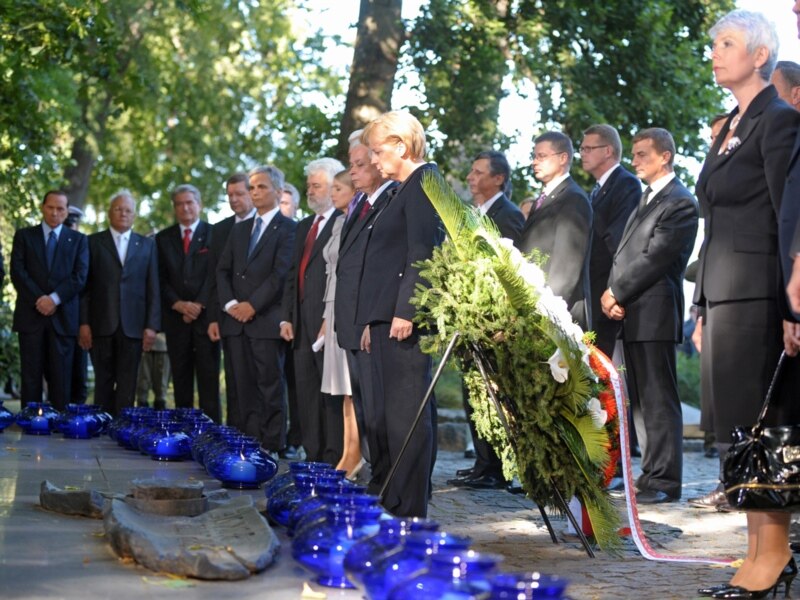
European leaders at a ceremony marking the 70th anniversary of the start of World War II at Westerplatte Monument in Gdansk on September 1.
September 01, 2009
By Gregory Feifer
Solemn ceremonies marking the 70th anniversary of the start of World
War II began before dawn on the Westerplatte peninsula near Gdansk, in
northern Poland, where a German battleship fired the first shots of the
war on a small Polish military outpost on September 31, 1939.Leaders from former allied and opponent states across Europe took part in the ceremonies, which set off renewed disagreement over the war's causes, with Russia accusing the West of rewriting history.
Standing at a Soviet-era monument to Polish soldiers, Polish Prime Minister Donald Tusk warned about the danger of forgetting history. "We meet here to remember who started this war, who was the perpetrator of this war, who was the executioner in this war, and who was the victim of this war and this aggression," Tusk said.
German Chancellor Angela Merkel apologized for Germany's role, saying there are "no words to describe the suffering of the victims of the war and the Holocaust."
Seventy years ago, Germany had expected the 182 Polish soldiers defending a small fort on Westerplatte to surrender within hours. Instead they held off more than 3,000 German troops for seven days in a battle that became Poland's chief symbol of resistance.
At the same time, German forces invaded Poland from east, west, and south, prompting Britain and France to declare war against Germany two days later. The 20th century's bloodiest conflict lasted almost six years, killed more than 50 million people, and redrew the map of Europe.
Anger Old And New
Tusk said seeking the truth about the massive suffering during the war would enable European countries to build trust in the future.

Poles believe a secret Nazi-Soviet pact gave Germany the green light to invade their country. Two weeks after the German attack, the Red Army also invaded, annexing eastern Poland under the terms of the Molotov-Ribbentrop agreement.. In a strong message to Moscow during the September 1 ceremonies, Polish President Lech Kaczynski called the actions a "stab in the back."
"This blow came from Bolshevik Russia, in accordance with the Molotov-Ribbentrop pact," Kaczynski said.
The Polish view has produced growing fury in Moscow.
In an interview ahead of his visit to Poland, Russian Prime Minister Vladimir Putin said that viewed in retrospect, the Molotov-Ribbentrop pact was "immoral." But anyone expecting him to deliver an apology was disappointed.
Putin said Moscow had no choice but to sign the agreement to postpone war after Western powers concluded their own agreement with Germany. He said the 1938 Munich pact ended "all hope of creating a united front against fascism."
Putin said the Soviet Union was just one country of many that had committed mistakes, blaming even Poland.
"I want bring to the attention of our respected colleagues the fact that the Molotov-Ribbentrop pact was the last document signed by a European power -- the Soviet Union -- with Hitler's Germany," Putin said. "It had been preceded by a 1934 agreement between Poland and Germany, bilateral nonaggression agreements between [Germany and] leading European powers, much like the Molotov-Ribbentrop pact, and the so-called Munich Agreement signed in 1938."
Debating History
In Moscow, Russia's intelligence agency poured more fuel on the fire, saying it was declassifying documents that show Poland was partly to blame for its invasion by the Nazis.
Also, Foreign Minister Sergei Lavrov lashed out against a recent resolution by the Organization for Security and Cooperation in Europe (OSCE) parliamentary assembly equating Nazism and Stalinism. He called the view "lies" and a "rewriting of history."
"Even during the Cold War no one ever tried to put the Nazi regime and Stalin's dictatorship on the same footing," Lavrov said. "It never occurred to anyone to equate the Nazi threat, which meant the enslavement and annihilation of entire nations, and the policy of the Soviet Union, which was the only force capable of standing up against the war machine of Hitler's Germany and in the end ensuring its defeat."
Russian President Dmitry Medvedev weighed in on August 30, saying the Soviet Union had "ultimately saved Europe" in the war.
The Soviet Union bore the brunt of the casualties in the fight against the Nazis, losing tens of millions of lives. In ever-grander ceremonies marking the war's end, contemporary Russians praise Soviet dictator Josef Stalin for bringing about victory against Nazi Germany, still seen as one of Russia's crowning achievements.

Poles are especially upset about disagreements over the Soviet massacre of 21,000 Polish army officers and intellectuals in the Katyn forest near the Russian city of Smolensk in 1940. The Soviets blamed the murders on the Nazis, admitting to the killings only in 1990.
'Common Front'
But at a September 1 news conference, Putin said the Soviet Union and Poland were "comrades in arms fighting a common front." He said Moscow may declassify documents relating to the massacre, but only on the basis of "reciprocity."
Putin used his speech at the ceremonies to praise the Soviet Union's achievements and sacrifices, saying half of those who died during the war were Soviet citizens. "Think about those frightening numbers," he said.
He said the Moscow has acknowledged its mistakes during the war.
"The Russian State Duma, Russia's parliament, has denounced the Molotov-Ribbentrop pact," Putin said. "We're right to expect that to happen in other countries that also made deals with the Nazis, and not on the level of declarations by political leaders, but on the level of political decisions."
Putin went on to say that Russia has since helped build "a new Europe," saying Moscow had brought down the Berlin Wall.
Critics say the Kremlin is especially sensitive over its role in the war because Putin has used nostalgia for the Soviet Union's superpower status to appeal to Russians.
"This is a part of not their ideology, but their PR campaign to legitimize and justify their absolutely corrupt and inefficient regime," says Russian political analyst Andrei Piontkovsky.
Piontkovsky says in comparison to occasional conciliatory statements made abroad, at home, Putin has presented a "complete justification of Stalin's regime."
Reply all
Reply to author
Forward
0 new messages