
Romania's King Michael Recalls Start Of World War II
0 views
Skip to first unread message

Andrew Grigorenko
Sep 1, 2009, 8:32:44 PM9/1/09
to General Petro Grigorenko Foundation
Romania's King Michael Recalls Start Of World War II
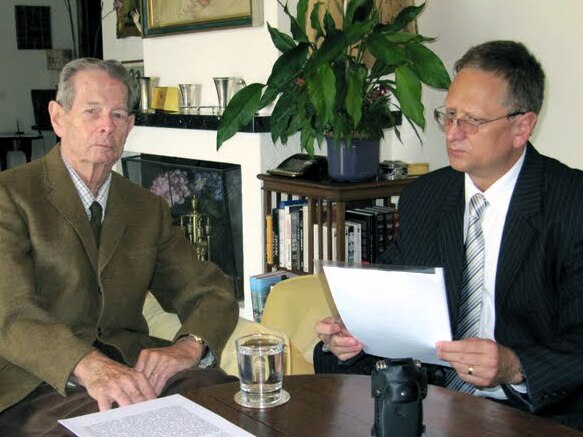
King Michael (left) with Eugen Tomiuc at the king's residence in Aubonne
August 31, 2009
Romania's former sovereign, King Michael, is one of the three surviving
heads of state from World War II (alongside Bulgaria's King Simeon and
Cambodia's Norodom Sihanouk), and the only one involved directly in the
war. RFE/RL correspondent Eugen Tomiuc spoke to the 89-year-old former
monarch at his residence in Aubonne, Switzerland, about the start of
the war and the impact of the Molotov-Ribbentrop Pact on Romania and
the rest of Eastern Europe.RFE/RL: We're marking this month the 70th anniversary of two fateful events in European history that also had a subsequent impact on Romania. On August 23, 1939, Nazi Germany and the USSR signed a nonaggression pact with a secret protocol that would result, less than a year later, in Romania losing territories to the USSR. And on September 1, as a direct consequence of the pact, Germany attacked Poland, thus triggering World War II. I would like to ask you to recall the moment when you learned about the beginning of the war -- what did you feel then?
King Michael: At that time I was still in school, and I wasn't involved with the running of the state, my father [King Carol II] did it all with his government. Of course, we knew what was happening around us, but the implications -- deep implications -- at the time, were difficult to understand, because I was concerned with what I had to do in school. But we felt deep down in a way without saying it, so to speak, that something very nasty was going on. And finally, what we felt was exactly what has actually happened.
RFE/RL: Britain and France declared war on Germany on September 3, and on September 17, the USSR invaded eastern Poland. The Allied powers, however, did not declare war on the Soviet Union, and Romania felt threatened from two sides. This feeling of unease you mentioned, the instinct that something bad was to come, did it have anything to do with the fact that even though Romania had established diplomatic relations with Soviet Russia, it knew that the issue of Bessarabia was still pending?
King Michael: Yes, of course. The question of the Soviet Union at the time -- we always kept it in our minds as something to be very careful of, because you never quite knew what was coming next. We had seen a lot of things about the history [of Romania and Russia]; it was enough to understand we could have been in a dangerous situation later on.
Because we had the possible danger from the Soviets, on the other hand, the German Nazis were also working up something and we were sort of caught between the two. So there are many, many things that people may be criticizing and so on, but we ought to -- this is the thing I realized later, not at the time itself -- we were facing danger in the sense that either the Soviets or the Nazis, if we didn't do the one thing or the other that they might have liked, we might have lost our independence. So it's a very difficult situation, come to think of it, after it happened. How do you try and steer as much as one can without being too dangerous? That was our problem.
RFE/RL: With the benefit of hindsight, as Your Majesty said, there are historians who say that if Romania had chosen to resist the Soviet ultimatum of 1940 and defend Bessarabia and Northern Bucovina, even though it would have been defeated and lost several tens of thousands of soldiers, it would have stood to gain more morally and even politically, like Finland. Why did Romania not fight?
King Michael: This is a question we have thought about very deeply. It is quite obvious that we all thought about that, even if later. Maybe something should have been tried, at least morally speaking. Now we were facing a colossus -- the Soviets -- and it would have been very possible that if we had presented some resistance, morally good as it may have been, we might have had an invasion, with the Russians all over the country. You could never tell exactly, but you know, you have to be very, very careful about certain things. So it is also possible that it was the thought of the government and of some other people then that it was perhaps safer to take a humiliating situation and try to safeguard the rest and the independence of the country. This is something that many other people in the West, of course, do not quite understand and not see the true situation that we were in.
RFE/RL: So basically Romania could have been in mortal danger as a state, it could have disappeared from the map, because Hungary might have taken Transylvania as well?
King Michael: That could have been the very possibility because the Nazis were on one side, the Soviets were on the other side, and we had certain problems with the Hungarians. Who knows what might have happened. We tried to be as friendly as we could with our neighbors but sometimes you don't know what might come out of it if you're not careful.
RFE/RL: Yes, someone once said that the only friendly neighbor Romania had was the Black Sea. In 1941, Romania took part in the invasion of the USSR initially under the justification of liberating Bessarabia, but later on it kept fighting alongside Germany on Russian territory and experienced the Stalingrad catastrophe. Many have said that Romania should have stopped at the River Dniester. Would that have been possible in 1941? What was it that Romania had risked?
King Michael: This was a very complicated situation. Because we were trying, at least, to get Bessarabia and Northern Bucovina back, and it would have been absolutely impossible to do that by ourselves. So at the time when [Marshal Ion] Antonescu was leading the state, he wasn't the head of state, he was leading the state -- the fuehrer...[chuckles] he decided that, probably for a short period, the only thing that could be done was to join the German troops and get back Bessarabia and Northern Bucovina. The problem was, how far could we go?
Because I remember very well, sometime later, Marshal [Carl Gustav Emil von] Mannerheim in Finland was, to a certain degree, in the same sort of situation that we had been in -- he joined the war against the Soviets but he stopped at the previous Finnish frontiers [after recovering Karelia]. And the result was that he lost the same part [Karelia] again anyhow. So we might have found ourselves in the same type of situation, that we might have taken back our territories and then lost them anyhow, and the situation might have been even worse. It is possible. In view of what happened afterward, it could have been very dangerous.
RFE/RL: But at least, could it have been presented to the great powers afterward not as a war of aggression but rather as a justified attempt of getting back what had been lost?
King Michael: I am very sorry to have to say this: The United States was still much too far away, while Great Britain and France, based on some experience I had afterward, they couldn't care less about our part of Europe. I remember very well when in 1938 my father took me to London on an official visit. I was not directly involved but I remember hearing that he was trying to get some sort of understanding from the British government to, not exactly safeguard us, but at least to have a minimum of [British] interest in our country and what was happening in that part of Europe, but unfortunately it did not happen that way.
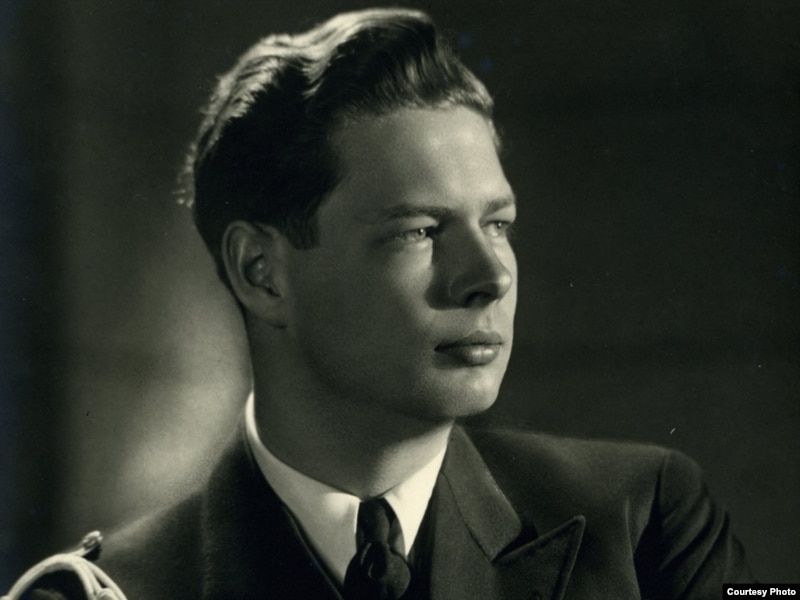
RFE/RL: In 2005, you were invited by then-Russian President Vladimir Putin to attend the Moscow celebrations of the 60th anniversary of the end of World War II. You have declared repeatedly that the Soviet Union's actions were "extremely horrific for Romanians" and said Russia should officially condemn the Molotov-Ribbentrop Pact. Do you still maintain this statement?
King Michael: I've been saying that since long before 2005. And when I was invited to Moscow for the celebrations, I was extremely surprised about that, I must say, because after all the history we and Russia had together I couldn't quite believe my ears. But I must say that now that the Soviet Union's finished and gone, I would like to see the Russians -- how should I say -- a little more open and honest about these things. They should say something about the Molotov-Ribbentrop Pact to put it right. I think it would be the right thing to do.
Memories Of Churchill, Hitler
RFE/RL: You mentioned earlier that Marshal Antonescu was the leader of the state -- the conductor -- but Your Majesty was the official head of state, and in your capacity you negotiated and met with the main players in the events during the war. Did you ever meet any of them personally? What impression did they make on you?
King Michael: Although I was the head of state, I wasn't allowed to do anything, because [Antonescu] was dealing with everything, taking care of politics and all. So, negotiations as such, no I couldn't conduct them. I didn't meet all of the leaders, only some of them. I met British Prime Minister Winston Churchill after the war, and also U.S. President Harry Truman when I visited the United States in 1948.
Churchill was very polite, as he usually was, but my impression was that he didn't even really know much about our country. One moment we were talking about some situation, and then he all of a sudden just said something like, "I don't know, does Romania have a constitution?" I was flabbergasted when I heard that, and I couldn't continue and I replied, "Yes, of course we have a constitution." I mean, Churchill was such an intelligent man and he had done so much to serve Britain during the war, but in a way, [about] all the rest of it [Europe], not that he really didn't know [about it], I don't know, I really can't quite understand how he came to that.
Something else, he did not actually recognize us when they had the conference in Yalta [in February 1945]. As far as I could make out, from what I understood, they drew up this list which was scribbled by hand with the spheres of influence, so we were already given up, so to speak.
RFE/RL: How about Hitler? Have you ever met him?
King Michael: Hitler, yes, I met twice. Once, with my father, when we came back from England and France in 1938. My father had discussions with him. I don't know what went on because I don't speak German at all. And then the second time, when my mother [Queen Elena, Carol II's estranged wife] wanted to go back to Florence to arrange some things, and we talked to Antonescu, and he gave us permission, but he said if you go to Italy you will have to meet the royal family of Italy, so you can't go without meeting [Italian dictator Benito] Mussolini probably, and Hitler! [chuckles] So, Antonescu fixed our trip, that we should go to Florence by going through Berlin! Mother didn't want that, but we did it. That's how it happened. We had lunch with Hitler someplace in Berlin. As I said, I don't speak German, but my mother could speak a little German. Not very much came out of the meeting, even though we had an interpreter.
RFE/RL: What was the impression Hitler made upon you? Did he strike you as someone extraordinary, or was it only the legend that was being built around him?
King Michael: When he came on a problem that interested him, I don't remember exactly what it was, but when he started...he was just making speeches to the people who were there for lunch...he suddenly had an expression fixed in his eyes, which looked to me very uncomfortable. When he started the speech he sort of went off, round and round. It was just a question of a few minutes, but you could see it on his face, when he came on the subject he'd wanted, he just went on like, huh...a bit unpleasant, though.
RFE/RL: Was he, excuse me for asking that, Sire, but you're actually someone who did see him, was he frightening?
King Michael: No, you know, we were so far [apart] on mentalities, that it [Hitler's intimidating impression] was like water off a duck's back, you know [chuckles]. It didn't go in. And my mother also wasn't impressed at all.
RFE/RL: You've mentioned Mussolini. Did you also meet him?
King Michael: I met Mussolini in Rome for 20 minutes during that same trip. He was, well, like all Italians we knew. How he got himself involved so much with Hitler, it's hard to tell, that's another problem.
RFE/RL: In 1940, at the Vienna Arbitration where Hitler and Mussolini decided to break a part of Transylvania and give it to Hungary, Mussolini shocked the Romanians by demanding "justice for wounded Hungary." Romanians felt betrayed by what they had seen as a "Latin brother," to such an extent that then-Foreign Minister Mihail Manolescu collapsed when he saw the new map of Romania.
King Michael: That was something that we didn't quite understand. What did Mussolini have with the Hungarians? Why was he pushing them so much, and not us? After all we were a Latin nation like the Italians. This was a situation that was very difficult to understand.
Helping Romania's Jews
RFE/RL: Romania's alliance with Nazi Germany was marked, aside from the hundreds of thousands of Romanian military casualties, by despicable acts, such as the extermination of Jews and Roma from Romania and Transdniester. I would ask you to tell us about the action Your Majesty and the Queen Mother took to stave off these crimes.
King Michael: You know, Antonescu was a very funny character in a way. I should mention that he had been our military attache in London before the war. Did that [period] leave some leftovers in his mind? I can't tell. But he had a certain respect for my mother. After all, after my father left in 1940 [after Antonescu took over and forced Carol II to leave], he very quickly told my mother to come back [from her exile in Italy]. He did that. But with me, he treated me like a child, therefore I could not conduct many discussions with him, because it was useless.
What happened with the Jewish situation especially was that we knew, we had very close relations with the chief rabbi of Romania, Alexandru Shafran, and thanks to him, we knew exactly when something was being prepared against the Jews. He used to come and see us, especially my mother, and explained exactly what was happening, and then she sent word to Antonescu and to [Foreign Minister] Mihai Antonescu and managed to get certain things through. Not as much as one would have liked, but she did. She managed to save about one hundred and something thousand Jews in Romania and from Transdniester. It wasn't as much as she would have liked, but it was something all the same. And that was because of Antonescu's respect for my mother.
She managed to stop a very nasty thing that was being prepared in Bucovina, and she managed somehow to get Antonescu to stop a part of that -- the deportation of the Bucovina Jews to Transdniester. For some Jews and Roma in Transdniester, she also managed to get the approval of Antonescu to send several trains with food and clothing for them. And this went on for quite some time, because Rabbi Shafran used to come every two or three weeks to say that something else was being prepared against the Jews, and she immediately let Antonescu know how she felt about that, and even enlisted the help of the Orthodox Patriarch Nicodim. I could do only very little personally since Antonescu didn't consider me anything very important [chuckles].
RFE/RL: How wrong he was in the end....
King Michael: The other Antonescu, [Foreign Minister Mihai Antonescu] was more respectful toward me, but Ion Antonescu, once he decided what he was going to do, he didn't explain anything.
RFE/RL: Your Majesty, did you have any hint at the time that something horrific was taking place in territories occupied by Nazi Germany? Was there any rumor about the Nazis perpetrating a horrendous act of mass murder against the Jews?
King Michael: Very little, but we had an inkling. Some of our people coming back from Europe smelled something. But details as to where or how, no. We knew though that something very unhealthy was going on, but we couldn't put our finger on it.
RFE/RL: The Queen Mother was subsequently honored by the Yad Vashem Museum.
King Michael: Yes, it was a number of years afterward, because they have very strict rules about Yad Vashem, and it took about two-three years to go through all the files, and they had a lot of documents from the SS concerning my mother.
There is something else that maybe I should mention. Antonescu wanted me to go and see the troops during the war, because I was also the head of the army. So he wanted me to go to Odessa, to Trasndiester and so on. I refused. I refused flatly. I told him, "We have no business over there." And then I took a plane and flew directly from Bucharest to Crimea. I spent two days there seeing the troops, then I came back. I refused to put my foot in Transdniester. And as far as I know, the Russians knew that, because they mentioned something to me afterwards.
Deposing Antonescu
RFE/RL: August 23 has dual significance for Romania. One side, the Nazi-Soviet pact of 1939, is profoundly negative. But the other, August 23, 1944, is positive. That is when Your Majesty ordered the arrest of Antonescu and brought Romania out of the war against the allied powers. Historians agree that your courageous action actually saved Romania. Could you evoke that day of August 23, 1944?
King Michael: The preparation for August 23 actually started in late 1942. In spite of Antonescu's dictatorship, Romania's traditional political parties -- the so-called historical parties -- were left alone and were not abolished, and we had a lot of contacts with them in Romania, besides, myself and the parties sent emissaries to discussions with the Allies in Ankara and Cairo.
As time went by these discussions were getting very acute because the situation was getting out of hand on the front, and we were telling them, "We need some help, we want to get out of this but we cannot do that alone." Much later on I understood that all the appeals we were sending to Americans and the British to help us, they were letting the Russians know about. Which was not very...how should I put it...I'll not say anything.
And this went on for quite a long time, because we never got even the slightest help. Yes, morally, maybe, but that doesn't help much when you're with the noose around your neck. So, finally when the situation got completely out of hand after Stalingrad, and the Russians were already getting very close to Bessarabia again, we discussed with political parties. Because the British and Americans had insisted that we bring the communists and the socialists in our group, we did that.
And then, accidentally -- this is very queer how history does things -- I was in Sinaia [royal residence in the mountains] at the time, and then an indiscretion of our doctor happened -- it was a very awkward situation if you like, but that's how it happened, a couple of days before August 23. We were discussing that we had to talk to Antonescu, and that we had to ask him to make the armistice and stop the war, but we had yet to come up with a particular date. And finally we decided that it was going to be August 26.
Our personal doctor was hosting one of Antonescu's staff officers at his house in Sinaia. The officer received a phone call from Bucharest, and, as the doctor's residence had three phones, the doctor accidentally picked up one of the receivers and overheard by chance the conversation in which the officer was being informed that Antonescu was leaving for the front the following days. See how history happened! And then the doctor came rushing to us and told us, "Look, I heard that Antonescu is going to the front the day after tomorrow!" and we all understood that something urgent had to be done. I immediately came back to Bucharest and gathered all the people we were talking to and informed them.
And that's how we came to act on August 23. We decided I should summon him for an audience to me to explain to him what was going on, and that the Russians were at the Dniester. Then I had a two-hour meeting with the head of my military household, [future Prime Minister] General Constantin Sanatescu and we set the details, that if Antonescu refuses, we will put him away.
So after many discussions, after I asked him and told him that we had to do something and stop the war, General Sanatescu told him, "If you can't do it, then let someone else do it!" and Antonescu then turned to him and said, in front of me, "What, leave the country in the hands of a child?" So finally, when he said flatly that he refused to declare an armistice, we had a code word, and I said very loudly, "Well, I'm very sorry, but there's nothing else I can do!" and then a door opened and three noncommissioned officers and a captain came in and took him. Locked him up in a room in the building.
RFE/RL: What was his reaction? Did he say anything to anyone?
King Michael: He turned around to the general and said, "What is this?" And then he wouldn't say anything, we locked him up in a house.
RFE/RL: There are reports that when the news of Antonescu's arrest reached Berlin, Hitler ordered his ambassador to Bucharest, Manfred von Killinger, to arrest you in turn. Your bold move could have had a different, dire outcome for you. Were you aware of the time that this was a fast-moving game and whoever moved faster would gain the upper hand?
King Michael: It was very fast indeed, because we had arranged with the commanding officers of Bucharest garrison, where we had few troops, and we even managed to get a few from outside the capital, and instructed them that, in case something happened with my life, they take over the situation. What I found afterward was that Berlin tried to find another Romanian general to take over the situation in Bucharest and replace Antonescu, but there was no such general. They were all loyal to me. Ambassador Killinger then came to the palace, but he did not try to arrest me or something, he just told me that I was playing with fire.
RFE/RL: Sire, I will attempt to set the record straight. There have been voices in Romania saying that Antonescu was hugely popular among the troops and in the country while you had been isolated. Or, the very fact that those troops chose to side with you and not with Antonescu, indicates that you have made the right decision in the eyes of history.
King Michael: That is, of course, true, because I was the commander in chief of the army, and had already had contacts with the commanders of some big units on the front line. No one, absolutely no one tried to set Antonescu free.
Moldova's Future
RFE/RL: The Republic of Moldova, whose territory is largely that of Bessarabia, is an entity that came into being as a direct consequence of the Molotov-Ribbentrop Pact. We could say that the Republic of Moldova is the place where World War II has not yet ended: Transdniestrian separatism, political instability, a struggle for geopolitical spheres of influence, immense poverty, all these are consequences of the appearance of an artificial state resulted from the Soviet occupation of Bessarabia. How do you see the future of this entity?
King Michael: It is a very difficult question to answer really. I very, very often think about that place and the people, and a feeling comes around sometimes.... And I know very well that they have an extremely difficult, horrible situation there, I know very well about that. The trouble is that we can't do very much about it. The one thing we could do, we should do, is to have a very good relationship with them, even as things are now, because in fact, it is up to the Bessarabians themselves to try and do something. We can't interfere. I've noticed that the last election there seems to be a little different from the others. Is that positive? I hope so. But I think about the people there very, very often, and it is very, very painful.
RFE/RL: Do you see the Republic of Moldova turning West or East in future?
King Michael: Well, as far as I understand they want to be West -- the people -- but, can they? That is the big question, because as I said, it is up to them to decide.
RFE/RL: Do you think the European Union should have a more prominent role in helping Moldova get closer to Europe?
King Michael: That would be the normal, logical thing, yes. But how far are they willing to go, that is the question. Because still, it is inexplicable to me, there's a sort of fascination that comes out of Russia. I don't want to say too much about this, but Russian people are very special people, and they have also gone through absolute hell for 80 years or whatever it was, but there is a fascination about them [in the West], of course it is an enormous country, and sometimes, the Western Europeans don't always put the foot down where it should be. They should also try and get Bessarabia back into Europe. Not because they are changing frontiers for the moment and all that, but it is part of Europe because it was [part of Europe].
Bringing Romania Back To Europe
RFE/RL: After 1989, you made substantial efforts to promote Romania's Euro-Atlantic integration, even when the new power in Bucharest treated you with hostility. The recognition and influence Your Majesty enjoys in Western chancelleries contributed to a great extent to speeding up Romania's joining EU and NATO. You are a most eloquent example that in spite of adversities of history and fate, patriotism and moral rectitude always win in the end, no matter how long the battle. It was a long way, marked by sacrifices for the king, but now the king has returned home, even though it is a changed home. When you look back, what are your feelings?
King Michael: It is difficult to put it exactly in a row of words. We were part of Europe, always have been, and I think that one of the things which are part of my duty is to try and get the country back the way it was, as much as possible, which is very difficult. Don't forget that when I went there was from 1997 on after Emil Constantinescu was elected president. With the few governments before that I couldn't even get back to Romania. Now we are in a place that we should be, but we still have a long way to go. But we are in the right kind of alliance and we have to stick together with the other Europeans.
During the drive to help Romania gain NATO membership, I and the rest of my family involved in this effort had some very interesting meetings with military people and politicians and it worked. I even saw some of the military people that I wasn't supposed to see because it [Romania's NATO membership] wasn't [a] done [deal] yet. There are ways of doing things, anyhow, we managed to do it somehow, I have a lot of explanations. And, that's never come up and it shouldn't come up, but the fact is that I managed to see quite a number of people then and it finally worked. But we had to pull our weight [chuckles].
RFE/RL: In a book published in 1992, you affirmed that you believed in miracles. Now, no matter how much fateful significance this year may have, there is still one event that we mark this year which was nothing short of a miracle: the fall of communism in 1989. In the summer of 1989, much of Eastern Europe was still under the grip of totalitarianism. Several months later, the "socialist" camp crumbled like a sand castle, culminating with the violent uprising of the Romanians. Two decades on, do you believe that, in Romania's case, this miracle has been completed?
King Michael: No...I would say, no.... A lot has been done, yes. But I have said that a lot of times, even though people probably don't like that -- that the Soviet Union, the system collapsed, but communism has not disappeared. No. Much has changed, but a lot of things underneath...it's enough to scratch a little bit and you'll find that again.
You know, after 40-50 years of what we went through, this is something like the Chinese drop, you know. Drop after drop after drop, I don't know how many people understand that, but after you get that [ideology] drop by drop for so many years, you start thinking it's your own idea. It is a very insidious way of behaving. On the surface of things much has changed, yes. But every once in a while you'll find some little things [from the past] that suddenly begin appearing again. And, you know, in all honesty, it's not just about my country but other countries as well.
You see, my idea, or my feelings about certain things are like this: one talks a lot about forgiveness, which is the right Christian, moral thing to do. There are certain things though, and certain positions. In my case, whether I'm still the active king of Romania or not, it is still my duty to look after my country. You said before that they treated me so badly and so on.
Yes, it's quite true. While I was away, and even after I came back. But that is a personal thing. And, the personal things, you can forgive, or not forgive, that is your own business.
But when you see what some people have done to one's own country can you forgive that sort of things? In my mind, as a Christian, I say no, you cannot. Because tens of millions of people have been destroyed practically, gone through absolute hell, and then suddenly you say, well, it's all finished let's forget it. You don't forget it. You know, the Jewish people, they have something like a prayer, I guess the title of that prayer is "We Remember." And, if our people and others will remember [the crimes of communism], that will be an extremely positive and moral way of thinking. But I know it is very difficult after all those years, because you lose your sense of direction.
RFE/RL: As the sovereign of the Greater Romanian Kingdom, which Your Majesty identifies with, do you have now, seven decades after the tragic events of 1939, a message for all Romanians -- inside and outside Romania's borders?
King Michael: If they want things to go on better than they are now, the thing I want to ask the Romanian people very much is to stick together, because some people are trying to separate them and we are not going to get where we should. We have to show solidarity among ourselves, remember that we are in Europe, and behave properly toward the others. Because it is not good doing certain things that everybody knows about in Romania now and when the foreigners criticize us we say it's none of their business. Of course it is their business, because we are part of Europe.
The Romanian people should really get together and wake up, because we've still got a long way to go. We have to get together and pull together and bring back Romania as it should be. I won't say necessarily as it was, because those are things of the past. But those things of the past should be an inspiration for the future.
That is my deep wish for the Romanian people to get together and stick together and try and think of the future. Not necessarily the private future, even though that is a good thing too. The thing is that if you're part of your country you have to pull your weight for your country.
Reply all
Reply to author
Forward
0 new messages