
Re: [fasola-discussions] leading slowly in 2

Wade Kotter
Here's a link to the Mount Pleasant Youtube video:
http://www.youtube.com/watch?v=c_GSEjbMY64
Wade Kotter
South Ogden, UT
--- On Mon, 7/6/09, John Garst <ga...@chem.uga.edu> wrote:
> Warren, is it the MOUNT PLEASANT Youtube video, Mike and
> Syd leading,
> to which you referred?
>
> As I see it, the two leaders are mostly together, but they
> are a
> little ragged here and there, and my eyes and ears indicate
> to me
> that the singers take the beat as beginning at the bottom
> of the
> downstroke. I don't know what Mike and Syd intended.
>
> My mind's eye tells me that some leaders mark the first
> beat of a
> duple measure by moving the hand away from the body, mostly
>
> horizontally and toward the singers he/she is facing,
> perhaps with an
> unflexing of the elbow - the hand then falls during that
> beat. Is
> this the traditional style that has been referred to
> here? If so,
> then the beat is unmistakable in that style - the leader
> punches out
> on the first beat.
>
>
> John

Janet Fraembs
to see the difference in these 2 leaders is Peggy Brayfield's recording of
Homeward Bound for Amanda Denson, from the same Missouri Convention.
Janet Fraembs
Charleston Illinois
wadek...@yahoo.com
Thanks, Janet. The difference does seem to be clearer int his video. Perhaps Warren can let us know which video he was referring to. Anyway, here's a link to the video of Homeward Bound:
http://www.youtube.com/watch?v=2ckxBb222Tc
Wade Kotter
South Ogden, UT

Thomas Malone
I think we can all agree that because of where I first learned to sing and beat time, my initial learning could hardly be considered traditional.
Then, four years ago, I went to Camp.
This was the first year that Hugh McGraw taught rudiments classes for both youth and adults.
Here I heard him say a phrase that he uses in all of his singing schools, "We have seven modes of time, three of common, two of triple, and two of compound."
In that moment, I quickly realized that I needed to set aside my previous training and "become a beginner" because I, and many other "northern singers" who had not sat in singing school before--- didn't even know what a "mode of time" was!
We, "in the North," tend to think of songs as being "in two", "in three", or even "in four" -- but none of these labels are correct, without fully understanding the seven modes of time.
This realization was the beginning of my dissertation project, with the hypothesis that many differences between so-called Northern and Southern practice could be attributed to difference in awareness of the rudiments as 'teaching and learning' rather than as variations due to aural tradition or folk-practice.
** For example we think that "four four" is a meter, but in Sacred Harp meter is an aspect of poetry! e.g. Long meter, short meter, 7's and 6's etc.... these are meters.
Because -- "Four over four" is not a meter at all -- it is actually the second mode of common time.
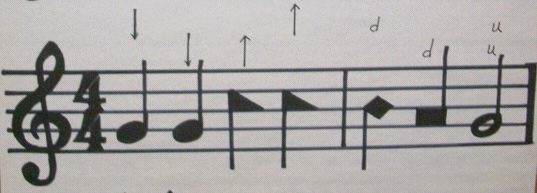
A measure of which, contains four beats of musical time, indicated with two strokes of the hand. The musical beats of one and two are both found on the downward stroke, and the musical beats of three and four are on the upward stroke, with the hand rising to four in order to complete the measure. I believe Henry and Warren made this point in different ways earlier. (see the graphic below, or attached illustration)
one two three four
down - down up - up
This manner of beating four four time differs from what University music and music education programs call 'cut-time', in which the half note 'gets the beat' -- and is this "in two" -- which might be understood like this:
one (and) two (and)
bottom rise top fall
The wording of the 1991 rudiments place the beat at "the bottom of the stroke" which may appear to describe the latter of these two methods. But this widespread practice of beating in 'cut-time' is probably more due to the influence of other forms of choral training among newer SH singers over the last 20 years than any technical discrepancy in the printed rudiments. This reality has gradually given rise to the widespread idea that the second mode of common time can and should be beat "in two".
Consider: These three teachers taught and learned from the 1936 Paine Denson rudiments, which instruct that the "primary accent comes and is placed on the first part of the measure when the hand starts down in marking time to the right of the measure bar." (emphasis in bold added)
Each of these thre teachers (Mr. Cagle, H.N. McGraw, Elder Kitchens) had the same primary mentor in teaching, and that was Thomas J. Denson. He inititally learned from the B.F. White Rudiments and taught largely from the James 1911 rudiments, which describe the placement of the primary accent (or one) in nearly the same language retained by Paine Denson.
I have worked closely with Hugh McGraw on this exact question, and he has demonstrated to me numerous times that in four four time, the muscial counts of one and two are on the downward stroke, and three and four are on the upward stroke. therefore "down-down, up-up" completes a measure of four four time. (again see attached graphic)
J.E. Kitchens, A.M Cagle, and H.N. McGraw were more than just "traditional singers," they were teachers of the rudiments. Sacred Harp is just as much a tradition of teaching as it is a tradition of singing. These three men were also the teachers and mentors of the elder generation who teaches at Camp Fasola today.
P.S.S. Yes, I just finished a dissertation on exactly this question. So plese orgive the length and throughness of my reponse, as well as any typoes or inconsistencies with quotes or spacing, I have learned that I am better at content than formatting.

mudws
Wade scripsit:
> Thanks, Janet. The difference does seem to be clearer int
> his video. Perhaps Warren can let us know which video he
> was referring to. Anyway, here's a link to the video of
> Homeward Bound:
> http://www.youtube.com/watch?v=2ckxBb222Tc
I agree that the difference is clearer in the Homeward
Bound video than in Mount Pleasant.
Warren Steel mu...@olemiss.edu
http://www.mcsr.olemiss.edu/~mudws/
Department of Music University of Mississippi
http://www.youtube.com/mudws
Tom Malone
earlier post, with one glaring keystroke error, (thanks Chris N.)
Here it is more clearly laid out.
** Seven Modes of Time in the Sacred Harp Rudiments: 1844 to present
Common
Triple Compound
first mode: 'two over two' 'three over two' 'six over
four'
second mode: 'four over four' 'three over four' 'six over
eight'
third mode: 'two over four' - - - -
- - - -
Tom M
On Jul 8, 12:40 pm, Thomas Malone <shapen...@gmail.com> wrote:
> WARNING : This is a long email. Please skip it if you are not interested!
> Thanks!
>
> : P
>
> Hello all... Tom Malone here.
>
> I was born and raised in Vermont, and learned to sing Sacred Harp both there
> and in Massachusetts, so I can represent, for the sake of this discussion, a
> typical "Northern Singer".
>
> I think we can all agree that because of where I first learned to sing and
> beat time, my initial learning could hardly be considered traditional.
>
> Then, four years ago, I went to Camp.
>
> This was the first year that Hugh McGraw taught rudiments classes for both
> youth and adults.
>
> Here I heard him say a phrase that he uses in all of his singing schools,
> "We have seven modes of time, three of common, two of triple, and two of
> compound."
>
> In that moment, I quickly realized that I needed to set aside my previous
> training and "become a beginner" because I, and many other "northern
> singers" who had not sat in singing school before--- didn't even know what a
> "mode of time" was!
>
> We, "in the North," tend to think of songs as being "in two", "in three", or
> even "in four" -- but none of these labels are correct, without fully
> understanding the seven modes of time.
> The 'modes of time' govern speed, rhythm, length of notes, and the placement
> of accent in every song. They are as follows.
>
> Compound*
> First mode: *'four over four' * 'three over two' 'six
> over four'*
> Second mode: '*four over four' 'three over four' 'six
> over eight'*
> Third mode: *'two over four' * - - - -
>
> (*The use of the word 'over' can be traced back to the 1844
> rudiments.)
>
> They are not the same as "meters" as taught in University schools of music
> or music education. (see the chapter in my dissertation 'Modes of Time are
> not Meters'.**)
>
> This realization was the beginning of my dissertation project, with the
> hypothesis that many differences between so-called Northern and Southern
> practice could be attributed to difference in awareness of the rudiments as
> 'teaching and learning' rather than as variations due to aural tradition or
> folk-practice.
>
> meter* is an aspect of poetry! e.g. Long meter, short meter, 7's and 6's
>
> In the North, we have no trouble describing four four time as being "in
> two", but it is not in two. It can't be.
>
> Only the first mode, (two-two) and the third mode (two-four) of common time
> can be "in two" because the top number tells you 'how many', and the bottom
> number 'what kind" of notes 'or their equivalent' will fill a measure of
> time. So, no matter how you beat it 'four over four" will continue to have
> four beats time in it.
>
> Because -- "Four over four" is not a meter at all -- it is actually
> *.
>
> A measure of which, contains four beats of musical *time*, indicated with
> the downward stroke, and the musical beats of three and four are on the
> upward stroke, with the hand rising to four in order to complete the
> measure. I believe Henry and Warren made this point in different ways
> earlier. (see the graphic below, or attached illustration)
>
>
> This manner of beating four four time differs from what University music and
> music education programs call 'cut-time', in which the half note 'gets the
> beat' -- and is this "in two" -- which might be understood like this:
>
>
> The wording of the 1991 rudiments place the beat at "the bottom of the
> stroke" which may appear to describe the latter of these two methods. But
> this widespread practice of beating in 'cut-time' is probably more due to
> the influence of other forms of choral training among newer SH singers over
> the last 20 years than any technical discrepancy in the printed rudiments.
> This reality has gradually given rise to the widespread idea that the second
> mode of common time can and should be beat "in two".
>
> If you are already exhausted by this email, you can stop here and come back
> later.... : )
>
> Believe me as a "Northern singer" I had to re-learn all of this over the
> past four years, especially the beating of 'four four time' --- and the
> fundamental question "where is the one?" (primary accent).
>
> But in close study with the many of finest teachers of the 1991 book, who
> were mentored and taught by J.E. Kitchens, A.M Cagle, and H.N. McGraw etc.,
> I have come to see that the "down down up up" approach is able to provide
> better accent in the second mode of common time, a fact which the recent
> recordings from Camp can attest to.
>
> Consider: These three teachers taught and learned from the 1936 Paine Denson
> rudiments, which instruct that the "primary accent comes and is placed on
> without the class unnecessarily correcting or overriding them. In the
> Sacred Harp we are all teachers, singers, and learners and no one person can
> 'know it all' but we can all make an effort.
>
> I personally find the illustration in the attachment offers new
> possibilities for personal and regional diversity in accent -- and four
> years into practicing it, I known I still have a long way to go.... but know
> I want to make the effort to improve.
>
> There is so much more we can learn.... in time, in tune, and in accent.
>
> Now let's sing!
>
> Tom Malone
>
> P.S. I would be glad to dialogue more 'off-list' with anyone on these 'deep
> water' questions, or by telephone. My number is in the minutes book.
>
> P.S.S. Yes, I just finished a dissertation on exactly this question. So
> plese orgive the length and throughness of my
> reponse, as well as any typoes or inconsistencies with quotes or
> spacing, I have learned that I am better at content than formatting.
>
>
> > Here's a link to the Mount Pleasant Youtube video:
>
> >http://www.youtube.com/watch?v=c_GSEjbMY64
>
> > Wade Kotter
> > South Ogden, UT
>
> > --- On Mon, 7/6/09, John Garst <ga...@chem.uga.edu> wrote:
>
> >> Warren, is it the MOUNT PLEASANT Youtube video, Mike and
> >> Syd
>
>
> read more »
>
> four over four illustration.jpg
> 46KViewDownload

Robert Vaughn
--- On Wed, 7/8/09, Thomas Malone <shap...@gmail.com> wrote:
> They are not the same as "meters" as
> taught in University schools of music or music education.
> (see the chapter in my dissertation 'Modes of Time are
> not Meters'.**)
I guess at times there's an advantage to not being cluttered up with too much knowledge! ;-D
>
> In the North, we have no trouble describing four four
> time as being "in two", but it is not in two. It
> can't be.
Thank you. I felt a little slow in trying to discern what was being described, but your e-mail made a light go off in my head. I couldn't figure out how the "one beat" could be at the bottom of the stroke in a 4/4 mode beat 'down-up'. I mean, you would have one-fourth of the measure on the down stroke and three-fourths on the up stroke (or something like that). But now I think I understand. The person beating this way is evidently not thinking 1-2-3-4, but simply 1-2.
> Only the first mode, (two-two) and the third
> mode (two-four) of common time can be "in two"
> because the top number tells you 'how many', and the
> bottom number 'what kind" of notes 'or their
> equivalent' will fill a measure of time. So, no matter
> how you beat it 'four over four" will continue to
> have four beats time in it.
>
I think those of us who beat down-left-right-up (I use both 'down-up' and 'down-left-right-up' as it suits my personal fancy) may be guilty of adding to this false impression by using the words "in four" (or something similar) as a warning/heads-up to the class that we will be beating 'down-left-right-up' instead of 'down-up'. But this is a misnomer. As you correctly point out, 4/4 is "in four" regardless of whether you use 'down-up' and 'down-left-right-up'. Perhaps we should find a new phrase for this pre-song "warning".
Sincerely,
Robert Vaughn
Mount Enterprise, TX
http://baptistsearch.blogspot.com/
Ask for the old paths, where is the good way.
http://mtcarmelbaptist.blogspot.com/
For ask now of the days that are past...
http://oldredland.blogspot.com/
Give ear, all ye inhabitants of the land.
Thomas Malone
And clearly, the first mode of common should have been 'two over two'. See rudiments on pg. 15
As you can all see I am better at singing and teaching than I am with computers.
Here it is in text, and if this doesn't work I'll try it again as an separate attachment.
Nothing worth doing well is easy, I guess..... but those who have ears, will hear,
even with my keystroke errors.
Thanks for your patience.
Tom M
Dr. Thomas B. Malone
Molloy College
www.SingIngalls.org

Karen
Bravo,
Karen Willard

Will Fitzgerald
See: http://www.entish.org/sh/malone-on-beating-time.html
I can't guarantee that it will be up for a long time, but it might be
helpful to see it all in one place.
Will

John Garst
*****
Moods/Modes of Common Time must have something in common or they
woulnd't all be called "Common Time."
If we ask how many notes of equal duration can fill a measure, the answer is
1 2 4 8 16 32 etc.
for each of the modes of Common Time.
If we ask where the accents fall, the answer is that the major accent
falls at the beginning of the first note of a "2" measure, that a
minor accent falls at the beginning of the second note of a "2"
measure, and that these accents persist in the same places in "4",
"8", "16", "32", and related compound measures (measures in which not
all notes are of equal duration), except when altered by syncopation.
Each of the above is true whether the time signature is 2/2, 4/4, or 2/4.
These are the things that characterize time as "Common."
2/2, 4/4, and 2/4 represent increasing tempos. In some of the older
books there was at least one more mode of Common Time (yet another
tempo).
Any mode of Common Time can be beat in two (or in one, or in four, or
in eight, etc.)
It is debatable, I think, what the top numeral means. Some take it
to mean the number of beats in a measure, and that's OK with me. A
leader may or may not mark each of those beats.
I prefer to think that the numerator gives instead the number of
notes of the denominator type that it takes to fill a measure. Thus,
2/4 means that two quarter notes will fill a measure, and 4/4 means
that it takes four quarter notes. This deals with notation, not
beats or leading.
Fundamentally, I see all the modes of Common Time as the same,
differing only in tempo.
John
--
john garst ga...@chem.uga.edu

John Plunkett
Sorry, Will. This was meant to go here. - John
*****
Moods/Modes of Common Time must have something in common or they
woulnd't all be called "Common Time."
If we ask how many notes of equal duration can fill a measure, the answer is
1 2 4 8 16 32 etc.
for each of the modes of Common Time.
If we ask where the accents fall, the answer is that the major accent
falls at the beginning of the first note of a "2" measure, that a
minor accent falls at the beginning of the second note of a "2"
measure, and that these accents persist in the same places in "4",
"8", "16", "32", and related compound measures (measures in which not
John Garst
At 6:56 AM -0400 7/10/09, John Plunkett wrote:
>Forgot about this little tidbit from JS James
>1909 (Union Harp) rudiments...p 45.
>
>If the song is in 4 shapes=common time is in 2=d (d) u (u)
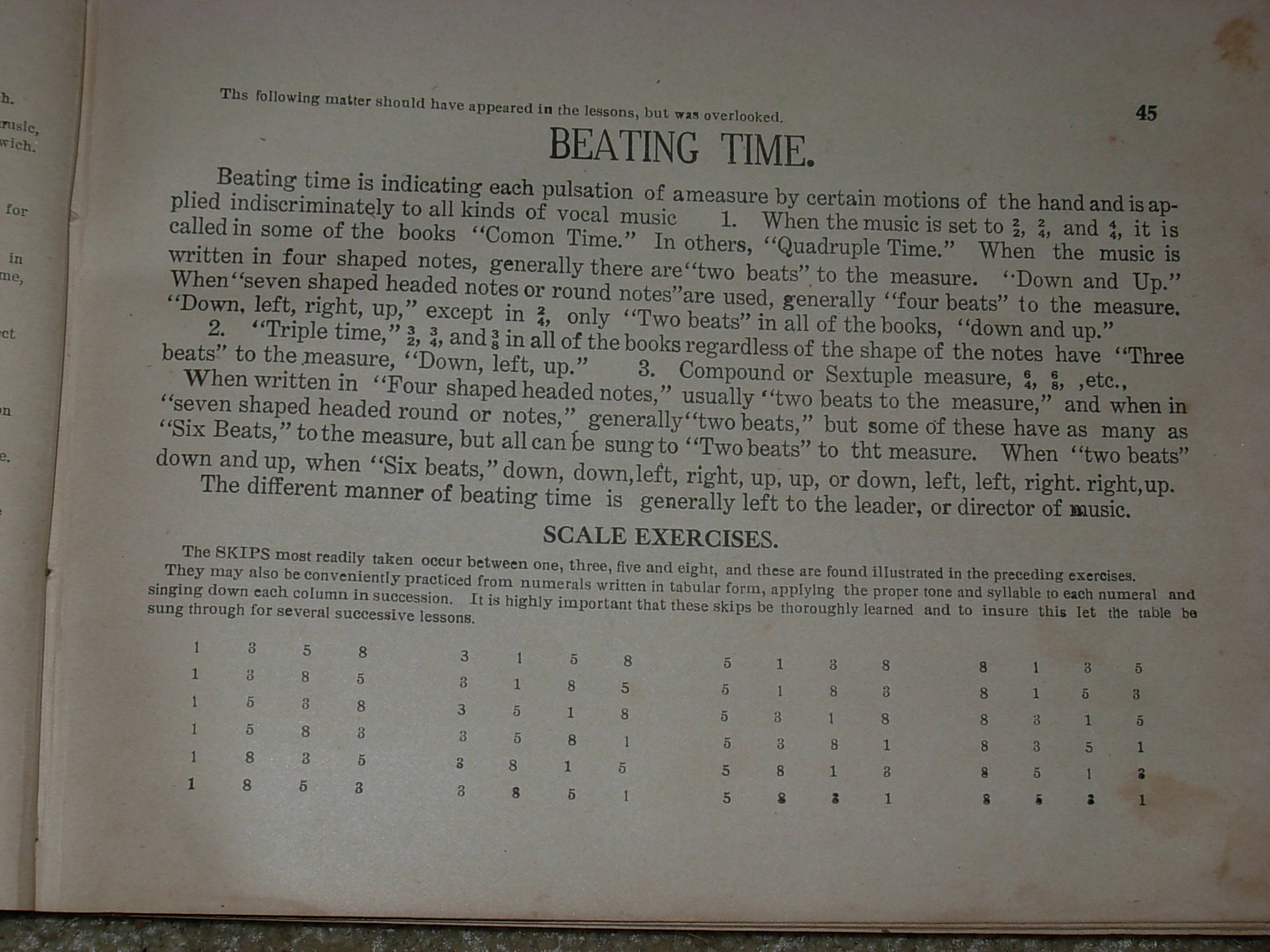
>If the song is in 7 shapes or round notes..okay to beat d-l-r-u !!!!
>
>Also think it's interesting that he says triple
>time should be d-l-u (how Raymond Hamrick leads
>in triple time)
>
>John Plunkett
>
>On Thu, Jul 9, 2009 at 3:47 PM, John Garst
>
>
>
>>
>
>Content-Type: image/jpeg
>Content-Disposition: attachment;
> filename="DSCN0737.JPG"
>X-Attachment-Id: f_fwysicuz0
>
>Attachment converted: Macintosh HD:DSCN0737.JPG (JPEG/«IC») (0016A4EF)
--
john garst ga...@chem.uga.edu
John Garst
Imagine a sudden pulse of a hand following by a relaxed, non-rhythmic
return to it original position, then another sudden pulse, etc.
Feet do this all the time.
J
At 1:49 PM -0700 7/10/09, Robert Vaughn wrote:
>--- On Thu, 7/9/09, John Garst <ga...@chem.uga.edu> wrote:
>>
>> Any mode of Common Time can be beat in two (or in one, or
>> in four, or
>> in eight, etc.)
>>
>How is a tune beat "in one"?
>
>Robert Vaughn
>Mount Enterprise, TX
>http://baptistsearch.blogspot.com/
>Ask for the old paths, where is the good way.
>http://mtcarmelbaptist.blogspot.com/
>For ask now of the days that are past...
>http://oldredland.blogspot.com/
>Give ear, all ye inhabitants of the land.
--
john garst ga...@chem.uga.edu
Robert Vaughn
--- On Fri, 7/10/09, John Plunkett <jhplu...@gmail.com> wrote:
> Forgot about this little tidbit
> from JS James 1909 (Union Harp) rudiments...p 45.
>
> If the song is in 4 shapes=common time is in 2=d (d) u
> (u)
> If the song is in 7 shapes or round notes..okay to
> beat d-l-r-u !!!!
>
> Also think it's interesting that he says triple
> time should be d-l-u (how Raymond Hamrick leads in triple
> time)
>
My Dad also beat triple time in this manner. I have no idea where he learned it, but probably in singing school (whether 4 or 7 shape I have no idea).
Robert Vaughn
--- On Thu, 7/9/09, John Garst <ga...@chem.uga.edu> wrote:
>
> Any mode of Common Time can be beat in two (or in one, or
> in four, or
> in eight, etc.)
>
How is a tune beat "in one"?
Robert Vaughn

Annie Grieshop
"one", and the rest of the rhythm just fills in evenly between 'em. Ja?
Annie
> -----Original Message-----
> From: John Garst [mailto:ga...@chem.uga.edu]
> Sent: Friday, July 10, 2009 4:11 PM
> To: Fasola Discussions
> Subject: [fasola-discussions] Re: leading slowly in 2
>
>
>
> Database version: 6.12800
> http://www.pctools.com/en/spyware-doctor-antivirus/
Robert Vaughn
Checking the James rudiments, I find they are almost word for word the same as the Union Harp.
It is interesting that Paine Denson dropped the James method for beating triple time -- d-l-u -- and went back to the White method -- d-d-u.
Robert Vaughn
Mount Enterprise, TX
http://baptistsearch.blogspot.com/
Ask for the old paths, where is the good way.
http://mtcarmelbaptist.blogspot.com/
For ask now of the days that are past...
http://oldredland.blogspot.com/
Give ear, all ye inhabitants of the land.
> Date: Friday, July 10, 2009, 4:02 PM
>
>
> --- On Fri, 7/10/09, John Plunkett <jhplu...@gmail.com>
> wrote:
> > Forgot about this little tidbit
> > from JS James 1909 (Union Harp) rudiments...p 45.
> >
> > If the song is in 4 shapes=common time is in 2=d (d)
> u
> > (u)
> > If the song is in 7 shapes or round notes..okay to
> > beat d-l-r-u !!!!
> >
> John, substantially the same is in the 1911 James revision,
> though perhaps formatted a little differently.
>
> > Also think it's interesting that he says triple
> > time should be d-l-u (how Raymond Hamrick leads in
> triple
> > time)
> >
> My Dad also beat triple time in this manner. I have no idea
> where he learned it, but probably in singing school (whether
> 4 or 7 shape I have no idea).
>
John Garst
Robert Vaughn
--- On Fri, 7/10/09, John Garst <ga...@chem.uga.edu> wrote:
> Well, you have to use your imagination.
>
> Imagine a sudden pulse of a hand following by a relaxed,
> non-rhythmic
> return to it original position, then another sudden pulse,
> etc.
>
> Feet do this all the time.
>
> J
>
Thanks.
I don't have a good imagination and tend to be overly literalistic, so your suggestion was causing pain on my brain! I recently told someone that I have a mind like a steel trap -- rusty and hard to open.

Richard Schmeidler
Thank you, Tom.
I have cruelly edited what you wrote to bring out two points.
First, I do know what Mr. McGraw teaches, but that is not what was taught at Camp Fasola last month -- at least in one class I attended. What was taught there (and buttressed, when I questioned it, by reference to the plain text of the 1991 rudiments) was that the beginning of the beat of one occurs at the bottom of the downstroke.
Two other people had earlier reported to this list the emphasis on the 1991 rudiments at Camp Fasola last month, and I was chiming in to give a specific instance of that emphasis.
Second, is it possible to get a copy of your dissertation?
--- On Wed, 7/8/09, Thomas Malone <shap...@gmail.com> wrote:
> From: Thomas Malone <shap...@gmail.com>
> Subject: [fasola-discussions] Re: leading slowly in 2
> To: wadek...@yahoo.com, ga...@chem.uga.edu, "Warren Steel" <mu...@olemiss.edu>, "Will Fitzgerald" <will.fi...@gmail.com>
> Cc: fasola-di...@googlegroups.com
> Date: Wednesday, July 8, 2009, 12:40 PM
> WARNING : This is a long email.
> Please skip it if you are not interested!
> Thanks! If you are interested please go
> slowly, I packed a lot of stuff in here. Whoo-wee!!!!
>
. . .
>
> I have worked closely with Hugh McGraw on this exact
> question, and he has demonstrated to me numerous times that
> in four four time, the muscial counts of one and two are on
> the downward stroke, and three and four are on the upward
> stroke. therefore "down-down, up-up" completes a
> measure of four four time. (again see attached
> graphic)
>
>
>
>
> This is not to say that everyone does it this
> way -- : )
>
. . .

Juniper Hill
where the accent/stress of the beat falls in the leading pattern, but now that
I analyze it, I realize that this is what I do myself:
- in slow pieces notated in common time, my arm does a relatively smooth
down-down up-up motion, using up lots of space, so that the beginning of the
downbeat lands towards the beginning of the down stroke motion (and the same
with slow pieces in three beating a languid down-down-up)
- however, in fast pieces with sharper rhythmic accents, I beat a brisk
cut-time down-up pattern in a relatively small space with the emphasis of the
downbeat landing at the bottom of the down stroke.
So indeed, I make use of both of the different downbeat-emphasis leading
styles that have been discussed in this thread, as appropriate to different
songs. No one taught me this, and I'm not sure where I picked it up, as I
wasn't even conscious that I was doing it until now. (I've been singing Sacred
Harp for about 10 years, mostly on the West Coast.) I wonder if others find
that they do this as well?
Juniper
+++++++++++++++++++++++++++
Juniper Hill, PhD
Department of Music
University College Cork
Cork, Ireland
PLEASE NOTE: This e-mail message was dictated using voice recognition
software. Sometimes it "mishears" what I speak and enters incorrect words. If
something is unclear, please reply with a query and I will clarify what I
spoke.

Paul T. Robinson
I had the chance to carefully observe the Lees leading at a
Seattle convention. The instant of the downbeat occurred at
the bottom of the downward stroke, not the top. I recall a
slight extra hand motion to mark the exact beat, or possibly
it was just an artifact of changing directions.
Regarding the two Youtube videos,
Warren Steel wrote:
>Once the song begins, you can see that the two
>leaders' hands are moving in opposite directions most of the
>time.
I carefully watched both the Homeward Bound clip:
http://www.youtube.com/watch?v=2ckxBb222Tc
and the Mount Pleasant clip:
http://www.youtube.com/watch?v=c_GSEjbMY64
In both cases the two leaders are not what you would call
synchronized, but in neither case are they at all "moving in
opposite directions most of the time." Am I watching the same
videos that everyone else is?
For example in Mount Pleasant, for every recurrence of the tenor
"Fly... fly..." both leaders have their hands down at the instant
that the "fly" melisma begins. Also for the bass fugue entrance,
both leaders have the hand down at the bottom of the stroke.
In Homeward Bound, during the second stanza after the break in
the video, the bass entrance is not clearly up or down but both
leaders clearly move to the tenors again at the bottom of the
stroke.
This video documentation coupled with my own observations tells me
that indeed in traditional _practice_ the pulse of the downbeat is
at the bottom of the stroke, not the top, regardless of what anybody
_says_ one way or the other.
John Garst wrote:
>dlru and dlu are what they teach in school. - J
In my non-SH school I was taught that the first intermediate beat
should be outward from the body, not across, to make it more clearly
visible. So the right hand motion would be drlu or dru. When using
both hands the motions are symmetric, down-out-in-up or down-out-up.
--paulr
rl_v...@yahoo.com
--- On Mon, 7/13/09, Paul T. Robinson <ptr....@comcast.net> wrote:
>
> I carefully watched both the Homeward Bound clip:
> http://www.youtube.com/watch?v=2ckxBb222Tc
> and the Mount Pleasant clip:
> http://www.youtube.com/watch?v=c_GSEjbMY64
>
> In both cases the two leaders are not what you would call
> synchronized, but in neither case are they at all "moving
> in
> opposite directions most of the time." Am I watching the
> same
> videos that everyone else is?
>
>
> This video documentation coupled with my own observations
> tells me
> that indeed in traditional _practice_ the pulse of the
> downbeat is
> at the bottom of the stroke, not the top, regardless of
> what anybody
> _says_ one way or the other.
>
>
> So the right hand motion would be drlu or
> dru. When using
> both hands the motions are symmetric, down-out-in-up or
> down-out-up.
>
Robert Vaughn
Mt. Enterprise, TX