|
Plus, why Europe has no room for complacency;
CO2 and methane emissions rose last year amid the
crisis; the outlook for the world’s gas markets;
global inequalities in CO2 emissions; and more
… |
|
Newsletter of the
International Energy Agency
Click here to view in your
browser |
|
Where
things stand one year into the global energy
crisis |
It’s been year since Russia invaded Ukraine,
an act that delivered a massive shock to global
energy markets and a crippling blow to Russia’s
relationship with its biggest customer, the
European Union. In a commentary published on
this first anniversary, our Executive Director
Fatih Birol assessed what has
changed during a tumultuous year for the global
energy system – highlighting three key takeaways
from the crisis so far.
First, Russia played the energy card and
didn’t win, with its oil and gas revenues
plummeting about 40% over the past year and set to
drop even more in the years ahead. Russia now
faces a permanent loss of standing in the energy
world: it is not only losing major customers but
also access to key technologies and financing due
to sanctions.
Second, government policies really do matter
– especially in times of crisis. Policies
incentivising faster deployment of clean energy
have been successful, while governments’
pragmatism and resourcefulness have helped secure
energy supplies to keep the lights on.
Third, the crisis isn't over yet, but
Europe’s strong response and the mild weather this
winter has bought it valuable time. This will be
key for implementing the bold policies and
structural changes needed to insulate energy
systems and shield consumers from
volatility.
|
|
Addressing
EU Commissioners and Ministers on energy security
and transitions |
On 23 February, the day before the
anniversary of the invasion, Dr Birol addressed
the College of Commissioners from 27 EU countries
in Brussels on the importance of strengthening
energy security while continuing to advance the
energy transition.
At the invitation of European Commission
President Ursula von der Leyen,
Dr Birol issued ‘one congratulation, one warning
and one opportunity’ to Europe for its efforts so
far and for what it needs to do in the months and
years ahead. Praising the EU institutions and
member states for significantly reducing reliance
on Russian energy in just 12 months, he also
warned that Europe is “certainly not out of the
woods yet” with many unknowns still to play out in
2023. Dr Birol called on Europe to deliver a new
industrial masterplan through bold and ambitious
policies to compete in the age of clean energy
technology manufacturing, particularly as other
regions of the world ramp up ambition in these
areas.
The following week, Dr Birol reinforced those
messages to Energy Ministers from across the EU at
a meeting in Stockholm under Sweden’s EU
Presidency, stressing that Europe has no room for
complacency – both in the current energy crisis
and in its efforts to seize the opportunities of
the new global energy economy that is
emerging.
|
|
Global
natural gas markets remain tight as uncertainties
persist |
After declining last year amid the global
energy crisis, the world’s demand for natural gas
is set to remain broadly flat this year, according
to our latest quarterly Gas Market Report. But
the outlook is subject to a high level of
uncertainty, particularly in terms of Russia’s
future actions and the economic impacts of
fluctuating energy prices.
Natural gas prices, although still high by
historical standards, have fallen in recent
months. However, that could change in 2023 as
demand for LNG picks up in Asia, particularly in
China. As the world’s largest importer of natural
gas, the country recently lifted its Covid
restrictions and if economic activity picks up
this could lead to a tightening in global supply,
triggering strong competition.
Last year’s decline in global gas consumption
was particularly pronounced in Europe, where
unprecedented price rises led to a 13% reduction
in gas demand as governments responded swiftly
with emergency policies, industry scaled back
production, and consumers dialled down
thermostats.
|
|
CO2
emissions rose less than initially feared in 2022,
reined in by clean energy
surge |
Global energy-related carbon dioxide
emissions rose by under 1% in 2022 – less than
initially feared – as the growth of solar, wind,
EVs, heat pumps and energy efficiency helped limit
the impacts of increased use of coal and oil amid
the global energy crisis, according to our
latest analysis.
Although the rise in emissions last year was
far smaller than the exceptional jump of
6% in 2021, emissions remain on an unsustainable
growth trajectory, calling for stronger actions to
accelerate the clean energy transition and move
the world onto a path towards meeting its energy
and climate goals, our CO2 Emissions in 2022
report shows.
It’s the first in our new series, the
Global Energy Transitions
Stocktake, which will bring together
our latest analysis in one place, making it freely
accessible in support of the first Global
Stocktake in the lead-up to the COP28 Climate
Change Conference in November.
|
To keep up with our very latest news and
analysis, follow the IEA on social media
( LinkedIn, Twitter) as well as our
Executive Director Fatih Birol ( LinkedIn, Twitter) |
|
Methane
emissions remained stubbornly high even amid
soaring energy
prices |
Last year’s combination of high energy
prices, security of supply concerns and economic
uncertainty were not enough to drive down the
energy sector’s emissions of methane, another
potent greenhouse gas, according to the latest edition of our
Global Methane
Tracker.
The energy sector accounts for around 40%
of total methane emissions attributable to human
activity, second only to agriculture. Our Tracker
shows that the global energy industry was
responsible for 135 million tonnes of methane
released into the atmosphere in 2022, only
slightly below the record highs seen in
2019.
Methane emissions from oil and gas alone
could be reduced by 75% with existing
technologies, highlighting a lack of industry
action on an issue that is often very cheap to
address. Less than 3% of the income accrued by oil
and gas companies worldwide last year would be
required to make the USD 100 billion investment in
technologies needed to achieve this
reduction.
|
|
SUVs’
CO2 emissions are nearing 1 billion tonnes as
sales continue to
rise |
Global car markets did not have a good year
in 2022, but SUVs were an exception, raising
further concerns about their impact on efforts to
tackle climate change, according to our new commentary. A
strong increase in sales of electric models was
not enough to prevent CO2 emissions from SUVs
worldwide reaching almost 1 billion tonnes in
2022.
Global SUV sales also increased despite
supply chain obstacles and rising inflation,
growing by around 3% between 2021 and 2022. In
2022, SUVs accounted for around 46% of global car
sales, with noticeable growth coming in the United
States, India and Europe. Of this, electric made
up around 16% of total SUV sales in 2022.
|
|
The
world’s top 10% of emitters are putting world’s
net zero ambitions at
risk |
Wealth, energy use, and the consumption of
goods and services are unevenly distributed within
different countries and across the world. And CO2
emissions are no exception.
A recent commentary by our
energy modellers highlights the stark inequalities
in CO2 footprints both between countries and
within them. It shows that the top 1% of emitters
globally produce over 1000 times more CO2 than the
bottom 1%. In terms of regional variations, the
average North American emitted 11 times more
energy-related CO2 than the average African in
2021. If the top 10% of emitters globally
maintain their current emissions levels from now
onwards, they alone will exceed the remaining
carbon budget in the IEA’s Net Zero Emissions by 2050
Scenario by the year 2046. In other
words, substantial and rapid action by the biggest
emitters is essential to decarbonise fast enough
to keep the possibility of limiting global warming
to 1.5 °C within reach. |
The first meeting of our new Finance
Industry Advisory Board last week brought
together 40 representatives of leading actors in
the world of energy finance, including banks,
asset managers and international financial
institutions. The new advisory board will enable a
more structured dialogue with the energy finance
community on a range of issues affecting energy
investment in clean energy transitions. Read the
news article about the
Board and its first meeting. European Commissioner for the Internal Market
Thierry Breton visited our
headquarters in Paris recently for a discussion
with our Executive Director on Europe’s
competitiveness, the importance of industrial
strategy and the impacts of the global energy
crisis. Our recent IEA for EU4Energy
Policy Forum gathered officials from five
Eastern European partner countries this week to
discuss how to strengthen energy security and
system resiliency in the midst of war and a global
energy crisis, with Moldovan and Ukrainian
government officials sharing their recent
experiences. Read the news article about
the event. Energy efficiency
indicators are key to tracking energy
efficiency progress for a variety of purposes such
as policy making, monitoring targets, making
energy projections, developing scenarios and
planning, and benchmarking. Our new guide for
professionals and decision makers describes
options and good practices for the collection of
energy end-use data and the development of energy
efficiency indicators at the national level. Read
the report.
Our Executive Director travelled to Rome
last month to present and discuss some of the key
findings of our latest World Energy Outlook
report in front of an audience of lawmakers,
ambassadors and industry leaders. His speech was
followed by remarks by Italian Environment and
Energy Security Minister Gilberto Pichetto
Fratin – and then a discussion with Enel
CEO Francesco Starace on topics
including the prospects for hydrogen, trends in
electrification, the important role of energy
efficiency, and security of critical minerals in
the energy
transition. |
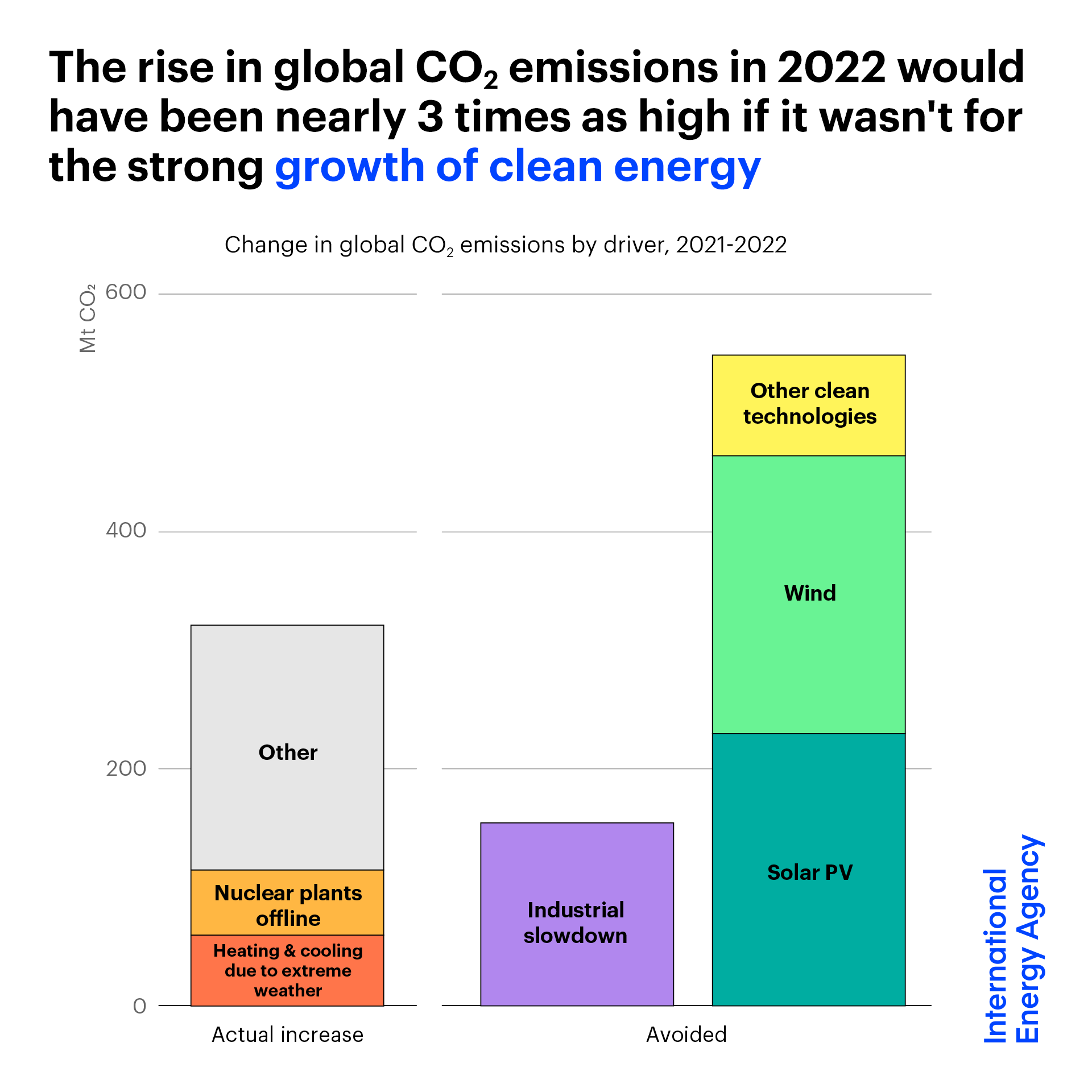
The rise in global CO2 emissions in 2022
would have been nearly three times as high if it
wasn't for the strong growth of solar, wind, EVs,
heat pumps and energy efficiency. Together, they
prevented 550 million tonnes of emissions. Read
more in our new CO2 Emissions in 2022
report. |
|
Late
March: Global
Heat Pump Sales in 2022
May: Renewables
Market Update
|
International
Energy Agency
International
Energy Agency,
Paris | |
From: International Energy Agency <ener...@iea.org>Date:
Mon, 6 Mar 2023 at 06:10 Subject: the energy mix: one year into
the global energy
crisis | |