


UT/TT Poll: Runoffs Loom in U.S. Senate Race
- by Ross Ramsey
Texasâ
Republican primary for U.S. Senate is close â and
could be headed for a July 31 runoff â with Lt. Gov. David
Dewhurst holding a single-digit lead over former
Solicitor General Ted Cruz,
according to the latest University of Texas/Texas
Tribune poll.
Dewhurst had the support of 40 percent of likely
voters, followed by Cruz at 31 percent. Former Dallas
Mayor Tom
Leppert had 17 percent and broadcaster and former
football player Craig
James was at 4 percent, with five other GOP
candidates bringing up the rear.
Daron Shaw, a UT-Austin government professor and
co-director of the poll, said Cruz has been able to
position himself to the right of the lieutenant governor
for a May 29 Republican primary where that's a big
advantage â and he's done that in a year in which
insurgent candidates have been scoring big wins against
establishment Republicans.
In Indiana, longtime U.S. Sen. Richard Lugar fell to state Treasurer Richard Mourdock in a GOP primary race that some framed as an establishment-versus-insurgent result (it was also a cautionary tale for incumbents falling out of touch with constituents). In Nebraska, state Sen. Deb Fischer, an outsider candidate backed by Sarah Palin, defeated state Attorney General Jon Bruning and state Treasurer Don Stenberg in the Republican primary for an open U.S. Senate seat after the two focused their attacks on each other and left her a path to victory. A good showing by Cruz could be read as another thread in that fabric.
"If they're in a runoff, Dewhurst is in trouble," Shaw said.
In Indiana, longtime U.S. Sen. Richard Lugar fell to state Treasurer Richard Mourdock in a GOP primary race that some framed as an establishment-versus-insurgent result (it was also a cautionary tale for incumbents falling out of touch with constituents). In Nebraska, state Sen. Deb Fischer, an outsider candidate backed by Sarah Palin, defeated state Attorney General Jon Bruning and state Treasurer Don Stenberg in the Republican primary for an open U.S. Senate seat after the two focused their attacks on each other and left her a path to victory. A good showing by Cruz could be read as another thread in that fabric.
"If they're in a runoff, Dewhurst is in trouble," Shaw said.

The Democrats, too, could be building to a July
finish, probably between former state Rep. Paul
Sadler and Sean
Hubbard, according to the poll.
Sadler led the Democrats with 29 percent, but was
followed closely â and within the poll's margin of
error â by Hubbard. Two other candidates â Addie
Dainell Allen and Grady
Yarbrough â also registered double-digit
support.
The Tribune thanks our Supporting Sponsors
The Republican race hasn't changed significantly
since the February UT/TT poll,
in which Dewhurst tallied 38 percent, an 11-point lead
on Cruz.
But Dewhurst, the front-runner throughout the race,
hopes to win the Senate primary with no runoff, and is
pressing to widen his lead. He opened the final two
weeks of the campaign â as this poll was ending and
early voting was beginning â with a sally of ads
attacking Cruz. A Super PAC, legally unaffiliated with
Dewhurst's campaign but run by the lieutenant governor's
former chief of staff, began an expensive negative
campaign targeted at Cruz as the early voting began.
Cruz, with less money and less frequency, is hitting
back, and the Washington, D.C.-based Club for Growth is
advertising heavily on his behalf, hoping to back
another insurgent conservative, Cruz, against an
establishment Republican in Dewhurst.
"It's not surprising that David Dewhurst is still in
front," said poll co-director Jim Henson, who teaches
government at the University of Texas at Austin and runs
the Texas Politics Project. "We're seeing the advantages
we expected him to have from the beginning of the
campaign."
But he said the number of contenders has worked
against Dewhurst. "Ted Cruz and Tom Leppert are claiming
some real estate," he said. Their numbers are keeping
the front-runner short of the majority he needs to avoid
a runoff.
"The extra time played to the benefit of Cruz and
Leppert," Henson said. The Senate race is no longer
overshadowed by a competitive presidential primary, and
they've been able to get attention that had been denied
them. Leppert's numbers have improved since February,
when he was tied with James. Leppert appears to have
earned enough support to be a spoiler, if not a
contender. He is doing best in the Dallas-Fort Worth
area, where he was known before this race, but he's
still in third place even there.
Shaw said Cruz's performance so far shows that money
isn't everything. Dewhurst, first elected to statewide
office in 1998, has far more money and has spent far
more of it, but he remains short of the 50 percent he
needs against an array of competitors who've never
attempted statewide campaigns. "There are alternate ways
to gin up support," Shaw said. "Money is necessary, but
it's not sufficient."
Dewhurst is running a two-pronged attack in his
marketing, building himself up and tearing Cruz down.
"He's in a classic front-runner's dilemma: To what
extent do you engage someone who's behind you, and to
what extent do you just ignore them?" Shaw said.
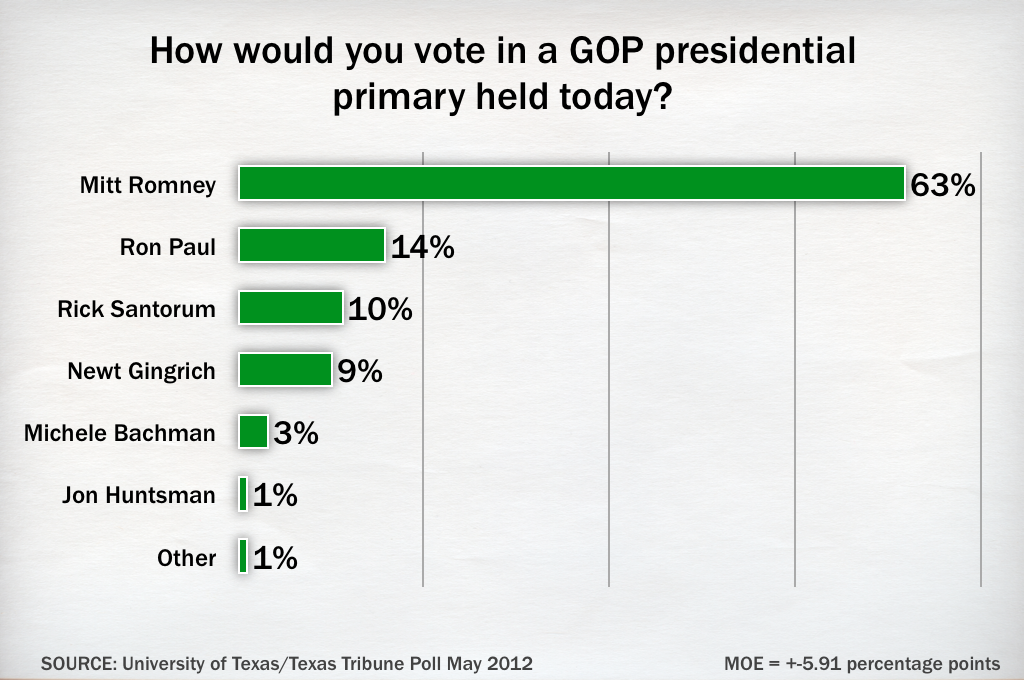
At the top of the ballot, the competitive tension has
come out of the Republican presidential race. Former
Massachusetts Gov. Mitt
Romney held a comfortable lead over everyone else
on that ballot, with the support of 63 percent of
Republican voters. U.S. Rep. Ron Paul
of Lake Jackson, who is still in the race but has
suspended many campaign activities, had 14 percent,
followed by a number of candidates who have dropped out
but whose names remain on the Texas ballot: Rick
Santorum, 10 percent; Newt
Gingrich, 9 percent; and Michele
Bachmann and Jon
Huntsman, with 3 percent and 1 percent
respectively.
The Tribune thanks our Supporting Sponsors
That's a big change from the February UT/TT poll,
which found Santorum well in front, and Romney in third
place. The results of Texas' delayed primary could, in
that race, be vastly different from what they might have
been had the primary remained on schedule in March.
Now it belongs to Romney, and he would go into
Novemberâs general election with a commanding lead
over President
Obama in Texas, harvesting 55 percent to the
incumbent's 35 percent in the poll.

Many voters were initially undecided about the Senate
race even with the primaries upon them. When first asked
about the Republican Senate primary, 22 percent said
they hadn't decided who would get their vote. Asked if
they had to make a choice, that dropped to 2 percent.
The numbers in the Democratic primary were even more
striking: Initially, nearly 85 percent said they had not
decided. Asked how they would vote if they had to
decide, the "don't know" contingent slipped to 9
percent.
The poll also sought Texansâ thoughts on some of
the candidates, officeholders and institutions.
Voters' views of Romney are split down the middle: 40
percent have a favorable opinion, while 38 percent have
an unfavorable opinion.
The president's numbers are upside down, with 38
percent saying they have a favorable opinion of him and
52 percent saying their opinion is unfavorable. When
asked for their views of his performance, the numbers
are slightly worse, with 36 percent saying they
"strongly" or "somewhat" approve, and 54 percent saying
they "strongly" or "somewhat" disapprove.
Congress is in worse shape: Only 10 percent of Texas
voters approve of the job that the members of the
legislative branch are doing, while 71 percent
disapprove (and 48 percent of those disapprove
"strongly").
In the Senate race, voters have net favorable views
of all but one of the GOP candidates.
Dewhurst was viewed favorably by 30 percent,
unfavorably by 25 percent. Cruz was viewed favorably by
23 percent, unfavorably by 19 percent. Leppert was
viewed favorably by 28 percent, unfavorably by 14
percent. James was viewed favorably by 10 percent,
unfavorably by 15 percent.
The UT/TT internet survey of 800 Texas voters was
conducted May 7-13 and has a margin of error of +/- 3.46
percentage points. Questions asked only of Republican or
Democratic voters have larger margins of error, as
indicated. And "likely voters" were defined as those who
indicated they were "somewhat" or "extremely" interested
in politics and who voted in "every" or "almost every"
election in recent years.
Tomorrow: Railroad Commission races, state
politics and the Tea Party in Texas.
